
The Definitive Golf Anxiety Checklist: 25 Tips for a Calm, Focused Mind
“`html
Golf anxiety can show up in a lot of different ways.
Your heart starts racing on the first tee.
Your hands feel different.
You become aware of people watching.
You start thinking about your swing.
You worry about hitting it out of bounds.
You begin trying not to make a mistake.
And suddenly the game feels much harder than it did on the range.
If you’re looking for practical golf anxiety tips, the first thing to understand is this:
You do not need to eliminate nerves before you can play good golf.
Anxiety becomes more problematic when you start treating it as evidence that something is wrong.
“I shouldn’t feel like this.”
“I need to calm down.”
“I’m too nervous to swing properly.”
Now you have two challenges:
The golf shot itself, and your battle with how you’re feeling.
A better approach is to learn how to recognize anxiety, accept its presence and keep directing your attention toward what matters.
These golf anxiety tips will help you do exactly that.
Key Takeaways
- Nerves are a normal response when golf feels important.
- You do not need to feel completely calm before you can perform well.
- Anxiety often becomes worse when you start fighting or judging it.
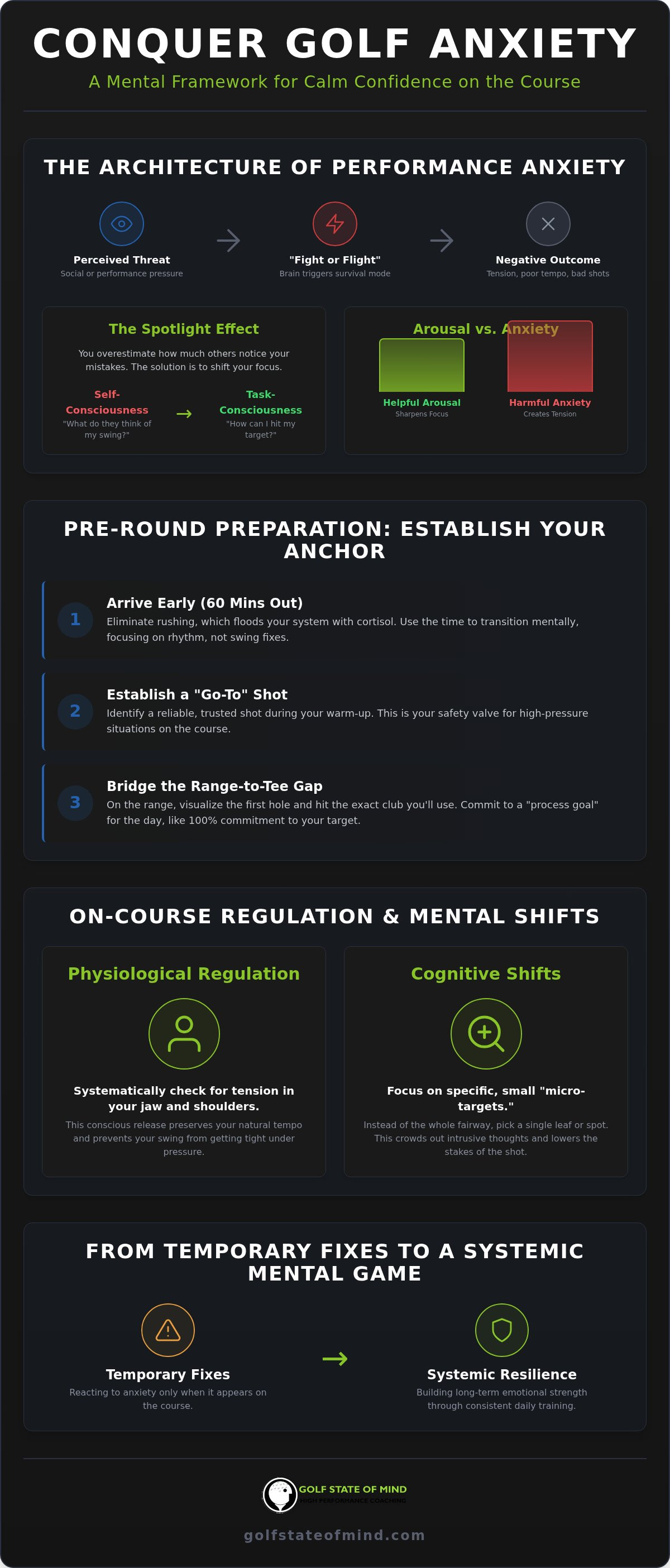
- Slow breathing can help regulate your arousal before and during a round.
- Your attention should move away from judgment and toward the task in front of you.
- A clear pre-shot routine reduces unnecessary thinking under pressure.
- Separate your identity from your golf performance.
- Use process goals so your score isn’t your only measure of success.
- Practice under consequence so competition isn’t the first time you experience pressure.
Why Does Golf Cause Anxiety?
Golf creates a perfect environment for anxiety.
There is time to think.
Every shot has a visible result.
Other people can see what happens.
You keep score.
And if you care about playing well, the outcome matters to you.
That means thoughts about consequences naturally appear.
“What if I hit this out of bounds?”
“What if I embarrass myself?”
“What if I ruin this good round?”
“What if I don’t qualify?”
Anxiety Is Not a Character Flaw
Feeling anxious does not mean you’re mentally weak.
It usually means something matters to you.
The goal isn’t to become a golfer who never experiences nerves.
The goal is to become better at playing while they are present.
Pressure Changes Where Your Attention Goes
When you’re comfortable, your attention may naturally be on:
- The target.
- The shot.
- The intended ball flight.
- Rhythm and feel.
When you’re anxious, attention often moves inward.
Now you’re thinking about:
- Your swing mechanics.
- Your hands.
- Your heart rate.
- Your score.
- What other people are thinking.
- What happens if you miss.
Part of managing golf anxiety is learning to redirect that attention.
Want to feel more confident and in control when golf feels important? Download my free ebook, 7 Key Mental Strategies, for practical strategies to improve focus, confidence and performance under pressure. Get the Free Ebook
Golf Anxiety Tips You Can Use Immediately
There isn’t one technique that removes anxiety for every golfer.
But there are several things you can do to stop anxiety taking over your entire performance.
Here are 25 practical golf anxiety tips you can start using.
1. Stop Trying to Eliminate Every Nerve
The more you insist:
“I have to calm down.”
the more attention you give the anxiety.
Try acknowledging it instead.
“I’m nervous. That’s okay.”
2. Reframe Nerves as Readiness
The physical sensations of nerves and excitement can feel very similar.
Instead of interpreting energy as danger, try:
“My body is getting ready to compete.”
3. Slow Your Exhale
Your breathing is one of the simplest ways to regulate how activated you feel.
Try:
Inhale for 4 seconds. Exhale for 6 seconds.
Repeat for several breaths.
4. Arrive With Enough Time
Rushing creates unnecessary stress before you’ve even started.
Give yourself enough time to check in, warm up and prepare without feeling hurried.
5. Don’t Use the Warm-Up to Judge the Day
A poor warm-up does not mean you’re going to play badly.
A great warm-up does not guarantee a great score.
Warm up to prepare, not to predict.
6. Stop Fixing Your Swing Before You Play
Competition is rarely the best time to start experimenting.
If you’re working on something technical, keep your on-course cue simple.
7. Decide How You Want to Show Up
Before the round, choose one or two qualities.
Perhaps:
- Committed.
- Patient.
- Brave.
- Present.
These give you something to return to when anxiety rises.
8. Choose Process Goals
Instead of making your only goal:
“Shoot 75.”
choose behaviors such as:
- Commit fully to every target.
- Use your routine.
- Accept each result.
9. Prepare for Anxiety
Don’t arrive hoping you won’t feel nervous.
Expect that you might.
Then decide how you’ll respond.
How to Handle First Tee Nerves
The first tee is one of the most common places golfers experience anxiety.
You’re standing still.
People may be watching.
The round hasn’t started yet.
There is plenty of time for your mind to imagine what could happen.
10. Accept the Sensation
Your heart might race.
Your hands might feel different.
That’s okay.
You don’t have to wait for those sensations to disappear.
11. Take a Few Slow Breaths
Use the 4–6 breathing pattern if it helps.
Let the exhale be slightly longer than the inhale.
12. Narrow Your Mind
Don’t think about the round.
Don’t think about the leaderboard.
Don’t think about how you’re going to play.
Ask:
“What does this shot require?”
13. Choose a Clear Target
Don’t simply aim “somewhere down the fairway.”
Give your attention something specific.
The clearer the target, the easier it becomes to move attention away from yourself.
Stop Worrying About What Other Golfers Think
Fear of embarrassment is one of the biggest sources of golf anxiety.
Especially when you’re:
- Playing with better golfers.
- Playing with strangers.
- Competing in a tournament.
- Playing in front of a coach or parent.
14. Remember That Other Golfers Are Thinking About Themselves
Most golfers are much more interested in their own game than yours.
They’re thinking about their score.
Their swing.
Their next shot.
The mistake they just made.
You’re probably under far less scrutiny than you imagine.
15. Move From Self-Consciousness to Task-Consciousness
Instead of:
“How do I look?”
ask:
“What am I trying to do?”
Target.
Shot.
Commitment.
That is your job.
Use Breathing to Regulate Your Arousal
Breathing isn’t a magic switch that guarantees calm.
But it can help reduce excessive arousal and give you something simple to focus on.
16. Use 4–6 Breathing
Breathe in for four seconds.
Breathe out for six.
Repeat several times before you play or while walking between shots.
17. Don’t Turn Breathing Into Another Test
If you take five breaths and still feel nervous, the exercise hasn’t failed.
The objective isn’t:
“Make all anxiety disappear.”
It’s:
“Help myself regulate and return to the task.”
Use Your Pre-Shot Routine Under Pressure
Your routine gives your attention somewhere useful to go when your mind becomes noisy.
18. Think Before You Play
Gather the information you need.
Distance.
Lie.
Wind.
Trouble.
Target.
Shot.
19. Make the Decision
Once you’ve chosen the club and shot, stop reopening the decision unless something genuinely changes.
20. Move From Analysis to Execution
See the shot.
Feel it.
Commit.
Play.
Your routine should help you move from thinking into doing.
Move Your Attention Toward the Target
Anxiety encourages you to focus on what you don’t want.
The bunker.
Out of bounds.
The water.
The embarrassing miss.
21. Ask What You Want to Do
Instead of:
“Don’t hit it right.”
ask:
“Where am I sending the ball?”
This creates a much clearer intention.
22. Use a Specific External Target
A tree.
A distant roof.
A particular section of fairway.
A mark on the green.
Give your attention something concrete.
Notice Physical Tension Without Fighting It
Anxiety can show up physically.
You may notice:
- Tight shoulders.
- A clenched jaw.
- Increased grip pressure.
- Shorter breathing.
- A faster pace.
23. Check In With Your Body
Notice the tension.
Then see if you can soften it slightly.
You don’t need to force complete relaxation.
24. Slow Down Between Shots
When golfers become anxious, they often speed up.
They walk faster.
Talk faster.
Make decisions faster.
Simply noticing your pace can help you avoid getting swept up in that momentum.
25. Don’t Make Relaxation a Requirement
You can still hit good shots with tension.
You can still compete while your heart is beating faster.
Freedom comes partly from knowing that you don’t need to feel perfect before you play.
Recover After a Bad Shot or Blow-Up Hole
Anxiety often increases after something goes wrong.
You hit a poor drive.
Make a double bogey.
Miss a short putt.
Now your mind starts predicting what happens next.
Don’t Turn the Shot Into a Story
A bad shot is one event.
Then the mind adds:
“Here we go again.”
“I’m going to blow up.”
“I always do this under pressure.”
Those are interpretations.
Not facts.
Let Yourself React
You don’t need to become emotionless.
If you’re frustrated, notice it.
If you’re disappointed, acknowledge it.
Then gradually bring your attention back to the next task.
Ask What the Next Shot Needs
Not:
“How do I get those shots back?”
But:
“What does this shot require?”
Stop Letting Score Control Your Mental State
Score anxiety often appears when you’re playing badly.
But it can also appear when you’re playing extremely well.
Don’t Protect a Good Round
You make the turn three under.
Suddenly you’re calculating.
“If I just make pars…”
Now your attention moves from playing to protecting.
Notice it.
Then return to your process.
Your Job Doesn’t Change
Whether you’re six over or three under:
The next task is still:
- Assess.
- Choose.
- Commit.
- Execute.
Want more tools for managing nerves and pressure on the golf course? Download my free 7 Key Mental Strategies ebook for practical ways to improve confidence, focus and emotional control. Download the Free Ebook
Separate Your Identity From Your Golf
One of the reasons golf can create so much anxiety is that performance starts to feel personal.
You don’t just think:
“I played badly.”
You start feeling:
“I’m a bad golfer.”
Or worse:
“What does this say about me?”
You Are a Person First and a Golfer Second
Golf is something you do.
It’s not who you are.
A tournament score does not measure your intelligence, character or value as a person.
Separating your identity from your performance gives you more freedom to compete.
Let Golf Matter Without Letting It Define You
You can care deeply.
You can work hard.
You can be disappointed.
But the result still doesn’t define you.
Practice Performing Under Pressure
If you only practice in comfortable conditions, competition will always feel very different.
Create Consequence
Use games and challenges where the result matters.
For example:
- Hole ten consecutive three-foot putts.
- Hit four out of five fairways.
- Get five out of seven chips inside a target area.
- Beat a previous practice score.
Notice What Changes
When you’re close to completing the challenge:
What happens?
Do you become careful?
Does your breathing change?
Do you start thinking about the outcome?
Does your routine speed up?
That’s useful.
Now practice returning to your process while the pressure is present.
When to Get Help With Golf Anxiety
Many golfers can improve their on-course anxiety through better routines, breathing, attention control, acceptance and pressure practice.
But sometimes it helps to work with someone else.
A mental performance coach can help with areas such as:
- First tee nerves.
- Fear of judgment.
- Tournament anxiety.
- Overthinking.
- Confidence.
- Emotional reactions.
- Pre-shot and post-shot routines.
If anxiety is severe, persistent, extends well beyond golf or significantly interferes with daily life, a qualified mental-health professional may be more appropriate.
You Don’t Have to Eliminate Golf Anxiety
This is the most important idea in the entire article.
The goal isn’t to become completely calm every time you play.
Trying to achieve that can become another source of pressure.
Instead, become better at:
- Recognizing anxiety.
- Accepting it.
- Regulating your arousal when useful.
- Directing your attention toward the task.
- Committing despite uncertainty.
- Responding effectively after mistakes.
Those are the golf anxiety tips that become valuable over time.
You don’t need your hands to feel perfect.
You don’t need your heart rate to be low.
You don’t need complete confidence.
You need enough clarity to decide what you’re trying to do — and enough commitment to do it.
Golf can matter.
You can feel nervous.
And you can still play well.
Frequently Asked Questions
How do I calm my nerves before playing golf?
Give yourself enough time to prepare, use slower breathing such as a four-second inhale and six-second exhale, and avoid judging your round by your warm-up. Rather than trying to become completely calm, aim to feel prepared and direct your attention toward the first task.
Why do I get so anxious playing golf?
Golf creates anxiety because there is consequence, evaluation, uncertainty and time to think. If the outcome matters to you, nerves are normal. Anxiety often becomes more disruptive when you interpret it as a problem and begin trying to control both your emotions and your golf swing.
How do I stop shaking on the first tee?
Don’t make stopping the shaking your only objective. Acknowledge that adrenaline can create physical sensations, use slower breathing, focus on a clear target and begin your normal routine. Many golfers can still make good swings while feeling physically nervous.
How do I stop caring what other golfers think?
You may not be able to eliminate the thought completely. Instead, remind yourself that most players are primarily concerned with their own game and redirect your attention from how you appear toward the task you’re trying to perform.
What should I think about when I’m nervous over a golf shot?
Keep your focus simple. Gather the information, choose the target and shot, then move toward intention, feel and commitment. Avoid trying to solve several technical swing issues while you’re preparing to execute.
Does breathing help golf anxiety?
Breathing can help regulate arousal and give your attention something simple to focus on. A slightly longer exhale, such as inhaling for four seconds and exhaling for six, can be useful before a round or between shots. It doesn’t need to eliminate all anxiety to be helpful.
Why do I hit it well on the range and get nervous on the course?
The two environments have different levels of consequence. On the range you usually have another ball immediately available, while on the course each shot affects your score. Adding one-ball practice, routines and consequence-based games can help make practice more representative of playing.
How do I recover after a blow-up hole?
Allow yourself to acknowledge the frustration, take any useful information from what happened and then return your attention to the next task. Avoid turning the hole into a prediction about the rest of the round.
How do I stop worrying about my score?
Score will naturally enter your thoughts because it matters. The goal isn’t to pretend otherwise. When you notice yourself projecting ahead, return to one or two process goals and the immediate shot in front of you.
Can golf anxiety affect my swing?
Yes. Anxiety can influence muscle tension, breathing, tempo, attention and decision-making. It can also encourage golfers to become more technical or cautious. Learning to manage attention and accept the physical sensations can help you continue executing without trying to force the anxiety away.
Should I change my pre-shot routine when I’m nervous?
Usually, the routine becomes more valuable when you’re nervous because it provides a familiar process for your attention. You don’t need to execute it with perfect timing, but avoid making unnecessary changes simply because you’re anxious.
How can I practice dealing with golf anxiety?
Use games and drills with consequence so you experience some pressure during practice. Pay attention to what changes in your thinking, breathing, routine and commitment, then practice returning to your process rather than trying to eliminate the pressure itself.
When should I seek professional help for golf anxiety?
If the problem is primarily about golf performance, a qualified mental performance coach may be helpful. If anxiety is severe, persistent, affects areas of life beyond golf or causes significant distress, it may be appropriate to speak with a qualified mental-health professional.
“`
Get your FREE Mental Game Scorecard
