
Fear of Short Putts: Build Confidence With Drills and Rhythm
A putt of less than 3 feet can feel harder than a longer one because the expectation to make it adds pressure. That fear of short putts can lead you to guide the ball or ease off instead of making a committed stroke. The answer isn’t to treat the putt as a test of nerve, but to return your attention to a clear target and a repeatable process.
If your hands tighten or your routine changes near the hole, the reaction can be frustrating, but it doesn’t mean you’ve lost your putting ability. Confidence on short putts comes from steady practice that rebuilds trust in your touch, stroke, and preparation.
This article explains why short putts can feel intimidating and how to respond with pressure drills, a consistent rhythm, and a focused pre-shot routine. It also covers how the yips can affect your stroke, helping you choose a practical next step instead of trying to force confidence.
Key Takeaways
- Rebuild trust with short-putt practice, then add pressure gradually so your routine holds when the result matters.
- Choose a clear target and commit to the line and pace instead of trying to steer the ball into the cup.
- Use the same pre-shot sequence and rhythm on practice putts and on the course, whether or not every ball drops.
- Notice when involuntary movement or disrupted timing may point to the yips, and consider focused mental-game support.
- Explore structured mental training or 1:1 coaching when fear keeps interfering with your putting process.
1. Confidence-building drills and pressure simulation
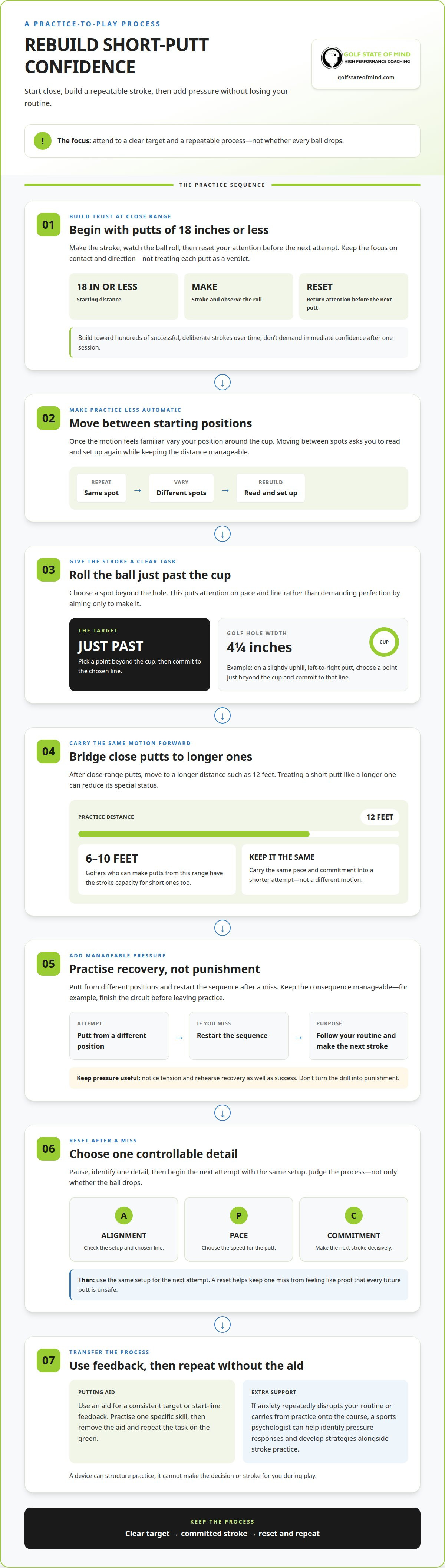
Begin rebuilding confidence with putts of 18 inches or less. Make the stroke, watch the ball roll, and reset your attention before the next attempt. Short repetitions let you focus on contact and direction without treating every putt as a verdict. Build toward hundreds of successful, deliberate strokes over time, rather than demanding immediate confidence after one practice session.
Once the motion feels familiar, vary your starting position around the cup. Try different spots, moving between them instead of repeating the same putt. This asks you to read and set up again, making practice less automatic while keeping the distance manageable enough to reinforce a steady stroke.
Give each attempt a clear task: roll the ball to a spot just past the cup. That target shifts attention from the result to pace and line. A golf hole is 4¼ inches wide, but aiming to make it can feel like a demand for perfection. A slightly uphill, left-to-right putt offers one example: choose a point just beyond the cup, then commit to that line.
After making putts from close range, move to a longer distance such as 12 feet. Treating a short putt like a longer one can reduce its special status. Golfers who can make putts from 6-10 feet have the stroke capacity for short ones too. The practice goal is to carry the same pace and commitment into a shorter attempt, not to manufacture a different motion.
Add pressure with a simple consequence. For example, putt from different positions and restart the sequence after a miss. Keep the consequence manageable, such as finishing the circuit before leaving practice. The goal is to notice tension, follow your routine, and make the next stroke. Don’t turn the drill into punishment; pressure practice should rehearse recovery as well as success.
After a miss, pause and identify one controllable detail: alignment, pace, or commitment. Then start the next attempt with the same setup. Fear of short putts can grow when one miss feels like proof that every future putt is unsafe. A reset breaks that chain. Judge your process, not just whether the ball drops.
Putting aids can help when they provide a consistent target or feedback about your start line. Use one to practise a specific skill, then remove it and repeat the task on the green. A device can structure practice, but it cannot make the decision or stroke for you during play.
Consider support from a sports psychologist when putting anxiety repeatedly disrupts your routine or follows you from practice onto the course. A professional can help identify the thoughts and pressure responses affecting your performance, then develop strategies to address them. This support can complement stroke practice, especially when repeated drills haven’t changed the pattern.
2. Feel, touch, and stroke mechanics
Short-putt anxiety can change your movement before the stroke begins. Your hands may tighten, your shoulders brace, or the putter slow near impact. Choose one mechanical intention for the next putt, such as keeping the putter moving through the ball. One cue is easier to trust than several instructions competing during the stroke.
Exhale gently before taking the putter back. Holding your breath can create tension in your chest and shoulders, making a smooth motion harder to maintain. Try this sequence: settle your feet, look at the target, breathe out, then begin the stroke. Keep the exhale comfortable. The goal is to release unnecessary tension, not force a special breathing pattern.
Develop feel by matching your stroke length to the pace you need. On a short putt, make a compact motion and let the putter swing through without stopping suddenly. Don’t baby or guide the ball toward the cup. Trust your hand-eye coordination to send the putter face along your chosen line.
What putting technique helps with short-putt anxiety? Focus on the chosen line and pace instead of monitoring whether the ball drops. Pick a specific point on the line, set the putter face, and make one committed stroke. This gives your attention a task you can control, even when the outcome is uncertain.
Use a simple practice check to connect feel with mechanics. Make a stroke without a ball and notice whether the putter swings freely. Then place a ball and repeat the motion, finishing with the putter pointing along your intended line. If your hands tighten or the finish becomes abrupt, pause and reset before trying again.
For example, if a short putt keeps missing low, don’t immediately add force with your hands. Recheck the line, then make a stroke with enough pace to hold it. A rushed jab can change both direction and speed. Keep your grip steady, your shoulders relaxed, and the putter moving through impact.
When technical thoughts multiply, a structured mental-game approach can help connect attention, confidence, and execution. The Ultimate Mental Game Training System offers a way to work on those performance skills alongside your putting practice.
Before each short putt, take a quiet moment to soften the start of your movement. Exhale gently before beginning the stroke; holding your breath can create tension in your chest and shoulders. Let the breath out comfortably, then focus on your chosen mechanical intention. The aim is not to add another instruction, but to start with less tension and a motion you can carry through.
At the ball, resist the urge to baby or guide the putt toward the cup. Trust your hand-eye coordination to send the putter along your chosen line at the pace you’ve selected. If doubt rises, return to the controllable task: set the face, make a committed stroke, and let the putter continue through impact. Afterwards, notice whether the motion felt free and the finish stayed in line. Use that observation to reset, rather than making a last-second correction.
3. Pre-shot routines, timing, and rhythm
A repeatable pre-putt routine gives your attention a sequence to follow instead of space to dwell on the consequence. Use the same steps on the practice green and during a round: read the break, choose a starting line, settle your stance, take one final look, then stroke. The details can be personal. Consistency matters more than adding extra movements.
Take enough time to read the putt, but separate preparation from execution. Behind the ball, assess the slope and choose a line. Once you step into your stance, stop gathering information and commit to your choice. If you keep changing the target over the ball, doubt can interrupt the sequence and make the stroke feel less natural.
A useful routine has a clear beginning and end. For example, read the slope, choose a point on your intended line, set the putter, and stroke after one final look. Rehearse that order without a ball, then repeat it with one. These steps create a dependable bridge between your decision and movement.
Your timing should feel steady, not hurried or prolonged. If you rush from reading to striking, you may skip the decision that gives the stroke direction. If you linger over the ball, extra thoughts can compete with your chosen line. Notice where your routine usually breaks, then practise that transition until it feels familiar.
Bobby Jones recalled preparing to make a putt about 3 inches long to win the 1926 United States Open at Scioto in Columbus, Ohio. The example illustrates how a prepared player can focus on executing a routine even when the putt carries significance. The lesson is not to imitate Jones’s exact motions, but to bring the same deliberate process to your own setup.
Keep your routine intact after a miss. The ball won’t always drop, even when you read the line and make a committed stroke. On your next putt, return to the same sequence instead of adding a corrective gesture or waiting for perfect confidence. This helps you respond to your process instead of letting one result dictate your timing.
Try a simple practice test: repeat your routine from different positions, then notice whether your pace changes near the cup. If your final look gets longer or your setup feels rushed, reset and begin again. A reliable rhythm isn’t a fixed tempo for every putt. It’s a familiar sequence that lets you prepare, decide, and move with commitment.
4. Putting yips and their neurological basis
The yips involve involuntary movements or disrupted timing during a putting stroke. You may feel your hands twitch, the putter hesitate, or the face turn unexpectedly. This can make a familiar movement feel difficult to control. It isn’t simply a lack of effort, and trying harder can add tension instead of restoring a smooth stroke.
Your brain coordinates attention and movement, and pressure can make that coordination feel less automatic. You may start monitoring each part of the stroke, such as the takeaway or impact, rather than allowing a rehearsed motion to unfold. That heightened control can interrupt timing. Notice the specific pattern, whether it’s a jab, a pause, or a sudden change in grip pressure.
A Mayo Clinic study estimated that 32.5% to 47.7% of low-handicap tournament golfers are affected by the yips. That estimate shows the experience is not limited to beginners. It does not identify the cause for an individual golfer. Record when the disruption appears, what the stroke feels like, and whether it changes across practice and play.
Approach shots and lag putting can affect how much pressure carries into your next putt. A long approach that leaves a difficult first putt can create a demanding recovery task. Practise controlling distance on lag putts, then focus on leaving a manageable second putt. This won’t eliminate short-putt nerves, but it can reduce avoidable pressure earlier in the hole.
Commit to a putting plan before addressing the ball. Read the break, choose a start line and pace, then execute without reopening the decision. For example, if the line bends around a subtle slope, identify where the ball should start before setting the putter. A clear plan gives your attention a task beyond checking for unwanted movement.
If a yip appears, avoid changing several mechanics at once. Briefly note the trigger and your response, then test one adjustment during practice. You might focus on a smooth takeaway or a stable finish. If the movement persists or causes distress, discuss it with a qualified health professional or sports psychologist who understands performance anxiety.
Separate the stroke from its outcome. After a missed putt, assess whether you followed your chosen line and pace instead of treating the miss as proof that the yips control every attempt. Return to the same plan on the next green. Progress is easier to judge when you track repeatable actions, such as completing your routine and making a committed stroke.
5. Why golfers fear short putts
A putt under 3 feet can create an expectation: you should make it. That expectation changes the task from rolling a ball along a chosen line into avoiding a visible mistake. A longer putt may allow room for a miss, while a three-foot attempt can feel like it demands perfection. The shorter distance can increase pressure, even though the physical stroke is smaller.
That pressure helps explain a puzzling pattern: some golfers make more putts from 10 feet than from 2-3 feet. At 10 feet, they may focus on pace and getting the ball close. From 2-3 feet, they may fixate on the result, tighten their hands, or steer the putter. Shaking hands can appear before the stroke, turning a familiar motion into a test.
What causes golfers to miss short putts? Common factors include tension, indecision, and trying to guide the ball instead of making a committed stroke. Fear of hitting the ball too far past the cup can also lead to a stroke that’s too soft, leaving the putt short or missing on the low side.
High-profile misses show how a short putt can carry an outsized consequence. Doug Sanders missed a 3-foot putt on the final hole of regulation at the 1970 British Open. Scott Hoch missed a 2-foot putt in a playoff loss to Nick Faldo at the 1989 Masters. Those moments are memorable partly because the distance seems so makeable, yet memory can make the same distance feel more threatening.
Other examples underline that no golfer is immune to a difficult moment. Ben Hogan missed a 2-foot putt on the final hole of the 1946 Masters. Craig Stadler missed a 14-inch putt that would have won his match at the 1985 Ryder Cup. These outcomes do not prove short putts are unpredictable. They show that pressure can disrupt execution, even for accomplished players.
Separate the expectation from the action. Before a 3-foot putt, decide on the line and pace, then commit to the stroke rather than rehearsing the consequences of a miss. If you miss, identify whether your read, pace, or commitment needs attention. That distinction turns a result into useful information instead of a verdict on your ability.
If pressure repeatedly overrides your plan, build a more structured mental approach to putting. Explore the mental game training system for support developing confidence and focus under pressure.
Two or three-foot putts bring shaking hands. Hale Irwin whiffed a 4-inch tap-in at the 1983 British Open, losing to Tom Watson; I.K. Kim’s 12-inch putt rimmed out at 2012 Kraft Nabisco, leaving her second place.
Golf State of Mind
Golf State of Mind helps golfers address the mental patterns that can make short putts feel intimidating. If pressure disrupts your focus, routine, or commitment, structured mental game training can help you work on those skills alongside your practice. Options include The Ultimate Mental Game Training System, 1:1 Mental Coaching, Mental Game Audios, and support focused on the yips. The right next step depends on what you’re experiencing: you may want a guided training structure, individualized coaching, or tools to strengthen your preparation before a round. Bring your putting concerns into the conversation and identify a practical direction for your mental game. Contact Golf State of Mind to discuss support for your putting confidence.
Carry a steadier mindset to the next green
Make your preparation dependable, even when a putt feels important. Let fear of short putts prompt you to return to your plan, not force a perfect result. Choose a clear intention, commit to the stroke, and assess your process afterwards. Confidence grows through repeated attention to actions you can control.
If you want structured support for that work, Golf State of Mind offers The Ultimate Mental Game Training System and 1:1 Mental Coaching. Golfers dealing with persistent putting disruptions can also explore How to Cure the Yips. Each option addresses the mental side of performance, helping you build a more deliberate approach to practice and play.
Explore mental game training and take one focused step toward a calmer, more committed putting routine. Progress begins with the next stroke.
Frequently Asked Questions
What are the best drills to overcome fear of short putts?
Use a randomized drill to make each attempt a fresh decision. Ask a playing partner to choose the starting position, or choose one yourself without following a fixed order. Before each putt, state your intended start line, then check whether the ball started there. This separates decision quality from the final result and helps reveal whether misses come from reading, alignment, or execution.
How can golfers improve confidence on short putts?
Build confidence from clear evidence, not by demanding a perfect streak. After practice, note one action you controlled well, such as choosing a target decisively or keeping your grip pressure steady. Note a miss only when it reveals something useful. Reviewing these observations before your next round gives you specific reminders of what has worked, rather than a general instruction to “be confident.”
How can golfers manage pressure during short putts?
Practise under mild observation before facing a high-pressure moment. For example, ask a playing partner to watch quietly while you putt, then gradually add a simple match-play consequence. If tension rises, name the next task neutrally, such as “choose the start line.” Avoid predicting the outcome or replaying an earlier miss. This keeps your attention on the decision in front of you.
How long does it take to overcome fear of short putts?
There’s no fixed timeline. Rebuild confidence through deliberate practice over time, starting with putts of 18 inches or less and gradually adding pressure; don’t expect immediate confidence after one session.
Get your FREE Mental Game Scorecard

Difference Between Golf Psychology and Mental Coaching: What Golfers Need to Know
What is the difference between golf psychology and mental coaching, and which kind of support fits your goal? The terms often appear side by side,…
Get your FREE Mental Game Scorecard
Can a Sports Psychologist Fix My Golf Game? What Helps
Your swing may not be the only thing shaping your score. The answer to “Can a sports psychologist fix my golf game?” is yes, in the sense that mental…
Get your FREE Mental Game Scorecard