
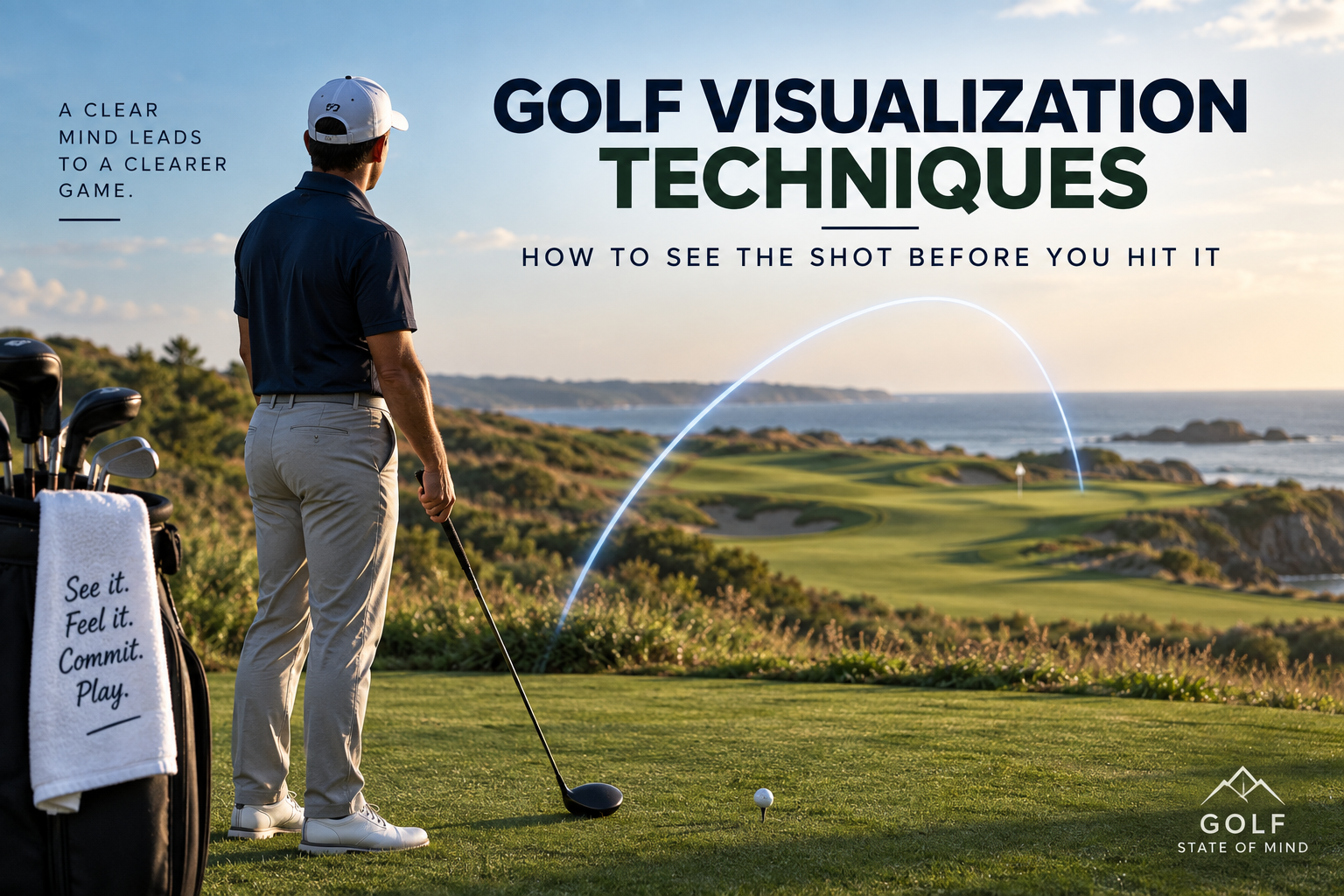
Golf Visualization Techniques: The Mental Blueprint for Lower Scores
Before you hit a golf shot, you have an opportunity to create a clear picture of what you’re trying to do.
Where will the ball start?
What shape will it have?
How high will it fly?
Where will it land?
How will the swing or stroke feel?
This is where golf visualization techniques can become an important part of your mental game.
Visualization isn’t about convincing yourself that the ball is definitely going to finish next to the hole.
It isn’t positive thinking.
And you don’t need to see a perfect high-definition movie in your mind for it to be useful.
The purpose is much simpler:
Visualization helps you create a clear intention for the shot you’re about to play.
Instead of standing over the ball thinking about your swing, worrying about the hazard or trying not to hit a bad shot, you’re directing your attention toward what you actually want to do.
See it.
Feel it.
Commit to it.
Then play.
Key Takeaways
- Golf visualization is about creating a clear intention for the shot rather than guaranteeing the outcome.
- You don’t need to see vivid pictures in your mind to benefit from visualization.
- You can use images, feelings, sounds or a combination of them.
- Visualize the shot you want to hit rather than becoming fixated on what you’re trying to avoid.
- Use visualization after you’ve gathered information and made your decision.
- Keep pre-shot visualization simple and brief.
- Putting visualization can include line, speed and the ball’s final roll toward the hole.
- Practice visualization on the range rather than expecting it to work automatically during competition.
- Performance practice is an excellent way to develop the connection between visualization, commitment and execution.
What Is Golf Visualization?
Visualization — or mental imagery — is the process of mentally rehearsing an experience before it happens.
In golf, that might mean imagining:
- The starting line of a drive.
- A draw moving toward the target.
- The trajectory of an iron shot.
- A pitch landing on a particular spot and releasing toward the hole.
- A putt rolling along your chosen line at the correct speed.
- The rhythm or feel of the swing you want to make.
Notice that visualization isn’t necessarily about your golf swing.
For most shots on the course, I’m much more interested in the golfer creating an image of what they want the ball to do.
Visualization Is About Intention
Imagine throwing a ball to somebody.
You don’t normally calculate every movement your arm needs to make.
You look at where you want the ball to go and respond to the task.
Golf is obviously more technically demanding, but the principle is useful.
Once you’ve made the technical improvements in practice, you want to give your athletic skills a clear task on the course.
Where am I sending the ball?
Why Visualization Can Help Your Golf
One of the biggest benefits of golf visualization is that it gives your attention somewhere useful to go.
It Creates Clarity
Compare these two thoughts:
“Don’t hit it in the water.”
and:
“Start it at the left edge of that bunker and let it fade toward the center of the fairway.”
The second creates a much clearer task.
It Can Reduce Technical Thinking
Golfers often become more technical when they feel pressure.
They start thinking about:
- Takeaway.
- Clubface.
- Shoulder turn.
- Transition.
- Weight shift.
- Impact.
Those thoughts may have a place during technical practice.
But when you’re playing, an image or feel can help move your attention away from controlling individual body movements and toward executing the shot.
It Connects Decision to Execution
You have assessed the lie.
You know the distance.
You’ve considered the wind and trouble.
You’ve chosen the club.
Now what?
Visualization helps turn all that information into a specific shot.
This is what I’m going to do.
Want to develop a stronger mental process before every shot? Download my free ebook, 7 Key Mental Strategies, for practical ways to improve visualization, focus, confidence and commitment on the golf course. Get the Free Ebook
What If You Can’t See Pictures in Your Mind?
This is an important point because the word visualization can be misleading.
Not every golfer experiences mental imagery in the same way.
Some golfers can create an incredibly vivid picture.
Others don’t.
That doesn’t mean visualization can’t work for you.
Use Feel
You might connect more strongly with the feeling of the shot.
For example:
- The rhythm of the swing.
- The sensation of a smooth transition.
- The weight of the clubhead.
- The feel of a controlled three-quarter wedge.
- The pace of a putting stroke.
Use Sound
You might imagine the sound of:
- A solid strike.
- A putt dropping into the cup.
- The contact of a crisp wedge.
Know the Shot Without Seeing It Clearly
You may simply have a sense of the ball flight you’re trying to create.
That’s enough.
Don’t turn visualization into another skill you believe you have to perform perfectly.
The goal is clarity of intention, not quality of picture.
How to Visualize a Golf Shot
Let’s make this practical.
You’re standing 155 yards from the green.
The pin is on the right side.
There’s trouble short and right.
You’ve decided the best shot is one that starts toward the middle of the green and draws slightly toward the flag.
1. Choose the Shot
Visualization should come after the decision.
Don’t try to visualize five possible shots.
Gather the information.
Make the decision.
2. Choose a Clear Target
Where exactly do you want the ball to start?
Choose something specific enough to direct your attention.
3. See the Ball Flight
Imagine the ball:
- Starting on your chosen line.
- Flying at the intended trajectory.
- Moving with the shape you’ve selected.
- Landing in the area you’ve chosen.
4. Connect It to Feel
If it’s useful, connect the image to the feel of the swing required to produce it.
A low punch feels different from a high soft iron.
A three-quarter wedge feels different from a full one.
The image and feel can work together.
5. Commit and Play
Once you’ve created the intention, don’t keep analyzing it.
Step in.
Connect with the target.
Commit.
Play.
Visualization in the Think Box and Play Box
The Think Box and Play Box provide a useful way of understanding where visualization fits into your pre-shot routine.
The Think Box
Behind the ball, you’re gathering information.
Consider:
- Lie.
- Distance.
- Trouble.
- Conditions.
- Club and shot selection.
- Target.
This is where you make the decision.
Moving Toward the Play Box
Once the decision is made, your attention can begin shifting from analysis toward execution.
See the shot.
Feel the shot.
Connect with the target.
The Play Box
When you’re over the ball, you don’t need to continue planning.
Your job is to react to the intention you’ve already created.
If you’re standing there still debating the club, target or shot shape, step away.
Return to the Think Box.
Make the decision.
Then begin again.
Visualize What You Want, Not What You Fear
One of the most valuable applications of golf visualization techniques is improving target orientation.
Where Is Your Attention?
Imagine a tee shot with water all the way down the right side.
The golfer stands behind the ball thinking:
“Don’t hit it right.”
They take a practice swing while looking at the water.
Then they address the ball with their attention still connected to the hazard.
The problem isn’t that merely thinking about water somehow makes the ball fly there.
The problem is that the golfer hasn’t created a sufficiently clear intention for where they actually want to send the ball.
Give Your Attention a Destination
Instead ask:
“Where am I sending this?”
Choose the target.
See the starting line.
Imagine the shape.
Commit to the shot.
The hazard can still be part of your strategic decision.
It just doesn’t need to remain the center of your attention when it’s time to execute.

Visualization for Putting
Putting is one of the easiest places to understand visualization because you’re trying to predict how a ball will move across the ground.
Read First
Before visualizing, gather the information.
Look at:
- Slope.
- Speed.
- Distance.
- Break.
Choose the line and speed.
See the Roll
Imagine the ball beginning on your intended starting line.
See it moving at the pace you’ve chosen.
See how the speed and break work together.
You may imagine the ball entering the hole, or simply see the entire roll clearly toward your target.
Feel the Speed
For many golfers, feel is even more useful than a detailed visual picture.
Look at the hole.
Make practice strokes while connecting with the distance.
Then step in and react.
Don’t Demand That the Ball Goes In
This matters.
Visualization doesn’t mean:
“I saw it going in, therefore it has to go in.”
You can visualize the putt beautifully, make an excellent stroke and miss.
Your responsibility is the process.
The outcome still contains uncertainty.
Visualization for the Short Game
Visualization can be particularly useful around the green because there are often several possible ways to play the shot.
See the Landing Spot
Rather than simply looking at the flag, imagine:
- Where the ball will land.
- How high it will fly.
- How much it will release.
- How it will react when it reaches the green.
Then Choose the Club
Many golfers do this backwards.
They grab their favorite wedge first and then try to manufacture a shot with it.
Instead:
See the shot → choose the landing spot → understand the trajectory and roll → choose the club that best produces it.
Connect the Picture to Feel
Once you’ve seen the shot, rehearse the movement that matches it.
Then play.
Visualization for Tee Shots
Tee shots often create more fear because the trouble is visually obvious.
Out of bounds.
Water.
Trees.
Bunkers.
Use the Trouble for Planning
You shouldn’t ignore trouble.
It’s important information.
Use it when choosing your strategy.
Then Shift Toward the Shot
Once you’ve decided what to hit, move your attention toward:
- Your starting line.
- Your intended shot shape.
- Your target.
This is the distinction between planning around trouble and performing while staring at it.
Using Visualization Under Pressure
Visualization doesn’t eliminate nerves.
That’s not its job.
But it can be particularly useful under pressure because pressure tends to pull attention toward outcomes.
“What if I miss?”
“What will I shoot?”
“What if I don’t qualify?”
“What if everyone sees me hit this badly?”
Give Your Mind a Job
When your mind starts jumping into the future, bring it back to the task.
What is the shot?
Where is the target?
What do I want the ball to do?
You Can Visualize While Nervous
You don’t have to wait until you feel completely calm.
You can have a faster heartbeat and still see the shot.
You can feel uncertain and still commit.
That’s an important distinction.
Want to become better at focusing on the shot you want to hit instead of the outcome you’re trying to avoid? Download my free 7 Key Mental Strategies ebook for practical strategies to improve visualization, focus and confidence under pressure. Download the Free Ebook
How to Practice Golf Visualization
Don’t wait until the club championship to start using visualization.
Practice it on the range.
Don’t Visualize Every Ball During Technical Practice
If you’re working on a swing change, there will be times when your attention needs to be on the movement.
That’s fine.
Technical practice and performance practice have different purposes.
Use Visualization During Performance Practice
Once you’ve completed the technical part of your session:
- Change targets.
- Change clubs.
- Go through your routine.
- See the intended shot.
- Connect it to feel.
- Hit one ball.
- Accept the result.
- Start again with a different task.
Now you’re practicing the same decision → visualization → commitment → execution sequence you need on the course.
Play Virtual Golf on the Range
One of my favorite ways to make range practice more like golf is to play holes in your imagination.
Choose a course you know.
Play the First Hole
Imagine the tee shot.
Where is the trouble?
What club would you hit?
Choose your target.
Visualize the shot.
Hit one ball.
Play the Next Shot From the Result
If you hit a good drive, imagine the approach you’d have.
If you missed right, perhaps you now need to visualize a recovery shot.
Change club.
Change target.
Go through the process again.
No Mulligans
If you hit a poor shot, don’t immediately drag another ball across and correct it.
That’s the point.
Accept the result and solve the next problem.
This develops much more than visualization.
You’re also practicing decision-making, commitment, acceptance and adaptability.
Off-Course Visualization
You can also practice mental imagery away from the golf course.
Rehearse a Familiar Hole
Close your eyes if that’s comfortable and imagine standing on the first tee of a course you know well.
Notice:
- What the hole looks like.
- Where the trouble is.
- The weather.
- The club in your hands.
- Your target.
Then imagine going through your routine and playing the shot.
Rehearse Your Process, Not Just Perfect Outcomes
This is important.
Don’t make every visualization session a fantasy in which you stripe every drive and hole every putt.
You can also rehearse:
- Feeling nervous and still committing.
- Getting a difficult lie.
- Missing a green and responding well.
- Making bogey and starting again.
- Playing the final holes while under pressure.
You’re rehearsing how you want to compete, not trying to predict a perfect round.
Common Visualization Mistakes
1. Trying Too Hard to See a Perfect Picture
If the image isn’t vivid, don’t force it.
Use feel, sound or simply a clear sense of the shot instead.
2. Visualizing Before You’ve Made the Decision
You can’t commit to an image if you’re still deciding between three clubs and two shot shapes.
Decide first.
3. Using Visualization as Positive Thinking
Seeing the ball finish next to the flag doesn’t guarantee it will happen.
Visualization creates intention.
It doesn’t control the outcome.
4. Making It Too Long
Your pre-shot routine doesn’t need a 30-second mental movie.
A brief image or feel may be enough.
5. Visualizing Your Swing Instead of the Shot
There may be times during technical training when imagining a movement is useful.
But on the course, be careful about turning visualization into another form of swing analysis.
See the ball flight.
Feel the shot.
React to the target.
6. Only Visualizing Perfect Golf
Golf is unpredictable.
If your mental rehearsal only includes perfect shots and perfect feelings, it isn’t preparing you for competition.
Practice seeing yourself respond well when things aren’t perfect too.
A Simple Golf Visualization Routine
You don’t need to make this complicated.
Before each shot:
1. Gather the Information
Lie. Distance. Trouble. Conditions.
2. Make the Decision
Club. Shot. Target.
3. See It
Imagine the ball flight, trajectory, shape and landing area.
4. Feel It
Connect with the rhythm or movement required to produce the shot if that helps you.
5. Commit
You’ve made your decision.
Give yourself permission to play.
6. Accept the Result
The visualization was an intention, not a promise.
Whatever happens, process the result and begin again.
The Real Goal of Golf Visualization
The purpose of golf visualization techniques isn’t to create a perfect mental movie before every shot.
And it isn’t to convince yourself that every shot will be successful.
The goal is to make your intention clearer.
Instead of:
“Don’t hit it there.”
You have:
“This is where I’m going.”
Instead of:
“What should my swing do?”
You have:
“This is the shot I’m creating.”
Instead of trying to guarantee the outcome:
See it. Feel it. Commit to it. Play.
That’s where visualization fits into a strong mental game.
Not as magic.
Not as a guarantee.
But as a simple way of connecting your decision to the golf shot you’re about to hit.
Frequently Asked Questions
What are the best golf visualization techniques?
Start by making a clear decision about the shot and target. Then imagine the intended starting line, trajectory, shape and landing area. If useful, connect that picture to the feel or rhythm of the swing required to create it. Keep the process brief and then commit to the shot.
How do you visualize a golf shot?
Stand behind the ball and imagine what you want it to do. See its starting line, flight, shape and landing area. You may also imagine how the swing will feel. Once the intention is clear, move into your setup and execute rather than continuing to analyze.
What if I can’t visualize pictures clearly?
You don’t need vivid mental pictures. Some golfers connect more strongly with feel, rhythm, sound or simply a sense of the shot they intend to play. The goal is clarity of intention rather than producing a perfect image.
Should I visualize every golf shot?
Visualization can be a useful part of your normal pre-shot routine, but it doesn’t have to be elaborate. For some shots, a very brief image or feel may be enough. Experiment with what helps you become clearer and more committed without slowing down your routine.
How long should golf visualization take?
There is no required number of seconds. During your pre-shot routine, visualization should generally be brief enough that it helps clarify the shot without becoming another source of analysis. For many golfers, the image or feel happens naturally within a few seconds.
Does visualization work for putting?
Yes. After reading the putt and making a decision, imagine the ball starting on your intended line and rolling at the speed you’ve chosen. You can visualize the break and final portion of the roll while also connecting your practice strokes to the required pace.
Should I visualize the ball going into the hole?
You can if that creates a useful image for you, but don’t turn it into a requirement. The purpose isn’t to convince yourself that the putt must go in. It’s to create a clear intention for line and speed before making the stroke.
Can visualization help with first tee nerves?
It can help redirect attention away from possible outcomes and toward the shot you’re trying to create. You don’t need visualization to eliminate your nerves. You can feel nervous, see the intended shot and still make a committed swing.
Can visualization help with golf anxiety?
Visualization can give your attention a more useful task when your mind becomes occupied with hazards, score or possible mistakes. It shouldn’t be used as a way of forcing anxiety to disappear. The objective is to remain capable of following your process while those feelings are present.
Can golf visualization help with the yips?
Imagery may be useful as part of a broader approach by helping some golfers direct attention toward the intended task or feel rather than fear and excessive control. However, the yips are complex and shouldn’t be described as simply a psychological problem that visualization can cure.
Should I visualize my golf swing or the ball flight?
During technical practice, visualizing a particular movement may sometimes be useful. During play, I generally prefer golfers to orient their attention toward the shot — the target, ball flight, trajectory and feel — rather than mentally inspecting individual swing positions.
How can I practice visualization on the driving range?
Include a performance-practice section after your technical work. Change clubs and targets, go through your complete routine, visualize each shot and hit one ball. You can also play a virtual round by imagining holes from a familiar course and changing the next shot based on the result of the previous one.
Is visualization the same as positive thinking?
No. Positive thinking generally involves interpreting a situation optimistically. Visualization is mental rehearsal of an intended action or outcome. In golf, its practical value is helping create clarity about the shot you’re trying to play rather than trying to convince yourself that something good will definitely happen.
Get your FREE Mental Game Scorecard

The Power of Visualization
In life, we generally become, or “live into” what we visualize for ourselves in the future. The same happens in golf.
Get your FREE Mental Game Scorecard