A steady putting mental game depends less on finding a special self-talk strategy than on choosing words that keep you focused on the task. The same principle applies to full-swing shots: useful self-talk is clear, personal, and consistent, helping you commit instead of overthinking under pressure.
It’s understandable to wonder whether putting calls for a different mental approach. A short putt can make doubt feel immediate, but forcing confidence or trying to silence every thought can add pressure. What matters is having a process you can return to when the result feels important.
Learn how to build a simple pre-putt routine, visualize the ball’s path, use purposeful self-talk, and manage stress without letting one missed putt shape the next. You’ll also see how to set process-focused goals and prepare for each stroke with greater composure. These practices won’t remove pressure, but they can help you respond with clarity and putt more consistently.
Key Takeaways
- Use a repeatable pre-putt sequence to settle your attention and commit to the line.
- Picture the ball’s intended path and focus on an external target rather than trying to control every movement.
- When pressure rises, use a deliberate reset to steady your breathing and return attention to the next task.
- Keep stroke thoughts simple under pressure; excess analysis can pull focus away from executing the putt.
- Build consistency by tracking controllable process goals and treating each putt as a fresh opportunity.
1. Establishing a pre-shot routine
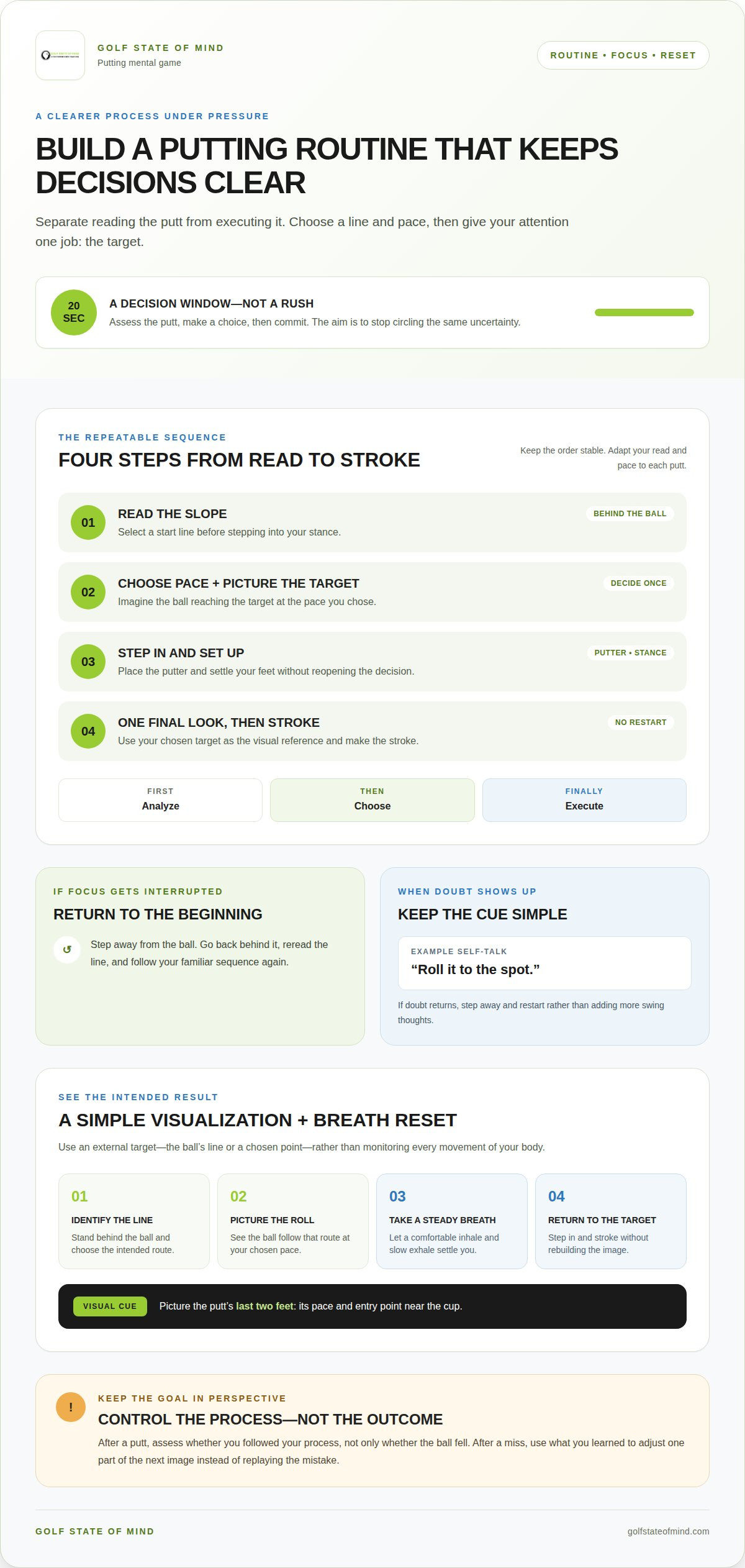
A consistent pre-putt routine gives each stroke a familiar beginning, even when the outcome matters. Use the same sequence to read the line, choose a pace, settle your stance, and begin the stroke. A 20-second window can help contain the decision process: assess the putt, make a choice, then commit. The goal isn’t to rush. It’s to stop circling the same uncertainty.
Keep the sequence simple enough to repeat on a short tap-in or a challenging breaking putt. For example, stand behind the ball to see the start line, choose a target, then step beside the ball and set your feet. You might remove a glove or adjust your hat as a familiar cue, but make sure each action is purposeful. Every step should move you toward the stroke, not create another decision.
Use this order as a starting point, then make the actions your own:
- Read the slope and select a start line from behind the ball.
- Choose a pace and picture the ball reaching the target.
- Step in, place the putter, and set your stance.
- Take one final look, then make the stroke without restarting.
This sequence separates analysis from execution. While reading the putt, consider the slope and the distance the ball must travel. Once you’ve chosen a line and pace, shift your attention to the target instead of reopening the decision. For example, if you’ve selected a point just outside the cup, use it as your visual reference. A clear decision gives your attention one job.
Consistency matters more than elaborate gestures. If you take a practice stroke, give it a purpose, such as sensing the pace. Avoid taking several rehearsal strokes, which can invite fresh doubts about your motion. Likewise, don’t add extra looks just because a putt feels important. Use the same final look and start cue you would on an ordinary green.
A routine can also help you reset after a distraction. If another player moves or a thought interrupts your focus, step away from the ball and return to the first action: reading the line from behind it. Then follow your established sequence. Restarting from a familiar point is more useful than standing over the ball and trying to force concentration.
Practise the routine on the putting green with different lines and distances. Keep the order stable while adapting your read and pace to each putt. After a miss, assess whether you followed your process, not only whether the ball fell. That distinction helps build a dependable putting mental game: your routine guides preparation, while the result remains outside your control.
2. Visualization and external focus
Visualization gives your attention a clear picture of the task before the putter moves. Imagine the ball’s route, the pace it needs, and its destination. For example, picture a breaking putt following its chosen curve and finishing near the cup. Keep the image simple and connected to the shot you intend to play, rather than rehearsing every possible miss.
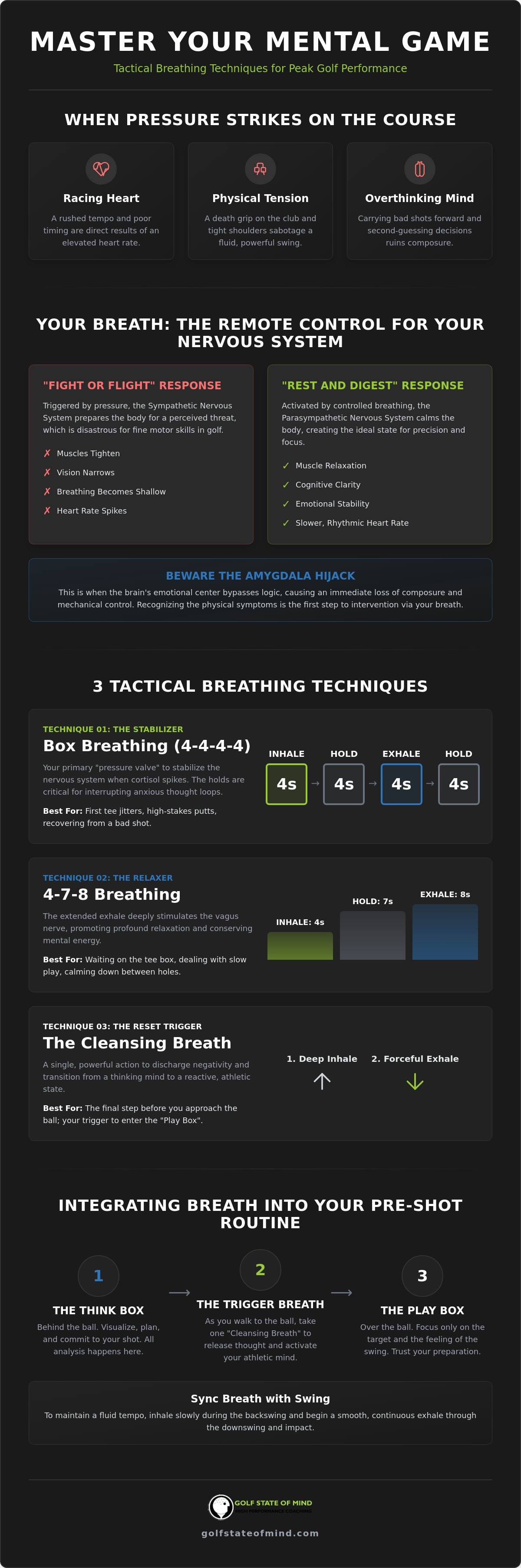
How do visualization and breathing techniques help with putting? Mental imagery directs your attention toward the intended result, while a controlled breath can help you settle before acting. Together, they offer a practical way to shift from anxious prediction to a specific target and a composed stroke.
Use the last two feet of the putt as a useful image. Before stepping over the ball, picture that final section rolling into the cup. Notice the pace and the ball’s entry point, not just the moment it drops. This gives your mind a clear outcome to follow and prevents the image from becoming a vague wish for a successful putt.
External focus means attending to something outside your body, such as the ball’s line or the target point. It differs from monitoring internal details like wrist position or the exact movement of your shoulders. On a putt that bends left, for example, look toward the chosen start point and picture the ball tracking across the green. Let the stroke respond to that image instead of trying to control each joint.
To make the image useful, practise this sequence on the putting green:
- Stand behind the ball and identify the intended line.
- Picture the ball rolling along that route at the chosen pace.
- Take a steady breath, then let your attention return to the target.
- Step in and make the stroke without rebuilding the image.
Keep your breathing natural. A comfortable inhale followed by a slow exhale can mark the transition from reading to execution. Don’t turn breathing into another performance test. If you notice tension in your shoulders, release it during the exhale, then direct your eyes back to the target. Use the breath as a cue for attention, not as a guarantee of a particular result.
Imagery also helps after a poor attempt. If a putt finishes short, identify whether the picture lacked pace or the line was misread. On the next stroke, adjust one part of the image instead of replaying the miss. This keeps visualization connected to useful information. For a structured approach to mental skills, mental game training can help you develop a repeatable practice.
A five-foot putt on the 18th green can feel heavier than the same putt during practice. The mind may jump to the score, the audience, or the consequences of a miss. That attention shift is understandable, but it pulls focus away from the immediate task: choosing a line, selecting a pace, and making a committed stroke.
Overthinking often grows when you keep changing your decision while standing over the ball. Choose your line and pace before settling into your stance, then use one brief cue, such as “roll it to the spot.” If doubt returns, step away and restart your routine instead of adding more swing thoughts.
Anxiety can also affect the body. It can shift a golfer’s wrist angle by nearly a full degree at impact, a small change that can alter the putter’s delivery. The point isn’t to monitor your wrist during the stroke. Instead, notice tension before addressing the ball, release your grip slightly, and direct your attention back to your intended target.
Try a pressure drill that makes practice feel more like a meaningful moment. Choose a short putt, picture the final putt on the 18th green, and go through your normal preparation before each attempt. After a miss, reset fully, choose a new target, and begin again. This trains your response to pressure, not just your ability to repeat a stroke in comfortable conditions.
For a separate challenge, alternate putts from different spots around the hole. Before each attempt, state your intended start line and pace in a few words. After the stroke, assess whether the ball started where you intended. This keeps practice focused on decisions and commitment, rather than treating every miss as evidence about your ability.
One case study described an elite golfer whose kinematics improved under stressful conditions despite severe reported anxiety. The useful lesson is that feeling anxious doesn’t automatically prevent coordinated movement. You can acknowledge the nerves, return to a specific task, and let practiced preparation guide the stroke.
After missing an easy putt, take one breath and name a useful observation, such as “pace was firm” or “start line missed right.” Then leave that result behind and begin the next putt with a fresh read. A mistake becomes useful when it informs a decision, not when it becomes a prediction about what will happen next.
Build confidence by practising that reset repeatedly. On the putting green, rehearse a pressure scenario, follow your preparation, and respond to each miss with one calm observation. The aim isn’t to eliminate anxiety. It’s to keep the next decision clear, even when the previous putt is still on your mind.
4. Pressure and putting stroke mechanics
Pressure can make familiar putting movements feel unfamiliar. On a short putt, you might grip the handle more tightly, rush the takeaway, or guide the putter toward the cup. These reactions can disrupt a smooth, committed stroke. Notice what changes for you, then keep your attention on the putter’s path and the ball’s intended start line.
Separate the mechanics you can prepare from the result you can’t control. Before a practice stroke, set your feet, let your arms hang comfortably, and place the putter behind the ball. Then rehearse the pace you want. On the actual stroke, avoid adding a last-second correction just because the putt suddenly feels important.
For example, imagine a straight putt that needs a firm roll to reach the cup. If you fear hitting it too hard, you may shorten the stroke or decelerate through impact. Instead, rehearse a stroke that matches your intended pace, then let that rehearsal inform the movement. The aim isn’t to force a particular technique, but to stop fear from changing your decision at the last moment.
A useful practice check is to observe the ball’s start line after each stroke. If it begins left of your chosen line, note the direction without immediately changing your grip, stance, and putter path all at once. Adjust one controllable element during practice, such as your setup alignment, then try another stroke. Changing one element at a time makes it easier to understand what affected the result.
Pressure can also draw your attention inward. You might start checking your wrists, shoulders, or backswing while standing over the ball. Replace that running commentary with one external cue, such as rolling the ball over a specific blade of grass. Your body still makes the movement, but your attention has a clear task beyond monitoring each joint.
Build pressure tolerance by practising with a meaningful consequence, without turning every session into a test. For instance, choose a short putt and commit to your full routine before each attempt. If you miss, step away, reset your grip, and begin again. This lets you practise restoring your preparation instead of reacting with hurried strokes or repeated mechanical changes.
After a round, recall one putt where pressure affected your movement. Identify the first change you noticed, such as a tight grip or rushed takeaway, and choose one cue for your next practice. A simple note like “soft hands” or “smooth through” can reconnect mechanics with intention. Keep the cue brief, then focus on the target instead of judging your stroke mid-motion.
Consistency comes from repeating useful decisions, not demanding perfect results from every putt. Golf is often described as 90% mental, but the practical point is simpler: attention, expectations, and reactions influence how you approach each stroke. Build a process you can follow across a full round, including after a mistake. That gives you a stable measure of performance beyond whether the ball drops.
Set goals at three levels. An outcome goal describes the result you want, while a performance goal tracks part of your play. A process goal identifies an action you control. For example, aiming to win a match is an outcome; averaging 30 putts per round is a performance target. Committing to your chosen pace on each putt is a process target.
- Outcome: Identify the result you hope to achieve, such as a strong finish.
- Performance: Track a measure, such as averaging 30 putts per round.
- Process: Focus on a repeatable action, such as making a clear pace decision.
Process goals give your attention a useful direction when the score changes. You can’t control whether a putt catches the edge and stays out, but you can assess whether you chose a line and committed to it. Give 100 percent effort, physically and mentally, to the stroke in front of you. That means acting with intent, not forcing tension or expecting every putt to fall.
Between rounds, review patterns rather than judging yourself by one memorable miss. Note the putts you made, the putts you’re currently making confidently, and the solid attempts that felt well-paced. If a practice session goes poorly, identify what it taught you. Perhaps your pace varied on long putts, or your attention drifted after a miss. Turn that observation into one process goal for your next practice instead of treating the session as a verdict.
After a missed putt, reset your attention to the next task. Annika Sorenstam advises golfers to forget bad shots and move on. Apply that principle by naming one lesson, then letting go of the replay. Over two weeks, try a consistent process goal and note whether your decisions feel clearer. Look for evidence in your preparation and commitment, not only on the scorecard.
For a more structured approach to mental preparation, explore The Ultimate Mental Game Training System. It can help you develop psychological skills and a repeatable plan for handling the demands of golf.
Golf State of Mind: The Ultimate Mental Game Training System
Golf State of Mind’s The Ultimate Mental Game Training System gives you a structured next step when routines, visualization, and pressure management need more consistent practice. It focuses on the psychological side of golf, helping you build skills to apply on the course.
Choose 1:1 Mental Coaching if you want individualized support with your mental approach. If a specific challenge is interfering with putting, How to Cure the Yips addresses that concern, while Mental Game Audios offer another way to engage with mental training.
Start with the support that best fits your current challenge, whether you’re building a steadier process or addressing a recurring mental block. Contact Golf State of Mind to discuss which mental training option suits your goals.
Carry Your Focus Into the Next Round
A strong putting mental game isn’t a state you have to wait for. It’s a capacity you develop by returning your attention to what you can influence, especially when a result matters. Treat each round as a chance to notice how you respond, then bring one useful adjustment into your next practice. Confidence grows when you follow through on a clear intention, not when you demand certainty before every stroke.
Choose one mental skill to keep developing. Make it specific enough to recognize on the green, and give it room to become familiar before adding another. If you want a structured path for strengthening your approach, explore The Ultimate Mental Game Training System. Take the next step with patience and purpose. Your focus can become a steadier part of your game.
Frequently Asked Questions
Does Self-Talk Strategy Type Matter More for Putting Than for Full-Swing Shots?
The usefulness of self-talk depends more on the task than on whether you’re putting or swinging. A short cue such as “start it on line” can direct your attention during a putt, while a full swing may benefit from a rhythm cue like “smooth tempo.” Try one phrase at a time during practice. Keep the words brief, neutral, and focused on an action you can perform.
How Does Self-Efficacy Physically Change Brain Activity During a Putting Stroke?
Self-efficacy can influence how you process a putt by shaping your expectations, attention, and sense of control. Feeling capable may make it easier to focus on the intended target instead of scanning for possible mistakes. It doesn’t guarantee a particular brain response or a successful stroke. For example, a golfer who trusts their preparation may spend less time questioning a decision they’ve already made.
Why Do Skilled Golfers Experience Less Cognitive Load Than Beginners Under Pressure?
Skilled golfers may use less conscious attention for familiar tasks because practice makes parts of their preparation more automatic. A beginner might actively monitor grip, alignment, pace, and stroke direction all at once. A more experienced player can often rely on established patterns and reserve attention for reading the putt. Either golfer can become distracted under pressure, so deliberate practice should include making decisions without repeatedly revisiting them.
What Is the Mental Game in Golf Putting?
The mental game in putting is how you direct attention, make decisions, and respond emotionally before and after a stroke. It includes confidence, patience, commitment, and the ability to move forward after an outcome you didn’t want. For example, after leaving a putt short, you can identify whether your pace judgment needs attention without deciding that the next putt will also miss.
What Are the Best Mental Techniques for Improving Putting?
Useful techniques include choosing a clear target, rehearsing the intended pace, and using a short cue that supports commitment. You can also keep a practice log focused on decision quality, not just makes and misses. For example, note whether you picked a start line before addressing the ball. Reviewing these observations can help show whether a challenge is about reading, commitment, or attention.
How Can Golfers Overcome Fear and Anxiety Over Short Putts?
Reduce the pressure attached to a short putt by treating it as one specific task, not a test of your ability. Choose a target point, decide on a pace, and focus on rolling the ball there. In practice, include short putts after a demanding drill, when concentration may feel less comfortable. This helps you practise making a clear decision under some pressure, rather than waiting to feel perfectly calm.
What Pre-Putt Routine Helps Improve Focus and Consistency?
A useful routine follows the same broad sequence while leaving room to adapt your read. For example, pause behind the ball, inspect the slope from another angle, select a starting point, and settle over the putt. If a distraction interrupts you, step away and begin again from behind the ball. Rehearse this reset during practice so an interruption doesn’t lead to a rushed stroke or a changed plan.
How Do Putting Strategies Differ for Casual Golfers and Professionals?
The core mental skills are similar, but the amount of structure and review may differ. A casual golfer might choose one reliable cue and focus on enjoying a steady process. A professional may track patterns across rounds and adjust preparation to competitive demands. For either golfer, the useful strategy is one they can repeat under pressure. A complicated routine that invites doubt is less practical than a clear, familiar approach.