

7 Mental Putting Drills to Stop Overthinking Putts
7 Mental Putting Drills to Stop Overthinking Putts
Have you ever stood over a putt, convinced you knew the line, only to start questioning yourself at the last moment?
You look at the hole again.
You wonder whether there’s more break than you originally thought.
You adjust your putter face slightly.
Then, just before starting the stroke, you have another thought:
“What if I’ve read this completely wrong?”
By the time you hit the putt, you’re no longer committed to anything.
This is one of the most frustrating mental challenges in putting. The more important the putt becomes, the more information you feel you need before you’re ready to hit it.
But more analysis doesn’t always produce a better decision.
The key to confident putting is knowing when to stop reading the putt and start trusting your decision.
I’m David MacKenzie, founder of Golf State of Mind. As a golf mental performance coach, I help golfers develop routines that allow them to make clear decisions and execute with greater commitment under pressure.
In this article, I’ll share seven mental putting drills that can help you read greens more decisively, reduce unnecessary hesitation, and develop a putting routine you can trust.
Why Golfers Overthink Putts
Putting presents a unique mental challenge.
Unlike a full swing, the movement itself is relatively small. That can make it tempting to believe you should be able to control every detail.
You may start thinking about your alignment, grip pressure, stroke path, tempo, face angle, green speed, and the amount of break.
Then there’s the outcome.
Missing a four-foot putt for par can feel far more frustrating than missing a green with a seven-iron.
And the more the result matters, the more likely you may be to question your judgment.
Three Common Putting Problems
- Indecision: You keep changing your read instead of committing to one starting line and speed.
- Overcontrol: You become excessively conscious of the putting stroke instead of responding to the target.
- Outcome anxiety: You become focused on making or missing rather than executing your intended roll.
These problems are related, but they aren’t identical.
A golfer who struggles to read greens accurately may need technical green-reading instruction.
A golfer who reads putts well but repeatedly changes their mind may need to work on decision-making and commitment.
And a golfer whose stroke changes under pressure may need to practise a more consistent performance routine.
That’s why I want you to use the following drills with a specific purpose.
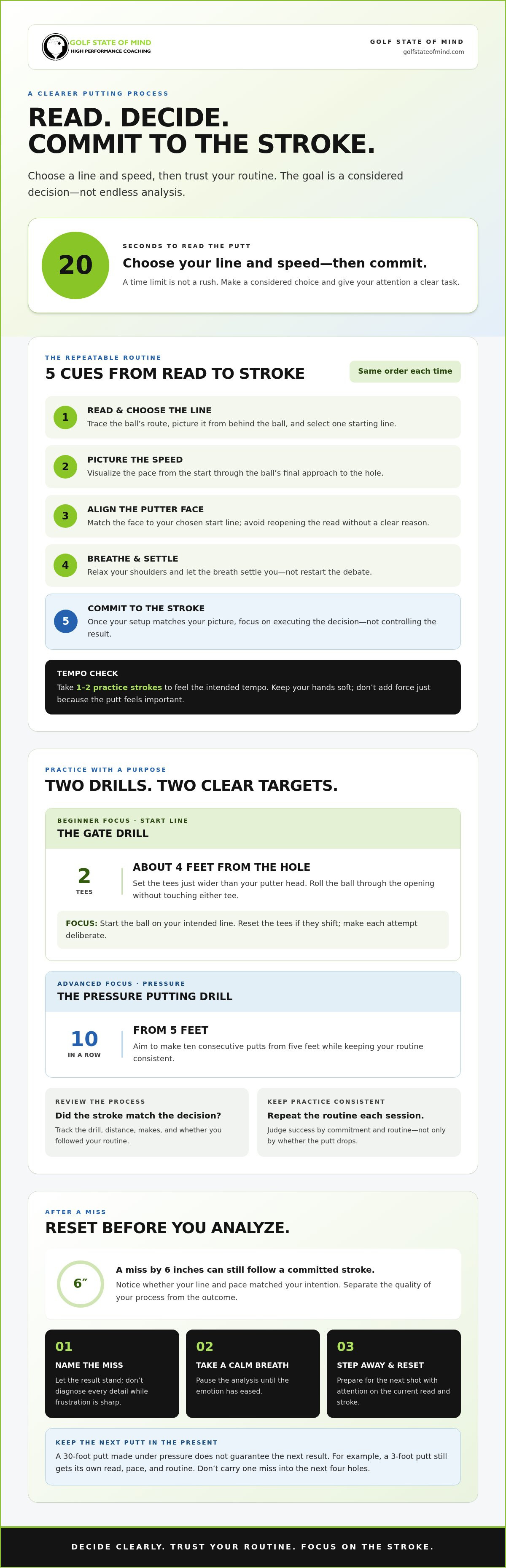
1. The 20-Second Green-Reading Challenge
Purpose: Practise making a clear putting decision without repeatedly second-guessing yourself.
This is a useful exercise for golfers who spend too long analyzing relatively straightforward putts.
The idea is simple: during practice, give yourself approximately 20 seconds to gather the information you need and make a decision.
This is a training constraint, not an official time allowance or a requirement for every putt.
Complex putts may require more information. And you should always respect the Rules of Golf and pace-of-play expectations.
How to Do the Drill
- Choose a putt between approximately six and fifteen feet.
- Stand behind the ball and assess the slope.
- Choose your intended starting line.
- Decide how you want the ball to approach the hole.
- Make your decision within roughly 20 seconds.
- Step into your normal routine and hit the putt without reopening the read.
Start the timing when you’re ready to begin your read, rather than treating it as a race from the moment you arrive at the green.
Repeat with different putts and slopes.
What You’re Training
You’re not trying to prove that your first read is always correct.
You’re practising the ability to make a reasonable decision without requiring complete certainty.
After each putt, ask:
“Did I make a clear decision and commit to it?”
That’s more useful than simply asking whether the ball went in.
Important: If your reads are consistently inaccurate, don’t just read faster. Work on your green-reading skill as well.
2. The One-Read Commitment Drill
Purpose: Stop changing your mind once you’ve selected a line and speed.
Many golfers don’t struggle because they can’t see the break.
They struggle because they don’t trust what they’ve seen.
They choose a line, stand over the ball, and then begin searching for reasons it might be wrong.
The One-Read Commitment Drill trains you to separate decision-making from execution.
How to Do the Drill
- Choose a putt with a noticeable but manageable break.
- Read the putt using your normal method.
- Select a starting line and intended speed.
- Pick a clear starting point or visual reference.
- Once you’ve made the decision, don’t change it while addressing the ball.
- Make your stroke with full commitment.
Afterward, evaluate whether you executed the putt you intended.
If you genuinely discover new information before addressing the ball, you can step away and reconsider.
But don’t make a habit of reopening the decision simply because you feel uncertain.
The Mental Skill
Commitment doesn’t mean knowing your read is perfect.
It means being willing to execute your best decision.
There will always be some uncertainty in putting.
Learning to accept that uncertainty is part of becoming a more confident putter.
3. The Line-and-Speed Visualization Drill
Purpose: Give your mind a clear picture of the putt before you execute it.
One of the mistakes golfers make is treating line and speed as completely separate decisions.
But the amount a putt breaks depends partly on how quickly the ball is travelling.
A putt played firmly may follow a different path from one played more softly.
That’s why I encourage golfers to visualize the complete roll of the ball.
How to Do the Drill
- Choose a putt with some break.
- Stand behind the ball and imagine its path toward the hole.
- Picture the speed at which it will travel.
- Notice how the ball should approach the hole.
- Take one or two practice strokes, if that’s part of your normal routine, to rehearse the intended pace.
- Step in and execute the putt.
Try to make the picture as simple as possible.
You don’t need to imagine every inch of the ball’s journey.
You’re developing a clear intention.
What to Focus On
For some golfers, the most useful image is the ball rolling along a particular path.
For others, it’s the speed of the ball as it approaches the hole.
Experiment during practice and discover which cue helps you commit.
The important thing is to avoid turning visualization into another lengthy analysis exercise.
See the putt. Feel the pace. Commit to the stroke.
4. The Putting Routine Transfer Drill
Purpose: Develop a clear transition from reading the putt to executing it.
This is probably the most important mental putting exercise in the article.
It connects directly to the mental pre-shot routine I teach golfers.
I divide the routine into three phases: Planning, Athletic, and Acceptance.
Planning Phase: Read and Decide
During this phase, gather the information you need.
Read the slope.
Choose your line and speed.
Decide on the putt you’re going to hit.
This is the appropriate time to analyze.
Athletic Phase: Trust and Execute
Once the decision is made, shift your attention toward the intended roll and the feel of the stroke.
You might take a comfortable breath to mark this transition.
Then step in and execute.
Avoid continuing to analyze the break or introducing several mechanical thoughts while standing over the ball.
Acceptance Phase: Respond to the Result
After the putt, acknowledge what happened.
Did you execute the stroke you intended?
Was the read accurate?
Was the pace appropriate?
You can learn from the outcome without becoming emotionally attached to it.
The Drill
Choose five putts from different locations.
For each putt, deliberately move through all three phases.
After each attempt, rate your commitment from one to five.
Don’t base the rating on whether the putt went in.
A missed putt can still receive a five if you made a clear decision and committed fully.
This helps separate the quality of your mental process from the result.
For more on this approach, read my guide to the mental pre-shot routine for golf.
Build More Confidence on the Greens
Download my free mental game ebook to learn practical strategies for improving focus, trusting your decisions, and performing with greater confidence under pressure.
5. The One-Ball Putting Challenge
Purpose: Make putting practice more like the golf course.
On the practice green, golfers often hit several putts from the same spot.
They miss the first one, adjust the line, and make the second.
Then they make the third.
By the end of the exercise, they feel confident.
But on the golf course, you don’t get to repeat the same putt until you’ve learned the line.
You get one attempt.
The One-Ball Putting Challenge helps develop that skill.
How to Do the Drill
- Take one golf ball to the practice green.
- Choose a putt between five and twenty feet.
- Read the putt using your normal process.
- Use your full routine and hit the putt.
- Move to a completely different location for the next attempt.
- Repeat for ten putts.
Each putt should present a different challenge.
Include uphill, downhill, left-to-right, and right-to-left putts.
Change distances regularly.
How to Score It
For each putt, award yourself:
- One point for making a clear line-and-speed decision.
- One point for following your routine.
- One point for committing to the stroke.
That’s a maximum of 30 mental-performance points across ten putts.
You can also record how many putts you made, but keep the two measures separate.
This is a useful way to build confidence in your process rather than becoming dependent on seeing putts go in.
6. The Pressure Putting Commitment Drill
Purpose: Practise making committed strokes when the outcome starts to matter.
It’s easy to feel relaxed when you’re casually rolling putts on the practice green.
But what happens when you have to make one to complete a challenge?
Do you start thinking about missing?
Does your routine change?
Do you become more tentative?
This drill helps you recognize those changes.
How to Do the Drill
- Choose a putt from approximately three to five feet, adjusted to your ability.
- Set a goal of making five putts in a row.
- Use your full routine before every attempt.
- If you miss, restart the count.
- Pay attention to your thinking as you approach the final putt.
The purpose isn’t simply to make five putts.
It’s to practise your routine when the consequences of missing feel greater.
What to Notice
As you approach your target, ask yourself:
- Am I becoming more focused on the result?
- Am I changing my normal routine?
- Am I taking longer because I’m uncertain?
- Am I trying to steer the putter instead of making a committed stroke?
If you notice these patterns, don’t criticize yourself.
Return to your line, speed, and routine.
And make the next stroke.
Pressure training isn’t about learning to feel nothing. It’s about learning to execute your process even when you feel uncomfortable.
Keep the challenge proportionate to your ability. If it becomes so difficult that you’re mainly practising frustration, reduce the distance or the number of consecutive makes.
7. The Miss-and-Reset Putting Drill
Purpose: Improve your emotional response after missed putts.
One of the most important putting skills is learning to recover from disappointment.
Think about how often one missed short putt affects the next few holes.
You become frustrated.
You start questioning your putting stroke.
Then you approach the next putt with less confidence.
That’s a pattern worth changing.
How to Do the Drill
During your putting practice, use the following response whenever you miss:
- Acknowledge: Notice the result without exaggerating it.
- Accept: Remind yourself that the putt is finished.
- Learn: Identify one useful observation, if appropriate.
- Reset: Return your attention to the next putt.
For example:
“That putt started on my intended line but had too much speed. I’ll take that information into the next read.”
Compare that with:
“I can’t believe I missed that. I’m such a terrible putter.”
The first response helps you learn.
The second turns one result into a judgment about your ability.
Use Your Inner Caddy
I encourage golfers to develop what I call their Inner Caddy: a constructive internal voice that helps them respond to challenges.
Your Inner Caddy doesn’t need to tell you every putt will go in.
It simply needs to help you stay focused on what matters.
Useful phrases might include:
- “Good decision. Trust the stroke.”
- “That one’s finished. Next putt.”
- “Choose the pace and commit.”
- “You don’t need certainty to make a good stroke.”
Practise these responses during ordinary putting sessions so they’re familiar when you need them during competition.
How Much Time Should You Spend Reading a Putt?
There’s no single number of seconds that works for every putt.
A relatively straight four-footer may require little analysis.
A long downhill putt with multiple slopes may require more careful assessment.
The goal isn’t to read every putt in exactly 20 seconds.
It’s to avoid spending unnecessary time repeatedly reconsidering information you’ve already gathered.
A Better Rule: Read Until You Have a Plan
Ask yourself three questions:
- Where do I want the ball to start?
- What speed do I want it to have?
- Am I ready to commit to that decision?
Once you’ve answered those questions, move into execution.
If you’re still uncertain because you haven’t assessed an important slope, gather the information you need.
But if you’re simply looking for reassurance that your read is correct, more time may not help.
Remember that the Rules of Golf require players to play without unreasonable delay, and the recommended time for making a stroke is generally no more than 40 seconds once you’re able to play without interference or distraction. That recommendation is not a universal 40-second green-reading allowance.
You can review the official guidance in Rule 5 of the Rules of Golf.
The Difference Between Reading a Putt and Trusting a Putt
This is the distinction I most want you to understand.
Reading a putt is a decision-making skill.
Trusting a putt is a performance skill.
Both matter.
If you don’t read the green accurately, commitment alone won’t guarantee a good result.
But if you make a good read and then abandon it because you’re afraid of missing, you’re not giving yourself the best opportunity to execute.
During practice, develop both skills.
Work on understanding slopes, start lines, and pace.
Then practise making a decision and committing to it.
The goal is not to stop thinking altogether. It’s to think at the appropriate time and then allow yourself to play.
A 20-Minute Mental Putting Practice Session
Here’s how to combine the drills into one focused session.
| Time | Exercise | Mental Focus |
|---|---|---|
| 0–4 minutes | 20-Second Green-Reading Challenge | Make decisions efficiently |
| 4–8 minutes | One-Read Commitment Drill | Stop second-guessing |
| 8–12 minutes | Line-and-Speed Visualization | Create a clear intention |
| 12–16 minutes | One-Ball Putting Challenge | Simulate the golf course |
| 16–20 minutes | Pressure Putting Commitment Drill | Trust the routine under pressure |
Use the Putting Routine Transfer Drill throughout the session.
Whenever you miss, practise the Miss-and-Reset response.
That way, you’re developing your entire mental putting process rather than treating each drill as an isolated task.
How to Measure Improvement in Your Putting Mental Game
Most golfers judge putting practice by the number of putts they make.
That’s useful information, but it doesn’t tell you everything about your mental performance.
I encourage golfers to measure behaviors they can control.
Choose four putting Performance Commitments:
- I will make a clear line-and-speed decision.
- I will follow my normal putting routine.
- I will commit fully to my intended stroke.
- I will accept the result and respond constructively.
After a practice session or round, review how consistently you followed these commitments.
You might discover that you’re excellent at reading putts but often change your mind once you’re standing over the ball.
Or perhaps your routine is consistent until you face a putt for birdie.
Those are specific mental skills you can train.
And they’re more useful than simply telling yourself to become a better putter.
Frequently Asked Questions About Mental Putting Drills
What are the best mental drills for putting?
Useful mental putting drills include the One-Read Commitment Drill, One-Ball Putting Challenge, pressure putting exercises, visualization, and practising a consistent pre-putt routine. The best drill depends on whether you struggle with decisions, commitment, pressure, or emotional recovery.
How do I stop overthinking my putts?
Separate reading from execution. Make a clear line-and-speed decision before addressing the ball, then shift your attention toward the intended roll and stroke. Avoid repeatedly reopening your read because of uncertainty.
Should I limit my green-reading time to 20 seconds?
A 20-second limit can be useful during practice to develop decisiveness. It isn’t a universal rule for every putt. More complex putts may require additional assessment, and players should follow the Rules of Golf and maintain a reasonable pace of play.
How do I trust my putting stroke under pressure?
Practise using the same routine in low-pressure and higher-pressure situations. Make your decisions before addressing the ball, focus on the intended roll, and evaluate commitment separately from whether the putt goes in.
Should I focus on the line or the speed when putting?
Both matter because the ball’s speed affects how much it breaks. Choose a line and speed that work together, then use a simple cue that helps you execute the intended roll.
How can I recover mentally after missing a short putt?
Acknowledge the miss, avoid turning it into a judgment about yourself, and identify one useful observation if appropriate. Then return your attention to the next shot and your normal routine.
Can visualization help my putting?
Visualization can help you form a clear intention for the putt. Picture the ball travelling along your chosen path at the intended speed, then make a committed stroke. Keep the visualization simple enough that it supports rather than complicates your routine.
How can I practise putting under pressure?
Create achievable challenges, such as making five short putts in a row or completing a one-ball putting circuit. Notice how your thinking and routine change as the challenge becomes more important, then practise returning to your process.
Final Thoughts: Make the Decision, Then Trust It
Good putting requires more than a technically sound stroke.
It requires the ability to read the green, make a decision, and commit to that decision without becoming distracted by the possibility of missing.
If you tend to spend too long reading putts, don’t simply try to hurry.
Develop a better process.
Gather the information you need.
Choose your line and speed.
Visualize the intended roll.
Then move from analysis into execution.
And once the putt is finished, accept the result and learn what you can.
Confident putting isn’t about knowing the ball will go in. It’s about trusting yourself to make a clear decision and execute it.
Start with the One-Read Commitment Drill during your next practice session, and notice how often you can make a decision without second-guessing yourself.
Develop a More Confident Putting Mindset
Download my free mental game ebook for practical strategies to improve focus, manage pressure, and build a more consistent mental routine on the greens and throughout your round.
Free Mental Game of Putting Course
