

The Mental Pre-Shot Routine for Golf: How to Plan, Commit & Play Every Shot
Why can you stand on the driving range and swing freely, yet find yourself thinking about your swing, worrying about the outcome or struggling to commit when you’re on the golf course?
Your swing hasn’t suddenly changed.
What has changed is what’s happening in your mind.
On the range, there is usually very little consequence attached to each shot. But on the course, every shot counts. There are hazards to avoid, scores to protect and expectations to live up to. That can easily shift your attention away from the shot you want to hit and toward everything you don’t want to happen.
A good mental pre-shot routine helps you make that shift in the other direction.
It gives you a repeatable process for making a clear decision, committing to that decision and then allowing yourself to play the shot without unnecessary interference.
But there’s another part of the routine that’s just as important: what you do after the ball has left the clubface.
That’s why I like to think about every golf shot as having three distinct phases:
Planning Phase → Athletic Phase → Acceptance Phase
Or, more simply:
Plan the shot. Play the shot. Accept the shot.
Let’s look at each phase and how you can use them to play with greater commitment and freedom.
Why Your Pre-Shot Routine Is More Than a Physical Routine
When golfers talk about their pre-shot routine, they often describe what they physically do before hitting the ball.
One practice swing. Stand behind the ball. Pick an intermediate target. Walk in. Waggle twice. Look at the target. Swing.
There’s nothing wrong with having a consistent physical routine. In fact, it can be very helpful.
But the physical movements aren’t really the point.
The purpose of your routine is to get your mind ready to hit the shot.
You can perform exactly the same physical routine before every shot and still be thinking:
Don’t hit it left.
Keep your head down.
I need to make par here.
Why did I hit that shot on the last hole?
Don’t make another double.
In that situation, you have a physical routine, but you don’t necessarily have an effective mental pre-shot routine.
The mental routine is about managing your attention.
It helps you move from thinking and deciding to trusting and playing.
And once the shot has been hit, it helps you accept what happened and move forward.
The Three Phases of a Mental Pre-Shot Routine
One of the biggest mistakes golfers make is trying to think and play at the same time.
There is a time for analysis in golf. You need to consider the lie, wind, yardage, hazards, target, club and type of shot you’re going to play.
But you don’t want to still be solving those problems while you’re standing over the ball.
That’s why it helps to separate every shot into three phases.
1. The Planning Phase
The purpose of the Planning Phase is to make a clear decision about the shot you’re going to play.
This is where thinking belongs.
Before walking into the ball, assess the situation in front of you.
- What’s the lie?
- What’s the wind doing?
- Where is the trouble?
- Where is your target?
- What shot gives you the best chance of achieving the outcome you want while accounting for your normal dispersion?
Then make a decision.
This is important because indecision is one of the biggest causes of poor commitment.
You’ve probably experienced standing over the ball while part of you is thinking:
Maybe this isn’t enough club.
Or:
Perhaps I should aim farther right.
Or:
I’m not sure about this shot.
It’s very difficult to make a committed athletic swing when you haven’t made a committed decision.
So take as much thinking as possible out of the Athletic Phase by doing it here.
See the Shot Before You Play It
Once you’ve made your decision, create a clear intention for the shot.
Where do you want the ball to start?
What shape do you want to see?
Where do you want it to finish?
Some golfers naturally see a very vivid image of the ball flight. Others get more from feeling the swing or imagining the trajectory and target without literally seeing a detailed picture.
Don’t worry about whether you’re “visualizing correctly.”
The purpose is simply to connect your mind with what you want to happen.
That’s very different from standing behind the ball imagining what you’re trying to avoid.
Instead of:
Don’t hit it in the water.
Your attention is on:
That’s my target. That’s the shot I’m going to play.
When you have made your decision and you’re ready to trust it, the Planning Phase is finished.
Now it’s time to become an athlete.
2. The Athletic Phase
The Athletic Phase begins when you move toward the ball with the intention of playing the shot you’ve just planned.
This is where many golfers get into trouble.
They make a perfectly good decision behind the ball, but as soon as they address it, their attention turns inward.
They start thinking about:
- their takeaway
- their backswing position
- their grip
- their shoulder turn
- their transition
- where the clubface is
- what happened on the previous swing
In other words, they go from playing golf to controlling a golf swing.
Your goal in the Athletic Phase is different.
Connect with the target, trust what you’ve trained and react.
You have already made the decision.
Now you’re giving your athletic ability the best opportunity to execute it.
Keep Your Attention External
A useful question is:
What am I connected to when I’m over the ball?
Ideally, your attention is connected to something relevant to the shot rather than being consumed by conscious swing control.
That might be:
- the target
- the intended ball flight
- the rhythm of the shot
- the feel of the shot you rehearsed
- an intermediate target
- the speed and line of a putt
Different players perform best with slightly different attentional cues.
The important distinction is that you’re no longer trying to solve the shot.
You’re playing it.
What If You Don’t Feel Committed?
Back away.
This is one of the simplest but most valuable habits you can develop.
If you address the ball and suddenly think:
This doesn’t feel right.
I’m not sure about the club.
The wind has changed.
I’m uncomfortable with this target.
Don’t force yourself to hit the shot simply because you’ve already started your routine.
Step away.
Return to the Planning Phase, make another clear decision and begin again.
Backing away isn’t weakness or indecision.
Hitting a shot you aren’t committed to is the bigger mistake.
3. The Acceptance Phase
The moment the ball leaves the clubface, you lose control over the outcome.
That’s an important distinction.
Before the shot, you control your preparation, decision, attention and commitment.
You can influence the quality of your execution.
But once you’ve hit it, you can’t bring the ball back.
Golf now gives you a new task:
Accept what happened and prepare yourself for the next shot.
This is the Acceptance Phase.
And it’s one of the most overlooked parts of a golfer’s routine.
Acceptance Doesn’t Mean You Have to Like the Shot
You’re going to hit bad shots.
You’re going to make mistakes.
You’re going to get bad bounces.
You’re going to hit good shots that finish in bad places and poor shots that somehow finish next to the hole.
Acceptance doesn’t mean pretending you aren’t disappointed.
And it doesn’t mean you have to feel calm all the time.
You will experience thoughts and emotions during a round of golf.
The skill is learning to notice them without allowing them to dictate what happens next.
You might feel frustrated after a poor drive.
That’s okay.
But there’s a difference between experiencing frustration and feeding it for the next three holes.
The Acceptance Phase is your opportunity to acknowledge what happened, respond intentionally and then return your attention to the present.
If reacting to mistakes is one of the biggest challenges in your game, learning better emotional control on the golf course can make a significant difference to what happens after a poor shot.
Separate the Shot From Your Identity
Be particularly careful about the story you attach to a bad shot.
There’s a big difference between:
That was a poor shot.
and:
I’m terrible today.
One describes an event.
The other turns an event into a judgment about you and your game.
That judgment can quickly affect confidence, decision-making and emotional state.
A shot is simply information.
You can review it later and decide whether there’s something to learn from it.
But on the golf course, your priority is getting yourself ready to give the next shot your full attention.
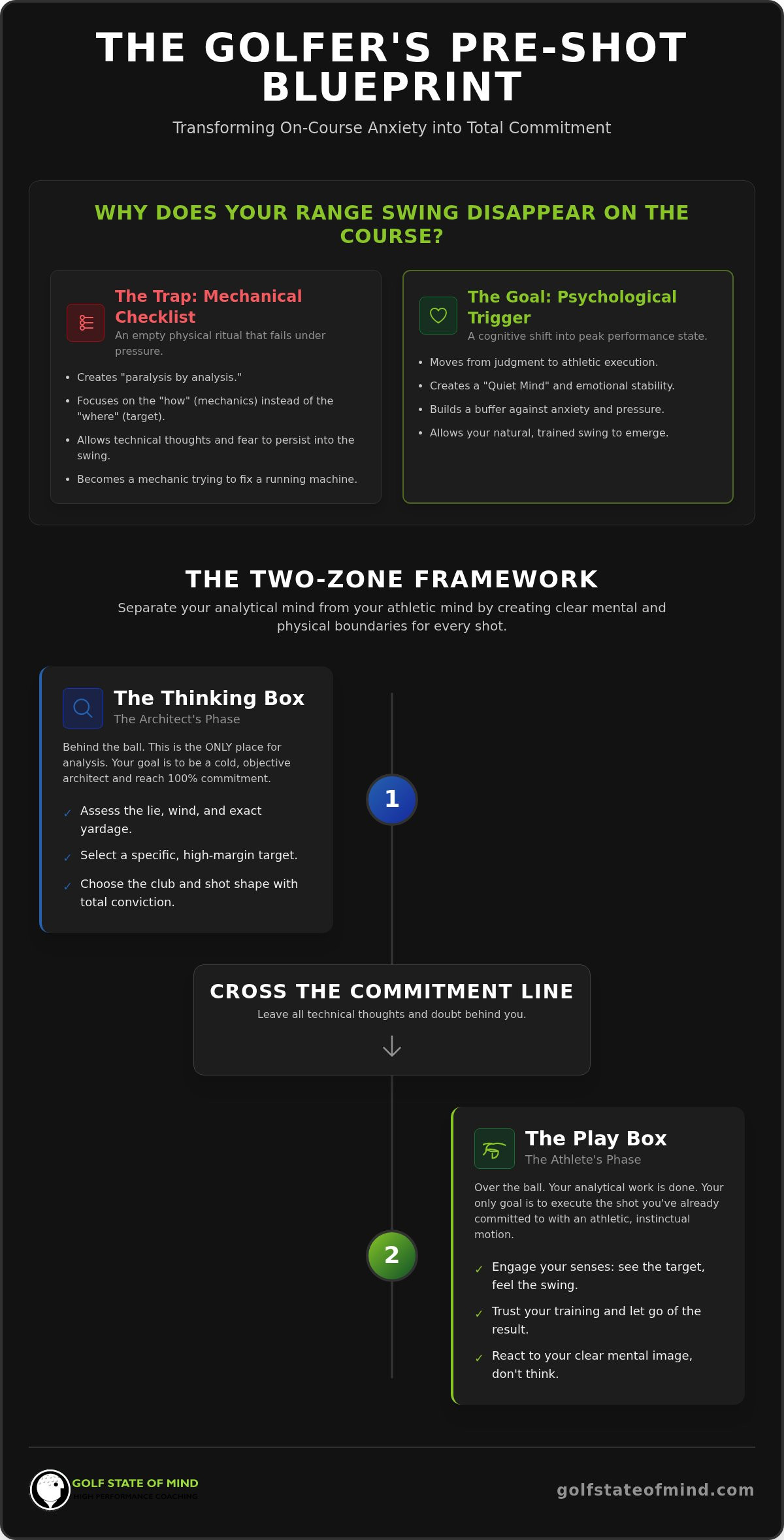
Your Mental Pre-Shot Routine Template
Here’s a simple template you can begin experimenting with.
Planning Phase
1. Assess
Take in the relevant information: lie, yardage, wind, hazards and conditions.
2. Decide
Choose the target, club and shot. Make the decision as clear as possible.
3. See and feel
Picture the intended shot or connect with the feel and trajectory you’re trying to produce.
4. Commit
Once you’ve made your decision, trust it. Then move into the Athletic Phase.
Athletic Phase
5. Connect
Keep your attention on the target, intended shot or another external cue that helps you play instinctively.
6. Trust
Allow the swing you’ve trained to happen rather than consciously trying to control every movement.
7. Execute
React to the target and play the shot.
Acceptance Phase
8. Notice
Observe your initial reaction without immediately judging yourself.
9. Accept
The shot has happened. Whether you like the result or not, you can’t change it.
10. Reset
Return your attention to the present and begin preparing for the next shot.
The routine doesn’t have to look exactly the same for every golfer.
What’s important is the mental sequence:
Plan → Commit → Play → Accept → Reset.
Don’t Judge Your Routine by Where the Ball Goes
This may be the most important part of the entire process.
A good mental routine does not guarantee a good golf shot.
You can choose the right target, make a clear decision, visualize exactly what you want, feel completely committed and make a free swing…
…and hit it into the trees.
That’s golf.
If you judge the quality of your mental process entirely by the result, you’ll eventually abandon good processes whenever they don’t produce immediate rewards.
Instead, learn to separate execution of your process from outcome.
After a shot, ask yourself:
- Did I make a clear decision?
- Was I committed to the shot?
- Was my attention where I wanted it when I swung?
- Did I accept the outcome and reset?
Those are much better measures of mental performance.
Over time, consistently doing those things gives your physical game the best opportunity to show up when it matters.
Want to Build a Stronger Mental Game?
I’ve put together a free mental game ebook to help you become a more confident, focused and resilient golfer.
How to Practice Your Mental Pre-Shot Routine
Don’t wait until your next tournament to start using this.
Your mental routine needs practice just like your golf swing does.
Unfortunately, the way many golfers practice encourages almost the exact opposite.
They stand in one place and hit ball after ball with the same club toward the same target.
There’s very little decision-making and very little consequence.
Then they go to the course and suddenly every shot requires a new decision.
Try making part of your practice look more like golf.
One Ball, One Routine
Instead of dragging another ball across immediately after hitting a shot, step away.
Choose a new target.
Go through your Planning Phase.
See the shot.
Commit.
Walk in.
Play it.
Then practice your Acceptance Phase before beginning again.
You don’t need to hit your entire bucket this way.
Even 10–15 balls at the end of a practice session can help you train the transition from planning to playing.
Change Clubs and Targets
Create variability.
Hit a driver to one target.
Then imagine a 145-yard approach.
Then a 70-yard wedge.
Then another tee shot.
Every shot requires you to gather new information, make a new decision and commit again.
That’s much closer to what golf actually asks you to do.
Add Pressure to Your Practice
Once your routine becomes familiar, test it.
Create challenges where the result matters enough to generate some emotion.
For example, give yourself one ball to hit a fairway.
Or create a nine-shot challenge where every shot has a different target and club.
But here’s the important part:
Don’t only score the ball flight. Score your mental performance as well.
Did you follow your routine?
Did you commit?
Did you stay athletic?
Did you accept the result?
This teaches you that success isn’t simply hitting good shots.
Success also means executing your process when you’re uncomfortable.
That’s the skill you’ll need under pressure.
If pressure tends to change the way you think or swing, you might also find my guide on how to stop choking in golf useful.
Your Routine Should Create Freedom, Not More Thinking
Be careful not to turn your mental routine into another checklist that makes golf harder.
You don’t want to stand over the ball thinking:
Okay, I’ve visualized. Now breathe. Now commitment. Now external focus. Now swing.
That’s just another form of overthinking.
With practice, the routine should become increasingly natural.
The Planning Phase gives you clarity.
The Athletic Phase gives you freedom.
The Acceptance Phase helps you move forward.
Ultimately, you’re trying to arrive over the ball with very little left to do.
You’ve made the decision.
You know what you’re trying to do.
You’re committed.
Now play.
The Pre-Shot Routine Is Only One Part of Your Mental Game
Your routine is one of the most important mental skills you can develop, but it doesn’t exist in isolation.
How well you commit to shots is influenced by your expectations, confidence, emotional state, focus and how much importance you’re placing on the outcome.
For example, if you’re standing on the 18th tee thinking that you have to make par to shoot your best score, simply telling yourself to “commit to the routine” might not be enough.
You also need to understand why that outcome has suddenly become so important and how to keep your attention on what you can actually control.
That’s why mental game training should go beyond individual tips and techniques.
You’re developing a set of skills that help you respond effectively to everything a round of golf can throw at you.
The pre-shot routine is where many of those skills come together.
Learning how to focus during a golf round can also help you understand where your attention should be during the periods between shots, rather than trying to concentrate intensely for four or five hours.
Start With Three Simple Questions
If you want to improve your mental pre-shot routine, don’t try to change everything at once.
During your next round, start by asking yourself three questions:
Before the shot:
Have I made a clear decision about what I’m trying to do?
Over the ball:
Am I thinking about how to swing, or am I connected to the shot I’m about to play?
After the shot:
Can I accept this result and give my full attention to the next one?
Remember:
Plan the shot. Play the shot. Accept the shot.
Do that more consistently and you’ll give yourself a much better opportunity to access the game you already have when the score matters.
Frequently Asked Questions
What is the most important part of a mental pre-shot routine?
Commitment is one of the most important goals of the routine. You want to make a clear decision before addressing the ball so that you’re not still debating the shot while trying to execute it.
The routine should help you move from thinking and planning into trusting and playing.
How long should my golf pre-shot routine take?
There isn’t one perfect length.
What’s more important is that the routine has a natural rhythm and gives you enough time to gather the information you need, make a decision and become committed without unnecessarily delaying the shot.
Don’t become obsessed with making your routine exactly the same number of seconds every time.
What should I think about when I’m standing over the golf ball?
Generally, you want to avoid filling your attention with several technical swing instructions.
Instead, experiment with connecting your attention to the target, intended ball flight, rhythm, feel or another cue that allows you to swing athletically.
The goal isn’t necessarily to have no thoughts.
It’s to put your attention somewhere that helps rather than interferes.
What should I do if I have doubt over the ball?
Back away.
If you’re genuinely uncertain about the club, target or shot you’ve chosen, return to the Planning Phase and make another decision.
You don’t earn anything for hitting a shot you weren’t committed to.
Should I use the same routine for putting?
The same three phases apply:
Planning → Athletic → Acceptance.
The details will change.
During the Planning Phase you’ll assess line and speed rather than wind and club selection. During the Athletic Phase you might connect more strongly with the intended starting line, target or feel of the speed.
But the mental objective remains the same: make the decision before you try to execute it.
Can a pre-shot routine stop me getting nervous?
The goal isn’t to eliminate nerves.
Trying to make yourself feel calm before you’re allowed to hit the shot can actually create another problem.
You can feel nervous and still make a clear decision, commit to a target and make an athletic swing.
Your routine gives you something useful to direct your attention toward when pressure increases.
You can also read more about dealing with first tee nerves.
How do I stop thinking about my golf swing during my routine?
Give technical work its proper place: the practice ground.
On the course, use the Planning Phase to decide what you’re trying to do and the Athletic Phase to allow your trained movement to produce it.
If you notice yourself becoming increasingly technical over the ball, step away when necessary, reconnect with the shot and begin again.
Why do I hit the ball better on the range than on the golf course?
On the range, individual shots usually have very little consequence. On the course, golfers become more attached to the outcome.
That can create extra thinking, tension, fear and an urge to control the swing.
A strong mental pre-shot routine won’t guarantee the same ball striking you experience on the range, but it can help you create the conditions for freer, more committed execution when the result matters.
Take Your Mental Game Further
A strong pre-shot routine gives you a process you can return to before and after every shot.
But becoming a better mental player also means learning how to manage expectations, build confidence, respond to mistakes, stay present and perform when the outcome matters to you.
If you’d like to work on those skills, I’ve created a free mental game ebook that you can start using today.
Click here to get your free mental game ebook
Get your FREE Mental Game Scorecard
