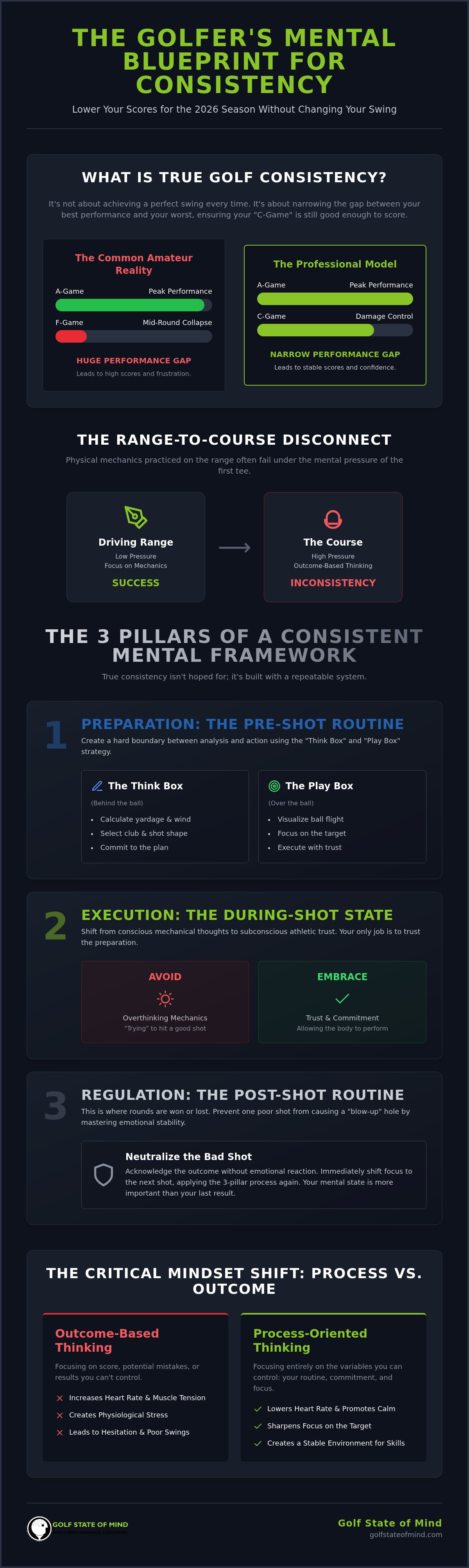
Every golfer wants to become more consistent.
But consistency in golf is often misunderstood.
It doesn’t mean hitting every fairway, striking every iron perfectly or shooting the same score every time you play.
That’s not realistic.
Even the best players in the world have days when their timing feels different, their ball striking isn’t as sharp and certain parts of their game aren’t working particularly well.
The difference is that good players become increasingly consistent in how they respond to those inevitable variations.
They make better decisions.
They commit to their shots.
They use their routines.
They respond better to mistakes.
They adapt to the game they have that day instead of spending 18 holes searching for the game they wanted to have.
This is where your golf consistency mental game becomes so important.
If you want to learn how to be more consistent in golf, don’t just ask how you can make your swing more repeatable.
Ask how you can make your behaviors more repeatable.
That’s what we’re going to explore in this guide.
Key Takeaways
- Golf consistency doesn’t mean playing your best every time you tee it up.
- Your physical game will vary from day to day, but your mental processes can become more consistent.
- Don’t judge your consistency solely by score or ball striking.
- A repeatable pre-shot and post-shot process can reduce unnecessary mental errors.
- Learn to play with the game you have today instead of constantly trying to fix it.
- Practice should include decision-making, routines, consequence and one-ball performance.
- Use a Mental Scorecard to measure the behaviors you can influence.
- The goal isn’t perfection. It’s reducing the difference between your good days and your difficult ones.
What Does Consistency in Golf Really Mean?
Most golfers define consistency through outcomes.
They want to hit the ball well every round.
They want their scores to stay within a narrow range.
They want yesterday’s swing to feel exactly the same today.
The problem is that golf contains too many variables for that definition of consistency to be realistic.
Your body feels different.
Your timing changes.
The weather changes.
The course changes.
Your confidence changes.
Some days you see the shot clearly. Other days you don’t.
That’s part of playing golf.
Consistency Doesn’t Mean Perfection
A more useful definition of consistency is:
How consistently can you do the things that give you the best chance of playing well?
Can you make good decisions?
Can you commit to your target?
Can you use your routine?
Can you respond well after mistakes?
Can you stay patient when the ball isn’t going where you want it to?
Can you keep playing instead of spending the round fixing your swing?
Those are areas where greater consistency is possible.
Raise Your Floor, Not Just Your Ceiling
Golfers spend a lot of time trying to improve their best golf.
But becoming a more consistent golfer also means improving what happens when you don’t have your best game.
Imagine your best round is 72.
The question isn’t only:
“How do I shoot 70?”
It might also be:
“How do I stop the rounds that could have been 78 from becoming 84?”
That’s where the mental game can have an enormous influence.
Want to build a more consistent mental game? Download my free ebook, 7 Key Mental Strategies, and learn practical strategies to improve your confidence, focus and performance on the golf course. Get the Free Ebook
Why Does Golf Feel So Inconsistent?
One reason golf can feel so inconsistent is that golfers often judge the quality of their game by their most recent shots.
You hit five good drives and then one terrible one.
Suddenly:
“My driver has gone.”
You miss two short putts.
Now:
“I can’t putt today.”
You make a double bogey.
Now the entire round feels as though it’s slipping away.
The problem isn’t necessarily the mistake itself.
It’s what happens next.
Golfers React to Inconsistency by Trying to Create More Control
When something feels wrong, the natural reaction is to try harder to control it.
You start thinking more about your swing.
You become more careful.
You search for the feeling you had yesterday.
You make adjustments after every poor shot.
Eventually you’re playing golf swing instead of playing golf.
Ironically, the attempt to become more consistent can make you less consistent.
Separate Training From Playing
There is a time to work on technique.
That’s what technical practice and lessons are for.
But when you’re playing, your objective changes.
You’re no longer trying to build a golf swing.
You’re trying to use the golf swing you brought with you that day to get the ball around the course in as few shots as possible.
That distinction is extremely important.
The Golf Consistency Mental Game
If physical performance naturally varies, what can become consistent?
Your process.
I like players to think about several areas:
- Preparation: How do you prepare before you play?
- Decision-making: How do you choose your target and shot?
- Commitment: How well do you commit to that decision?
- Attention: Where is your focus before and during the shot?
- Response: What happens mentally after the ball is hit?
- Between shots: Can you switch off rather than continually analyzing your game?
These behaviors create the foundation of a strong golf consistency mental game.
Consistency Comes From Behaviors
This changes the question you ask yourself.
Instead of:
“Why can’t I hit it consistently?”
you can ask:
“How consistent was I with my process today?”
That’s a question you can actually do something about.
Play the Game You Have Today
This is one of the most important skills in golf.
Golfers often arrive at the course with an expectation of how they should play.
Perhaps you hit it beautifully yesterday.
So you expect the same today.
Then you hit several poor shots early in the round and frustration appears.
“Where has my swing gone?”
Now you’re searching.
Your Job Is to Adapt
Instead of fighting the game you have, learn from it.
If you’re hitting the ball slightly shorter than usual, adapt your club selection.
If your normal shot shape isn’t appearing, adjust your strategy.
If you don’t feel particularly confident, don’t make confidence a requirement for commitment.
Your responsibility isn’t to produce your ideal game every day.
It’s to make the best decisions you can with the game you have.
Stop Trying to Recreate Yesterday
This is particularly important after a great round.
Golfers frequently arrive the next day trying to recreate the same feelings.
They ask:
“What was I doing yesterday?”
Now they’ve turned an instinctive performance into something they’re consciously trying to reproduce.
Yesterday is useful evidence of what you’re capable of.
It isn’t a set of feelings you have to recreate.
Start again.
Build a Consistent Pre-Shot Process
Your pre-shot routine is one of the most important tools for developing greater mental consistency.
But I don’t think the objective is to make every routine identical down to the second.
The objective is to make the purpose of the routine consistent.
Gather Information
Before the shot, determine the information you need.
That might include:
- Distance.
- Wind.
- Lie.
- Elevation.
- Hazards.
- Where the best miss is.
- What the situation requires.
Then make a decision.
Choose the Shot
What are you trying to do?
Choose:
- Your target.
- Your club.
- Your intended shot.
Once you’ve made the decision, continually reopening it usually doesn’t help.
Move From Thinking to Playing
At some point, analysis has to stop.
You’ve gathered the information.
You’ve made the decision.
Now your attention needs to move toward execution.
See the target.
Feel the shot.
Commit.
Play.
That transition is one of the most important parts of a consistent pre-shot process.
Develop a Better Post-Shot Routine
You cannot control exactly where every golf shot finishes.
But you can become much more consistent in what you do afterward.
This matters because golfers rarely destroy rounds with one poor shot.
The bigger damage often comes from the reaction.
Separate the Shot From Your Reaction
Suppose you hit a drive into the trees.
The shot costs you something.
But then you become angry.
You rush the recovery.
You attempt an unrealistic shot through a tiny gap.
You make double or triple.
Now the original mistake has multiplied.
Mental consistency means becoming better at preventing that multiplication.
Use the Post-Shot Routine to Learn and Reset
After the shot:
- Notice your initial reaction.
- Take any useful information from what happened.
- Accept the result.
- Allow the emotional reaction to settle.
- Return your attention to the next task.
You don’t have to pretend the shot was good.
You simply don’t want to keep playing it after it’s finished.
Stop Chasing Consistency Through Score
Score matters.
Golf is ultimately a scoring game.
But score is a poor short-term measure of whether you’re becoming mentally more consistent.
You can execute your process extremely well and get a terrible bounce.
You can hit a poor shot and get a wonderful result.
That’s golf.
Don’t Let Score Determine Your Mental State
A common pattern is:
Good score → confidence → commitment → freedom.
Then:
Bad score → doubt → increased control → tension.
If your mental state continually follows your score, your golf will always feel volatile.
The goal is to become increasingly committed to your process whether you’re two under or six over.
Use a Mental Scorecard
One of my favorite tools for improving the golf consistency mental game is a Mental Scorecard.
Instead of only recording your strokes, track the mental behaviors you’re trying to improve.
What Should You Measure?
You might measure:
- Commitment.
- Pre-shot routine.
- Target focus.
- Acceptance.
- Response to mistakes.
- Staying present.
Don’t try to measure everything at once.
Choose one or two areas that are particularly important to your game.
Measure Execution, Not Outcome
Imagine you hit a committed seven-iron directly at your target and a gust of wind pushes it into a bunker.
From a traditional scoring perspective, the shot may have created a difficult situation.
From a mental execution perspective, you may have done your job extremely well.
Conversely, you might hit a tentative shot that takes a fortunate bounce and finishes six feet from the hole.
The outcome was good.
The process wasn’t.
Learning to distinguish between those two things is essential for developing a more stable mental game.
Want more practical strategies for building a stronger mental game? Download my free 7 Key Mental Strategies ebook and learn how to improve your confidence, focus and ability to perform under pressure. Download the Free Ebook
Practice for Consistency
If you want your mental game to become more consistent on the course, you need to practice the behaviors you want to use there.
That doesn’t mean traditional practice is useless.
Repetition can be very valuable when you’re developing or changing a technical skill.
But at some point, you need to practice playing golf.
Move From Block Practice to Performance Practice
After completing your technical work, make part of your practice more representative of the course.
Change:
- Club.
- Target.
- Distance.
- Shot shape.
- Lie when possible.
Use one ball.
Go through your routine.
Make a decision.
Hit the shot.
Then create a different problem.
Play the Course on the Range
This is a simple exercise I like.
Imagine the first hole at a course you know.
Hit the tee shot.
Based on where that shot would have finished, decide what your next shot would be.
Then play the second hole.
Continue through the course.
You’re now practicing:
- Decision-making.
- Changing clubs.
- Changing targets.
- Pre-shot routines.
- Responding to imperfect shots.
That’s much closer to what golf actually asks you to do.
Add Pressure and Consequence
Performance changes when something matters.
So occasionally create practice situations where there is something at stake.
You might need to:
- Hit three out of five fairways before leaving.
- Get a certain number of balls up and down.
- Hole a sequence of short putts.
- Compete against another player.
- Beat your previous score in a practice game.
The point isn’t to make practice stressful all the time.
It’s to learn what happens to your thinking, routine and commitment when the outcome begins to matter.
How to Be More Consistent in Golf
If you want to become a more consistent golfer, don’t make your goal:
“I need to hit the ball consistently today.”
That’s too dependent on outcomes.
Instead, create consistency around your behaviors.
Before Your Round
- Decide what mental process you’re working on.
- Set one or two process goals.
- Warm up to prepare rather than to prove that you’re swinging well.
During Your Round
- Gather the information you need.
- Make clear decisions.
- Commit to the shot you’ve chosen.
- Use your routine.
- Accept the result.
- Reset before the next shot.
After Your Round
- Record the positives.
- Review your Mental Scorecard.
- Identify where your process broke down.
- Choose something specific to practice.
Then repeat the process.
The Real Secret to Golf Consistency
The irony of golf consistency is that you become more consistent when you stop demanding consistent outcomes.
Your swing will vary.
Your confidence will vary.
Your score will vary.
That’s unavoidable.
But your preparation can become more consistent.
Your decision-making can become more consistent.
Your commitment can become more consistent.
Your response to mistakes can become more consistent.
Your practice can become more intentional.
That’s the foundation of a strong golf consistency mental game.
Don’t try to become the golfer who never hits bad shots.
Become the golfer who knows what to do when they happen.
Don’t try to feel exactly the same every day.
Learn to play well with different feelings.
And don’t judge the quality of your mental game solely by the number on the scorecard.
Become more consistent in the things you control and give the score a chance to follow.
Frequently Asked Questions
How can I be more consistent in golf?
Focus on making your process more consistent rather than trying to produce identical results. Develop repeatable habits around preparation, decision-making, commitment, your pre-shot routine and your response to mistakes. Your physical performance will naturally vary, but these behaviors can become increasingly stable.
Why am I so inconsistent at golf?
Golf is inherently variable, so some inconsistency is normal. Problems often become worse when golfers react to poor shots by changing their swing, becoming more technical, losing commitment or allowing frustration to influence subsequent decisions. Look at both your physical game and your mental responses before deciding what needs improvement.
Is golf consistency mental or physical?
It’s both. Your technical skills determine the shots you’re capable of hitting, while your mental skills influence how effectively you access those skills on the course. Improving your swing can increase your physical capabilities, while improving your mental game can help you use those capabilities more consistently.
How does the mental game improve golf consistency?
A stronger mental game can help you make better decisions, commit more fully, stay focused on relevant information, respond better to mistakes and avoid unnecessary technical adjustments during a round. These behaviors can reduce the mental errors that often turn a few poor shots into a poor round.
Why do I play well on the range but inconsistently on the course?
The range and golf course create different demands. On the range, you may hit multiple shots with the same club without consequence. On the course, you get one attempt, continually change clubs and targets, make strategic decisions and keep score. Adding one-ball, random and consequence-based practice can help make practice more representative of playing.
What should I focus on to play more consistent golf?
Focus on your target, decision, commitment and routine rather than trying to consciously control the outcome. Between shots, allow your attention to relax rather than continually analyzing your swing or score. After poor shots, take useful information from what happened and then move on.
What is a Mental Scorecard in golf?
A Mental Scorecard measures the quality of your mental execution rather than simply your strokes. You might track commitment, routine, target focus, emotional response or another behavior you’re developing. It helps separate the quality of your process from the outcome of individual shots.
Should I use the same pre-shot routine on every golf shot?
The exact timing and physical movements don’t need to be identical, but the purpose of the routine should be consistent. Gather the necessary information, make a clear decision, establish your target and intention, then transition from analysis into execution.
How do I stay consistent after a bad hole?
Avoid making the next hole responsible for fixing the previous one. Review anything useful from what happened, accept that the strokes are already on the scorecard and return your attention to the next decision. Your goal isn’t to get the shots back immediately; it’s to execute the next shot well.
How should I practice for more consistent golf?
Use a combination of technical practice and performance practice. Once you’ve completed your technical work, introduce changing clubs and targets, one-ball drills, your full routine, scoring games and consequence. This helps you practice the decision-making and mental skills required on the course.
Can a golf mental coach help me become more consistent?
A golf mental coach can help identify the behaviors and thought patterns contributing to inconsistent performance and develop practical strategies around focus, routines, confidence, emotional response, decision-making and practice. Mental coaching won’t eliminate physical variability, but it can help you respond to that variability more effectively.