
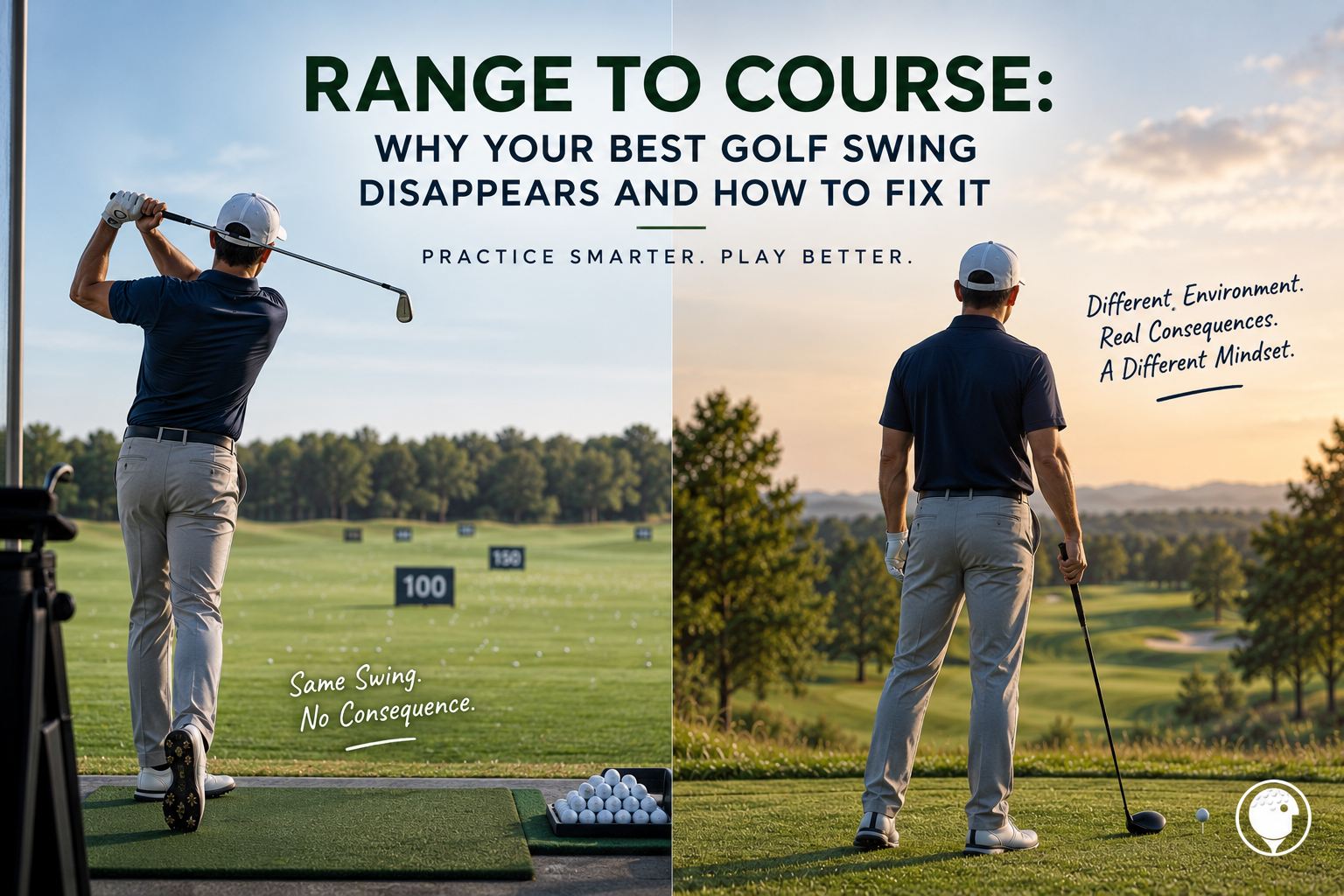
Range to Course: Why Your Best Golf Swing Disappears and How to Fix It
You’ve probably experienced it.
You hit the ball beautifully on the range.
Your swing feels free. Contact is good. You’re seeing the ball flight you want.
Then you walk to the first tee and suddenly everything feels different.
The swing that seemed automatic 20 minutes earlier feels difficult to find.
You start thinking more.
You become aware of trouble.
Your body feels tighter.
And after a couple of poor shots, you start wondering:
“Where did my swing go?”
This is one of the most common challenges in the range to course golf mental game.
It doesn’t necessarily mean your swing has suddenly disappeared.
The range and the golf course simply ask you to perform under very different conditions.
On the range, there’s another ball waiting.
On the course, there’s one ball, one opportunity and a consequence attached to the result.
The solution isn’t necessarily to hit more balls.
You need to become better at practicing the skills required to play golf — decision-making, commitment, routines, target focus, acceptance and performance under consequence.
Key Takeaways
- The range and golf course are different performance environments.
- Hitting balls well in repetitive practice doesn’t automatically mean you’ll access the same performance on the course.
- Technical practice and performance practice serve different purposes, and you need both.
- Use one ball, change clubs and targets, and go through your routine to make practice more representative of golf.
- Pressure often makes golfers more conscious of their swing and more concerned about avoiding mistakes.
- Your pre-shot routine should help you move from analysis to commitment and execution.
- Don’t use your warm-up as a prediction of how you’re going to play.
- Practice with consequence so the course isn’t the only place where individual shots matter.
- Measure commitment and process as well as the outcome of each shot.
Why Does Your Golf Swing Feel Different on the Course?
The most obvious difference is consequence.
Imagine hitting a seven-iron on the range.
You hit the first one poorly.
What happens?
You pull another ball across.
Perhaps you make a rehearsal.
You hit another seven-iron.
Then another.
By the fourth or fifth ball, you’ve adjusted to the club, target and movement.
Now compare that with the golf course.
You have 158 yards to the flag.
There’s water short and right.
You haven’t hit a seven-iron for 25 minutes.
You get one attempt.
Then whatever happens becomes part of your score.
That’s a completely different task.
The Golf Course Requires More Than Ball-Striking
On the course, you’re constantly having to:
- Assess different lies.
- Calculate distances.
- Account for wind and conditions.
- Choose clubs.
- Choose targets.
- Decide between different shots.
- Commit to those decisions.
- Respond to the previous shot.
- Handle consequence.
And you have to do all of that before you even swing the club.
This is why improving the range to course golf mental game requires more than simply improving your technique.
The Range Can Give You an Illusion of Improvement
There’s nothing wrong with hitting the same club repeatedly.
If you’re working on a technical change, repetition can be extremely useful.
But there’s an important distinction:
Getting better at a drill isn’t necessarily the same as getting better at playing golf.
You Get Another Attempt Immediately
Hit ten seven-irons in a row and every swing contains information from the one immediately before it.
You know how the club feels.
You know the target.
You know the distance.
You can make tiny adjustments from shot to shot.
Eventually, you may find a rhythm.
That’s useful when you’re learning.
But golf doesn’t normally give you that opportunity.
Good Range Performance Can Become a Test
Another problem occurs when golfers start using the range to prove they’re ready.
You hit six beautiful shots in succession and think:
“I’ve got it today.”
Now you expect the course to confirm what happened on the range.
Then you hit a poor opening drive.
Suddenly:
“Where did it go?”
The expectations created by a good range session can sometimes make the first mistake feel even more significant.
Want to take more of your practice game onto the golf course? Download my free ebook, 7 Key Mental Strategies, for practical strategies to improve focus, commitment and confidence when your shots actually count. Get the Free Ebook
Technical Practice vs. Performance Practice
I think one of the most important distinctions golfers can make is between technical practice and performance practice.
Both are valuable.
But they’re trying to accomplish different things.
Technical Practice
If you’re working with your swing coach on changing a movement, technical practice might involve:
- Hitting the same club repeatedly.
- Using drills.
- Making slow-motion rehearsals.
- Using alignment aids.
- Using video.
- Thinking internally about the movement.
That’s appropriate.
You’re learning or refining a movement.
Performance Practice
Performance practice asks a different question:
“Can I access my skills when I get one opportunity?”
Now you might:
- Use one ball.
- Change clubs.
- Change targets.
- Use your full pre-shot routine.
- Create different shots.
- Add scoring.
- Add consequence.
This is much closer to what happens on the golf course.
You Need Both
This isn’t an argument against block practice.
If you’re learning something technically, repetition can be exactly what you need.
The mistake is spending 100% of your practice in that environment and expecting it to automatically transfer to competitive golf.
Once you’ve done your technical work, spend part of the session practicing performance.
What Changes When a Shot Matters?
When the shot has consequence, your mental state can change.
You may become more aware of:
- Trouble.
- Your score.
- Other people’s reactions.
- Your swing.
- The possible miss.
You may also notice physical changes.
Your grip pressure might increase.
Your breathing may change.
You might move faster or slower than usual.
You may feel tension.
The Desire for Control Increases
This is one of the biggest differences I see between practice and performance.
When golfers care more about the result, they often try harder to control it.
They start steering.
They become more technical.
They try to make sure they don’t hit the bad shot.
Instead of seeing the target and allowing the swing to produce the shot, their attention becomes increasingly occupied by the movement itself.
You Don’t Need to Eliminate Pressure
The objective isn’t to make the golf course feel exactly like the range.
It probably won’t.
The objective is to become better at accessing your skills when the environment feels different.
Stop Using Your Warm-Up to Predict Your Round
This is one of the simplest changes you can make.
Your warm-up is preparation.
It isn’t a prediction.
A Good Warm-Up Doesn’t Guarantee Anything
You can flush it on the range and struggle on the course.
That’s frustrating, but it doesn’t mean something mysterious happened to your swing.
The environment changed.
A Poor Warm-Up Doesn’t Guarantee Anything Either
I’ve seen golfers hit it terribly before a round and then play beautifully.
But many golfers don’t give themselves that opportunity.
They hit it badly on the range and immediately decide:
“I don’t have it today.”
Now they’re standing on the first tee already searching for their swing.
Play With the Game You Have Today
Use the warm-up to:
- Prepare your body.
- See the ball flight.
- Get a feel for the conditions.
- Hit different clubs.
- Finish with some course-like shots.
Then go play.
You don’t need to know exactly what your swing is going to feel like for the next four hours.
How to Practice More Like You Play
If you want better transfer from the range to the golf course, start making part of your practice look more like golf.
Use One Ball
One of the simplest changes is also one of the most powerful.
Instead of hitting another ball immediately, treat the shot as finished.
Whatever happened, happened.
Now create a new problem.
Change the Club
Driver.
Seven-iron.
Wedge.
Five-iron.
Hybrid.
On the course, you rarely hit the same full-swing club repeatedly.
Practice switching.
Change the Target
Don’t keep firing toward the same flag.
Move your attention around the range.
Choose a new target for every shot.
Go Through Your Routine
Step behind the ball.
Assess the shot.
Choose your target.
Visualize or feel what you’re trying to do.
Commit.
Then hit.
If you only use your routine on the golf course, you’re expecting a competition skill you rarely practice to suddenly work when you need it most.
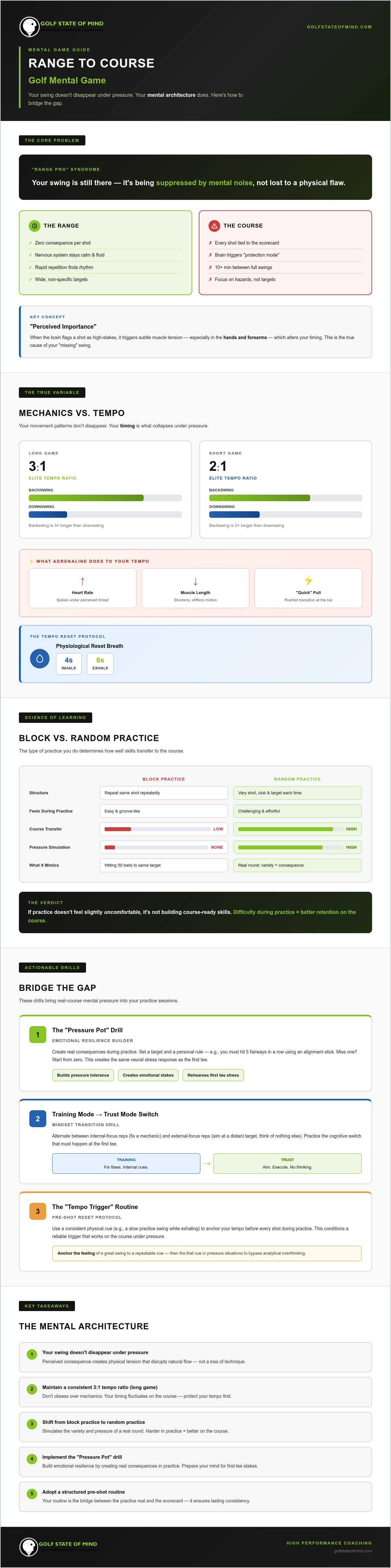
Play the Golf Course on the Range
This is one of my favorite ways to finish a practice session.
Play an imaginary nine holes.
Start With the First Tee
Picture the first hole at your home course.
Where is the trouble?
What’s your target?
What club are you hitting?
Go through your routine and hit one ball.
Play the Next Shot From Where It Finished
If you hit a good drive, perhaps you’re hitting an eight-iron next.
If you pushed it right, maybe you need to imagine playing from the rough or hitting a recovery shot.
Then move to the next hole.
Don’t Give Yourself Mulligans
This is important.
If you hit a terrible drive, don’t immediately hit another driver to prove you can do it.
That’s exactly the habit you’re trying to get away from.
Accept the shot and solve the next problem.
That’s golf.
Use the Same Pre-Shot Process
Your pre-shot routine is one of the most important bridges between practice and play.
It creates familiarity even when the environment changes.
The Think Box
Before the shot, give yourself permission to think.
Consider:
- Lie.
- Distance.
- Trouble.
- Conditions.
- Club and shot.
- Target.
Make your decision.
The Play Box
Once the decision has been made, your job changes.
Now you’re moving from analysis toward execution.
See the shot.
Feel it.
Connect with the target.
Commit.
Play.
Don’t Keep Solving the Swing Over the Ball
If you’re standing at address still debating what you’re doing, step away.
Return to the Think Box.
Resolve the uncertainty.
Then come back when you’re ready to play.
Move Your Attention Toward the Target
Another major difference between range golf and course golf is where your attention goes.
On the range you may simply be trying to hit the ball toward a target.
On the course there may suddenly be:
- Water right.
- Out of bounds left.
- A bunker short.
- Trees behind the green.
Now your mind becomes occupied by what you’re trying to avoid.
Ask Where You’re Sending the Ball
Rather than:
“Don’t hit it right.”
ask:
“Where am I sending this?”
Choose something specific.
Give your attention somewhere useful to go.
Practice Target Orientation
Don’t hit balls toward a general area of the range.
Choose:
- A flag.
- A tree.
- A post.
- A landing area.
Then make the shot about sending the ball there.
Add Consequence to Practice
The golf course gives every shot consequence.
Most range sessions don’t.
You can partially close that gap by creating games and challenges.
Create a Performance Challenge
For example:
Imagine a fairway between two targets.
Hit five drives.
Your goal might be to hit four of the five into the fairway.
Notice what happens when you’ve hit the first three successfully.
Suddenly the fourth shot matters more.
That’s the Shot You Want to Learn From
Do you become more careful?
Does your routine change?
Do you start thinking about the result?
Do you become technical?
Do you swing differently?
This is valuable information.
Don’t Punish Yourself
Consequence doesn’t need to mean punishment.
You don’t need to run laps or stay on the range indefinitely.
Simply keeping score can be enough.
Try to beat your previous performance.
Now the outcome matters a little more, and you get an opportunity to practice your mental skills.
Want to make your practice transfer more effectively to the golf course? Download my free 7 Key Mental Strategies ebook for practical ways to improve your focus, confidence, commitment and performance under pressure. Download the Free Ebook
What If You’re Hitting It Badly on the Range?
This is where your mental game becomes particularly important.
You have a tournament or important round starting in 20 minutes and you’re hitting it terribly.
What do you do?
Don’t Start a Full Swing Rebuild
The temptation is to find the answer.
You hit more balls.
You start changing things.
You search for a feeling.
You become increasingly concerned that you can’t leave until you’ve fixed it.
Sometimes that works.
Often it simply creates more uncertainty.
Accept What You’re Seeing
Your ball flight may be telling you something useful.
Perhaps you’re hitting a slight fade today rather than your normal draw.
Fine.
Can you play with it?
Your job isn’t always to produce your ideal golf swing.
Your job is to solve the golf course with the game you have.
Separate Warm-Up From Performance
Remind yourself:
“The warm-up is not the round.”
Then go compete.
What to Do When Your Swing Disappears on the Course
You’re six holes into the round and nothing feels right.
This is where golfers often make the problem worse.
Don’t Search for the Range Swing
You don’t need to recreate exactly how the swing felt an hour ago.
Feel changes.
Your body changes.
The environment changes.
Searching for a particular sensation can pull your attention increasingly inward.
Simplify
Ask:
What is the simplest version of golf I can play right now?
Choose sensible targets.
Make clear decisions.
Commit to the shot.
Accept the result.
Use a Simple Cue If You Need One
If you and your swing coach have a simple feel that helps organize your movement, use it.
But avoid diagnosing three different technical faults in the middle of the round.
Return to the Target
The target gives your attention somewhere external to go.
See where you’re sending the ball.
Feel the shot.
Commit.
Let the swing happen.
A Simple Range-to-Course Practice Plan
You don’t need to completely change the way you practice.
Instead, divide the session according to what you’re trying to accomplish.
Part 1: Warm Up
Start with shorter shots.
Gradually build toward fuller swings.
Get your body moving.
Part 2: Technical Practice
If you’re working on something with your swing coach, do that work here.
Use repetition.
Use drills.
Make rehearsals.
This is where technical thinking belongs.
Part 3: Performance Practice
Now change the environment.
Use one ball.
Change clubs and targets.
Use your routine.
Score the outcome.
Part 4: Play Golf
Finish by playing several imaginary holes.
Driver.
Approach.
Different target.
New hole.
No mulligans.
No immediately correcting the previous shot.
You’re no longer practicing your swing.
You’re practicing playing golf.
The Real Goal: Learn to Access Your Skills
The answer to the range to course golf mental game isn’t finding a magical way to make the golf course feel consequence-free.
Nor is it convincing yourself that your swing will always feel exactly the same.
It won’t.
The goal is to become more adaptable.
To make decisions when the shot matters.
To commit when you aren’t completely confident.
To accept the result when you only get one attempt.
To move from thinking to playing.
And to access the technical skills you’ve developed without needing everything to feel perfect first.
Your practice should help you do that.
Don’t just practice hitting golf balls.
Practice playing golf.
Frequently Asked Questions
Why do I hit the ball better on the range than on the golf course?
The range and golf course create very different demands. On the range, you can hit the same club repeatedly and immediately correct a poor shot. On the course, you change clubs and targets, make decisions and get one attempt with consequence attached to the result. Pressure can also change your attention, tension and commitment.
Why does my golf swing disappear on the course?
Your swing may not literally disappear, but the conditions surrounding it change. You may become more conscious of your mechanics, more concerned about hazards and score, or more physically tense. Technical inconsistencies can also become more noticeable when you only get one attempt. The goal is to develop a process that helps you access your skills under those conditions.
How do I take my range swing to the golf course?
Make part of your practice more representative of golf. Use one ball, change clubs and targets, go through your pre-shot routine, create consequence and practice accepting each result before moving to a new shot.
Should I stop block practice?
No. Block practice can be very useful when you’re learning or changing technique. The problem is relying exclusively on repetitive practice. Combine technical practice with performance practice that requires decision-making, target changes and one-shot execution.
How should I practice golf on the driving range?
Structure your practice according to its purpose. Warm up first, complete any technical work, then move into performance practice using changing clubs and targets, your routine, one ball and scoring. Finishing by playing imaginary holes is an effective way to make the session more course-like.
Should I use my pre-shot routine on the range?
Yes, during performance practice. You don’t need to use your full routine before every ball when you’re doing repetitive technical work, but once you move into performance mode, practice the same decision-making and commitment process you want to use on the course.
What should I do if I hit the ball badly during my warm-up?
Don’t automatically assume you’re going to play badly. Use the warm-up to gather information and prepare rather than predict the round. Avoid making several last-minute swing changes, identify a simple intention or feel if necessary, and commit to playing with the game you have that day.
How can I create pressure on the driving range?
Use scoring and consequence-based challenges. For example, define a fairway between two targets and see how many of five drives you can hit into it. Try to beat a previous score or complete a challenge. The goal is to make individual shots matter enough that you can observe and practice your response to pressure.
Should I think about my golf swing on the course?
A simple feel you’ve developed with your swing coach may be useful, particularly if it helps organize the movement. The problem is becoming increasingly analytical and trying to fix several technical components during the round. Keep your on-course thinking as simple and performance-oriented as possible.
How do I stop getting technical on the golf course?
Give technical thinking a clear place during practice, then use your pre-shot routine to shift attention toward the shot and target. Make the decision behind the ball, visualize or feel what you’re trying to do, commit and execute. If you’re still analyzing at address, step away and restart.
Why do I lose confidence after one bad shot on the course?
One poor shot can become evidence for a much bigger story: “I’ve lost my swing” or “it’s going to be one of those days.” Try separating the shot from the story. Take any useful information from what happened, then approach the next shot as a new problem rather than proof that your game has disappeared.
What is performance practice in golf?
Performance practice is practice designed to replicate more of the demands of playing golf. Instead of repeating the same movement, you change clubs and targets, use one ball, make decisions, follow your routine and introduce scoring or consequence. It complements technical practice rather than replacing it.
How much of my range session should be performance practice?
There isn’t one percentage that works for every golfer. It depends on what you’re working on. If you’re making a significant technical change, more of the session may need to be technical. As competition approaches, or when your main challenge is transferring your skills to the course, increasing the amount of performance practice can be valuable.
Get your FREE Mental Game Scorecard

How To Practice More Effectively