

Competitive Golf Mental Preparation: The Elite Guide to Tournament Success
“`html
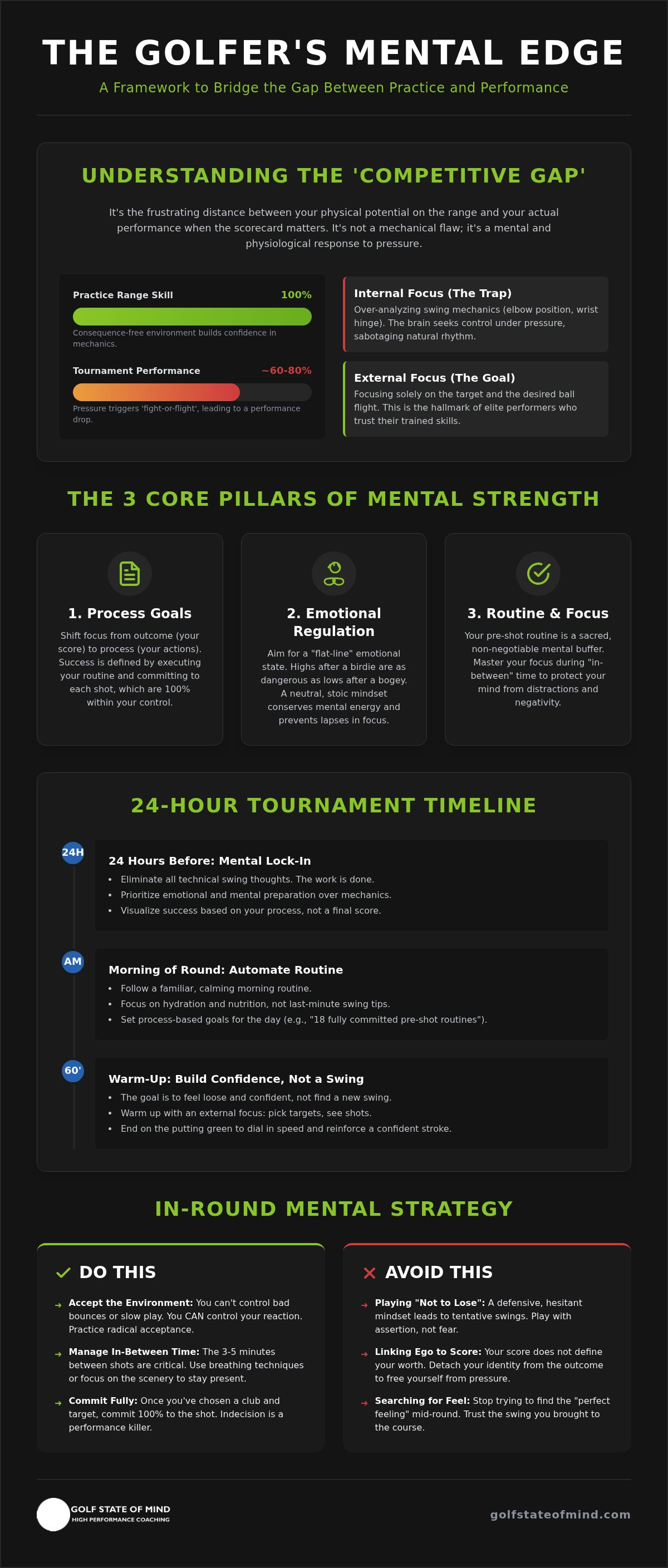
Tournament golf feels different.
You know it before you even hit the first shot.
The range suddenly feels more important.
Your body feels different.
You become more aware of your swing.
You start thinking about score, expectations, who you’re playing with, what could go wrong and what the round might mean.
And that’s exactly why competitive golf mental preparation matters.
The goal isn’t to make competition feel exactly like a casual round.
It probably won’t.
The goal is to prepare yourself to perform well while the round feels important.
You don’t need to eliminate nerves.
You don’t need to feel perfectly confident.
You don’t need to force yourself into a particular emotional state.
You need a clear process for how you want to prepare, where you want your attention to go and how you want to respond when the inevitable challenges of tournament golf appear.
That’s what this guide is about.
Key Takeaways
- Competition naturally feels different from practice, and that isn’t a problem you need to eliminate.
- Your goal is to prepare for pressure rather than trying to avoid it.
- Use process goals to guide your attention instead of making score your only measure of success.
- Your pre-round warm-up should prepare you to play, not become a last-minute swing-fixing session.
- Acceptance is a key part of competitive golf because conditions, ball striking, emotions and results will vary.
- Use your pre-shot routine to narrow your attention before every shot.
- Relax your attention between shots rather than trying to concentrate intensely for four hours.
- Practice your response to mistakes and difficult moments before competition.
- Review tournament rounds based on mental execution as well as score.
Why Tournament Golf Feels Different
A tournament changes the meaning of the golf shots you’re about to hit.
You’re keeping score.
There may be rankings, qualifying, selection, money, a championship or personal goals attached to the result.
Other people may be watching.
You care.
That changes the experience.
Nerves Are Not Evidence That Something Is Wrong
Golfers sometimes interpret nerves as a warning:
“I’m too nervous.”
“I need to calm down.”
“I don’t feel like I did in practice.”
But feeling different in competition is normal.
The better question is:
“Can I perform while I’m feeling this?”
That’s a much more useful objective than trying to manufacture complete calm.
Pressure Often Increases the Desire for Control
When the round matters, golfers commonly become more careful.
They think more about their swing.
They become more conscious of technique.
They hesitate over club selection.
They start trying not to make mistakes.
In other words, their golf becomes increasingly defensive.
Good competitive golf mental preparation helps you recognize this tendency and return to a clearer process.
Want to feel better prepared when the pressure is on? Download my free ebook, 7 Key Mental Strategies, for practical strategies to improve confidence, focus and performance in competition. Get the Free Ebook
What Competitive Golf Mental Preparation Really Means
Mental preparation isn’t positive thinking.
It isn’t convincing yourself that you’re going to play well.
And it isn’t trying to remove every uncomfortable thought or emotion before you tee off.
It’s deciding how you want to show up and what behaviors are going to guide you during the round.
Decide Who You Want to Be
Before competition, ask yourself:
“How do I want to show up today?”
You might choose qualities such as:
- Committed.
- Patient.
- Brave.
- Resilient.
- Present.
- Decisive.
This creates a player identity you can return to when the round becomes difficult.
Decide What You Want to Do
Your mental game then needs a process.
How will you:
- Make decisions?
- Commit to targets?
- Use your pre-shot routine?
- Respond after mistakes?
- Manage your attention between shots?
These are the guidelines for how you want to compete.
Set Process Goals Before You Play
It’s completely normal to have outcome goals.
You may want to win.
You may want to qualify.
You may want to shoot a certain score.
You don’t have to pretend those outcomes don’t matter.
But once the tournament begins, constantly thinking about them doesn’t necessarily help you produce them.
Move From Outcome to Process
Before the round, choose one or two process goals.
For example:
- Commit fully to every target.
- Complete your pre-shot routine before every shot.
- Accept the result before moving to the next shot.
- Keep your attention on the current hole instead of projecting your score.
Now you have something useful to return to throughout the day.
Don’t Choose Too Many
Tournament golf is not the time to carry a mental checklist of eight different things.
Keep it simple.
One or two priorities are usually enough.
The Day Before a Tournament
Good tournament preparation begins before you arrive at the course.
One of the easiest ways to reduce unnecessary stress is to remove avoidable uncertainty.
Take Care of the Logistics
Know:
- Your tee time.
- Your travel time.
- When you need to arrive.
- What you’re going to eat.
- What equipment you need.
- What the weather is likely to be.
Get the practical things organized so they don’t occupy your attention the next morning.
Review Strategy — Then Leave It Alone
If you know the course, you can think through key holes and likely decisions.
But don’t spend the entire evening trying to play the tournament in your head.
Preparation should create clarity, not more tension.
Visualize How You Want to Respond
Visualization doesn’t have to mean imagining 18 perfect holes.
In fact, I think it’s valuable to rehearse difficult moments.
Imagine:
- Feeling nervous on the first tee.
- Missing an early green.
- Getting a bad bounce.
- Making a bogey.
- Having a good round going late in the day.
Then see yourself responding the way you want to respond.
You’re not predicting what will happen.
You’re rehearsing who you want to be if it does.
Build a Better Pre-Round Routine
Your warm-up should help you become ready to play.
That’s different from trying to prove that your swing is working.
Don’t Turn the Range Into an Examination
A common mistake is judging the day by the quality of the warm-up.
Good warm-up:
“I’m going to play well.”
Bad warm-up:
“Today could be a disaster.”
Neither conclusion is particularly useful.
The warm-up is not the tournament.
Prepare Your Body
Start by getting physically ready.
Move.
Hit shorter shots.
Build gradually toward fuller swings.
Allow your body to warm up.
Prepare Your Golf
Move through different clubs and different shots.
Toward the end of the warm-up, make the practice more representative of the golf course.
Choose targets.
Use your routine.
Hit one ball.
Change the problem.
Prepare Your Mind
Before leaving the range, remind yourself:
“I will play with the game I have today.”
You don’t know exactly what that game will look like.
You don’t need to.
Your job is to adapt.
How to Handle First Tee Nerves
First tee nerves are one of the most common experiences in competitive golf.
And they aren’t something you need to eliminate.
Accept the Physical Sensations
Your heart may beat faster.
Your hands may feel different.
Your breathing may change.
You may feel more energy in your body.
Let it be there.
Instead of:
“I need to get rid of this.”
try:
“This is what competition feels like.”
Use Your Breathing
A simple breathing exercise can help you regulate your arousal.
One option I use with players is:
Inhale for 4 seconds. Exhale for 6 seconds.
Repeat for several breaths.
The goal isn’t to become completely relaxed.
It’s to give yourself a little more space before you begin your routine.
Narrow Your Attention
Once it’s your turn:
What’s the situation?
What’s the target?
What’s the shot?
Commit.
You don’t need to solve the tournament on the first tee.
You need to hit one golf shot.
Manage Your Focus During the Round
A four-hour tournament does not require four hours of intense concentration.
Trying to stay completely locked in for the entire round can be exhausting.
Focus On and Focus Off
When you’re preparing to hit:
Switch on.
Gather information.
Make the decision.
Commit.
Execute.
After the shot:
Switch off.
Walk.
Talk.
Notice your surroundings.
Let your attention broaden.
You Don’t Lose Focus Because You Talk to Someone
Some golfers believe they have to remain intensely serious throughout the round.
They don’t.
The important skill is being able to return your attention when it’s time to play.
Use the Environment to Stay Present
If your mind starts running ahead:
Notice what you can:
- See.
- Hear.
- Feel.
- Smell.
This is a simple way to reconnect with what’s actually happening rather than living inside an imagined future score.
How to Respond to Mistakes
No tournament round goes exactly according to plan.
You will hit poor shots.
You will get bad breaks.
You will make mistakes.
Your competitive advantage comes partly from how well you respond to those moments.
Don’t Demand an Immediate Emotional Reset
You don’t need an arbitrary number of steps or seconds.
If you’re angry, acknowledge that you’re angry.
If you’re disappointed, acknowledge the disappointment.
Then gradually bring yourself back to the next task.
Separate the Shot From the Story
A double bogey is a double bogey.
It doesn’t have to become:
“Here we go again.”
“I’ve blown the tournament.”
“I always do this.”
Those are stories added after the event.
Your job is to return to:
“What does the next shot require?”
Learn, Accept, Move On
Your post-shot process can be simple:
- Notice the reaction.
- Take any useful information.
- Accept the result.
- Return to the next task.
That’s resilience in practice.
What to Do When You’re Playing Well
Pressure isn’t only created by bad golf.
Sometimes the hardest mental challenge is playing really well.
Don’t Start Protecting the Score
You make the turn three under.
Now suddenly every shot feels more important.
You become careful.
You aim farther from trouble.
You begin trying to avoid mistakes.
You stop playing the golf that got you there.
Notice the Future Thinking
Your mind may start calculating:
“If I par in…”
“This would be my lowest tournament round…”
“I could win this…”
You don’t have to fight those thoughts.
Notice them.
Then bring yourself back.
Play the Next Shot
The score can wait.
What is the situation?
What’s your target?
What shot are you committing to?
Your job hasn’t changed just because you’re playing well.
Want a stronger process for tournament golf? Download my free 7 Key Mental Strategies ebook and learn practical ways to improve focus, commitment, confidence and emotional control under pressure. Download the Free Ebook
Use a Mental Scorecard
Your tournament score matters.
But it shouldn’t be the only thing you review.
A Mental Scorecard helps you evaluate how well you competed.
Choose Your Commitments
You might track:
- Commitment.
- Routine.
- Acceptance.
- Target focus.
- Response to mistakes.
- Staying present.
Choose one or two areas that matter most to you.
Separate Execution From Outcome
You can hit a beautifully committed shot and get a terrible bounce.
You can hit an indecisive shot that finishes next to the flag.
One produced a worse outcome.
But which one represented better mental execution?
That distinction is important.
Practice for Competition
Competitive golf mental preparation doesn’t begin the morning of the tournament.
You need to practice the skills you want to access when competition arrives.
Use Performance Practice
During part of your practice:
- Change targets.
- Change clubs.
- Use one ball.
- Go through your routine.
- Create consequence.
You’re training decision-making and execution, not just your swing.
Create Pressure
Use games where something matters.
Perhaps you need to:
- Hit 4 out of 5 fairways.
- Get 5 out of 7 balls inside a target area.
- Hole a series of short putts.
- Beat a previous score.
Then notice what happens when you’re close to completing the challenge.
Does your routine change?
Do you get careful?
Does your attention move toward the result?
That’s what you’re learning to manage.
Practice Difficult Moments
Don’t only practice feeling comfortable.
Practice:
- Playing after a poor shot.
- Finishing a challenge under pressure.
- Stepping away and restarting your routine.
- Committing when you don’t feel confident.
Competition should not be the first place you encounter these situations.
Review the Round Properly
After competition, resist the temptation to judge the entire day with one number.
Your score contains useful information, but it doesn’t tell you everything.
Start With What You Did Well
Ask:
- What did I do well mentally?
- Where did I commit well?
- Which moments did I respond to particularly well?
Build evidence of improvement.
Then Identify the Learning
Where did your process break down?
When did your attention move toward score?
What triggered frustration?
Where did you become technical?
What could you practice before your next event?
Don’t Turn the Review Into Self-Judgment
The purpose of reviewing isn’t to prove whether you’re mentally strong or weak.
It’s to learn.
A tournament gives you information that practice cannot.
Use it.
The Goal of Competitive Golf Mental Preparation
The objective isn’t to become a golfer who never feels nervous.
It isn’t to become emotionless.
And it isn’t to guarantee that your best swing appears every time competition begins.
The goal is to become better at accessing the skills you already possess when the round matters.
That means:
- Knowing how you want to show up.
- Knowing what your process is.
- Accepting the game you have that day.
- Directing your attention toward what matters.
- Responding effectively when things go wrong.
- Continuing to commit when pressure increases.
That’s effective competitive golf mental preparation.
Competition doesn’t have to feel easy.
You simply need to become better at playing while it feels important.
Frequently Asked Questions
How should I mentally prepare for a golf tournament?
Decide in advance how you want to show up and choose one or two process goals for the round. Take care of logistics early, rehearse how you want to respond to pressure and adversity, and use your pre-round routine to prepare yourself to play rather than to prove that your swing is perfect.
How far in advance should I start preparing mentally for a golf tournament?
Your broader mental skills should be developed continually through practice, while tournament-specific preparation can begin in the days leading up to the event. The evening before is a good time to organize logistics, review your process goals and mentally rehearse how you want to respond during the round.
How do I handle first tee nerves in a golf tournament?
Accept that nerves are a normal response to something that matters. Use slower breathing if helpful, narrow your attention to the immediate shot and begin your normal routine. Don’t make feeling completely calm a requirement for hitting a committed shot.
Should I use swing thoughts during a tournament?
There isn’t an absolute rule. A simple feel you’ve developed with your coach may sometimes be useful. The problem is becoming increasingly technical and trying to consciously control several parts of your swing during competition. Keep your on-course focus as simple and performance-oriented as possible.
What should I focus on during a golf tournament?
Focus on the information relevant to the shot in front of you: the situation, target, decision, intention and commitment. Between shots, allow your attention to relax rather than continually thinking about your swing or score.
How do I stop thinking about my score during a tournament?
You don’t need to force score-related thoughts away. Notice when your mind projects into the future, then deliberately return your attention to the next task. A clear pre-shot process and process goals give you something specific to return to.
How do I recover mentally after a double bogey?
Allow yourself to acknowledge the frustration, take any useful information from what happened and then return to the next decision. Avoid turning one poor hole into a story about the rest of the round. The next shot does not know what you made on the previous hole.
How do I stay calm when I’m playing well in a tournament?
You don’t necessarily need to become calm. Expect some excitement and increased awareness when the round begins to matter more. Notice thoughts about the final score, then return to the same process you’ve been using all day: situation, target, commitment and execution.
How can I practice for tournament pressure?
Include performance practice that uses one ball, changing clubs and targets, your full routine and scoring or consequence-based games. The purpose is to experience what happens to your thinking and behavior when an outcome begins to matter and practice returning to your process.
What is a Mental Scorecard?
A Mental Scorecard measures the quality of your mental execution rather than only your strokes. You might track commitment, routine, acceptance, focus or response to mistakes. It helps you evaluate how well you competed even when the outcome of individual shots was unpredictable.
What should I do the night before a golf tournament?
Organize practical details such as equipment, travel and tee time, review any important strategic information and then allow yourself to switch off. You can also briefly visualize how you want to respond to nerves, mistakes and other situations you may encounter.
Is visualization useful before a golf tournament?
Yes, particularly when it’s used to rehearse both good execution and effective responses to difficult situations. You don’t need to imagine a perfect round. Visualize yourself making clear decisions, committing to shots, handling nerves and responding well when golf doesn’t go exactly according to plan.
“`
Get your FREE Mental Game Scorecard

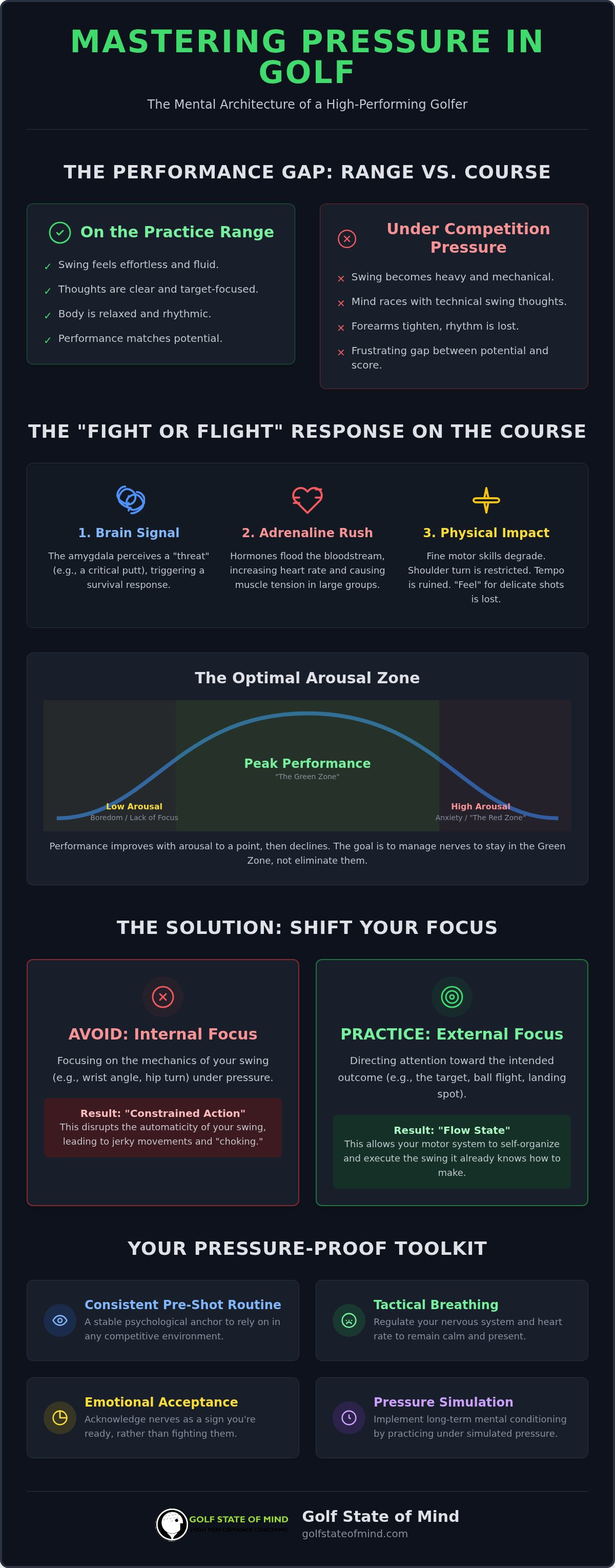
How to Handle Pressure in Golf: The Science and Strategy of Peak Performance
Why does a swing that feels effortless on the practice range suddenly become heavy and mechanical when you step onto the first tee? You’ve likely…
Get your FREE Mental Game Scorecard