“`html id=”5d8pqm”
Why can you hit the ball beautifully on the range and then feel like a completely different golfer when you’re playing an important round?
Your swing hasn’t suddenly disappeared.
What’s changed is the situation.
Now there’s a score. There’s consequence. You care about what happens. Perhaps you’re trying to qualify, win a tournament, break a scoring barrier or simply avoid embarrassing yourself in front of the people you’re playing with.
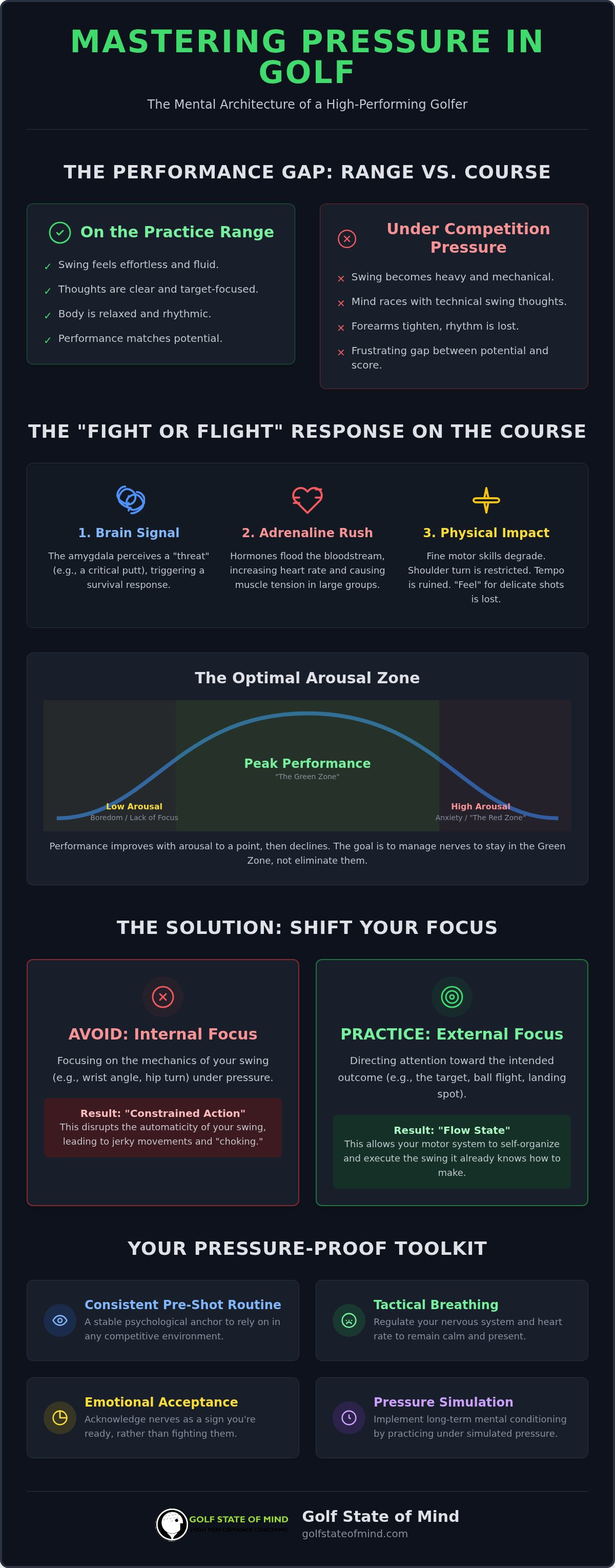
As the outcome becomes more important, you may notice your heart beating faster, your breathing changing, your muscles becoming tighter and your thoughts speeding up.
This is pressure.
And one of the biggest mistakes golfers make is believing they need to get rid of it before they can play well.
You don’t.
Learning how to handle pressure in golf isn’t about eliminating nerves. It’s about becoming better at recognizing your response to pressure, accepting it and continuing to execute your performance process while it’s there.
That’s a skill. And like every other skill in golf, it can be trained.
Key Takeaways
- Feeling nervous doesn’t mean you’re going to play badly. Pressure is a normal part of competing.
- Trying to eliminate nerves can make you even more aware of them.
- Learn your personal pressure response so you can recognize it early.
- Use your breathing to regulate your physical state without expecting it to remove every nervous feeling.
- Move your attention away from score and outcome and back toward your performance process.
- Under pressure, simplify rather than adding more technical thoughts and conscious control.
- Practice your mental skills under consequence so they’re familiar when you need them in competition.
What Happens When You Feel Pressure in Golf?
Pressure changes your state.
When a situation feels important, you might notice:
- Your heart beating faster.
- Your breathing becoming quicker or shallower.
- Tension in your hands, arms, shoulders or jaw.
- Your walking pace increasing.
- Your routine becoming faster.
- More thoughts appearing.
- A stronger desire to control your swing.
- Your attention moving toward the possible outcome.
None of those responses automatically causes poor performance.
Problems arise when you interpret them as evidence that something is wrong.
You notice your heart beating faster and think:
“I’m too nervous.”
Then you become nervous about being nervous.
You notice some tension in your hands and think:
“I need to relax.”
Now you’re monitoring the tension.
You notice your mind thinking about the result and start desperately trying not to think about the result.
The battle with your internal state can become more distracting than the original pressure itself.
Pressure Usually Means You Care
Think about the situations in which you experience the most pressure.
They’re usually situations that matter to you.
If you’re standing over a putt to win a tournament, of course it feels different from the same putt on the practice green.
There’s something at stake.
The presence of nerves isn’t a weakness. It’s a natural response to doing something you care about.
The question isn’t:
“How do I stop feeling nervous?”
A better question is:
“How do I perform well while I’m feeling nervous?”
That shift changes your relationship with pressure.
Stop Trying to Get Rid of Nerves
Many golfers have an idea of the emotional state they believe they need in order to play well.
They want to feel calm, confident and completely in control.
So when they feel nervous, doubtful or uncomfortable, they immediately try to change those feelings.
But golf doesn’t always give you the state you want.
You can feel nervous and hit an excellent golf shot.
You can feel completely confident and hit a terrible one.
Your feelings don’t determine the outcome.
Make Room for the Feeling
Instead of telling yourself:
“I shouldn’t be nervous.”
Try:
“I’m feeling nervous because this matters. That’s OK.”
You don’t have to like the feeling.
You simply don’t need to make getting rid of it your next task.
Your task is still the golf shot.
This is one of the most important changes you can make when learning how to handle pressure in golf.
Learn Your Pressure Response
Pressure doesn’t look exactly the same for every golfer.
Some players speed up.
Some become extremely slow and careful.
Some start talking more.
Others become quiet.
Some golfers become aggressive. Others start steering the ball away from trouble.
Some immediately begin thinking technically.
Your first job is awareness.
Know Your Warning Signs
Think about your last few competitive rounds.
When pressure increased:
- What happened to your breathing?
- What happened to your walking pace?
- Did your routine change?
- Where did you feel tension?
- What thoughts started appearing?
- Did you become more technical?
- Did you become more aware of your score?
- Did your decisions become more conservative or more aggressive?
These patterns are useful information.
If you know that you tend to rush when nervous, you can notice yourself speeding up.
If you know you start thinking technically, you can recognize the shift.
If you know you become consumed by score, you can catch your attention moving into the future.
You can’t respond to something you haven’t noticed.
Want to build a stronger mental game? Download my free ebook, 7 Key Mental Strategies, and learn practical strategies to improve your confidence, focus and performance under pressure. Get the Free Ebook
Use Your Breathing to Regulate Your State
One of the simplest tools you have for influencing your physical state is your breathing.
When golfers become nervous, breathing often becomes faster and shallower.
I teach golfers a very simple breathing technique:
- Breathe in for four seconds.
- Breathe out for six seconds.
- Repeat for 10 breaths.
You can use this before your round, before an important stretch of holes, while waiting on a tee or whenever you notice your state becoming unsettled.
The longer exhale can help reduce unnecessary physical tension, while counting the breath gives your attention something immediate to focus on.
Most importantly, don’t turn the breathing exercise into another test.
You don’t need to finish 10 breaths and think:
“Why am I still nervous?”
The purpose isn’t necessarily to eliminate nerves.
It’s to help regulate your state and bring your attention back to the present.
You can read more about this in my guide to golf breathing techniques.
Move From Outcome Back to Process
Pressure tends to pull your attention toward the future.
You start calculating:
“If I par the last three…”
“If I make this putt…”
“If I shoot 72, I’ll qualify…”
“If I bogey this hole, I’ve blown it…”
These thoughts are understandable.
But none of them helps you execute the shot in front of you.
Outcome Goals Aren’t the Problem
There’s nothing wrong with wanting to win.
There’s nothing wrong with wanting to shoot a certain score, make a team or qualify for an event.
Those goals can provide direction and motivation.
The problem is trying to control them while you’re performing.
Once the round starts, your attention needs to move toward the things you can actually influence.
Return to Your Performance Process
Ask yourself:
- What is the shot?
- What is my target?
- What is the smartest decision?
- Am I committed?
- What do I want to see or feel?
Then execute your routine.
Your score will take care of itself one shot at a time.
Pressure becomes much harder to manage when you’re mentally trying to play the next six holes simultaneously.
Simplify Your Thinking Under Pressure
Another common response to pressure is trying harder.
And in golf, trying harder often means thinking more.
You start checking your backswing.
You think about your takeaway.
You remind yourself to stay down.
You become aware of your grip.
You try to guide the club into the correct position.
But the golf swing is a skill you’ve already trained.
Competition isn’t the time to consciously rebuild it.
Trust the Skills You Brought to the Course
Your job during the round is to use the golf swing you have that day.
That doesn’t mean technical thoughts are always forbidden.
Some golfers perform well with one simple feel or cue.
But under pressure, less is usually better than more.
Ask yourself:
“What is the minimum information I need to hit this shot?”
For many golfers, that means a clear target, a picture of the shot and perhaps one simple feel.
Then trust your body to organize the movement.
Use Your Pre-Shot Routine Under Pressure
Your pre-shot routine is particularly valuable when the situation becomes uncomfortable.
It gives you a familiar process to return to regardless of the importance of the shot.
But the routine isn’t simply a collection of physical movements.
Its purpose is to help you transition from thinking to playing.
The Think Box
Behind the ball, do the thinking that needs to be done.
Consider:
- The lie.
- The wind.
- The distance.
- The target.
- The club.
- The shot you want to hit.
Make your decision.
Then commit to it.
The Play Box
Once you move toward the ball, the job changes.
You don’t need more analysis.
You’ve already made the decision.
Now connect with the target, the picture or feel of the shot and allow yourself to play.
This distinction becomes especially important under pressure because pressure creates a temptation to keep checking and controlling.
Trust your decision and go.
How to Respond After a Mistake
Handling pressure isn’t only about what happens before the shot.
Your response afterward can be just as important.
A mistake late in an important round can create an immediate emotional reaction.
That’s normal.
The danger is allowing one mistake to change your state for the next three holes.
Don’t Demand an Instant Positive Reaction
If you’ve just made a double bogey, you don’t need to pretend you’re delighted about it.
Allow yourself to experience the disappointment.
Then begin the process of letting it go.
Ask:
“Is there anything useful I need to learn from that?”
If there is, take the information.
Then return to the present.
A deliberate breath can help create that transition.
Your Next Shot Doesn’t Know What Happened
The next golf shot has no knowledge of your previous one.
It doesn’t know that you just made double.
It doesn’t know you’re two over your target score.
It doesn’t know you missed a three-footer.
Those things only exist in your mind.
Your job is to give the next shot your full attention.
Practice Playing Under Pressure
If the only time you practice your mental game under pressure is during tournaments, you’re making the task unnecessarily difficult.
Golfers spend a lot of time practicing their skills without practicing how they want to think and respond when the outcome matters.
That’s why I encourage performance practice.
Create Consequence
You can’t perfectly recreate tournament pressure in practice.
But you can create situations where you care about the outcome.
For example:
- Play competitive games against another golfer.
- Keep score during practice.
- Give yourself only one attempt at each shot.
- Set a target you must reach before finishing.
- Use drills where a miss means starting again.
The objective isn’t simply to complete the drill.
Notice what happens mentally as you get closer to the goal.
Do you speed up?
Do you become careful?
Does your breathing change?
Do you start thinking about the result?
Now you have an opportunity to practice your response.
Try the N-S-E-W Putting Drill
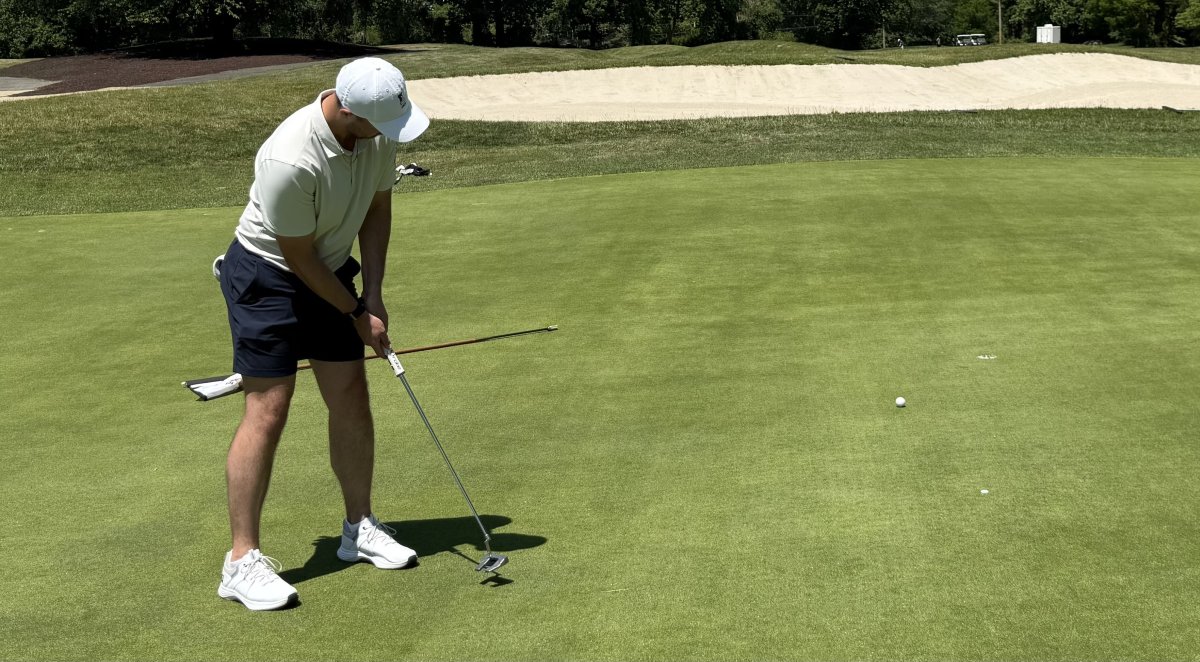
Place tees at 3, 4 and 5 feet from the hole from four different directions: north, south, east and west.
You now have 12 putts.
Work your way around and try to make all 12 consecutively.
If you miss, start again.
The first few putts may feel easy.
But what happens when you’ve made nine or ten?
Now the next putt means something.
That’s the moment to practice:
- Accepting the pressure.
- Maintaining your breathing.
- Following your routine.
- Keeping your attention on the putt rather than the consequence.
- Committing to the stroke.
You’re not just practicing putting anymore.
You’re practicing performing.
Want more practical mental game strategies? Download my free 7 Key Mental Strategies ebook and learn seven strategies you can start using immediately to improve your confidence, focus and ability to perform under pressure. Download the Free Ebook
You don’t need to become a golfer who never feels nervous.
That’s neither realistic nor necessary.
You want to become a golfer who recognizes pressure without immediately treating it as a problem.
And don’t wait until an important tournament to practice these skills.
Build consequence into practice and give yourself repeated opportunities to experience pressure.
The more familiar you become with performing while uncomfortable, the less threatening those sensations become.
Not the absence of pressure.
The ability to play your game while it’s there.
Don’t make complete calmness a requirement for playing well. Feeling nervous before an important round is normal. Use a familiar pre-round routine, complete 10 rounds of 4–6 breathing and remind yourself of the process you want to follow rather than trying to predict your score.
I recommend 4–6 breathing: inhale for four seconds and exhale for six seconds. Repeat this for 10 breaths. The objective isn’t necessarily to eliminate nerves but to regulate your physical state and bring your attention back to the present.
When you’re less concerned about the result, you’re often freer to stay present and react naturally to the target. When score becomes extremely important, attention can move toward future outcomes and you may begin trying to consciously control your performance. The solution isn’t to stop caring but to direct your attention toward your process while you play.
Complete your analysis and decision-making before stepping into the shot. Once you’ve committed, shift attention toward the target, shot or one simple feel rather than continuing to analyze your mechanics. Under pressure, simplifying your thinking is generally more useful than adding more instructions.
Allow yourself to acknowledge the disappointment without carrying it forward indefinitely. Take any useful information from what happened, use a deliberate breath to reset and begin directing your attention toward the next shot. You don’t need to force yourself to feel positive before moving on.
Visualization can help clarify the shot you’re intending to play. Rather than visualizing simply to make yourself feel confident, use imagery to create a clear picture of the target, trajectory, landing spot or roll you want. This gives your attention something relevant to connect with before execution.
Think about the information required to make the decision: target, lie, distance, conditions and the shot you want to play. Once you’ve made the decision, stop searching for more information. Commit to the shot and move from thinking into playing.
Pressure can change your physical and mental state. You may become more tense, speed up or start consciously controlling movements that normally happen automatically. Recognizing these tendencies allows you to respond by regulating your state, simplifying your thoughts and returning to your normal routine.
Add consequence to some of your practice. Keep score, compete against someone, use one-ball drills or create challenges where a miss has a consequence such as starting again. Then pay attention to what happens to your thoughts, breathing and routine as the outcome becomes more important.