Your first tee shot is one shot, not a verdict on your round. To manage fear of the first tee, accept that nerves may bring extra energy, settle into a familiar routine, and focus on one clear target rather than the people watching. You don’t need to feel perfectly calm before you swing.
It’s understandable to feel pressure when others are waiting or watching, especially if you expect yourself to play well. The goal isn’t to force the nerves away, but to give your attention somewhere useful to go. A steady preparation routine can help you make that shift.
In this article, you’ll learn how to practise and visualise your opening shot, set more helpful expectations, choose a target, and move your focus beyond fear of judgment. Each step makes your preparation clearer, so you can commit to a shot you know how to hit and begin the round with greater composure.
Key Takeaways
- Use a brief moment of gratitude and controlled breathing to settle before you tee off.
- Practise your opening routine on the range, then visualise a successful tee shot in slow motion.
- Replace pressure to play perfectly with a process goal you can control.
- Choose one clear target and a familiar shot shape instead of focusing on trouble or the gallery.
- When attention drifts to who’s watching, return it to your routine and the shot in front of you.
1. What is your best advice to overcome nerves on the first tee?
Accept the nerves instead of treating them as evidence that something is wrong. The first tee can feel unusually exposed: other players may be waiting, and your opening shot can seem to set the tone. That pressure can turn ordinary energy into a demand to perform perfectly. Name the feeling calmly, then reframe it: your body is preparing for a shot that matters to you. Even Ryder Cup players can feel nervous while representing their countries before boisterous crowds. Nerves don’t mean you’re unprepared; they’re a cue to return to your routine.
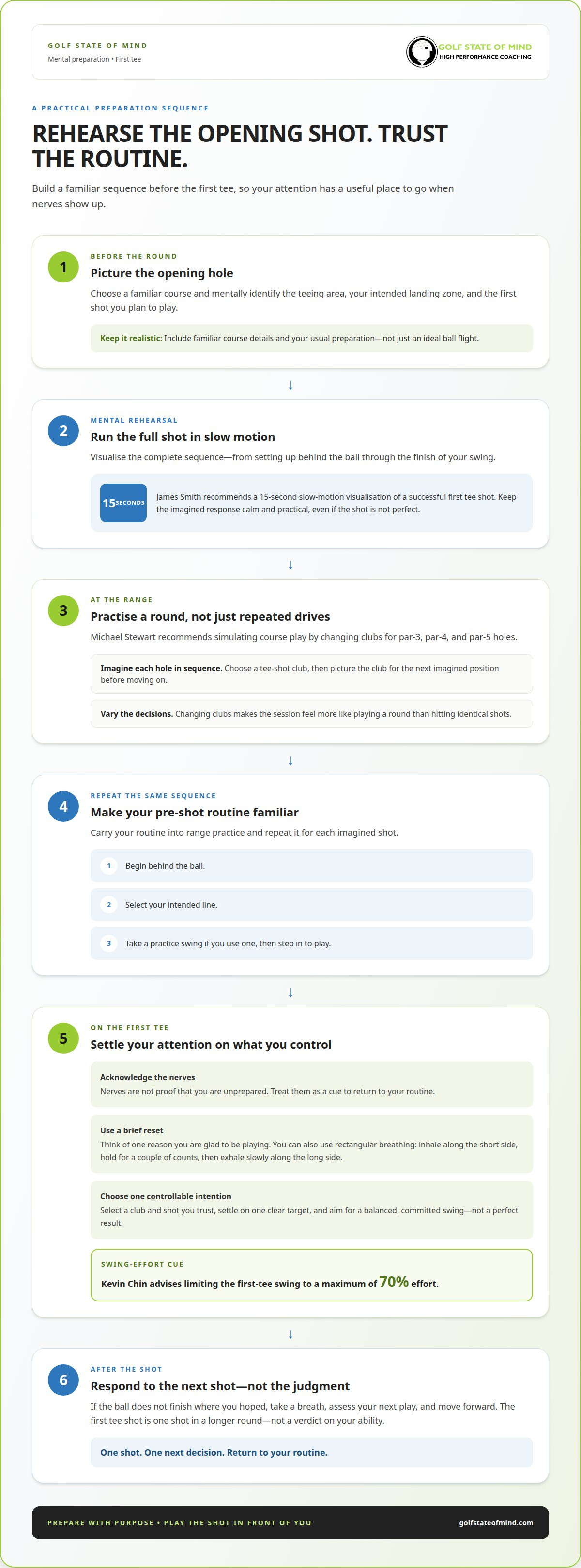
Give your attention a steadier point of reference before taking your stance. Think of one specific reason you’re glad to be playing, such as spending time outdoors, enjoying good company, or working on your game. This brief moment of gratitude doesn’t have to erase tension. It shifts your perspective from being judged to taking part. Then choose a practical intention, such as making a balanced swing or committing to your target, rather than demanding a perfect result.
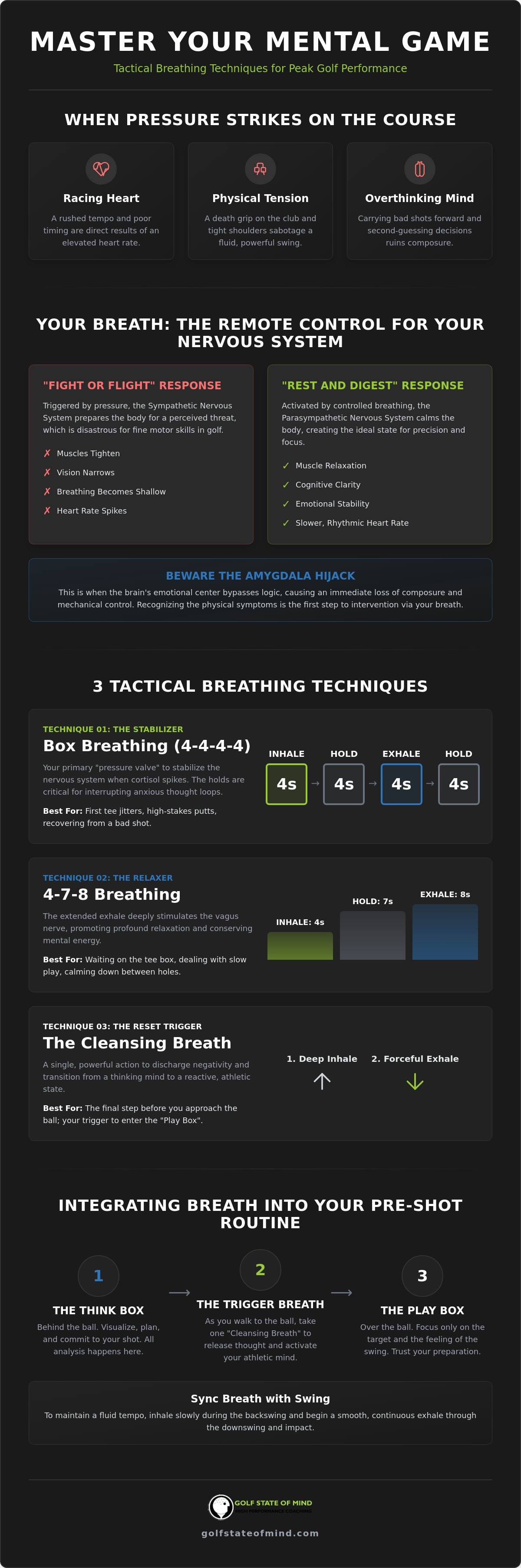
Use rectangular breathing to slow the moment down. Picture a rectangle: inhale along its short side, hold your breath for a couple of counts, then exhale slowly along the long side. Repeat the sequence while your feet are still behind the ball. Keep your shoulders loose as you breathe, then let the final exhale mark the transition into your pre-shot routine. The rectangle gives your mind a simple task instead of leaving it to rehearse possible embarrassment.
For beginners, first-tee etiquette means being ready when it’s your turn, respecting the playing order, and waiting until the group ahead is clear before hitting. Keep conversation low while another golfer prepares, and follow the course’s directions for teeing off. These habits help protect other players’ concentration and safety.
Yes, first-tee anxiety can affect performance by narrowing your attention and changing how you move. Fixating on the ball, for example, can make your body feel frozen and encourage a hands-and-arms swing instead of a committed motion.
Replace the demand to hit a perfect opening shot with one controllable decision. Choose a club and shot you trust, then settle on a target before stepping into the ball. Kevin Chin advises limiting the first-tee swing to a maximum of 70% effort. That cue can discourage a rushed, forceful swing when nerves make you want to prove yourself.
Finally, treat the opening tee shot as one shot in a longer round, not a verdict on your ability. Patrick O’Hara’s reminder is simple: every shot counts as one shot, including the first-tee shot. If the ball doesn’t finish where you hoped, take a breath, assess your next play, and move forward. Your task is to respond to the shot in front of you.
2. Practising and visualising the opening tee shot
Prepare for the first tee before you arrive there. Rehearse the opening hole on a familiar course in your mind, including the teeing area, your intended landing zone, and the first shot you plan to play. James Smith recommends visualising a successful first tee shot in slow motion for 15 seconds. Picture the complete sequence, from setting up behind the ball to finishing your swing, rather than imagining only the ball’s flight. A detailed mental rehearsal gives your attention a task before pressure builds.
Make the image realistic, not perfect. See yourself using your usual pre-shot routine, making a committed swing, and responding calmly to the result. If your imagined shot lands short of the ideal spot, continue the scene: assess the next shot and move forward. That response prepares you for golf as it’s played, where a useful next decision matters more than replaying a miss. Keep the visualisation in real time or slow motion, and include familiar details from the course.
On the driving range, Michael Stewart recommends simulating a course by changing clubs for par-3, par-4, and par-5 holes. Instead of hitting repeated drives, imagine you’re playing each hole in sequence. Choose a club for the tee shot, follow it with the club you’d use for the next imagined position, then move to the next hole. This practice adds decision-making and variation, so the range session feels closer to a round than a series of identical swings.
Use that simulated round to practise your pre-shot routine, too. Begin behind the ball, select your intended line, take a practice swing if you use one, and step in to play. Repeat the same sequence for each imagined shot. A routine becomes more familiar through consistent use, which can reduce the urge to make last-second adjustments when the opening tee feels exposed. Keep the sequence simple enough to repeat under pressure.
For a focused rehearsal, choose one familiar course and imagine its opening hole away from the course. Identify the tee, select your normal club, and picture the target you would aim toward. Then visualise your routine and swing for Smith’s 15 seconds. At the range, carry the same routine into Stewart’s simulated par-3, par-4, and par-5 holes. The point is to practise the decisions and sequence, not to demand a flawless imagined result.
If you want a structured way to develop mental preparation alongside physical practice, a mental game training system can help you work on focus and performance habits. Use visualisation to prepare, then let your established routine guide the actual shot.
Golfers often feel nervous on the first tee because they expect one opening shot to prove their ability. Pressure can also come from trying to meet a personal standard, even when nobody else has set it. A golfer who expects to find the fairway every time may feel tense before swinging. The expectation, not just the audience, can make the moment feel like a test.
Separate the goal you control from the outcome you don’t. A fairway result depends on the shot, but your process can be clear: choose a familiar club, commit to a specific target, and make a balanced swing. This shift matters for golfers at every level. Golf is meant to be enjoyed whether a player has a plus-2 or a 32 handicap. Your standard for success should fit the round you’re playing, not an imagined requirement to impress others.
Ask what you’re demanding of yourself before the round begins. “I must make par” sets an outcome target that can tighten your attention. “I’ll choose a shot I trust and commit to it” gives you a decision to follow. This distinction is useful when a playing partner is watching or the opening hole looks narrow. Replace predictions about your score with an intention for your next action.
Elite results also show why one hole cannot define a round. Rory McIlroy made a double bogey on the 1st hole during his final round at Augusta, then went on to win his first Green Jacket. That example doesn’t promise a comeback; it shows that an imperfect start can be followed by many more decisions. After a poor opening shot, assess the lie, choose a sensible next play, and avoid turning one result into a judgment about your ability.
Reset your expectations before teeing off. Name the standard creating pressure, such as “I have to hit a perfect drive.” Then replace it with a process goal, such as “I’ll commit to my chosen shot.” Finally, decide how you’ll respond if the result misses your target. Planning that response can prevent one miss from becoming a reason to rush your next swing.
Seek structured support if performance anxiety repeatedly disrupts your rounds, leads you to avoid playing, or prevents you from enjoying golf. A golf mental-performance professional can help identify the expectations and thought patterns driving that response, then develop a practical plan for the course. You don’t need to wait until every round feels unplayable. A recurring pattern is enough reason to address it deliberately.
4. Visualising the shot and choosing a target
A clear target gives your attention a task before the club moves. On the first tee, choose one place where you want the ball to go, such as the left edge of a fairway or a broad landing area. Then picture the shot reaching that spot. This simple image replaces a vague instruction like “hit it straight” with a direction you can commit to. Keep the target specific enough to picture, but not so narrow that it demands a perfect result.
Many average golfers divide their attention between two targets: the intended destination and the ball itself. The ball matters for setup, but it doesn’t need to dominate your final focus. Decide where you want the shot to travel, then use that intention to guide your routine. For example, look toward a tree beyond the fairway that lines up with your intended direction. Return to the ball to set up, but keep the target in mind as you prepare to swing.
When the drive looks difficult, shift your attention away from trouble. A high target, such as a distant tall tree or a passing cloud, can give your eyes a more useful reference than a bunker or trees beside the fairway. Choose that reference to help direct the shot, not because aiming at it guarantees a particular result. If the landing area feels tight, identify a safer part of the hole rather than staring at the hazard you want to avoid.
Match your target to a shot you already know how to hit. First-tee pressure is a poor time to attempt an unfamiliar shot shape simply because it seems useful for the hole. If your dependable drive curves slightly from left to right, select a target and starting line that suit that pattern. A familiar shot gives you a clear intention; experimenting with a new shape adds decisions that can distract from commitment.
Build the image in a deliberate sequence. Stand behind the ball and look from your chosen target back toward it. Picture the ball’s path and where it should finish. Then pick a visible reference on that line, such as the distant tree, and align your setup with it. Step in, let your eyes return briefly to the ball, and swing toward the intention you formed. The sequence connects what you see with what you plan to do.
If the first target stops feeling useful, reset before taking your stance. Choose one new, visible point, imagine the shot travelling toward it, and commit to your familiar swing. Don’t keep changing targets after addressing the ball. One decision reduces mental clutter and gives your attention a steady direction through the opening shot.
5. Focusing attention and avoiding fear of judgment
The gallery in your mind can feel louder than the people beside the tee. A slower group may wave you through, or other golfers may wait while you prepare. Either way, your attention can shift from the shot to imagined reactions: “They’ll remember this miss.” That thought doesn’t help you choose a club, set your stance, or swing. Notice it, then return to one task you control.
Use a short attention reset when you feel watched. First, identify what has pulled you away, such as a waiting group or a comment from a playing partner. Next, name your immediate task: “Choose my starting line.” Then complete that task before moving to the next part of your routine. This sequence replaces the vague goal of ignoring everyone with a practical action. You don’t have to make the gallery disappear; you need to stop treating it as the audience for your performance.
Keep your routine focused on decisions, not reactions. Pick your club, select a clear target, and commit to your familiar shot. If you notice someone looking at you, don’t add a practice swing or change clubs just to manage their impression. Make an adjustment only when it serves the shot. Your standard is a committed decision, not a display of confidence for someone else.
A useful boundary is to let other people’s attention remain outside your playing process. You can be considerate without rushing: be ready when it’s your turn, then use the routine you’ve practised. If a slower group waves you through, pause long enough to assess the hole and decide on a shot. Hurrying to repay their patience can create more pressure, while a clear decision keeps your attention on the task.
Prepare a response for the moment your mind predicts judgment. For example, if “They’ll think I can’t play” appears, answer with a neutral cue: “My job is to commit to this shot.” Then look at your target, take your setup, and swing. The cue doesn’t argue with the thought or promise a good result. It interrupts the imagined conversation and directs your attention toward an action you can complete.
After the shot, resist checking faces for approval. Follow the ball, note where it finishes, and make the next decision from its actual position. That response keeps one tee shot from becoming a performance for the group. If judgment concerns repeatedly take over your focus, build a more deliberate mental game practice around attention, commitment, and response.
Golf State of Mind
Golf State of Mind helps golfers develop the mental skills behind steadier decisions and focused play. If first-tee nerves keep disrupting your routine, structured mental game training can help you work on preparation, attention, and response under pressure. The Ultimate Mental Game Training System offers a way to build those skills, while 1:1 Mental Coaching provides individual support for golfers seeking a more tailored approach. Mental Game Audios can also support focused practice between rounds.
Choose the format that fits how you prefer to work on your game. If you’re ready to discuss a next step for your mental game, contact Golf State of Mind.
Carry a steadier mindset into your next round
Make your next opening tee shot a chance to practise responding under pressure, not a test of your worth as a golfer. After the round, reflect on one thing you handled well and one decision you’d like to repeat. This gives you a useful measure of progress beyond the ball’s final position. Fear of the first tee may still surface, but it doesn’t have to direct your choices.
Build consistency through small, deliberate adjustments. Notice which thoughts pull your attention away, then choose a cue that brings it back to the task. With repetition, you can develop a more dependable response for the next round. If you’d like structured support for that work, explore The Ultimate Mental Game Training System.
Take your time, trust your preparation, and let each round strengthen your composure.
Frequently Asked Questions
What is your best advice to overcome nerves on the first tee?
Make your first goal a committed decision, not a perfect opening shot. Before your next round, write down one cue to use when pressure rises, such as “smooth tempo” or “finish balanced.” Use the same cue during practice and play. A familiar phrase gives your attention something concrete to return to, especially if you start imagining how other golfers might judge your shot.
What is fear of the first tee in golf?
Fear of the first tee is apprehension or pressure around making the opening shot, often intensified by waiting golfers, unfamiliar surroundings, or performance expectations. It can show up as hesitation, self-conscious thoughts, or difficulty committing to a swing. The feeling doesn’t define your ability. Notice what triggers it for you, such as playing with a new group, then decide on one practical response before stepping onto the tee.
How can I overcome first tee anxiety?
Reduce uncertainty before you reach the tee. Check the course layout, decide which club you’re comfortable using, and arrive with enough time to settle into the round. If you’re playing with unfamiliar golfers, introduce yourself before the first hole rather than waiting until everyone is watching. These small preparations give your attention useful tasks and leave fewer last-minute decisions to manage.
What pre-shot routine helps calm nerves on the first tee?
Choose a short sequence you can repeat without adding extra movements under pressure. For example, stand behind the ball, check your intended line, set your feet, take one final look, then begin your swing. Use a brief cue such as “commit” as you step into position. Practise the same sequence during ordinary range sessions so it feels familiar before a more exposed tee shot.
What breathing techniques reduce golf anxiety?
Try a gentle rectangular breathing pattern before addressing the ball: inhale along an imagined short side, pause for a couple of counts, and exhale slowly along the longer side. Keep the breath comfortable rather than forcing it. Practise the pattern away from the course first, so you know how it feels. On the tee, one calm cycle can serve as a transition to your next decision.
How can beginners prepare for their first tee shot?
Beginners can simplify the opening shot by learning where to stand, checking the hole’s direction, and having the ball and tee ready before their turn. Ask a playing partner to clarify the order of play if you’re unsure. Choose a club you’ve already used comfortably and focus on making a balanced swing, rather than trying to match a more experienced golfer’s distance.
What should golfers do if they feel panic or choke on the first tee?
If panic rises, step back from the ball rather than forcing a swing while distracted. Take a moment to notice your surroundings, loosen your grip, and decide whether you’re ready to restart your routine. If choking or intense anxiety keeps disrupting rounds, consider performance coaching focused on golf’s mental demands. A recurring pattern is a useful reason to seek structured support, not a personal failing.