

Golf Mental Training Program: Building a System for Calm Confidence in 2026
“`html
Why does the swing you trust on the practice range sometimes disappear the moment the round starts to matter?
It’s one of the most frustrating parts of golf. You can hit the ball beautifully in practice, feel completely in control, and then become tense, distracted or overly technical when you step onto the course.
The problem usually isn’t that your skills have suddenly disappeared.
The problem is that performance introduces things that practice often doesn’t: consequence, uncertainty, pressure, score, expectations and emotion.
That’s why improving your mental game requires more than collecting a few tips. You need a golf mental training program that helps you develop the skills you need to access your game when it matters.
A good mental training program should help you become more aware of your thoughts and reactions, stay present more consistently, commit to your decisions, respond better to mistakes and build routines you can trust under pressure.
The goal isn’t to feel perfect on the golf course.
The goal is to become better at performing regardless of how you feel.
Key Takeaways
- A golf mental training program should develop repeatable mental skills rather than rely on motivation or positive thinking.
- The mental game is about learning how to access the skills you already possess when pressure and consequence are present.
- Your performance process should focus your attention on what you can control rather than score and outcome.
- Pre-shot and post-shot routines help you move between thinking, playing and recovering more consistently.
- Mental skills should be practiced deliberately, including during practice sessions that simulate the demands of the golf course.
- Tracking your mental performance can reveal patterns that score alone doesn’t show.
What Is a Golf Mental Training Program?
A golf mental training program is a structured way of developing the mental skills that influence performance.
That distinction is important.
Knowing that you should “stay positive,” “forget the last shot” or “focus on the process” doesn’t necessarily mean you can do those things when you’re five over par, protecting a lead or standing over an important putt.
Knowledge isn’t the same as skill.
Mental skills need to be trained, practiced and reviewed just like physical skills.
A golfer who has developed a strong mental game is not somebody who never experiences nerves, frustration, fear or doubt.
Those experiences are part of competing.
Instead, mental training helps you improve what happens after those thoughts and feelings appear.
Can you notice them without becoming consumed by them?
Can you bring your attention back to the shot in front of you?
Can you commit to a decision even when you’re uncomfortable?
Can you hit a poor shot without allowing it to affect the next three holes?
These are trainable skills.
Golf Is Something You Do, Not Who You Are
One of the biggest challenges in competitive golf is becoming too attached to the outcome.
When score starts to feel like a judgment of who you are, every shot becomes more threatening.
A bogey isn’t just a bogey. It begins to feel like evidence that you’re not playing well enough.
A tournament result can start to feel like a judgment of your ability or your future.
This creates unnecessary pressure.
A healthier performance mindset separates the person from the golfer.
Golf is something you do. It isn’t who you are.
That doesn’t make you less competitive. In many cases it gives you more freedom to compete because every shot no longer carries the weight of your identity.
Why Your Range Game Doesn’t Always Transfer
The practice range and the golf course are very different performance environments.
On the range, you usually have another ball waiting.
You can hit several shots with the same club. You can make adjustments. There is very little consequence attached to any individual swing.
Golf isn’t like that.
On the course, you get one opportunity.
There is a target, a score, hazards, uncertainty and often some emotional significance attached to the result.
This is why golfers can become frustrated when their range game doesn’t transfer to the course.
They may have practiced the physical skill extensively without practicing the mental and emotional demands that accompany performance.
A complete golf mental training program should therefore include both mental skills training and what I call performance practice.
Stop Expecting Practice to Feel Like the Course
Many golfers judge their practice by how well they hit the ball.
If they’re striking it beautifully, they leave the range feeling confident.
But that confidence can be fragile because it is based on the conditions of practice rather than the demands of competition.
Instead, some practice should test:
- Your commitment to a target.
- Your ability to go through your complete routine.
- Your response to a poor result.
- Your ability to change clubs and shots.
- Your ability to perform when there is a consequence.
- Your ability to stay present when you feel pressure.
Those are much closer to the challenges you actually face on the golf course.
Build a Performance Process
One of the foundations of mental training is learning to distinguish between outcomes and process.
Outcomes matter.
You probably care about your score. Competitive players care about results, rankings, qualifying and winning.
There is nothing wrong with having outcome goals.
The problem is trying to control an outcome while you’re performing.
You cannot directly control your final score.
You cannot control what another player shoots.
You cannot control every bounce, lie, weather condition or result.
What you can control is your performance process.
What Can You Control?
A useful performance process might include:
- Making clear decisions.
- Choosing a specific target.
- Committing fully to the shot.
- Going through your routine.
- Accepting the result.
- Using helpful self-talk.
- Maintaining constructive body language.
- Returning your attention to the present.
These are things you can actually train.
They also give you a much better way to evaluate your performance than score alone.
You can shoot 75 and perform poorly mentally.
You can also shoot 75, make excellent decisions, commit to every shot and respond brilliantly to adversity.
The number is the same. The performance isn’t.
Want to build a stronger mental game? Download my free ebook, 7 Key Mental Strategies, and learn practical skills to improve your confidence, focus and performance on the golf course. Get the Free Ebook
Train Awareness and Presence
You cannot change something you’re unaware of.
That’s why awareness is such an important mental skill.
During a round, begin noticing where your attention goes.
Are you thinking about the previous hole?
Are you calculating what you need to shoot on the remaining holes?
Are you worrying about what your playing partners think?
Are you thinking about your swing?
Are you imagining what happens if you miss?
You don’t need to fight those thoughts.
The first step is simply to recognize them.
Presence Is a Skill
Golf is played one shot at a time, but the mind rarely wants to stay there.
It moves backward into what has already happened and forward into what might happen next.
Training presence means becoming better at recognizing when that happens and returning your attention to what is happening now.
Your breath can help. So can your footsteps, your surroundings, your target or your routine.
For example, if you notice your mind racing ahead to your final score, you can acknowledge the thought and then bring your attention back to something physical and immediate.
This isn’t about forcing your mind to become completely quiet.
It’s about becoming better at redirecting your attention.
You can also use simple golf breathing techniques to help you regulate your state and reconnect with the present.
Develop Pre-Shot and Post-Shot Routines
Routines give structure to performance.
They help you move through the different stages of a golf shot without becoming trapped in unnecessary thinking.
A good routine should help you make a decision, commit to that decision, execute the shot and then move on.
The Pre-Shot Routine
Before you hit the shot, there is information to process.
You may need to consider:
- Lie.
- Distance.
- Wind.
- Target.
- Club selection.
- Shot shape.
This is the thinking phase.
But at some point the thinking needs to stop.
Once you’ve made the decision, your job changes from analysis to execution.
This is the transition I often describe as moving from the Think Box into the Play Box.
Inside the Play Box, your focus should be on commitment, target and athletic execution rather than continuing to search for technical answers.
The Post-Shot Routine
The shot doesn’t finish when the ball stops moving.
Your response matters too.
After a shot, there may be something useful to learn.
But there is a difference between learning and dwelling.
If you made a poor decision or lost commitment, acknowledge it.
If there is something useful to take from the shot, take it.
Then let the shot go.
The post-shot routine creates a clear ending.
This prevents one shot from becoming two or three mental mistakes.
Practice for Performance, Not Just Technique
If you want your mental game to improve on the course, some of your practice needs to recreate the demands of the course.
This doesn’t mean all technical practice is bad.
There is absolutely a place for technical work and repetition.
But at some point you need to switch from skill development to performance practice.
The One-Ball Practice Drill
Instead of hitting ten drivers in a row, hit one.
Choose the target.
Go through your complete routine.
Hit the shot.
Then change clubs and choose a completely different target.
Treat each ball as though it is the only ball you have.
This changes the nature of the practice.
You are no longer simply developing a movement. You’re practicing decision-making, commitment, routine and response.
The N-S-E-W Putting Drill
Putting practice is another good place to create consequence.
One drill I use is the N-S-E-W putting drill.
- Place tees at 3, 4 and 5 feet from the hole.
- Repeat this from four directions around the hole: north, south, east and west.
- You now have 12 putts.
- Work your way around the hole, making each putt.
- If you miss one, start over.
- Your goal is to make all 12 putts in succession.
The technical difficulty is not the main point.
The drill becomes mentally different when you’ve made eight, nine or ten in a row and know that a miss means starting again.
Now you have an opportunity to observe your thoughts, breathing, commitment and routine when the outcome begins to matter.
That’s performance practice.
Track Your Mental Performance
Most golfers evaluate a round almost entirely by score.
That makes it difficult to understand why certain performances happen.
A mental scorecard gives you another layer of information.
You can evaluate areas such as:
- Commitment.
- Pre-shot routine.
- Post-shot response.
- Presence.
- Self-talk.
- Emotional control.
- Body language.
- Decision-making.
You don’t need to track twenty different things at once.
Choose two or three areas that are particularly relevant to you.
For example, after a round you might ask:
- How well did I commit to my decisions?
- How quickly did I recover after poor shots?
- How often did I catch myself thinking about score?
This helps turn vague impressions into useful information.
Review the Round Without Judging Yourself
A post-round review shouldn’t become another opportunity to criticize yourself.
The objective is learning.
Ask:
- What did I do well?
- Where did my mental process break down?
- What situations triggered me?
- What did I learn?
- What will I practice next?
A round of golf contains a lot of valuable information if you know how to look for it.
A Simple 4-Week Golf Mental Training Plan
You don’t need to change everything at once.
In fact, trying to improve ten mental skills simultaneously usually creates more thinking, not better performance.
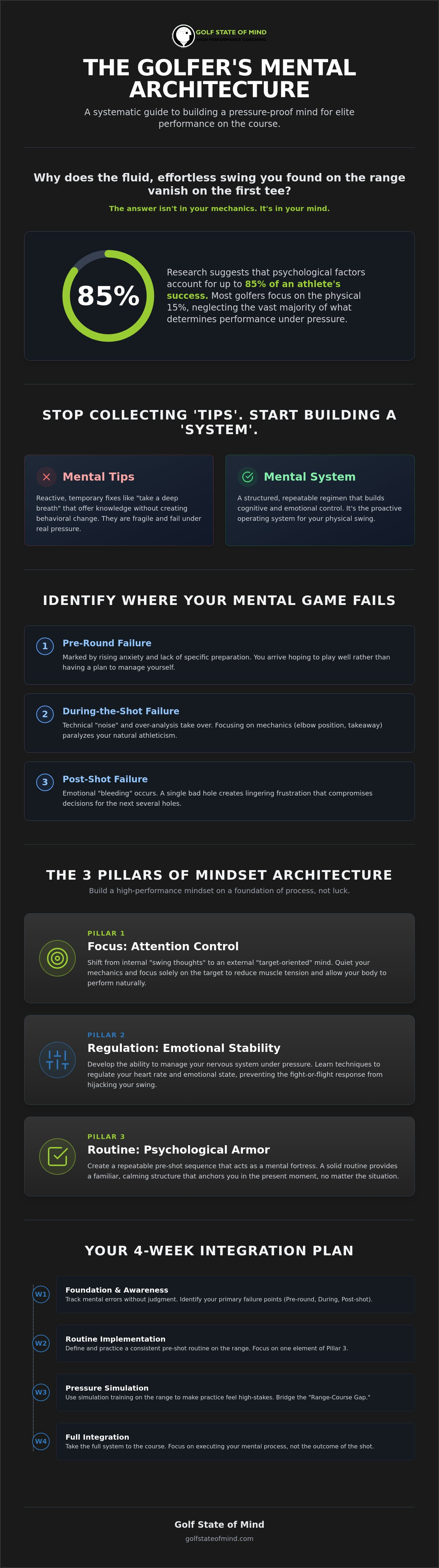
Here is a simple four-week framework you can use to begin building your own golf mental training program.
Week 1: Awareness
Don’t try to fix every thought or reaction.
Spend the week observing.
During practice and play, notice:
- What situations cause you to become tense?
- When do you start thinking about score?
- What happens after poor shots?
- When do technical thoughts enter your mind?
- What situations affect your confidence?
Write down the patterns after your rounds.
Week 2: Build Your Performance Process
Choose three or four process goals that you can control.
For example:
- Commit fully to every target.
- Complete my pre-shot routine.
- Accept the result of each shot.
- Return my attention to the present between shots.
Evaluate yourself on these rather than trying to manufacture a particular score.
Week 3: Train Your Routines
Use your pre-shot and post-shot routines during practice.
Don’t save them for competition.
Go through your full routine during one-ball practice and during putting drills where there is some consequence.
Your routine becomes more reliable under pressure when it has already been repeated hundreds of times.
Week 4: Performance Practice
Begin adding more consequence and variability to practice.
Use different clubs and targets.
Play games against yourself.
Use putting drills that require you to start again after a miss.
Keep score during certain practice exercises.
The objective isn’t to make yourself anxious.
It’s to give yourself opportunities to practice your mental skills when you care about the outcome.
Want a simple place to start? Download my free 7 Key Mental Strategies ebook and learn seven practical mental skills you can begin applying to your golf immediately. Download the Free Ebook
What a Good Golf Mental Training Program Should Teach
There are many ways to approach the mental game, but a useful program should eventually help you become more self-sufficient.
You should understand your own performance patterns and know how to respond to them.
A complete mental training program should help you improve areas such as:
- Goal setting and process goals.
- Awareness and presence.
- Confidence and belief.
- Pre-shot and post-shot routines.
- Commitment.
- Managing pressure.
- Emotional control.
- Self-talk.
- Performance practice.
- Post-round review.
The ultimate objective isn’t to create a golfer who needs a mental technique for every possible situation.
It’s to develop a golfer who understands themselves well enough to recognize what is happening and respond effectively.
Calm Confidence Comes From Your Process
Confidence is often treated as something you either have or don’t have.
I don’t think that’s particularly helpful.
Confidence becomes much more reliable when it is built on evidence.
If you’ve practiced your routines, trained your attention, worked on your responses to poor shots and repeatedly put yourself into competitive practice situations, you have something to trust.
You don’t need to stand on the first tee trying to convince yourself that you’re going to play brilliantly.
You can simply trust the process you’ve trained.
That’s a much more sustainable form of confidence.
The objective of a golf mental training program isn’t to guarantee a certain score.
It’s to help you access more of the ability you already have, more often, when the game becomes difficult.
Frequently Asked Questions
What is a golf mental training program?
A golf mental training program is a structured process for developing the mental skills that influence performance. These can include awareness, presence, confidence, routines, commitment, emotional control, self-talk and your response to mistakes.
How is mental training different from positive thinking?
Mental training isn’t about forcing yourself to feel positive. You can play excellent golf while feeling nervous, frustrated or uncomfortable. Mental training teaches you how to respond effectively to those experiences and keep your attention on the things you can control.
How often should I practice my mental game?
Mental skills should be part of your regular practice rather than something you only think about before an important tournament. You can practice routines, commitment, presence, breathing and response to outcomes during ordinary range and putting sessions.
What is the best way to stop overthinking on the golf course?
Start by recognizing when your attention has moved into technical analysis or outcome thinking. Once you’ve made your decision, use your routine to move away from analysis and toward the target and the shot you want to play. The objective isn’t to eliminate thoughts but to redirect your attention.
Why can I hit the ball well on the range but not on the course?
The range and course place different demands on you. Range practice often includes repetition, little consequence and multiple attempts. On the course, you have one ball, changing targets, score and uncertainty. Adding performance practice to your training helps bridge that gap.
What mental skills should golfers track?
You don’t need to track everything. Useful areas include commitment, routine, presence, emotional response, self-talk and decision-making. Choose the areas that are most relevant to your game and review them after your rounds.
Can mental training help with pressure?
Yes. Mental training can help you recognize your pressure response, regulate your physical state, stay connected to the present and continue following your process even when the outcome feels important. The goal isn’t to eliminate pressure but to perform more effectively while experiencing it.
How long does golf mental training take to work?
You may notice improvements in awareness quite quickly, but developing reliable habits takes repetition. Instead of looking for a quick mental fix, treat these skills like any other part of your golf game and continue practicing them over time.
Do good golfers still get nervous?
Absolutely. Playing well under pressure doesn’t require the absence of nerves. Strong competitors learn how to recognize nerves without treating them as a problem and continue making clear decisions and committed swings.
“`
Get your FREE Mental Game Scorecard

Golf Psychology: 2026 Mental Performance Guide
Why does the effortless, rhythmic swing you discovered on the practice range often vanish the moment your spikes touch the first tee? It’s a…
Get your FREE Mental Game Scorecard