“`html
Imagine standing on the eighteenth tee with your best round of the year on the line.
You know how to hit the shot. But suddenly your heart rate increases, your breathing gets quicker, and you can feel tension creeping into your hands, arms and shoulders.
This is one of the challenges of playing golf under pressure. Your skills haven’t disappeared, but your physical and mental state has changed.
One of the simplest ways to manage that state is through your breathing.
I encourage my players to use breathing not just when they’re nervous, but as part of their regular mental game routine. Your breath can help bring your attention back to the present, reduce physical tension and create a valuable pause between what just happened and what you need to do next.
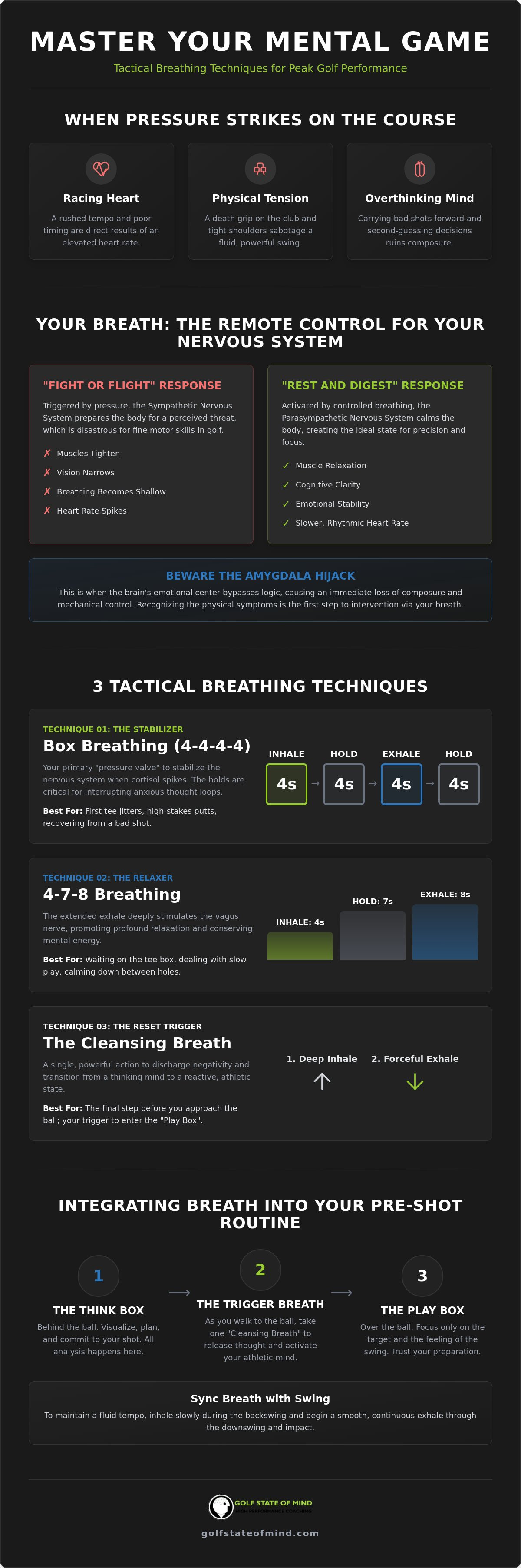
A simple technique I use is the 4–6 breath: breathe in slowly for four seconds and breathe out slowly for six seconds. Repeat this for 10 breaths.
You can use this before a round, while waiting on a tee, after a difficult stretch of holes, or whenever you notice yourself becoming tense or caught up in your thoughts.
The goal isn’t to eliminate nerves. It’s to help you respond to them better.
Key Takeaways
- Use your breathing as a way to bring your attention back to the present moment.
- Practice the 4–6 breathing technique: inhale for four seconds and exhale for six seconds.
- Use 10 rounds of 4–6 breathing before you play or whenever you need to regulate your state.
- Learn to recognize physical signs of pressure such as faster breathing, increased heart rate and tension.
- Use your breath as part of your reset after a poor shot instead of carrying frustration into the next one.
Why Breathing Matters Under Pressure
Pressure changes the way we feel physically.
Your heart rate may increase. Your breathing can become faster and shallower. You may notice more tension in your hands, forearms, shoulders or jaw. Your thoughts can also speed up as your mind begins thinking about score, consequences or what might happen next.
None of this means you’ve suddenly lost your golf swing. It’s a normal response to a situation that feels important.
The problem starts when you react to those sensations by trying harder, becoming more controlling, or allowing your attention to move away from the shot in front of you.
This is where simple golf breathing techniques can be extremely useful.
Slowing your breathing, particularly by using a longer exhale, can help you reduce unnecessary tension and create a feeling of greater control. Just as importantly, focusing on your breath gives your attention something happening right now rather than allowing your mind to drift into the past or future.
That’s one reason I use breathing frequently with golfers who want to improve their ability to perform under pressure.
If you want to understand pressure in golf in more detail, you can also read my guide on how to handle pressure in golf.
Recognizing Your Pressure Response
One of the most important mental skills in golf is awareness.
Before you can respond effectively to pressure, you need to recognize what pressure feels like for you.
Some golfers notice their heart beating faster. Others feel tension in their grip. Some begin walking faster or rushing their routine. Others notice that their mind becomes much noisier.
Instead of judging these sensations, simply notice them.
You might think:
“My heart rate is up.”
“I’m feeling some tension.”
“My mind is starting to get ahead of me.”
That awareness gives you an opportunity to respond rather than automatically reacting.
The 4–6 Breathing Technique for Golf
The primary breathing exercise I recommend to golfers is very simple.
- Breathe in for four seconds.
- Breathe out for six seconds.
- Repeat for 10 breaths.
There is nothing complicated about it, and that’s one of the reasons I like it for golf.
You don’t need another difficult technique to remember when you’re already dealing with the demands of competition. You need something simple enough that you can actually use when it matters.
The longer exhale encourages you to slow things down physically, while concentrating on the count helps bring your attention away from outcome-focused thinking and back into the present.
I recommend practicing this away from the golf course as well as using it during competition. The more familiar the technique becomes, the easier it is to access when you’re under pressure.
Don’t Wait Until You’re Nervous
A common mistake is to think breathing techniques should only be used when you’re feeling extremely nervous.
I prefer golfers to make breathing part of their regular mental game practice.
You can use 10 rounds of 4–6 breathing:
- Before leaving for the course.
- Before beginning your warm-up.
- Shortly before going to the first tee.
- During a delay or long wait.
- After a difficult stretch of holes.
- Whenever you notice your physical or mental state becoming unsettled.
The objective isn’t always to become completely calm. Golfers can perform extremely well while feeling nervous.
The objective is to become more aware of your state and give yourself a reliable way to influence it.
Want to strengthen your mental game? Download my free ebook, 7 Key Mental Strategies, and learn seven of the mental skills I teach golfers to help them play with more confidence, focus and consistency. Get the Free Ebook
How to Use Breathing Before and During Your Round
Before the Round
The period before a round is often when golfers allow their minds to become overly active.
You may start thinking about what score you need, how important the tournament is, who is watching, whether your swing feels good enough, or what happened the last time you played the course.
Instead, use your pre-round period to establish the state in which you want to compete.
Find somewhere relatively quiet and complete 10 rounds of 4–6 breathing.
As you breathe, allow your attention to remain with the physical sensation of breathing rather than your score or expectations for the round.
This can become part of a broader pre-round mental routine in which you remind yourself of your process, your attitude and what you want your attention to be on during the round.
During Moments of Pressure
There will be moments during every competitive round when the outcome feels more important.
Perhaps you’re protecting a lead. Maybe you’re playing the final few holes of a qualifier. You might simply be standing over a four-foot putt that feels much more important than the other four-foot putts you’ve hit that day.
When you notice pressure rising, don’t immediately try to get rid of it.
Acknowledge what you’re feeling and use your breath to help you stay connected to the present.
A slow inhale followed by a longer exhale can be enough to create a small gap between the feeling of pressure and your response to it.
From there, return your attention to your process:
- What is the shot?
- What is the target?
- What does a committed swing look and feel like?
Then go through your normal routine.
You’re not trying to manufacture a feeling of complete calm. You’re simply helping yourself stay present enough to make a clear decision and commit to the shot.
Using Your Breath After a Bad Shot
One of the most valuable uses of breathing in golf comes after the shot.
A poor shot doesn’t have to damage your round. What often causes more damage is the reaction that follows it.
You hit a bad drive, become angry, replay the mistake while walking down the hole and then arrive at your next shot still mentally connected to the previous one.
This is where a good post-shot routine becomes essential.
Your first job is to accept that the shot has already happened.
You can learn from it later. Right now, you need to be able to move on.
Take a slow breath. Make the exhale deliberate. Allow your body to release some of the tension associated with the previous shot.
Then begin bringing your attention back to your surroundings and eventually to the next shot.
Breathing won’t magically remove frustration. That’s not the goal.
The goal is to help you stop feeding the emotion and create a transition from the previous shot back to the present moment.
Use the Walk Between Shots
Golf gives you a lot of time between shots.
That time can either help you or hurt you.
If you spend the entire walk thinking about your score, analyzing your swing or replaying mistakes, you will eventually arrive at your next shot mentally exhausted.
Instead, use periods of the walk to reconnect with the present.
You might notice:
- The feeling of your feet contacting the ground.
- The sights and sounds around you.
- The sensation of your breathing.
- Your posture and walking pace.
These simple physical anchors can prevent you from spending four hours trapped inside your own thoughts.
Integrating Breathing Into Your Pre-Shot Routine
Your pre-shot routine should help you transition from thinking and planning to trusting and playing.
Before the shot, you need to make decisions: assess the lie, calculate yardage, evaluate the wind, choose the target and select the club.
But once those decisions have been made, continuing to analyze doesn’t help you execute.
This is the transition from what I often describe as the Think Box into the Play Box.
Breathing can help with that transition.
Once you’ve made your decision and committed to the shot, allow yourself a slow breath and begin shifting your attention away from analysis and toward the shot you want to play.
The breath doesn’t need to become another technical part of your routine that you obsess over.
In fact, that would defeat the purpose.
It should simply help you settle, commit and allow your athletic skills to take over.
Don’t Try to Control Your Swing With Your Breath
I don’t recommend trying to create an exact breathing pattern during the golf swing itself.
The objective is freedom, not adding another conscious instruction.
If you’re thinking:
“Inhale here, exhale here, start the backswing here…”
you’ve simply created another form of overthinking.
Instead, use breathing before the shot to reduce unnecessary tension and improve your state, and then allow the swing to happen.
Beyond Breathing: Building Your Mental Game
Breathing is a powerful mental game tool, but it isn’t a complete mental game system.
To become a better competitor, you need to develop several skills that work together.
These include:
- Being able to stay present instead of becoming consumed by score and outcome.
- Developing a consistent pre-shot and post-shot routine.
- Recognizing the situations that trigger fear, tension or overthinking.
- Improving your self-talk.
- Responding effectively to mistakes.
- Committing fully to your decisions.
- Separating your identity from your golf scores.
The strongest players aren’t mentally perfect. They still experience nerves, frustration, doubts and difficult stretches.
The difference is that they develop better ways of responding to those experiences.
Breathing is one of those tools.
Practice Your Mental Skills
Golfers spend thousands of hours practicing their swing, short game and putting, but very little time practicing how they want to think, feel and respond on the golf course.
Mental skills improve through repetition just like physical skills.
If you want 4–6 breathing to become available to you during a tournament, practice it before you need it.
Do 10 breaths regularly away from the course. Use it during practice sessions. Use it before competitive rounds.
Then, when pressure appears, it won’t feel like something new you’re trying to remember.
It will already be part of how you compete.
Want more practical mental game strategies? Get my free 7 Key Mental Strategies ebook and start building a stronger approach to confidence, pressure, focus and mistakes on the golf course. Download the Free Ebook
Build a More Reliable Mental Game
You don’t need to eliminate nerves to play your best golf.
You need to become better at recognizing your response to pressure and returning your attention to what you can control.
Your breath gives you a simple way to do that.
Remember the basic technique:
- Inhale for four seconds.
- Exhale for six seconds.
- Repeat for 10 breaths.
Use it before you play. Use it when you notice pressure building. Use your breathing as part of your reset after poor shots.
Over time, the goal is not simply to become a calmer golfer. It’s to become a golfer who is better able to stay present, committed and resilient regardless of what happens during the round.
Frequently Asked Questions
What is the best breathing technique for golf?
A simple technique I recommend is 4–6 breathing. Inhale slowly for four seconds and exhale for six seconds. Repeat this for 10 breaths. It can be used before your round or whenever you notice yourself becoming tense, distracted or overly focused on the outcome.
Can breathing help with first tee nerves?
Yes. Breathing can be particularly useful before the first tee because it gives you something simple and controllable to focus on. Try completing 10 rounds of 4–6 breathing before you begin your round. The goal isn’t necessarily to remove nerves, but to help you respond to them without becoming tense or rushed.
Should I inhale or exhale during my golf swing?
I wouldn’t recommend consciously controlling your breathing during the swing. Doing so can simply give you another thing to think about. Instead, use a slow breath before the shot to reduce unnecessary tension, commit to the target and then allow the swing to happen naturally.
Can breathing techniques help with the golf yips?
Breathing can be useful for golfers experiencing the yips because anxiety, tension and excessive conscious control can make the problem worse. However, the yips are more complex than simply being nervous, so breathing should be considered one part of a broader approach. You can read more in my guide to overcoming the golf yips.
How can I use breathing after a bad shot?
After a poor shot, take a slow breath and make the exhale deliberate. Use it as a reminder that the previous shot is finished. Then begin bringing your attention back to your surroundings and eventually to the next shot. The objective isn’t to force yourself to feel positive; it’s to stop carrying the previous shot forward.
How do I stay present in golf?
One of the simplest ways to stay present is to direct your attention toward something you can experience right now. Your breath is one option. You can also notice your footsteps, sounds around you, physical sensations or your surroundings. These anchors help pull your attention away from past mistakes and future outcomes.
How often should golfers practice breathing techniques?
Don’t wait until you’re under pressure. Practice 10 rounds of 4–6 breathing regularly away from the golf course and incorporate it into your pre-round routine. The more familiar the skill becomes, the easier it will be to use naturally when you need it during competition.
“`