

How to Focus During a Golf Round: A Masterclass in Mental Energy Management
Most golfers think learning how to focus during a golf round means staying intensely concentrated for four straight hours.
That isn’t realistic, and it isn’t necessary.
Golf requires periods of high concentration, but it also gives you long periods between shots. Trying to remain completely locked in from the first tee to the 18th green can leave you mentally exhausted and make it harder to focus when you actually need to.
The better approach is to learn how to switch your focus on and off.
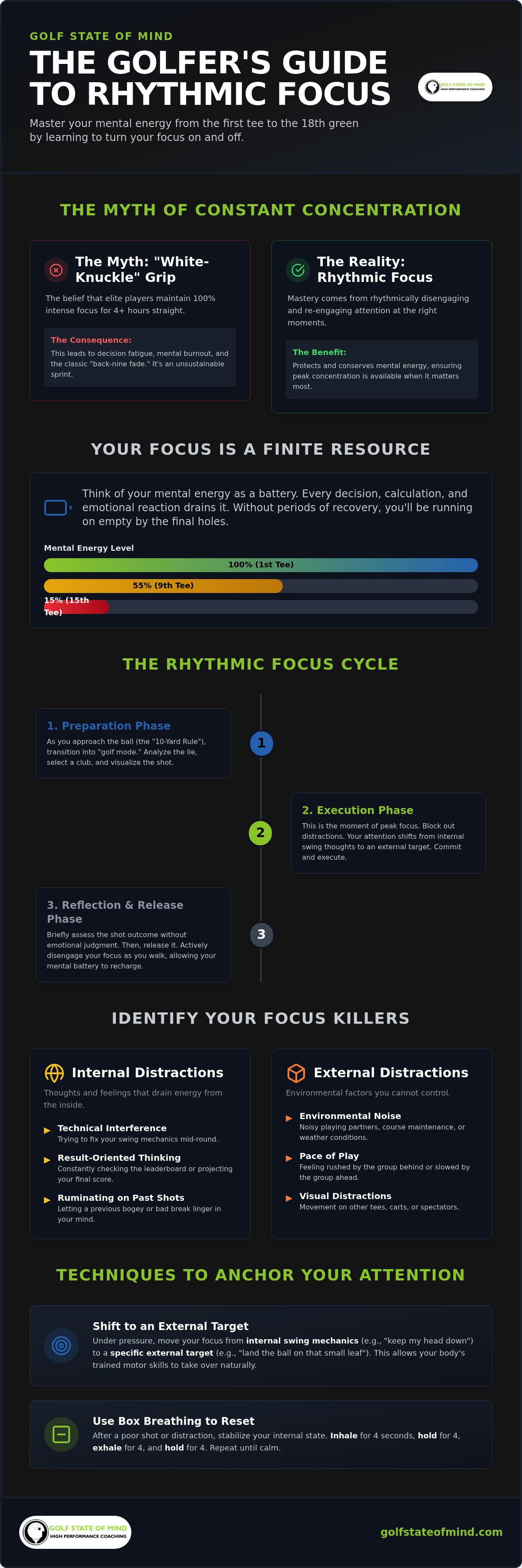
You want to engage fully when you’re preparing for and hitting the shot, then allow your attention to relax between shots before deliberately bringing it back when the next shot begins.
This is one of the most important skills for golfers who want better concentration, fewer mental mistakes and more consistent performance late in the round.
In this article, I’ll show you how to focus during a golf round without trying to concentrate for four hours continuously. We’ll look at what deserves your attention, what doesn’t, how to recover after distractions and poor shots, and how to train your ability to return to the present moment.
Key Takeaways
- You do not need to concentrate intensely for an entire round of golf.
- Learn to engage your focus around the shot and relax your attention between shots.
- Your best golf focus should be directed toward relevant information such as the target, decision and shot in front of you.
- Trying to fight every distraction usually gives the distraction more attention.
- Use your pre-shot and post-shot routines to create clear transitions in your attention.
- Simple grounding exercises and breathing can help bring your mind back to the present.
- Practice focus deliberately rather than expecting concentration to appear automatically in competition.
Why You Can’t Focus for Four Hours
A round of golf can last four hours or more.
But you’re only actually preparing for and hitting golf shots for a small percentage of that time.
Trying to maintain the same level of concentration for the entire round doesn’t make much sense.
Think about what happens when golfers try to stay constantly “locked in.”
They start thinking about golf while walking between every shot.
They replay the previous swing.
They think about the next hole.
They calculate their projected score.
They monitor how they’re feeling.
They start trying to solve problems that haven’t happened yet.
By the time they get to the back nine, they’re mentally tired.
Want to improve your focus and mental game? Download my free ebook, 7 Key Mental Strategies, and learn practical strategies to improve your confidence, concentration and performance on the golf course. Get the Free Ebook
Focus Is About Selection
Good concentration doesn’t mean noticing nothing except golf.
It means being able to direct your attention toward the information that matters when it matters.
Before a shot, that information might include:
- The lie.
- The distance.
- The wind.
- The target.
- The shot you want to play.
Once the shot is over, none of that information needs your full concentration anymore.
You can allow your focus to broaden again.
This rhythm of engaging and disengaging attention is one of the keys to understanding how to focus during a golf round.
How to Focus During a Golf Round
I prefer golfers to think of concentration as something they deliberately turn on when they need it.
As you approach your ball, begin bringing your attention toward the next shot.
Gather the information.
Make the decision.
See the target.
Commit.
Hit the shot.
Then allow your attention to come back down again.
You’re not abandoning the round.
You’re conserving your mental energy for the moments when it matters most.
Think Narrow, Then Broad
When you’re preparing for the shot, narrow your attention.
Become specific.
What exactly is the target?
What shot are you playing?
What does commitment look like?
Once the shot has been completed and you’ve gone through your post-shot response, broaden your attention again.
Notice the course.
Talk to your playing partners.
Walk.
Breathe.
Allow yourself to be a person walking around a golf course rather than a golfer trying to solve golf continuously for four hours.
What Should You Focus On in Golf?
One reason golfers struggle with concentration is that they focus very intensely on things that don’t help them perform.
You can be extremely focused on your score.
You can be extremely focused on your swing mechanics.
You can be extremely focused on what your playing partner thinks.
That doesn’t mean the focus is useful.
Focus on Relevant Information
During the shot, your attention should be connected to the task.
That might include:
- Your target.
- The shape or trajectory of the shot.
- The landing area.
- A simple feel.
- Your commitment to the decision.
For many golfers, the target is particularly valuable because it moves attention outward toward what you’re trying to accomplish rather than inward toward controlling every part of the swing.
Be Careful With Technical Thoughts
Technical work has an important place in golf.
But the course isn’t usually the best place to conduct a detailed swing lesson with yourself.
If you have one simple swing feel that helps you play, that’s different.
The problem begins when your attention becomes consumed by multiple body positions and mechanical corrections.
Ask yourself:
“Is this thought helping me play the shot, or is it making me more conscious of the movement?”
During performance, simple is usually better.
How to Focus Between Shots
Learning how to focus during a golf round also means learning when not to focus intensely on golf.
The time between shots is a natural opportunity to allow your mind to recover.
Get Out of Golf Mode
After you’ve completed your post-shot response, give yourself permission to disengage.
You might:
- Talk to your playing partners.
- Look around the course.
- Notice the weather.
- Pay attention to your walking pace.
- Enjoy the surroundings.
- Notice your breathing.
You don’t need to force yourself to think about something specific.
The goal is simply to stop analyzing golf until it’s time to prepare for the next shot.
Don’t Play the Next Shot Too Early
Another common mistake is arriving mentally at the next shot long before you physically arrive at the ball.
You’re walking toward a difficult approach and already thinking:
“This is a horrible yardage.”
“Don’t miss this left.”
“I always struggle from this distance.”
You’re effectively playing the shot repeatedly in your head before you’ve even assessed the situation.
Wait until you have the information you need.
Then engage your golf focus.
Use the Think Box and Play Box
The Think Box and Play Box concept provides a useful structure for your attention.
The Think Box
The Think Box is where you make the decisions.
This is where you consider:
- Distance.
- Wind.
- Lie.
- Course strategy.
- Target.
- Club selection.
- The shot you want to play.
Think clearly here.
Once you’ve made the decision, commit to it.
The Play Box
Once you move into the Play Box, you’re no longer looking for more answers.
The decision has already been made.
Now your attention shifts toward:
- The target.
- The picture of the shot.
- The feel you want.
- Commitment.
Then you play.
This distinction helps prevent the analytical part of your mind from continuing to interfere when it’s time to execute.
How to Deal With Distractions on the Golf Course
There will always be distractions in golf.
Your playing partner may talk at the wrong time.
A cart might move.
Someone may make noise.
Slow play may frustrate you.
The weather might become difficult.
You may start thinking about your score.
Your own thoughts can be just as distracting as anything happening around you.
Don’t Try to Eliminate Every Distraction
The objective isn’t to create a perfectly controlled environment.
That’s impossible.
The skill is recognizing that your attention has moved somewhere unhelpful and bringing it back.
For example:
“I’m thinking about my score.”
Good.
You noticed it.
Now bring your attention back to the next task.
You don’t need to become angry with yourself for losing focus.
Returning your attention is the skill.
Playing Partners Can Be a Distraction
This is something golfers mention to me frequently.
A playing partner may be slow, negative, talkative or simply have habits that irritate you.
You can’t control them.
But you can recognize how much mental energy you’re giving them.
Every time you rehearse how annoying they are, you’re keeping your attention on something outside your control.
Notice your reaction and bring yourself back to your own process.
How to Regain Focus After a Bad Shot
One poor shot can easily occupy your attention for several minutes.
You replay the swing.
You criticize yourself.
You calculate how much the mistake has cost you.
Then you arrive at the next shot while still mentally connected to the previous one.
This is one of the most common ways golfers lose concentration during a round.
Use Your Post-Shot Routine
You don’t have to pretend a bad shot didn’t bother you.
Acknowledge the reaction.
If there’s something useful to learn, take it.
Then begin letting it go.
Your post-shot routine creates a transition between what just happened and what comes next.
That might include:
- Recognizing the emotion.
- Taking one useful lesson if necessary.
- Using a deliberate breath.
- Putting the club away.
- Returning your awareness to your surroundings.
The next shot deserves your attention more than the previous one does.
Don’t Carry Good Shots Forward Either
Interestingly, golfers can lose focus after good shots too.
You make three birdies in four holes and suddenly start imagining your final score.
You begin thinking about winning.
You start protecting what you’ve achieved.
Now you’re no longer playing the shot in front of you.
The same principle applies:
Enjoy the good shot.
Then come back to the present.
Use Grounding to Return to the Present
If your mind becomes particularly busy during a round, grounding exercises can help reconnect your attention with what is happening around you.
One method I use is a version of the 5-4-3-2-1 exercise.
Identify:
- 5 things you can see.
- 4 things you can physically feel.
- 3 things you can hear.
- 2 things you can notice around you.
- 1 thing you’re grateful for.
The exact items aren’t the important part.
The purpose is to bring your attention away from the story running through your head and back toward your immediate experience.
This can be particularly useful while walking between shots.
Use Breathing to Help Your Focus
Your breath is another simple present-moment anchor.
When pressure increases, golfers often notice that their breathing becomes quicker or shallower.
One technique I use is 4–6 breathing.
- Breathe in for four seconds.
- Breathe out for six seconds.
- Repeat for 10 breaths.
This can be useful before the round, during a delay, or when you notice yourself becoming physically or mentally unsettled.
Counting the breath also gives your attention a clear present-moment task.
The goal isn’t to force yourself into complete calm.
It’s to regulate your state and help reconnect your attention with the present.
You can learn more in my guide to golf breathing techniques.
How to Practice Focus in Golf
Most golfers expect themselves to concentrate brilliantly during a tournament without ever deliberately practicing concentration.
Focus is a skill.
It improves when you train it.
Practice Switching Your Focus On and Off
On the range, don’t simply stand in one place and hit ball after ball.
Try this:
- Step away from the hitting area.
- Allow your attention to relax.
- Choose a new target.
- Approach the ball as though you’re playing a shot on the course.
- Go through your routine.
- Hit one ball.
- Step away again.
This trains the same engagement-disengagement rhythm you’re trying to use on the course.
Create Distractions
You don’t need perfect silence when you practice.
Allow yourself to experience some distractions and practice returning your attention.
The objective isn’t never being distracted.
The objective is becoming quicker at noticing and returning.
Use a Mental Scorecard
After your round, don’t evaluate concentration by asking:
“Was I focused for four hours?”
Instead, ask:
- Did I engage fully before my shots?
- Did I commit to my decisions?
- Did I notice when my attention wandered?
- How quickly did I return after distractions?
- Did I disengage effectively between shots?
- How well did I respond after poor shots?
These questions give you much more useful information.
Want seven practical mental game strategies you can use immediately? Download my free 7 Key Mental Strategies ebook and start improving your focus, confidence and performance on the golf course. Download the Free Ebook
Focus Is About Returning, Not Being Perfect
The best answer to how to focus during a golf round is not to try harder to concentrate.
It’s to become better at managing your attention.
Engage when it’s time to play.
Disengage between shots.
Direct your attention toward relevant information.
Recognize distractions without fighting them.
Return to the present when your mind drifts.
Use your routines to create structure.
And give yourself permission to switch off from golf between shots.
You will lose focus during a round.
Everybody does.
The important question is how quickly you notice and return.
That’s what good concentration really looks like.
Frequently Asked Questions
How do you stay focused for 18 holes of golf?
Don’t try to concentrate intensely for all 18 holes. Engage your focus as you approach each shot, go through your decision-making and routine, execute the shot and then allow yourself to disengage between shots. This helps preserve your attention for the moments when you actually need it.
How do I focus during a golf round?
Focus on the information relevant to the shot in front of you: the lie, distance, target, decision and commitment. Once the shot is complete, allow your attention to broaden again. Good golf concentration is about deliberately directing and redirecting your attention rather than maintaining constant intensity.
What should I think about between golf shots?
You don’t need to think about golf continuously. Talk to your playing partners, notice your surroundings, walk and allow your mind to relax. As you approach your ball, deliberately begin bringing your attention back toward golf and the upcoming shot.
How can I regain concentration after a bad shot?
Use your post-shot routine. Acknowledge your reaction, take any useful information from the shot, use a deliberate breath if helpful and then return your attention to your surroundings. Don’t continue replaying the previous shot as you approach the next one.
Why do I lose focus on the back nine?
One reason can be spending too much mental energy early in the round. If you’re analyzing golf continuously for several hours, concentration can become more difficult later. Learning to disengage between shots can help you preserve your attention for the final holes.
How do I stop thinking about my golf score?
You may still notice thoughts about score, particularly when you’re playing well or approaching the end of an important round. Don’t fight the thought. Recognize it and redirect your attention toward the next controllable task: the decision, target, routine and shot in front of you.
What should I focus on during my golf swing?
For many golfers, an external intention such as the target, ball flight or shot shape is more useful than monitoring several body positions. Some players also use one simple feel or tempo cue. The goal is to avoid making the swing unnecessarily conscious and complicated during performance.
Can breathing improve focus in golf?
Yes. Breathing can provide a simple present-moment anchor and help regulate your physical state. One technique is 4–6 breathing: inhale for four seconds and exhale for six seconds. It can be particularly useful when you notice your thoughts speeding up or your attention becoming scattered.
How do I deal with distracting playing partners?
Recognize that you cannot control another player’s behavior. Notice when your attention has become consumed by irritation and deliberately bring it back to your own process. The more time you spend mentally rehearsing how annoying another golfer is, the more attention you’re giving away.
Can you practice concentration for golf?
Yes. Use one-ball practice, deliberately switch your attention on and off between shots, create consequence in drills and review your concentration after practice. Focus improves through repeated practice just like other golf skills.
Get your FREE Mental Game Scorecard
