Best Golf Mental Coaching App: 2026 Performance Guide
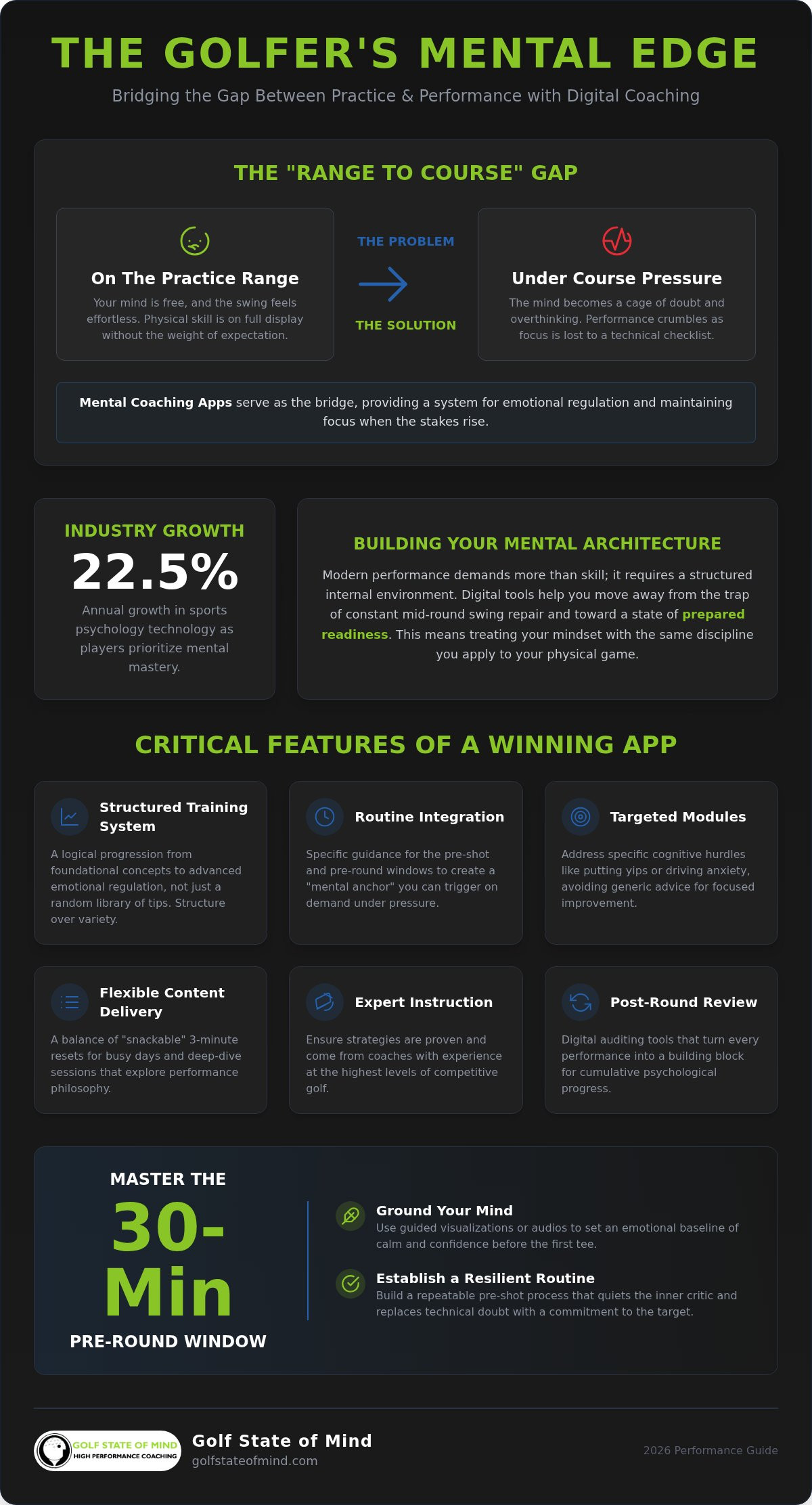
Why does a swing that feels effortless on the practice range often crumble under the pressure of the final three holes? You’ve likely felt that…
Get your FREE Mental Game Scorecard



Research shows that an active dynamic warm-up can decrease your shot error rate by over 47 percent, yet most golfers spend their morning reinforcing the very anxiety that ruins their scorecard. You likely know the frustration of a brilliant range session that evaporates the moment you step onto the grass of the opening hole. This disconnect happens because your pre round golf routine is often focused on fixing a swing that isn’t broken instead of preparing a mind that isn’t ready. Mastery of the craft begins with a deliberate transition from your daily identity into a focused, competitive state.
It’s exhausting to feel your confidence slip away just as the starter calls your name. You deserve to step onto that first tee with the same calm stability you felt during your warm-up. This article provides a 30 minute mental blueprint designed to regulate your nervous system and shield you from the pressure of the opening shot. We will examine a structured system to manage your transition from the car to the course, ensuring you arrive with the emotional resilience required to maintain peak performance until the final putt drops. You will learn to replace frantic effort with a repeatable process that works under the highest pressure.
The 15 minutes you spend on the range before a round are often the most misunderstood moments in the game. Most amateurs view this time as a mechanical checklist, a chance to “find” their swing or fix a slice that has haunted them for weeks. This is a fundamental error. A true pre round golf routine isn’t a physical rehearsal; it’s a psychological bridge. It’s the deliberate process of shedding your identity as a professional, a parent, or a stressed commuter and adopting the persona of a focused, resilient athlete.
While a warm-up prepares your muscles and joints for the explosive movement of the swing, a routine prepares your mind for the emotional volatility of the course. By applying established principles of sport psychology, you can cultivate what we call a “Quiet Mind.” This state of internal stillness is your primary defense against the adrenaline spike and technical overthinking that cause first-tee blowups. Without this mental transition, you step onto the first tee with your “daily life” brain still active, leaving you vulnerable to the first sign of adversity on the scorecard.
Searching for your swing on the range is a dangerous trap that creates immediate tension. When you evaluate every ball flight, you enter a state of judgment. If the ball hooks, you panic; if it fades, you doubt your grip. This evaluative thinking is the enemy of performance. Your goal is to transition into “performance thinking,” where your focus shifts to rhythm, target, and intent rather than mechanics. Adopt a stoic baseline. Accept that you don’t know exactly which swing will show up today, but realize you’re fully prepared to manage whatever version of your game you have. To build this discipline, many players utilize The Ultimate Mental Game Training System to anchor their focus before the first shot.
Most golfers sabotage their performance before they even reach the bag drop. These errors are often rooted in a lack of structure:
By identifying these pitfalls, you can begin to treat your pre round golf routine as a sacred space for mental preparation, ensuring your best golf isn’t left on the range.
Your performance doesn’t begin on the first tee; it begins the moment you leave your driveway. Treating the drive to the course as a “buffer zone” is a critical component of a disciplined pre round golf routine. This period allows you to decompress from the stresses of work or domestic life, ensuring you don’t carry that frantic energy into your game. Plan to arrive at the course 45 to 60 minutes before your scheduled tee time. This window is not for extra practice, but to prevent “panic mode,” a state of high arousal that narrows your focus and impairs decision-making.
Scientific research on choking under pressure indicates that structured routines and physical cues help prevent the destructive cycle of over-analysis. While still in your car, utilize golf breathing techniques like box breathing to lower your heart rate. Spend two minutes in a “Parking Lot Reset,” visualizing yourself navigating the first few holes with a steady hand and a clear mind. This simple act of mental architecture establishes the internal control necessary for the challenges ahead.
Your auditory environment dictates your internal rhythm. Avoid news broadcasts or high-stress podcasts that trigger your sympathetic nervous system. Instead, curate a playlist that mirrors the tempo you want on the course. Listening to golf mental game audio during your commute can prime your subconscious for focus and resilience. This auditory training acts as a mental warm-up, aligning your cognitive processes with the technical demands of the sport before you even touch a club.
Once you step out of the car, your physical pace must dictate your mental pace. Move slowly. Rushing to the pro shop or the locker room creates unnecessary urgency. Implement a strict “No-Phone Rule” the moment you arrive to maintain your focus on the upcoming task. Checking emails or social media invites external distractions that clutter the mind. Instead, approach the check-in with a sense of gratitude. Acknowledging the privilege of spending the day on the course lowers performance pressure and fosters a positive emotional baseline. For those looking to deepen this preparation, The Ultimate Mental Game Training System offers specific modules on maintaining this composure throughout the round.
A disciplined pre round golf routine requires a fundamental shift in perspective. The driving range is not a space for technical reconstruction; it is an activation zone. Instead of hitting a full bucket of balls, limit yourself to 15 purposeful shots. This constraint forces you to value every swing, mirroring the scarcity of shots you face on the course. Data tracking shows that PGA Tour competitors spend over 60 percent of their pre-round session on wedges and short irons, emphasizing rhythm and strike over raw distance. Professional pre-round warm-up guidelines confirm that elite players use this time for emotional management and shot commitment rather than mechanical fixes.
Rehearse your full pre-shot routine on every single warm-up shot. If you skip your routine on the range, you are essentially training your brain that your process is optional. It isn’t. As you move through your 15 balls, visualize the first three holes of the course. If the opening hole requires a long iron to a narrow fairway, hit that specific club while seeing the target in your mind’s eye. This mental rehearsal prepares your nervous system for the specific demands of the day’s opening challenges.
Bad shots will happen during your warm-up. When you hit a poor ball, acknowledge it with stoic indifference. It is simply data, not a prophecy of your performance. If you hit a slice, don’t try to fix your grip; simply note the ball flight and move to the next shot. Your goal is to build a “Quiet Mind” that remains unruffled by temporary physical imperfections. You are here to find your rhythm, not a perfect swing.
Identify the specific club and target for the first hole before you leave the range. Execute this specific shot three times with full visualization, seeing the ball flight and the landing area clearly. This builds a sense of familiarity that dampens first-tee anxiety. Performance mode is the psychological state where you trust your intent and aim over your physical mechanics.
Many golfers struggle with why you play better on the range than the course because their warm-up lacks the pressure of variety. To fix this, implement the “Target-Switch” drill. Never hit the same target twice in a row during your session. This forces your brain to recalibrate for every shot, just as it must do on the course. End your session on a “feel” shot, such as a smooth 50-yard wedge. This locks in a positive final memory of a centered strike and a controlled tempo before you walk to the putting green.
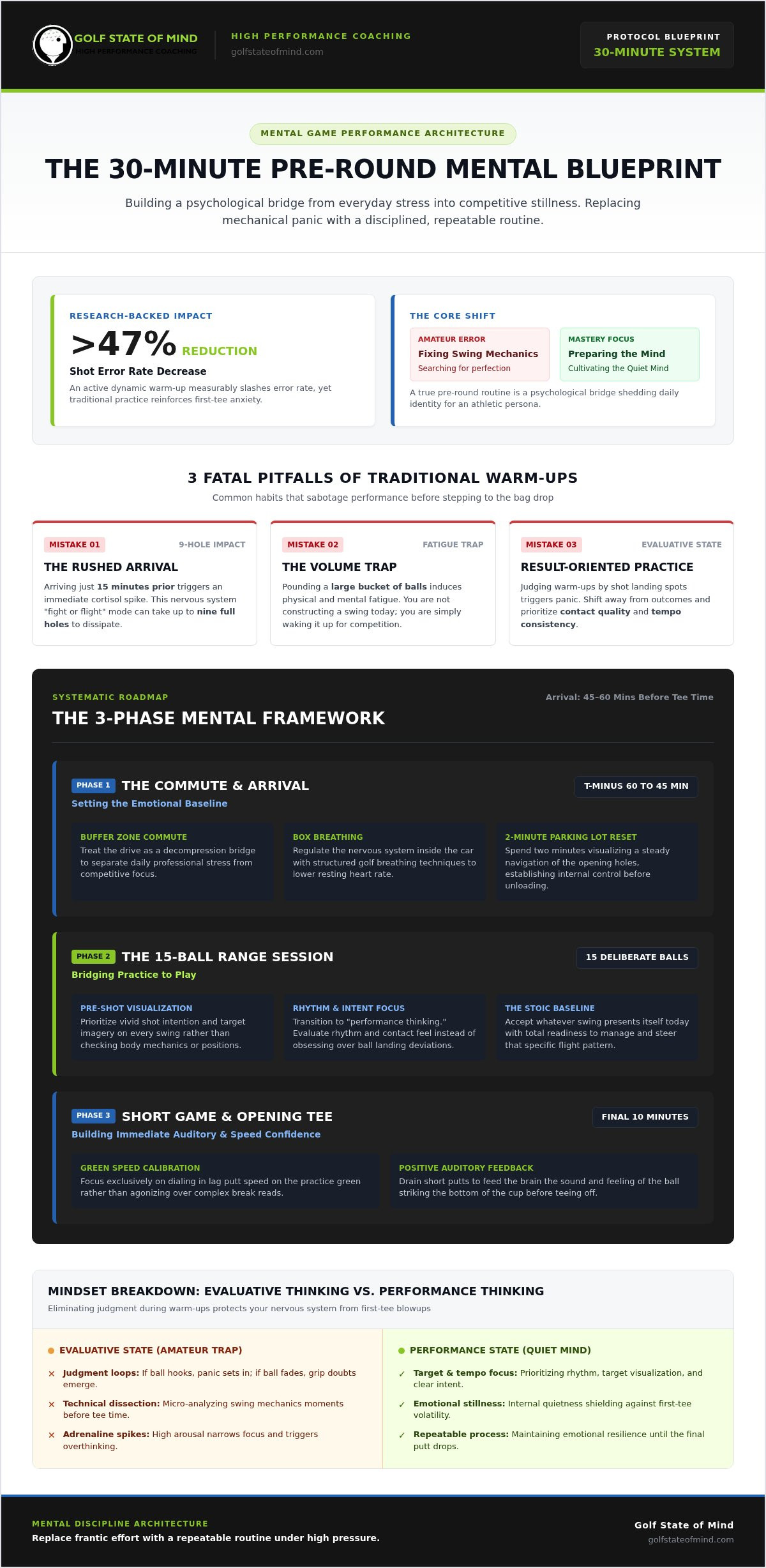
After the activation of the range session, move to the putting green. This is the most critical area for establishing an emotional floor for your round. A successful pre round golf routine concludes by building positive sensory feedback. Spend your first few minutes on lag putting. Don’t worry about the specific break. Instead, focus entirely on speed calibration. Your goal is to develop a feel for the green’s pace so that your subconscious can take over during the round.
Once you’ve calibrated your speed, move to the “Confidence Circle.” This involves holing out 5 to 10 consecutive putts from only 3 to 5 feet. Research across elite tours confirms that over 75 percent of professional players conclude their putting warm-up within this range. They aren’t practicing their stroke; they are feeding their brain the visual and auditory data of the ball disappearing into the cup. This creates a powerful mental image of success that carries over to the first hole.
To improve putting confidence, you must abandon technical adjustments. If your stroke feels slightly off, ignore it. Focus on the “Sound of Success” drill: keep your head down and listen for the rattle of the ball in the plastic. This auditory anchor shifts your focus from the mechanics of the hands to the reality of the result. Managing your pre round golf routine effectively at the tee box means staying grounded in this sensory experience rather than over-analyzing your path.
Walking to the first tee often triggers an adrenaline spike. You can manage these first tee nerves by creating a “Social Buffer.” While it’s polite to greet your playing partners, don’t let their chatter pull you out of your internal rhythm. Maintain your presence by focusing on your breathing and staying within your own mental architecture.
When it’s your turn to play, narrow your focus to a single, small target, such as a specific leaf or a distant branch. Use a trigger word, such as “smooth” or “tempo,” to initiate your swing. Most importantly, practice stoic acceptance. Accept the outcome of the shot before you even take the club back. By detaching from the result, you eliminate the fear that causes physical tension. For a complete guide on mastering these transitions, consider investing in The Ultimate Mental Game Training System.
A professional-grade performance is never the result of chance. It’s the inevitable outcome of a disciplined process. By adopting a structured pre round golf routine, you move away from hoping for a “lucky” day and toward a systematic execution of your skills. The 30 Minute Pre-Round Confidence Booster is designed to facilitate this shift, providing a specific auditory roadmap that guides your brain from the chaos of daily life to the focused clarity required for the first tee. Using our mental coaching app for golfers allows you to access these tools in real-time, ensuring your preparation remains consistent regardless of the venue or the stakes.
True mastery of the mental game requires moving beyond occasional success. It demands a repeatable system that works when the pressure is highest. When you rely on a proven protocol, you develop the emotional stability to handle poor shots without losing your composure. This systematic approach transforms your relationship with the game, allowing you to play with a sense of calm authority rather than frantic effort.
To implement this effectively, you must treat your time as a finite resource. This 30-minute protocol is divided into three distinct phases of mental architecture:
While a solid pre round golf routine is essential, it’s only one component of a complete performance architecture. To truly excel, you need a comprehensive golf mental training program that addresses your psychological habits on and off the course. For those who struggle with deep-seated anxiety at the start of a round, personalized support can be the catalyst for a breakthrough. You can book a 15-minute mental game consultation to discuss your specific hurdles with a professional coach.
Ultimate success comes from committing to a proven process over time. Investing in The Ultimate Mental Game Training System provides you with the tools to build a resilient mindset that withstands the pressure of competition. Stop leaving your scores to chance and start building a game founded on the quiet strength of a prepared mind.
Mastering your performance requires a fundamental shift from technical obsession to psychological discipline. By treating your pre round golf routine as a mental bridge rather than a mechanical repair session, you shield your focus from the volatility of the course. You now have the tools to regulate your nervous system during the commute, activate your intent on the range, and anchor your confidence on the putting green. These logical steps ensure that the skills you’ve honed in practice finally translate to the scorecard through improved emotional regulation and shot commitment.
True consistency is built on the foundation of a proven system. Developed by leading mental game coach David MacKenzie and utilized by over 100,000 golfers worldwide, our training focuses on measurable score reduction through the mastery of internal states. It’s time to stop leaving your opening-hole composure to chance. Download the 30-Minute Pre-Round Confidence Booster and start your round with total clarity. Step onto the grass with the quiet strength of a prepared mind. Your best golf is always within reach when you trust the process.
A comprehensive routine should take approximately 30 to 45 minutes of active preparation. This window allows you to move through the three essential phases of mental architecture without inducing physical fatigue. The 30 Minute Pre-Round Confidence Booster structures this time into 10-minute segments for your commute, range activation, and green-side presence. This duration is long enough to regulate your nervous system and anchor your mental state before the first shot.
Prioritize your emotional baseline and green-side feel over hitting full shots. Spend five minutes on lag putting to calibrate your speed and five minutes on short 3-foot putts to build auditory confidence. If you must skip the range entirely, use your walk to the tee for box breathing to lower your heart rate. A rushed warm-up is counterproductive, so maintain a slow physical pace even when you’re short on time.
You should hit your driver, but only after establishing a rhythm with your wedges and mid-irons. PGA Tour data reveals that professional players dedicate only 10 to 15 percent of their warm-up shots to the driver. Use these shots to visualize your specific first tee shot three times. This builds a sense of familiarity and trust. Avoid chasing distance or fixing mechanics; focus entirely on maintaining a smooth tempo and hitting your target.
Transition from evaluative thinking to performance thinking by focusing on external targets rather than your body. Instead of monitoring your elbow position or wrist hinge, focus on the flight of the ball or the sound of the strike. Use a trigger word to initiate your swing and accept that you’re assessing today’s swing rather than fixing it. Your pre round golf routine should always prioritize rhythm and intent over mechanical perfection.
Listen to auditory mental priming or music that mirrors the calm tempo you want on the course. Avoid stressful news or business calls that trigger the sympathetic nervous system. While drawing weekly inspiration from motivational podcasts like The Determined Society℠ helps reinforce general determination and personal growth, game-day audio should focus specifically on grounding your composure. Specialized mental game audios are highly effective for guiding box breathing and visualization. Under USGA Rule 4.3a(4), you may listen to these before your round to steady your internal state, though using them during play to assist tempo is prohibited.
Use diaphragm breathing to regulate your heart rate and narrow your focus to a single, specific target. Tournament anxiety often stems from outcome-based thinking, so shift your focus to your pre-shot process rather than the scorecard. Accept any result before you take the club back. By detaching from the outcome and anchoring to your routine, you neutralize the adrenaline spike that often causes rushed backswings and decoupled kinesthetic tempo.
A structured routine provides the psychological stability needed to manage the yips, though it is part of a larger training system. By focusing on sensory feedback, such as the sound of the ball dropping on short putts, you bypass the cognitive interference that causes the yips. While a disciplined pre round golf routine builds immediate confidence, deep-seated issues often require a dedicated training program like How to Cure the Yips to achieve lasting results.
Putting is the higher priority because it establishes your feel for the greens’ speed and builds immediate confidence. Calibrating your lag putting and holing consecutive short putts provides the positive visual data your brain needs. If time allows, hit a few chips to feel the turf interaction, but always conclude your warm-up on the putting green. Seeing the ball drop into the hole is the final mental image you want before teeing off.
Why does a swing that feels effortless on the practice range often crumble under the pressure of the final three holes? You’ve likely felt that…
Research suggests that at the elite level, up to 90% of golf performance is mental, yet the average player spends nearly all their energy on swing…
What if the best response to a three-putt isn’t a pep talk, but one calm sentence that helps you move on? A good 3-putt-quote can acknowledge the…