What Does Choking in Golf Mean? Signs and Causes
You’re standing over a four-foot putt to win a tournament.
You’ve made putts of this length all day. But suddenly, this one feels different.
Your heart is beating faster. Your hands feel less comfortable on the putter. You start thinking about what will happen if you miss.
Instead of focusing on the line and pace, you’re thinking about the consequences.
You make a hesitant stroke, and the ball misses.
Did you just choke?
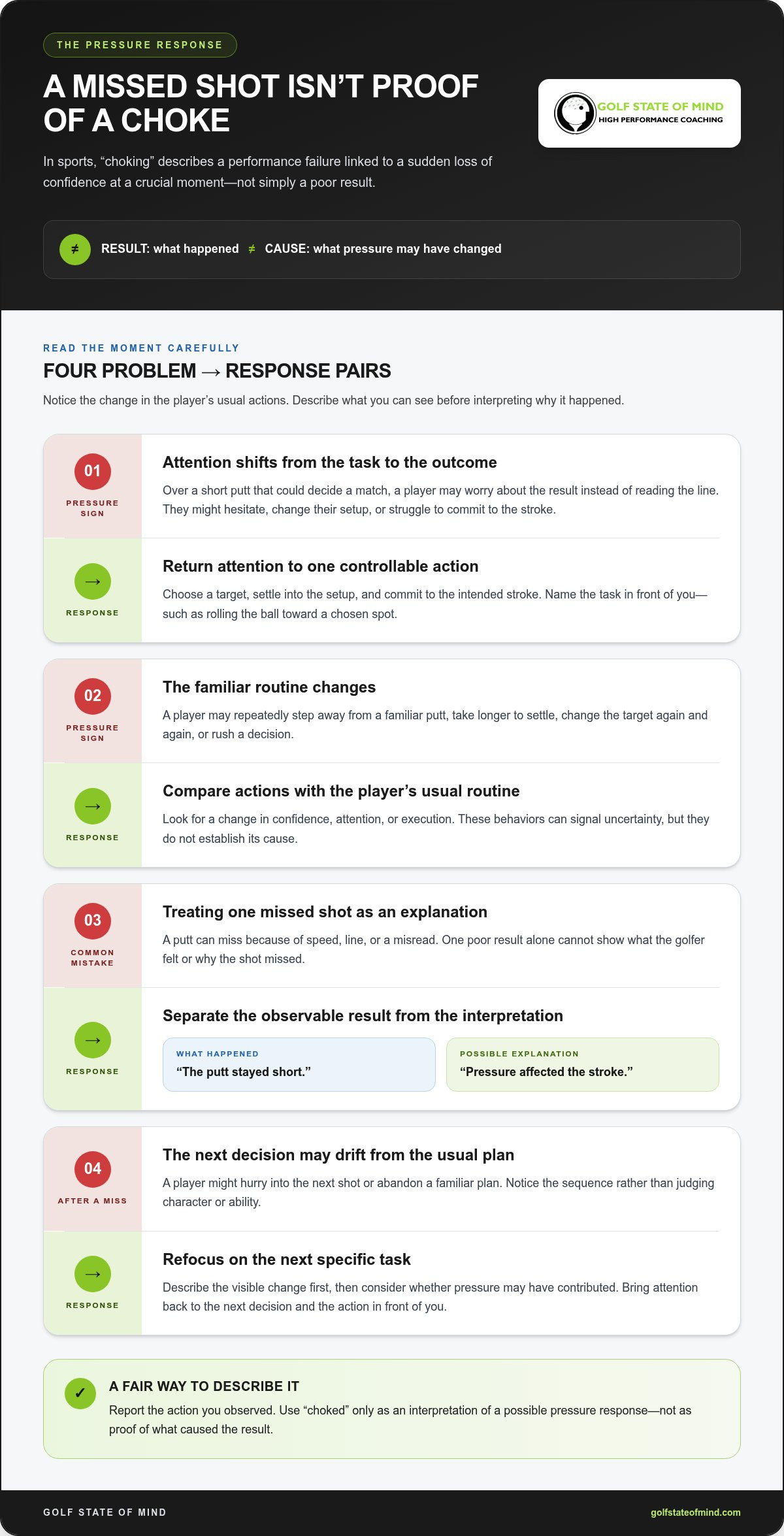
Choking in golf describes a drop in performance associated with the pressure of an important moment. But not every missed shot under pressure is a choke.
I’m David MacKenzie, founder of Golf State of Mind. As a golf mental performance coach, I work with golfers who want to perform more consistently when the stakes are high.
One of the things I’ve learned is that the language golfers use to describe their performances can influence how they approach future challenges.
Calling yourself a choker after one missed putt isn’t particularly helpful.
Understanding what changed in your thinking, preparation, or execution is much more useful.
Let’s look at what choking means in golf, why it happens, how to recognize the signs, and what you can do differently.
What Does Choking Mean in Golf?
In sports psychology, choking under pressure generally refers to performing below your usual ability because the perceived importance of the situation interferes with performance.
In golf, it might happen when:
- You miss a short putt you would normally feel comfortable hitting.
- You become unusually tentative with a lead late in a tournament.
- You abandon your normal routine on an important tee shot.
- You start consciously controlling your swing instead of trusting it.
- You make uncharacteristically poor decisions because you’re worried about the outcome.
But there’s an important qualification.
A bad shot isn’t proof that a golfer choked.
Even the best players miss short putts, hit poor drives, and make mistakes at important moments.
Golf involves uncertainty. No player can control every result.
The more useful question is whether pressure changed the player’s normal process.
Why Do Golfers Choke Under Pressure?
There isn’t one single explanation for every pressure-related performance problem.
But several patterns appear frequently in mental game coaching.
1. Attention Shifts From the Shot to the Outcome
Imagine you’re standing on the 18th tee needing par to shoot your lowest-ever round.
Instead of thinking about your target, you begin calculating what your score will be if you make par.
Then you imagine making bogey.
Then double bogey.
Suddenly, your attention is no longer on the shot you’re trying to play.
It’s on the result you’re trying to protect.
This is one of the most common changes I see when golfers become uncomfortable under pressure.
The solution isn’t to pretend the score doesn’t matter.
It’s to recognize that thinking about the score doesn’t help you execute the next shot.
2. You Start Trying to Control Your Swing
Another common response to pressure is becoming excessively conscious of your technique.
A golfer who normally swings freely might suddenly think:
- “Keep my head still.”
- “Don’t rush the transition.”
- “Make sure I release the club.”
- “Don’t leave the face open.”
These instructions may be useful during technical practice.
But trying to manage several movements during an important shot can interfere with a skill you’ve already developed.
Instead of responding naturally to your target, you’re trying to supervise the movement.
I encourage golfers to separate their practice mindset from their performance mindset.
Practise technique when you’re learning.
During competition, make your decisions and commit to the shot.
3. You Become Afraid of Making a Mistake
Pressure can change the way you approach a challenge.
Earlier in the round, you might have been playing confidently toward sensible targets.
But once you have a good score going, your thoughts change.
“Don’t mess this up.”
“Don’t hit it in the water.”
“Don’t throw away this opportunity.”
I call this moving into a protection mindset.
You’re no longer primarily focused on executing the shot.
You’re trying to avoid an unwanted outcome.
That can lead to hesitation, indecision, and defensive execution.
A performance mindset doesn’t mean taking reckless risks.
It means choosing an appropriate shot and giving it your full commitment.
4. You Interpret Nervousness as a Warning Sign
Some golfers believe they need to feel calm before they can play well.
So when their heart starts beating faster, they become concerned.
“Why am I so nervous?”
“I shouldn’t feel like this.”
“This always happens when I’m about to choke.”
Now they’re anxious about being anxious.
But nervousness is a normal response to an important challenge.
It doesn’t automatically mean your performance will suffer.
You can feel nervous and still make a committed golf swing.
That’s a skill worth developing.
What Are the Signs of Choking in Golf?
Because we can’t directly observe another golfer’s thoughts, it’s important not to diagnose choking simply by watching someone miss a shot.
However, certain changes may suggest that pressure is affecting their process.
| Possible Sign |
What You Might Notice |
| Indecision |
Changing targets or clubs repeatedly |
| Excessive swing thoughts |
Trying to consciously control multiple movements |
| Routine changes |
Rushing, hesitating, or repeatedly stepping away |
| Outcome focus |
Thinking about winning, losing, or protecting a score |
| Defensive decisions |
Choosing shots primarily to avoid embarrassment or failure |
| Physical tension |
Unnecessary tightness in the hands, arms, or shoulders |
| Negative self-talk |
“Don’t choke” or “I always mess this up” |
None of these signs proves that a golfer is choking.
But if you recognize these patterns in your own game, they give you something specific to work on.
Choking vs. Making a Normal Golf Mistake
This distinction is especially important for confidence.
Imagine two golfers miss the same five-foot putt.
The first golfer reads the putt, chooses a line, commits fully, and makes a confident stroke. The ball catches the edge and stays out.
The second golfer repeatedly changes the line, worries about missing, abandons their routine, and makes a hesitant stroke.
Both golfers record the same result.
But their mental processes were very different.
The first golfer may have executed their process well and simply missed.
The second golfer has evidence that pressure interfered with their preparation or commitment.
That’s something they can practise.
When reviewing your golf, don’t confuse a disappointing outcome with a poor mental process.
How to Respond When You Feel Yourself Choking
Suppose you’re standing over an important shot and notice that your mind is racing.
You’re thinking about the score, your swing, and the possibility of failure.
What should you do?
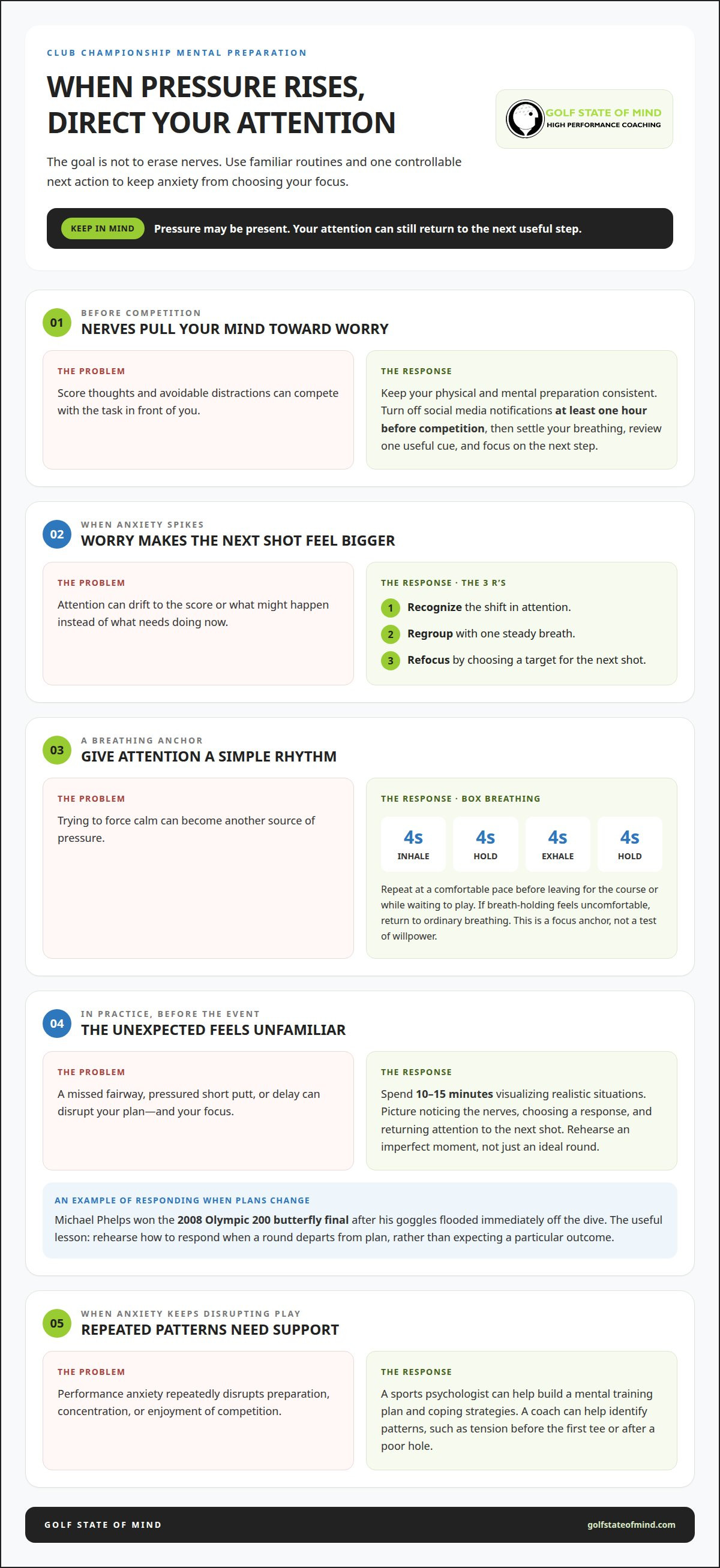
Step 1: Recognize the Change
Ask yourself:
“Am I focused on executing this shot, or am I trying to avoid a bad result?”
You don’t need to criticize yourself for feeling pressure.
Simply recognize where your attention has gone.
Step 2: Accept the Uncertainty
Remind yourself that you can’t guarantee the outcome.
Even a perfectly prepared shot can produce a disappointing result.
Acceptance doesn’t mean lowering your standards.
It means being willing to play the shot without demanding certainty.
Step 3: Return to a Clear Decision
Choose a target and an appropriate shot.
Complete your planning before stepping in.
Don’t keep reopening the decision over the ball.
Step 4: Commit to Your Routine
Use your normal mental pre-shot routine:
- Planning: Choose the shot.
- Athletic: Shift your attention toward the target and execution.
- Acceptance: Respond constructively to the result.
For more guidance, read my article on developing a consistent mental pre-shot routine.
Step 5: Evaluate Your Commitment, Not Just the Result
Afterward, ask:
“Did I make a clear decision?”
“Did I follow my routine?”
“Did I commit fully?”
These questions help you learn from the moment without turning one missed shot into a statement about your ability.
Why Calling Yourself a Choker Can Make Things Worse
One of the biggest problems with the word “choke” is that golfers can begin using it as an identity.
They miss an important putt and say:
“I’m a choker.”
They struggle to finish a good round and say:
“I always choke when it matters.”
Now they’re no longer describing a particular moment.
They’re making a statement about who they are as a golfer.
That distinction matters.
Because the next time they face a similar situation, they may expect the same thing to happen.
And that expectation can influence how they prepare.
Separate Your Player Identity From Your Performance
One of the principles I teach is that your identity as a player shouldn’t be determined by individual results.
Instead of saying:
“I’m someone who always chokes.”
Try:
“I became outcome-focused on that shot and didn’t fully commit. That’s something I can improve.”
The second statement is more specific.
And, importantly, it gives you something to work on.
You don’t need to change who you are.
You need to develop a better response to pressure.
If pressure repeatedly disrupts your performance, don’t wait until your next tournament to practise handling it.
Build small challenges into your normal practice.
Exercise 1: Five Putts in a Row
Choose a short putt that’s realistic but not automatic for your ability.
Your goal is to make five in a row using your full routine.
If you miss, restart the count.
Notice what happens as you approach the fifth putt.
Do you become more cautious?
Do you start thinking about your stroke?
Do you become concerned about having to start again?
Use the exercise to practise committing despite those thoughts.
Exercise 2: One-Ball Pressure Challenge
On the driving range, select a specific target.
Give yourself one opportunity to hit the intended shot.
Go through your full routine.
Then move on to a different club and target.
This removes the comfort of repeatedly hitting balls until you produce a good result.
Exercise 3: The Premortem
Before your next competitive round, imagine a situation where pressure might affect your performance.
Perhaps you’re standing over a putt to win.
Or you’re trying to finish a personal-best round.
Ask yourself:
“What thoughts might appear?”
“How might my routine change?”
“What will I do to return to my process?”
Then rehearse a constructive response.
For example:
“If I start thinking about the score, I’ll acknowledge it, return to my target, and commit to my normal routine.”
This prepares you to respond rather than react.
If you want to become more consistent, it’s helpful to measure something other than your score.
Choose four Performance Commitments:
- Make a clear decision.
- Follow my pre-shot routine.
- Commit fully to the shot.
- Accept the result and respond constructively.
After each hole, award yourself one point for each commitment you followed consistently.
That’s a maximum of four points per hole, or 72 points for an 18-hole round.
This is your Mental Scorecard.
It helps you identify whether your process changes when the pressure increases.
For example, you might notice that you follow your routine consistently for the first 14 holes but begin rushing or hesitating when you have a good score going.
Now you’ve identified a specific area for improvement.
That’s far more useful than simply concluding that you can’t handle pressure.
Golfers often use several expressions interchangeably, but they don’t mean exactly the same thing.
| Term |
Meaning in Golf |
| Choking |
Performance deteriorating because pressure interferes with execution |
| Freezing |
Becoming unusually hesitant or unable to initiate an action |
| Underperforming |
Playing below your usual standard, regardless of the cause |
| Losing composure |
Struggling to manage emotions or behavior |
| Playing defensively |
Prioritizing the avoidance of mistakes over committed execution |
| Faltering |
Becoming less steady or consistent during a challenge |
These distinctions matter because different problems require different responses.
A golfer who is making poor decisions under pressure may need to work on course strategy and commitment.
A golfer whose routine becomes rushed may need to practise their preparation.
A golfer who becomes overly technical may need to improve the transition from practice to performance.
Specific descriptions lead to more useful solutions.
Frequently Asked Questions About Choking in Golf
What does choking mean in golf?
Choking in golf generally means performing below your normal ability because pressure interferes with your thinking, decisions, or execution during an important moment.
Is missing an important putt always choking?
No. Golfers can miss important putts because of normal execution errors, misreads, or other factors. A missed putt alone doesn’t establish that pressure caused the mistake.
Why do golfers choke on the final holes?
As the outcome becomes more important, some golfers shift their attention toward protecting their score, avoiding mistakes, or consciously controlling their swing. These changes can interfere with their normal process.
How do you stop choking under pressure in golf?
Develop a consistent pre-shot routine, practise making committed decisions, learn to accept uncertainty, and rehearse pressure situations during practice. Focus on behaviors you can control rather than demanding a particular result.
Can professional golfers choke?
Yes. Professional golfers experience pressure too. However, it’s important not to assume that every poor shot at an important moment was caused by choking.
What’s the difference between choking and the yips?
Choking refers to a pressure-related decline in performance. The yips involve involuntary movement disturbances or disruptions that can affect skills such as putting or chipping, and their causes may involve neurological, psychological, or combined factors. They shouldn’t automatically be treated as the same problem.
Does feeling nervous mean I’m about to choke?
No. Nervousness is a normal response to an important situation. You can feel nervous and still make clear decisions, follow your routine, and execute committed shots.
How can I rebuild confidence after choking?
Review what actually changed during the moment, identify one behavior to improve, and practise it in realistic situations. Avoid turning one performance into a negative identity statement about yourself.
Final Thoughts: Pressure Doesn’t Have to Define You
Choking in golf is a real performance challenge, but the term is often used too casually.
A missed putt doesn’t make you a choker.
A poor finish doesn’t define your ability.
And feeling nervous doesn’t mean you’re incapable of performing under pressure.
What matters is understanding how pressure affects your attention, decisions, and preparation.
When you can recognize those changes, you can begin training a more effective response.
Focus on clear decisions.
Follow your routine.
Commit to the shot.
Accept the result.
Confidence under pressure isn’t about knowing you’ll succeed. It’s about trusting yourself to commit, even when the outcome is uncertain.
Build a Stronger Mental Game Under Pressure
Download my free mental game ebook to learn practical techniques for managing nerves, improving concentration, and performing with greater confidence when it matters.
Click here to download the free mental game ebook