

How to Improve Putting Confidence: The Mental Blueprint for Fearless Greens
If you want to improve putting confidence, the answer isn’t simply to tell yourself to be more confident.
Confidence on the greens is closely connected to trust.
You read the putt, make a decision, see the line and then allow yourself to make the stroke without continuing to search for answers.
When putting confidence disappears, that process often changes.
You begin questioning the read. You become more aware of your stroke. You think about your hands, the putter face or what happened on the previous green. A three-foot putt that normally feels simple suddenly feels like something you need to control.
The more important the putt becomes, the more tempting it is to interfere.
That’s why learning how to improve putting confidence isn’t only about making more putts in practice. It’s about developing a process that helps you make committed, athletic strokes when the outcome matters.
In this article, I’ll show you how to build putting confidence through better focus, a repeatable routine, target orientation, performance practice and a more constructive response to missed putts.
Key Takeaways
- Putting confidence comes from trust in your process, not from expecting every putt to go in.
- Complete your analysis before addressing the ball so you can move from thinking into playing.
- Direct more attention toward line, speed and target and less toward consciously controlling your stroke.
- A consistent pre-putt routine can help you make committed strokes under pressure.
- Practice should include consequence so you learn to putt when the outcome matters.
- Your response to missed putts has a major influence on your confidence.
- Evaluate the quality of your decision, commitment and stroke rather than judging yourself entirely by whether the ball went in.
Why Putting Confidence Disappears
One reason putting can become mentally difficult is that the result is so obvious.
The ball either goes in or it doesn’t.
And on a short putt, golfers often feel as though they should make it.
That expectation can turn a simple task into a test.
Instead of seeing the line and rolling the ball, you begin thinking:
“I have to make this.”
“Don’t pull it.”
“I missed one of these on the last hole.”
“What if I three-putt?”
Your attention has moved away from the task and toward the consequences.
Confidence Becomes Fragile When It Depends on Results
If your definition of putting confidence is:
“I feel confident because I’ve been making everything.”
then your confidence is always vulnerable.
What happens when you miss two short putts?
What happens when you three-putt?
What happens when the greens are difficult and you don’t make anything for six holes?
A more resilient form of confidence comes from trusting your ability to:
- Read the putt.
- Choose your line.
- Commit to the decision.
- See and feel the speed.
- Go through your routine.
- Make a free stroke.
- Accept the result.
You can’t completely control whether every putt goes in.
You can become very good at doing those things.
Notice When You Become Mechanical
A common sign of lost putting confidence is increased awareness of mechanics.
You start monitoring:
- Your takeaway.
- Your putter path.
- Your wrists.
- Your grip pressure.
- Your head position.
- The putter face through impact.
Technical work certainly has a place in putting.
But if you’re standing over a four-foot putt during a round trying to consciously organize several parts of your stroke, you’ve made the task considerably harder.
You’ve already developed the physical skill.
Now you need to give yourself permission to use it.
Want to improve your confidence on the golf course? Download my free ebook, 7 Key Mental Strategies, and learn practical strategies to improve your confidence, focus and ability to perform under pressure. Get the Free Ebook
How to Improve Putting Confidence
The first step to improve putting confidence is to stop making confidence itself the goal.
You don’t need to stand over every putt feeling certain that it’s going in.
You need to become increasingly certain about your process.
There is an important difference.
You might stand over an eight-foot putt and have no idea whether you’re going to make it.
That’s fine.
But you can know:
“I’ve read it. I’ve chosen my line. I know the speed I want. I’m committed.”
That’s enough.
Confidence Doesn’t Require Certainty About the Outcome
Golf doesn’t offer certainty.
A perfectly struck putt can hit a spike mark, catch the edge and stay out.
A poorly struck putt can occasionally go in.
If you demand certainty about the outcome before making the stroke, you’re asking golf to give you something it cannot provide.
Instead, seek clarity about your intention.
What putt are you trying to hit?
That’s something you can answer.
Build a Consistent Pre-Putt Routine
Your pre-putt routine gives you a familiar process to follow regardless of the importance of the putt.
That becomes particularly valuable under pressure.
When your mind starts thinking about the outcome, the routine gives you something useful to return to.
Do the Thinking Before You Address the Ball
Before stepping into the putt, determine:
- The break.
- The line.
- The speed.
- The target or entry point.
This is where the analytical work belongs.
Take the information available to you and make a decision.
Then commit to it.
Move From Thinking Into Playing
Once you’ve made your decision and moved toward the ball, the task changes.
You don’t need another read.
You don’t need to check your stroke.
You don’t need to predict whether the putt will go in.
Connect with the target, line, speed or feel and make the stroke.
This transition from analysis to execution is one of the most important skills for confident putting.
If You’re Not Committed, Step Away
Sometimes you’ll stand over the putt and doubt your decision.
Perhaps the line suddenly looks different.
Don’t force yourself to hit the putt while thinking:
“This doesn’t look right.”
Step away.
Reassess.
Make another decision.
Then recommit.
That’s very different from repeatedly second-guessing yourself while standing over the ball.
Become More Target-Oriented
One of the most useful ways to improve putting confidence is to move more of your attention away from the mechanics of the stroke and toward what you’re trying to do with the ball.
Become interested in:
- Where the ball needs to start.
- The speed of the putt.
- The break.
- The entry point into the hole.
- The picture of the ball rolling along your intended line.
This gives your attention a clear external task.
See the Putt Before You Hit It
Before making your stroke, create a clear picture of the putt.
Where does it start?
How quickly is it moving?
Where does it begin to break?
How does it enter the hole?
You don’t need an incredibly detailed movie every time.
Some golfers naturally visualize more clearly than others.
The important thing is having a clear intention rather than standing over the ball thinking primarily about your stroke.
Use an Entry Point
Instead of seeing the hole as one large target, consider where you expect the ball to enter.
A breaking putt may enter from the side rather than directly through the center.
This can help clarify both your line and your speed.
Again, the objective isn’t to create another complicated putting rule.
It’s simply a way of making your target more specific.
Stop Trying to Control Your Putting Stroke
When golfers lose confidence, they often try to regain it by increasing control.
They become more careful.
They try harder to make the perfect stroke.
They consciously guide the putter through impact.
Unfortunately, this can make the stroke feel even less natural.
Trust the Skill You’ve Already Developed
Think about throwing a ball to someone.
You look at the target and your body organizes the movement.
You don’t consciously calculate every joint angle required to produce the throw.
Putting obviously isn’t identical, but the principle is useful.
You want to give your trained movement an opportunity to organize itself around a clear intention.
See the putt.
Feel the speed.
Commit.
Then allow the stroke to happen.
Try Target-Focused Practice
One useful exercise is to hit some putts while looking at the target rather than the ball.
This isn’t necessarily how you need to putt on the course.
It’s a training exercise.
Choose putts of different distances and keep your eyes on the hole while making the stroke.
Notice how your body responds to the target and how you sense the distance.
The purpose is to reduce the feeling that you need to consciously supervise the putter head.
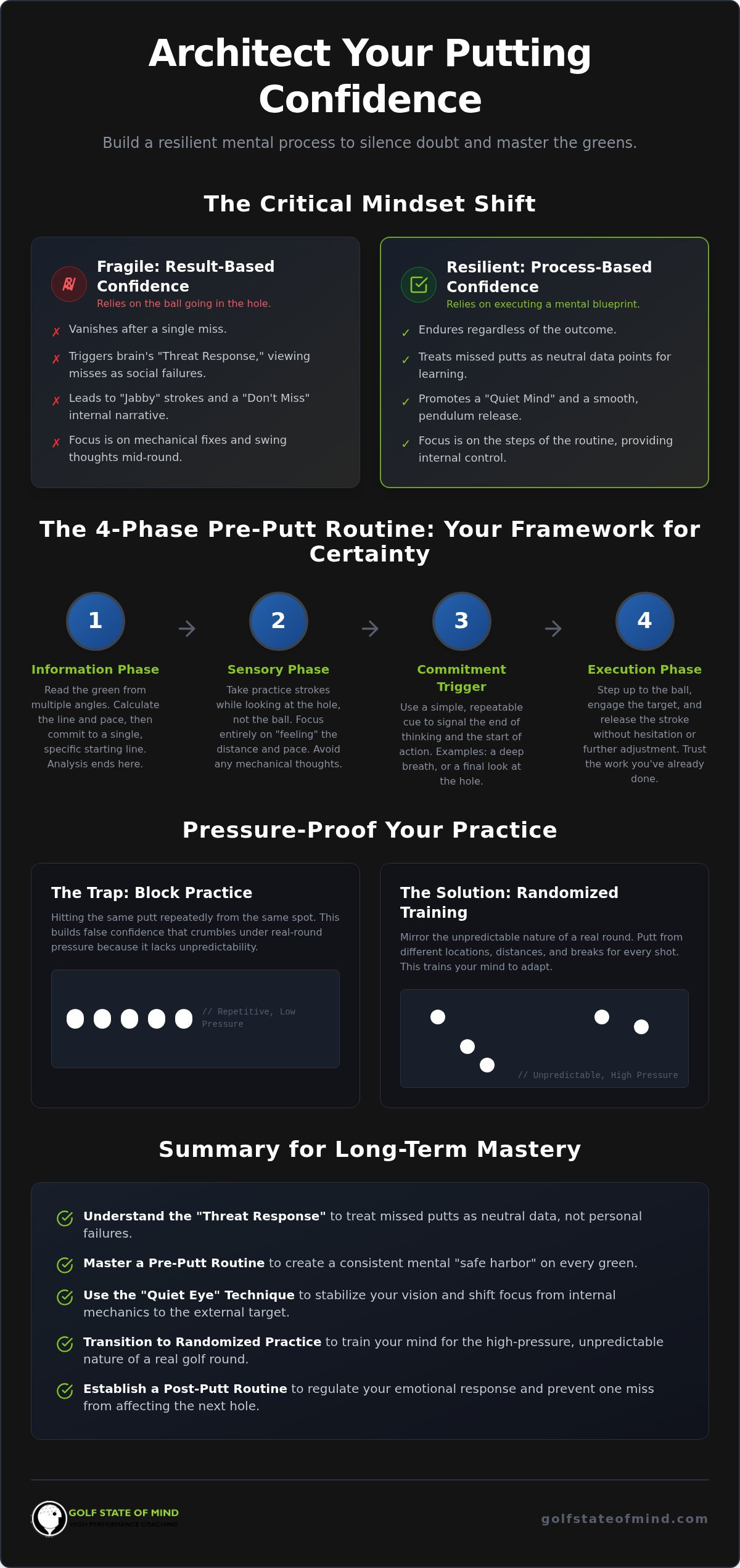
Practice Putting With Consequence
Making 20 consecutive putts from the same spot can feel good.
But it doesn’t necessarily recreate what happens on the golf course.
During a round, you get one attempt.
The distance changes.
The break changes.
And sometimes the outcome matters.
If you want to improve putting confidence under pressure, some of your practice should reflect those conditions.
Use One-Ball Practice
Instead of repeatedly hitting putts from one location, use one ball.
Choose a putt.
Read it.
Go through your full routine.
Hit it once.
Then move somewhere else.
Every putt becomes a new problem.
This is much closer to what happens on the course.
Add Consequence
Once your routine and stroke feel comfortable, create situations where you care about the result.
You might:
- Keep score.
- Compete against another golfer.
- Set a target number of makes.
- Use drills where a miss means starting again.
- Finish practice only after completing a challenge.
Now notice what changes as you get closer to completing the drill.
Does your breathing change?
Do you become more careful?
Do you start thinking about your stroke?
Do you rush?
That’s where the mental training begins.
Build Confidence on Short Putts
Short putts are particularly interesting because golfers know they’re expected to make a high percentage of them.
That expectation can create pressure.
One drill I like for combining putting skill with mental performance is the N-S-E-W Putting Drill.
The N-S-E-W Putting Drill
Place three tees at:
- 3 feet.
- 4 feet.
- 5 feet.
Repeat this from four different directions around the hole: north, south, east and west.
You now have 12 putts.
Work your way around the hole and try to make all 12 consecutively.
If you miss one, start again.
The first few putts may not feel particularly important.
But what happens when you’ve made nine, ten or eleven?
Now there is consequence.
Use the Drill to Practice Confidence
Don’t simply judge whether you completed the drill.
Pay attention to:
- Your routine.
- Your commitment.
- Your breathing.
- Your target focus.
- Your stroke freedom.
- Your reaction if you miss.
The purpose is not merely to hole 12 putts.
It’s to practice executing the same process when the putt begins to matter.
Want to build more confidence when the pressure is on? Download my free 7 Key Mental Strategies ebook and learn practical mental game strategies you can start using in practice and on the course. Download the Free Ebook
How to Handle Putting Pressure
Confidence doesn’t mean you never feel nervous over an important putt.
You can feel nervous and still make an excellent stroke.
The mistake is assuming the nerves need to disappear before you can perform.
Accept That the Putt Matters
If you’re standing over a putt to win a tournament, break 80 for the first time or shoot your lowest round, of course it may feel different.
There’s something at stake.
Rather than fighting the feeling, acknowledge it:
“I’m nervous because this matters.”
Then return to your process.
Read.
Decide.
Commit.
See the putt.
Make the stroke.
Use Your Breathing
If you notice your physical state becoming unsettled, breathing can help you regulate it.
One technique I use with golfers is 4–6 breathing:
- Breathe in for four seconds.
- Breathe out for six seconds.
- Repeat as appropriate before playing or while waiting.
You don’t necessarily need to do 10 complete breaths while standing over an important putt.
The longer exercise is better used before the round or between periods of play.
When you’re preparing to putt, one deliberate breath may be enough to help you reconnect with the present.
You can learn more in my guide to golf breathing techniques.
How to Respond After a Missed Putt
Your response to a miss has an enormous influence on your putting confidence.
Imagine missing a four-footer and immediately saying:
“Here we go again. I can’t make anything.”
You’ve taken one missed putt and turned it into a prediction about every future putt.
Now the next short putt carries the weight of the previous one.
Separate the Process From the Result
After a putt, ask:
- Did I read it well?
- Was I committed?
- Did I start it where I intended?
- Was the speed appropriate?
- Did I make a free stroke?
If you did those things and the ball didn’t go in, that’s golf.
Take any useful information and move on.
Don’t Label Your Putting
Be careful with statements such as:
“I’m putting terribly.”
“I’ve lost my putting.”
“I can’t make short putts.”
Those statements take a small sample of results and turn them into an identity.
Describe what happened more accurately.
“I missed two short putts.”
That’s information.
It doesn’t tell you what will happen on the next green.
How to Build Long-Term Putting Confidence
If you want to improve putting confidence over the long term, don’t wait until you’ve lost it before working on it.
Build the mental skills alongside the physical ones.
Your putting practice should develop:
- Green reading.
- Speed control.
- Start line.
- Routine.
- Commitment.
- Target orientation.
- Pressure response.
- Post-putt response.
Confidence then becomes the result of preparation.
Keep Evidence of Good Putting
Golfers are often very good at remembering misses.
The three-footer on 18 stays with you.
The six-footer you confidently holed on the 7th disappears from memory.
After your rounds, deliberately notice evidence of good putting.
Not just putts that went in.
Include:
- Putts where you committed completely.
- Excellent speed.
- Good reads.
- Free strokes under pressure.
- Strong responses after misses.
This creates a more accurate picture of your putting performance.
Putting Confidence Comes From Trust
If you want to improve putting confidence, stop waiting for confidence to magically appear.
Build something you can trust.
Develop a consistent routine.
Make clear decisions.
Become more target-oriented.
Reduce unnecessary mechanical thinking.
Practice with consequence.
Learn how you respond when a putt matters.
And stop allowing every missed putt to become evidence that something is wrong.
You will miss putts.
So will the best putters in the world.
Confidence isn’t believing you’re going to make everything.
It’s knowing that regardless of what happened on the previous green, you can read the next putt, commit to it and make a free stroke.
That’s a form of confidence you can actually train.
Frequently Asked Questions
How can I improve putting confidence?
To improve putting confidence, focus on developing a repeatable process rather than trying to guarantee that every putt goes in. Build a consistent routine, make clear decisions, direct your attention toward line and speed, practice under consequence and evaluate the quality of your commitment and stroke rather than judging yourself entirely by the result.
How do I regain confidence after a bad putting round?
Avoid immediately rebuilding your technique based on one poor round. Review what actually happened. Were your reads poor? Was your speed off? Did you become tentative or mechanical? Identify anything useful, then return to practice with a clear objective. One bad putting round isn’t evidence that you’ve permanently lost your ability.
Why do I putt better in practice than on the golf course?
Practice often has less consequence. You may hit several balls from the same position and quickly become comfortable with the putt. On the course, you get one attempt and the result affects your score. Use one-ball practice and consequence drills to make some of your practice more representative of performance.
How do I stop thinking about my putting stroke?
Move more of your attention toward the task: line, speed, target and the picture of the putt. Complete any necessary technical work during practice rather than trying to consciously control several parts of the stroke during competition. Target-focused drills can also help you develop greater trust in the movement.
How do I become more confident on short putts?
Practice short putts with a consistent routine and gradually introduce consequence. Drills such as the N-S-E-W Putting Drill allow you to experience increasing pressure as you approach completion. Use that pressure to practice commitment, target focus and a free stroke rather than simply trying to accumulate easy makes.
Why do I get nervous over short putts?
Short putts often feel as though you should make them, which increases the perceived consequence of missing. Instead of trying to eliminate the nerves, accept that the putt matters and return your attention to your process: read, decision, target, commitment and stroke.
What should I focus on when putting?
During your analysis, focus on the information required to read the putt: line, break and speed. Once you’ve made the decision, shift toward the target, entry point, picture or feel of the putt. Avoid continuing to analyze your stroke once you’ve committed.
Does visualization help putting confidence?
Visualization can help create a clear intention for the putt. Picture the starting line, speed, break and how the ball might enter the hole. The purpose isn’t to guarantee the outcome; it’s to give your attention a clear representation of the putt you’re trying to hit.
How do I putt better under pressure?
Practice putting in situations where there is consequence, learn how pressure changes your normal behavior and maintain the same decision-making and routine you use on less important putts. Don’t make feeling calm a requirement. Your goal is to execute your process even when you feel nervous.
Should putting confidence depend on whether I make the putt?
No. If confidence depends entirely on makes and misses, it will always be fragile. A more resilient form of confidence comes from knowing you can read the putt, commit to your decision, make a free stroke and respond constructively regardless of the outcome.
Free Mental Game of Putting Course
