
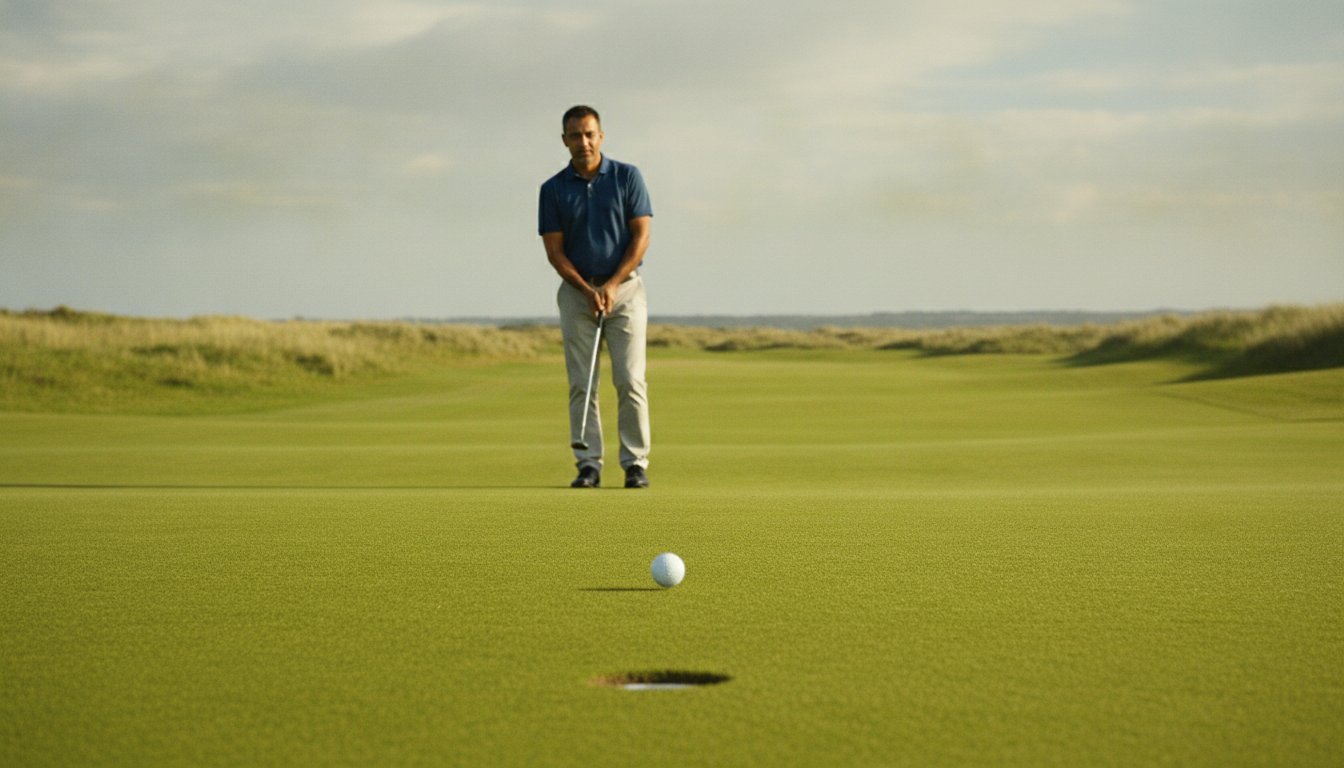
Golf Putting Yips Fix: A Scientific Approach to Permanent Recovery
“`html
Few things in golf are more frustrating than the putting yips.
A putt you’ve made thousands of times suddenly feels completely different.
You stand over a three-footer knowing exactly what you want to do, but instead of allowing the stroke to happen naturally, you become increasingly aware of your hands, the putter and the moment of impact.
You might feel a twitch.
You might jab at the ball.
You might freeze over it.
Or you might simply feel as though you no longer trust yourself to start the putter.
Then the fear of the yip becomes almost as difficult as the yip itself.
If you’re searching for a golf putting yips fix, the first thing I’d encourage you to do is stop treating every yipped putt as evidence that you’ve somehow forgotten how to putt.
The yips are complex. For some golfers there appears to be a strong anxiety and performance component. For others there may be a movement-related component, and research has also examined the possible role of task-specific focal dystonia.
That’s one reason I don’t believe there’s one universal putting yips cure.
But there are practical changes you can make to the way you think, practice and approach these putts that can help you reduce fear, decrease excessive control and begin rebuilding trust in the stroke.
Key Takeaways
- The putting yips are complex and shouldn’t automatically be treated as either purely mental or purely technical.
- Fear of the yip can create a cycle of anticipation, increased control and further fear.
- Constantly trying to prevent the yip can make you increasingly conscious of the movement.
- Acceptance doesn’t mean giving up; it means reducing the struggle with what you’re experiencing.
- Changing your attention can help you move away from consciously controlling the stroke.
- Different grips, putters and techniques can help some golfers and shouldn’t automatically be dismissed.
- Practice should gradually rebuild trust rather than repeatedly testing whether the yips have disappeared.
- Measure progress by freedom, commitment and response as well as makes and misses.
What Are the Putting Yips?
The term “yips” is used to describe involuntary or unwanted movements that interfere with the execution of a familiar skill.
In putting, golfers describe experiences such as:
- A sudden twitch or jerk.
- Freezing before starting the stroke.
- Difficulty taking the putter back.
- A stabbing or hitting motion through impact.
- A feeling that one hand suddenly takes over.
- An overwhelming urge to consciously control the putter.
What makes the yips particularly difficult is that the golfer usually knows perfectly well how to putt.
They may even stroke the ball freely on the practice green.
Then a particular situation appears — often a short putt with something riding on the outcome — and the experience changes.
The Fear of the Yip Becomes Part of the Problem
After you’ve experienced the yips enough times, you begin anticipating them.
You walk toward a three-foot putt and think:
“Please don’t do it.”
You become aware of your hands.
You become aware of the putter.
You become aware of the moment of impact.
You start monitoring the movement you’re trying to perform.
Now you’re no longer simply putting.
You’re putting while watching yourself put.
That distinction is important.
Want to build greater trust and confidence in your mental game? Download my free ebook, 7 Key Mental Strategies, for practical strategies to improve focus, confidence and performance under pressure. Get the Free Ebook
Why Can the Putting Yips Get Worse?
The natural response to losing control is to try to create more control.
That’s understandable.
If your hands feel unpredictable, you want to make sure they behave.
So you grip tighter.
You think more about the stroke.
You rehearse it repeatedly.
You try to guide the putter through impact.
You tell yourself:
“Don’t twitch.”
But now your entire attention is centered on the very movement you’re afraid of.
The Yips Can Become a Cycle
A pattern can develop:
Yip → fear of yipping → increased control → increased awareness of the stroke → more fear.
That’s why simply telling yourself to relax usually isn’t enough.
You need to begin changing your relationship with the experience itself.
Are the Putting Yips Mental or Physical?
This is one of the most common questions golfers ask me.
The most responsible answer is:
It depends.
The yips have been studied from both psychological and neurological perspectives.
For some golfers, anxiety and pressure appear to play a significant role.
For others, movement-related factors may be involved.
And sometimes those factors may overlap.
That’s why I’d be cautious of anyone who tells you that every case of the putting yips has exactly the same cause.
Look at When the Yips Appear
Start becoming curious about your own pattern.
Do they happen:
- Only on short putts?
- Only when keeping score?
- Only in competition?
- During practice as well as play?
- With one particular hand or movement?
- When you become highly conscious of the stroke?
You’re not trying to diagnose yourself.
You’re trying to understand the circumstances surrounding the problem.
That information can help determine the most appropriate way forward.
Step 1: Stop Fighting the Yip
This sounds counterintuitive.
You’ve come here looking for a golf putting yips fix, so surely the objective is to stop the yip?
Ultimately, you want to putt more freely.
But trying desperately to prevent the yip on every stroke can increase your fear of it.
Acceptance Is Different From Resignation
Acceptance doesn’t mean:
“I have the yips and there’s nothing I can do.”
It means:
“This is something I’m experiencing right now. I don’t have to fight it on this stroke.”
That shift can be important because it changes the objective.
Instead of:
“I absolutely cannot yip this putt.”
you can move toward:
“I’m going to choose my line, connect with the target and make the stroke.”
Remove the Test
One of the biggest traps in yips recovery is continually asking:
“Are they gone yet?”
You hit a few good putts.
Then you find a three-footer and test yourself.
You feel something unusual.
Immediately:
“They’re still there.”
Now you’re back to monitoring.
Recovery is more useful when you’re practicing a different way of approaching the putt rather than repeatedly checking whether the symptom has disappeared.
Step 2: Change Your Attention
Golfers with the putting yips often become intensely focused on the movement itself.
The hands.
The putter.
The takeaway.
Impact.
Trying to control all of this can make the stroke feel increasingly unnatural.
One useful approach is to experiment with moving your attention somewhere else.
Focus on the Target
Instead of asking:
“How am I going to move the putter?”
become clearer about:
“Where am I sending the ball?”
See the line.
See the entry point.
Feel the speed.
Allow putting to become a target-oriented task again.
Use Rhythm or Feel
Some golfers respond well to a simple cue such as:
“Smooth.”
“Roll.”
“Through.”
The word itself isn’t magic.
Its purpose is to give your attention somewhere to go other than monitoring the movement you’re afraid of.
Experiment With Looking at the Hole
Some golfers find it useful to practice putting while looking at the target rather than the ball.
This isn’t necessarily a permanent technique you have to adopt.
It can simply be an exercise that changes where your attention goes and allows you to experience the stroke differently.
Try Putting With Your Eyes Closed
Another practice exercise is hitting short putts with your eyes closed.
Again, this isn’t about discovering a miracle cure.
It’s an experiment.
Can you feel the stroke without watching and controlling it?
Can you allow the movement to happen?
The goal is curiosity rather than judgment.
Step 3: Simplify Your Putting Routine
When a golfer develops the yips, the routine can gradually become longer and more complicated.
More practice strokes.
More checking.
More time over the ball.
More reassurance.
That can create even more opportunity for doubt.
Make the Routine About the Putt
Your routine might simply involve:
- Read the putt.
- Choose the line.
- Feel the speed.
- Look at the target.
- Set up.
- Go.
The objective is not to create the perfect routine.
It’s to give yourself a simple path from decision to action.
Don’t Wait Until You Feel Perfect
You may still feel nervous.
Your hands may not feel exactly how you want them to feel.
You may still have the thought:
“What if I yip it?”
That’s okay.
The goal isn’t to eliminate every uncomfortable feeling before you’re allowed to putt.
The goal is to become increasingly willing to make the stroke without resolving all of that first.
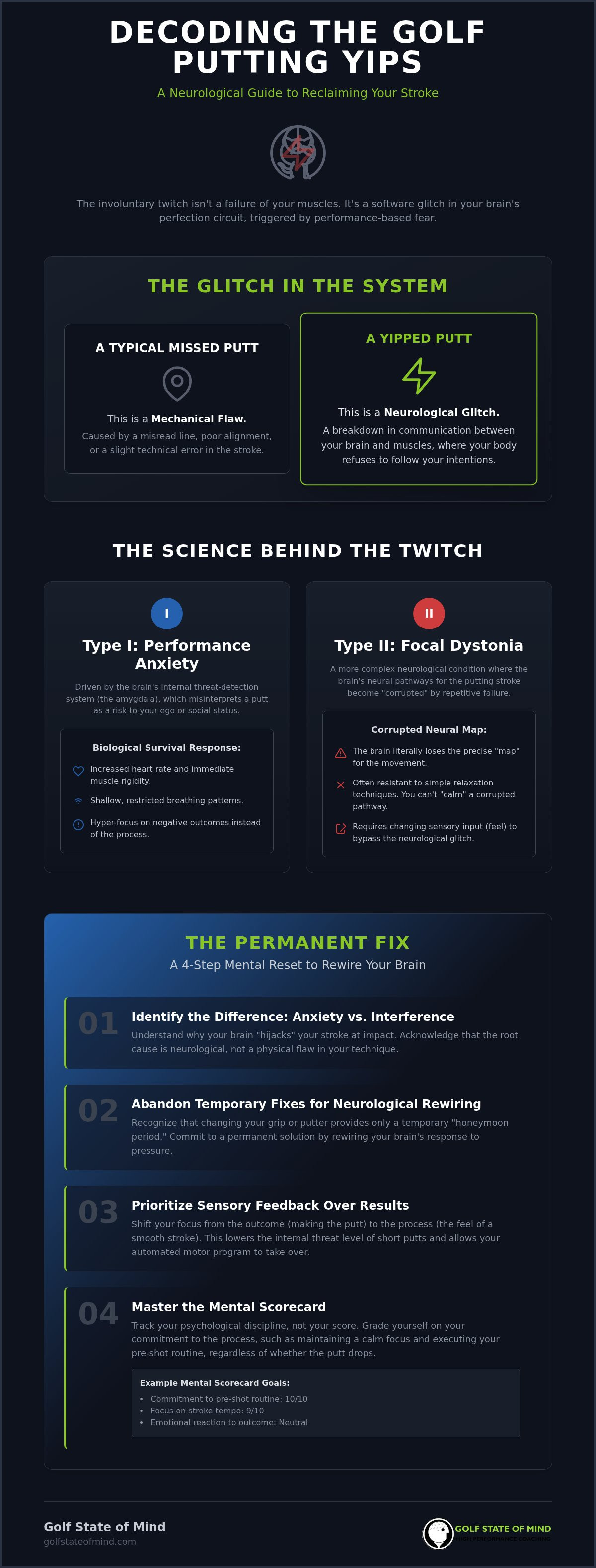
Step 4: Rebuild Trust Through Practice
How you practice is particularly important when you’re dealing with the putting yips.
You don’t want every practice session to become another examination.
“Can I make this one?”
“What about this one?”
“Are the yips gone?”
Instead, start creating experiences of freedom and commitment.
Begin Without Much Consequence
Start with putts where the outcome doesn’t feel particularly important.
Experiment with:
- Looking at the hole.
- Eyes-closed putting.
- Different speeds.
- Different distances.
- One-handed putting.
- Putting to a tee rather than a hole.
- Focusing entirely on rhythm or roll.
Notice what helps you become less concerned with controlling the movement.
Don’t Groove the Fear
If you stand in the same place hitting 50 three-footers while anxiously waiting for the yip, you may simply be practicing fear and monitoring.
Change distances.
Change targets.
Move around the green.
Make putting feel like a skill again rather than a test.
Can Changing Your Grip or Putter Help?
Yes, sometimes.
I wouldn’t dismiss physical changes simply because the yips have a mental component.
Golfers have successfully used different approaches including:
- Left-hand-low putting.
- The claw grip.
- Different grip pressure.
- Different putter styles.
- Different stroke feels.
- Looking at the hole.
A change can alter both the movement and your experience of the movement.
For some golfers that can be extremely useful.
Don’t Turn Equipment Into an Endless Search
The problem occurs when every difficult experience causes another change.
New putter.
New grip.
New technique.
New thought.
Now you’re constantly searching for something that guarantees the yip won’t happen.
No technique can give you that guarantee.
If you make a change, give yourself time to explore and learn it rather than immediately judging it by whether you miss a short putt.
Reintroduce Pressure Carefully
Eventually, you want to be able to putt when the outcome matters.
But don’t turn every practice session into a pressure test from the beginning.
Build Gradually
You might progress from:
Freedom → target → routine → consequence → competition.
First, rediscover a freer movement.
Then connect it to a target.
Then use your routine.
Then introduce simple scoring games.
Finally, test it in more competitive situations.
Expect Some Discomfort
When pressure returns, some of the old sensations or thoughts may return too.
That doesn’t automatically mean you’ve gone backwards.
This is your opportunity to practice responding differently.
Notice the fear.
Accept its presence.
Return to the target.
Make the stroke.
Use a Mental Scorecard
One of the problems with recovering from the putting yips is that golfers measure everything by makes and misses.
If the putt goes in:
“I’m getting better.”
If it misses:
“The yips are back.”
That’s an exhausting way to measure progress.
Measure the Process Too
You might score yourself on:
- Commitment.
- Acceptance.
- Target focus.
- Routine.
- Freedom of stroke.
- Response after a difficult putt.
You still care whether the ball goes in.
Of course you do.
But you’re also measuring whether you’re changing the behaviors that surround the yips.
What to Do With the Yips During a Round
It’s one thing to work on the yips in practice.
It’s another when you’re standing over a three-footer on the sixth green and can feel the fear returning.
Don’t Start Fixing Your Stroke
Avoid making a new technical diagnosis after every difficult putt.
That can quickly increase your internal focus and uncertainty.
Return to Something Simple
Your job might be:
Read it. See it. Feel the speed. Go.
Or simply:
Target. Roll.
The exact words aren’t important.
Simplicity is.
Allow the Possibility of the Yip
This is difficult, but powerful.
Instead of:
“I cannot yip this.”
try:
“It might happen. I’m still going to make a committed stroke.”
You’re removing some of the struggle.
You’re no longer demanding certainty before you can act.
When to Get Help With the Putting Yips
Because the putting yips can have different contributing factors, it can be useful to get another perspective if the problem is persistent.
A qualified putting instructor can help determine whether there are technical or equipment factors worth addressing.
A mental performance coach can help with areas such as:
- Fear of the yip.
- Attention and focus.
- Excessive conscious control.
- Acceptance.
- Confidence.
- Practice structure.
- Performance under pressure.
And if the involuntary movement is persistent, occurs outside golf, or you have concerns that there may be a neurological component, it’s appropriate to discuss it with a qualified healthcare professional.
Are the putting yips stopping you from enjoying your golf or playing the way you know you’re capable of? I’ve worked with golfers on the mental and performance aspects of the yips for many years. If you’d like to discuss what you’re experiencing and whether mental coaching could help, Book a Free 15-Minute Consultation.
A Better Way to Think About Recovery
If you’re looking for a permanent golf putting yips fix, it’s understandable that you want the problem gone as quickly as possible.
But I would be careful about making “never yip again” the measure of success.
That can keep you continually monitoring yourself for signs of the problem.
A better objective is to progressively rebuild:
- Freedom.
- Trust.
- Target focus.
- Commitment.
- Acceptance.
You may experience setbacks.
You may have days when the stroke feels easy and others when some of the old fear returns.
That doesn’t mean you’re back at the beginning.
You’re learning a different response.
Instead of fighting the yip, become less afraid of it.
Instead of controlling the stroke, reconnect with the target.
Instead of continually testing yourself, practice freedom.
And instead of asking:
“How do I guarantee this won’t happen?”
start asking:
“How do I want to approach this putt, even if I feel uncomfortable?”
That shift can be an important part of finding your way back to more instinctive, confident putting.
Frequently Asked Questions
What are the putting yips?
The putting yips describe unwanted or involuntary movements that interfere with a golfer’s putting stroke. Golfers may experience twitching, jerking, freezing or difficulty initiating the stroke. The experience can vary considerably from one golfer to another.
Are the putting yips mental or physical?
The yips are complex and shouldn’t automatically be categorized as purely mental or purely physical. Research has examined psychological factors such as anxiety as well as movement-related and neurological factors, including task-specific focal dystonia. The relative contribution of these factors may differ between golfers.
How do you fix the putting yips?
There isn’t one putting yips fix that works for everyone. Useful approaches can include changing where you direct your attention, reducing excessive conscious control, simplifying your routine, changing practice structure, experimenting with different grips or techniques and gradually rebuilding confidence under pressure. Persistent cases may benefit from input from appropriate technical, mental-performance or healthcare professionals.
Can the putting yips be cured permanently?
Some golfers are able to significantly reduce or overcome their yips, but I would be cautious of anyone guaranteeing a permanent cure. The yips can have different contributing factors, and recovery varies between individuals. Focusing on freedom, trust and your response to symptoms is generally more useful than continually testing whether they’re permanently gone.
Why do I get the yips on short putts?
Short putts often carry greater expectation because golfers feel they should make them. That can increase attention to the outcome and awareness of the stroke itself. Once you’ve experienced a yip from a particular distance, anticipation can also become part of the pattern.
Why can I putt normally in practice but get the yips on the course?
Practice and competition create different levels of consequence. If the yips are strongly associated with anxiety, expectation or conscious control, they may become more noticeable when the putt affects your score. This is why gradually introducing consequence into practice can be useful.
Can changing my grip help the putting yips?
Yes, it can help some golfers. Changing to a claw, left-hand-low or another grip changes the movement and sensory experience of the stroke. However, no particular grip is guaranteed to eliminate the yips, and repeatedly changing technique whenever symptoms appear can become another form of searching for certainty.
Does buying a new putter help with the yips?
A different putter can change feel, setup and movement and may help some golfers. Equipment should therefore not automatically be dismissed. However, if fear, attention and excessive control are major parts of your yips, equipment alone may not address all of the contributing factors.
Should I look at the hole when putting with the yips?
It’s worth experimenting with. Looking at the hole moves visual attention away from the putter and ball and toward the target. Some golfers find this helps them make a freer stroke. It can be used as a practice exercise or, if effective, explored as a putting method.
Should I practice short putts if I have the yips?
Yes, but be careful about repeatedly hitting the exact putt that creates the most fear simply to test yourself. Begin by creating freer putting experiences, vary distances and targets, and gradually reintroduce the situations that challenge you.
What should I think about when I feel a yip coming?
Rather than telling yourself not to yip, direct your attention toward something useful such as the target, intended roll, speed, rhythm or a simple cue word. The objective is not to guarantee that the yip won’t occur, but to reduce the amount of attention devoted to monitoring and controlling the stroke.
Can anxiety make the putting yips worse?
Yes, anxiety can contribute to or intensify the yips for some golfers. Increased concern about the outcome can lead to greater self-monitoring, physical tension and attempts to consciously control the stroke. However, anxiety isn’t necessarily the only contributing factor in every case.
Can stress outside golf make the putting yips worse?
It’s possible. General stress can affect tension, attention and how you respond to pressure on the course. If you notice that your symptoms are worse during particularly stressful periods, that’s useful information to consider as part of the broader pattern.
“`
Cures For The Yips
