How to Handle Pressure in Golf: The Science and Strategy of Peak Performance
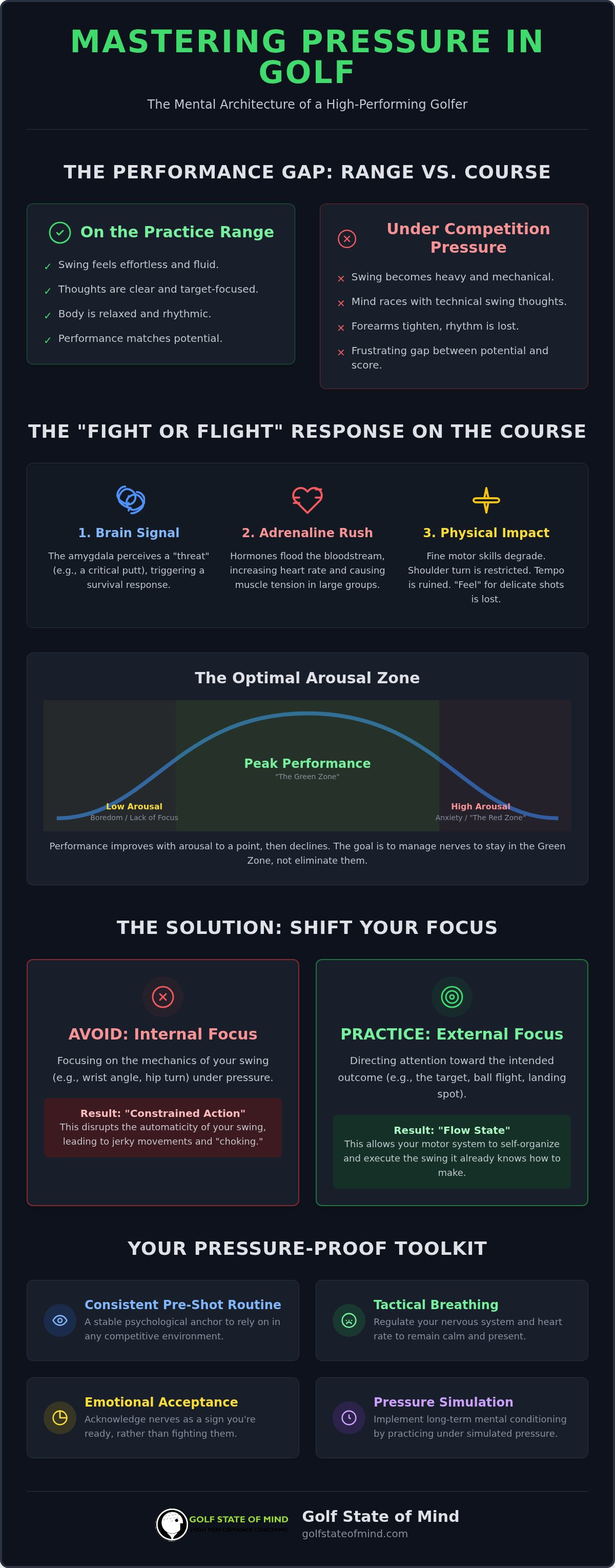
Why does a swing that feels effortless on the practice range suddenly become heavy and mechanical when you step onto the first tee? You’ve likely…
Cures For The Yips



“`html
If you’ve experienced the yips, you know how frustrating they can be.
A putt or chip that you’ve executed thousands of times can suddenly feel completely different. Instead of simply seeing the target and making the stroke, you become intensely aware of the movement. You may feel tension, hesitation, a flinch or the sense that you can’t simply let the stroke happen.
Then something else happens: you start anticipating it.
You stand over the next short putt wondering whether the yip is going to happen again. That anticipation creates more tension and more conscious control, which can make the problem even worse.
I’ve worked with many golfers struggling with putting, chipping and other forms of the yips, and one of the most important things to understand is that simply trying harder to control the movement is rarely helpful.
In many cases, that’s exactly what keeps the cycle going.
There isn’t one universal golf yips cure that works for every golfer, and the yips can have different contributing factors. But there are mental strategies that can help you reduce fear, shift your attention and begin rebuilding trust in your natural movement.
This article will show you where to start.
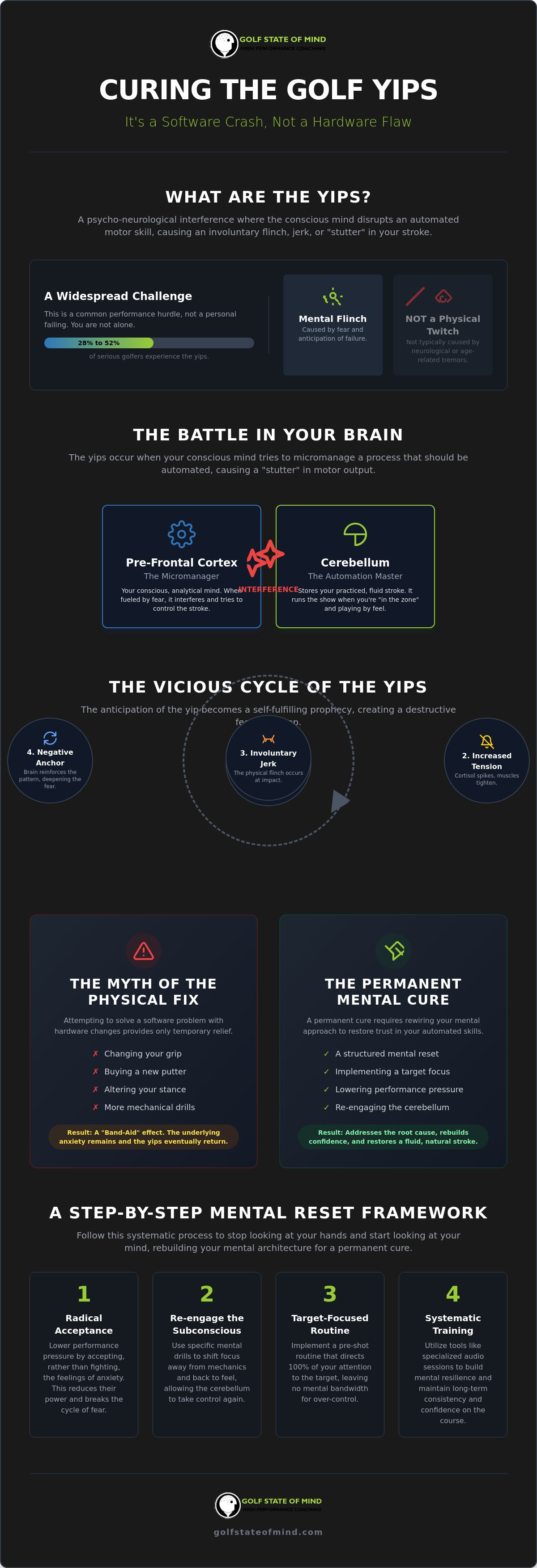
The yips are involuntary movements or disruptions that can appear during skills that were previously comfortable and automatic.
In golf, they’re most commonly associated with putting and chipping, although golfers can experience similar problems with pitching, bunker shots and even the full swing.
The experience varies from golfer to golfer.
You might feel:
One of the most difficult parts of the yips is that you know you possess the physical ability to execute the shot.
You may even be able to make a perfectly free stroke when there is no ball there, or when you’re practicing without caring about the result.
But once the outcome matters, everything can change.
Putting yips are probably the form golfers are most familiar with. A short putt that once felt almost automatic begins to create tension and uncertainty.
Chipping yips can produce a similar experience. Instead of seeing the landing spot and reacting naturally, the golfer becomes increasingly focused on making perfect contact.
Some golfers experience the problem with longer shots too. They may struggle to start the backswing, become extremely tense over the ball or feel unable to swing freely.
Although these experiences aren’t identical, they often share an important characteristic:
The golfer’s attention has become increasingly focused on controlling a movement that used to happen more automatically.
The yips are more complicated than simply saying they’re “all in your head.”
Researchers have examined both psychological factors and neurological factors, including task-specific focal dystonia, and different golfers may experience the problem differently.
That’s important because I don’t think golfers should assume every involuntary movement has exactly the same cause.
If you’re experiencing unexplained or persistent involuntary movements, particularly outside golf as well, it’s appropriate to discuss them with a qualified medical professional.
From a mental performance perspective, however, we can work on something very important: the fear, attention, tension and conscious control surrounding the movement.
For many golfers, changing those patterns can make a significant difference.
Imagine a golfer who misses a short putt because of a sudden twitch.
What is their natural response?
Usually, they try to make sure it doesn’t happen again.
They might start thinking about their grip pressure.
Then their wrists.
Then the putter face.
Then the path of the stroke.
Then exactly what their hands should be doing through impact.
The movement that was once largely automatic has now become something they’re consciously trying to supervise.
And the more important the putt becomes, the more urgently they try to control it.
This is one reason mechanical fixes don’t always provide a lasting golf yips cure.
A different grip, putter or technique can sometimes help. There’s nothing inherently wrong with experimenting with those things.
But if the underlying fear and need for control remain unchanged, the golfer can eventually become just as conscious of the new technique as the old one.
This is an important shift.
If you’ve made thousands of good putting strokes or chips in your life, you don’t need to consciously manufacture every part of the movement.
The skill is already there.
The challenge is creating the conditions that allow you to access it.
That’s a very different goal from trying to build the perfect stroke while you’re standing over the ball.
Eventually, many golfers aren’t just afraid of missing.
They’re afraid of the yip itself.
You walk toward a three-foot putt and think:
“What if it happens again?”
Now your attention isn’t really on the putt.
It’s on detecting and preventing an unwanted movement.
You may grip the club more tightly, become more careful and start monitoring your hands.
If the stroke goes badly, that becomes more evidence for the next putt.
The cycle can look something like this:
Fear of the yip → increased attention on the movement → tension and control → poor or uncomfortable stroke → more fear of the yip.
Breaking that cycle is an important part of recovery.
Want to strengthen your mental game? Download my free ebook, 7 Key Mental Strategies, and learn practical strategies for improving your confidence, focus and response to pressure on the golf course. Get the Free Yips Cure Ebook
This can feel counterintuitive.
When golfers desperately want the yips to disappear, their instinct is to fight them.
But fighting creates another demand:
“This absolutely cannot happen.”
That makes the shot feel even more threatening.
A more useful approach is to begin reducing your resistance to the possibility of the yip.
You might tell yourself:
“It might happen. I’m going to hit the putt anyway.”
That doesn’t mean you want it to happen.
It means you’re no longer making the absence of the yip a requirement for hitting the shot.
This is a very important distinction.
Acceptance doesn’t mean resignation.
It doesn’t mean deciding you’ll have the yips forever.
It means acknowledging what you’re experiencing without immediately trying to fight, suppress or control it.
If you feel tension, notice the tension.
If you feel nervous, notice the nerves.
If the thought “I’m going to yip this” appears, recognize that it’s a thought rather than an instruction.
Then return your attention to what you actually want to do.
One of the biggest changes I want golfers with the yips to make is where they place their attention.
The more frightened you become of the movement, the more tempting it is to monitor the movement.
Instead, gradually move your attention outward.
For a putt, become interested in:
For a chip, focus on:
The objective is to make the shot more important than the mechanics of producing it.
If you need something to connect with during the movement, a general feel or rhythm is often more useful than several technical positions.
You might connect with the weight of the putter head, the overall rhythm of the stroke or the picture of the ball rolling toward the hole.
Experiment with what allows you to become less conscious of controlling your hands.
There isn’t one universal focus that works for everybody.
The important question is:
Does this focus help me become more athletic and less controlling?
If you’ve had the yips for some time, you may have accumulated a lot of negative evidence.
You remember the three-footer you missed on the 18th.
You remember the chip you bladed across the green.
You remember the embarrassment and frustration.
Recovery requires creating new experiences.
But don’t immediately make the practice as difficult and threatening as possible.
Start by creating an environment in which you can rediscover freedom of movement.
Hit putts or chips where the outcome isn’t particularly important.
Instead of judging every shot, pay attention to freedom, rhythm and intention.
For putting, you might initially putt toward a tee or another general target rather than obsessing over whether the ball goes into the hole.
For chipping, focus on landing the ball in an area rather than demanding a perfect result.
Your initial objective is not proving that you’re cured.
It’s rebuilding a different relationship with the movement.
As the movement begins to feel freer, gradually make the outcome more relevant.
Hit putts to the hole.
Vary the distance.
Go through your normal routine.
Hit one ball rather than repeatedly rehearsing the same stroke.
If a yip appears, resist the temptation to immediately begin diagnosing your technique.
Notice what happened, reset and continue with your process.
Feeling comfortable on the practice green is encouraging, but ultimately you need to transfer that freedom back to the golf course.
This should be progressive.
Don’t judge your recovery based on whether you ever experience another uncomfortable stroke.
Instead, pay attention to how you respond when fear appears.
Once you’ve started rebuilding trust, introduce some consequence into practice.
You might:
This gives you the opportunity to experience some pressure while practicing your new response.
If you notice fear or tension returning, that’s not failure.
That’s the training opportunity.
If you notice your heart rate increasing or tension building, your breathing can help you settle physically without making the stroke itself the focus.
One technique I use with golfers is the 4–6 breath: breathe in for four seconds and breathe out for six seconds.
You can learn more about using this during competition in my guide to golf breathing techniques.
The purpose isn’t to guarantee that you feel completely calm before every putt.
It’s simply another way of helping yourself respond to the state you’re in.
One of the traps in overcoming the yips is constantly testing yourself to see whether they’re gone.
You hit a few good putts and think:
“Great. I’ve fixed it.”
Then one uncomfortable stroke appears and you think:
“They’re back.”
That creates another cycle of fear.
Instead of measuring progress by the complete absence of unwanted sensations, look for broader signs of improvement:
Those are meaningful signs of progress.
This is important.
If your goal becomes:
“I must never yip another putt.”
then every short putt becomes a test.
You’re back to monitoring yourself.
A better objective is to become increasingly willing to see the target, trust your process and make the stroke regardless of what thoughts or sensations appear.
Freedom comes from reducing the importance of the yip, not constantly checking whether you’ve eliminated it.
Want more help developing a stronger mental game? Download my free 7 Key Mental Strategies ebook and learn practical strategies you can start using immediately to improve your confidence, focus and response to pressure. Download the Free Yips Cure Ebook
The yips can be incredibly frustrating because they make a familiar skill feel unfamiliar.
But responding by adding more fear, more technical thinking and more conscious control often takes you further away from the freedom you’re looking for.
Instead, begin working in the opposite direction.
The objective isn’t to force your hands to behave.
It’s to create the conditions in which you can trust the skills you already have.
Golfers can make significant improvements and, in some cases, become free of the problem. However, there isn’t one universal golf yips cure because different golfers can experience the yips for different reasons. From a mental performance perspective, reducing fear, excessive conscious control and attention on the movement can be important parts of recovery.
The yips aren’t necessarily explained by one cause. Research has examined psychological factors as well as neurological factors such as task-specific focal dystonia. If you experience persistent involuntary movements, particularly outside the specific golf movement that causes difficulty, consider discussing them with an appropriate medical professional.
On the practice green, there is usually less consequence attached to the result. On the course, fear of missing or fear of experiencing the yip can increase tension and conscious monitoring. Performance practice can help you gradually bridge the gap between comfortable practice and competitive play.
It can. Some golfers experience improvement after changing equipment, grip or technique. A change can alter the feel of the movement and interrupt an established pattern. However, if fear and excessive conscious control remain, it’s also worth addressing the mental side rather than relying entirely on an equipment change.
Constantly monitoring your stroke can make an already uncomfortable movement feel even less automatic. Experiment with shifting more of your attention toward the target, line, speed, rhythm or overall feel of the putt instead of consciously controlling individual body parts.
Breathing won’t necessarily solve the yips by itself, but it can help you respond to the tension and anxiety surrounding the shot. A slow breathing exercise before playing or between shots can help regulate your state without requiring you to consciously interfere with the stroke.
When the outcome feels more important, golfers often become more aware of the possibility of the yip and try harder to prevent it. This can increase tension and conscious control. Learning to accept the presence of nerves and maintain an external, target-oriented focus can help you respond differently to pressure.
There isn’t a universal timeline. The experience varies considerably between golfers. Rather than constantly testing whether the yips have disappeared, focus on whether you’re becoming less fearful, less controlling, more target-oriented and more able to make free movements when the outcome matters.
Yes. Although putting yips are widely discussed, golfers can experience involuntary movements, freezing or excessive conscious control in chipping, pitching and longer shots as well. The specific approach may differ, but reducing fear and rebuilding trust in the movement remain important goals.
“`
Why does a swing that feels effortless on the practice range suddenly become heavy and mechanical when you step onto the first tee? You’ve likely…
The most useful thing golf hypnosis may change isn’t your swing, but how steadily you access skills you’ve already practised. So, does golf hypnosis…
What if the involuntary twitch in your hands at impact isn’t a failure of your muscles, but a software glitch in your brain’s perfection circuit?…