

Driver Yips in Golf: How to Regain Freedom and Confidence Off the Tee
You make a few practice swings beside the tee and everything feels completely normal.
Your swing is free. The club is moving. There’s no hesitation.
Then you put the ball on the tee.
Suddenly, everything changes.
You might freeze over the ball. You might struggle to start the backswing. You might feel a sudden hitch or jerk in the swing. Or you become so concerned about where the ball might go that you feel as though you’ve forgotten how to swing the club freely.
Then you step away, make another practice swing — and everything feels fine again.
If you’ve experienced this, you’ll know how frustrating the driver yips can be.
It can be tempting to conclude that something is fundamentally wrong with your golf swing.
But when your movement changes dramatically depending on the situation, it’s important to look at more than technique alone.
The goal isn’t to guarantee that you’ll never feel uncomfortable over a driver again. It’s to help you rebuild trust, freedom and commitment when the ball is actually in front of you.
What Are the Driver Yips?
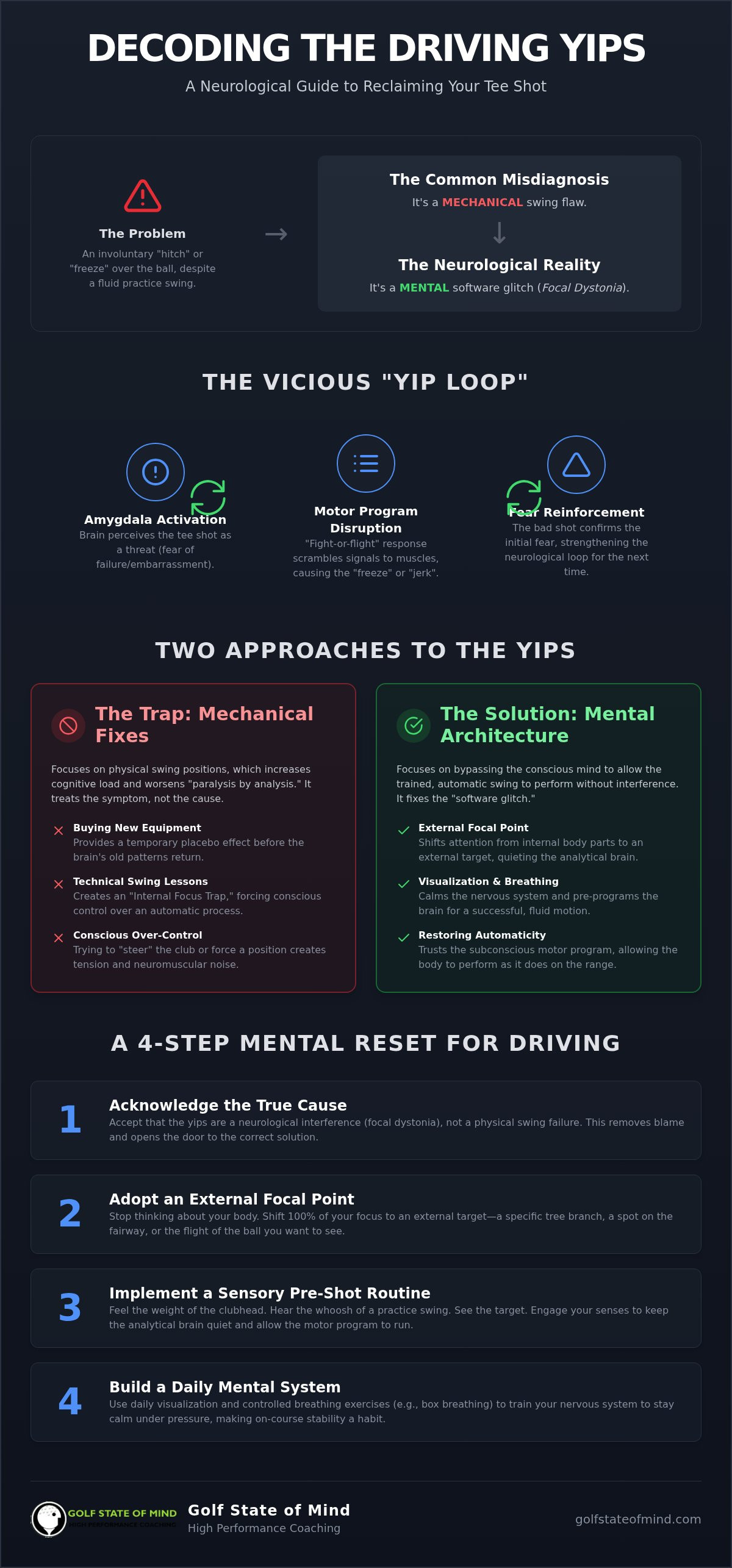
The term “driver yips” is commonly used to describe a sudden or persistent difficulty making a normal, free golf swing with the driver.
Different golfers experience it differently.
For some, it’s a hesitation starting the backswing.
For others, there’s a hitch or involuntary-feeling movement during the swing.
Some golfers freeze completely over the ball.
Others can start the swing but feel as though they’re desperately trying to steer or control the club through impact.
And one of the most confusing characteristics can be this:
The problem isn’t always there.
You might make perfectly normal practice swings.
You might hit driver beautifully on the range.
You may even swing freely on certain holes.
But introduce a narrow fairway, out of bounds, a tournament, the first tee or a situation where the result feels especially important — and the movement changes.
That’s useful information.
Are the Driver Yips Mental or Physical?
There isn’t one explanation that applies to every golfer experiencing the yips.
The term “yips” can describe different experiences, and researchers have explored both neurological and psychological factors.
That’s one reason I wouldn’t automatically diagnose every golfer who freezes over a driver as having a particular neurological condition.
Nor would I automatically assume the golf swing has nothing to do with it.
What we can look at is the pattern.
Ask yourself:
- Can I make a free practice swing?
- Can I hit driver normally on the range?
- Does the problem become worse when the outcome matters?
- Does trouble on one side of the hole make it worse?
- Am I anticipating the yip before I even address the ball?
- Do I become much more conscious of my swing when it happens?
- Am I trying to prevent a particular miss?
If your movement changes considerably when the context changes, then your thoughts, attention, expectations and response to pressure are worth investigating.
The Practice Swing vs. Real Swing Clue
This is one of the first things I want a golfer with driver yips to notice.
Make a practice swing.
Then address the ball.
What changes?
The physical task is very similar.
But psychologically, it can be completely different.
The practice swing has almost no consequence.
There’s no ball to hit out of bounds.
There’s no result to judge.
There’s nothing to lose.
Once the ball is introduced, so is uncertainty.
Now the golfer might think:
What if it happens again?
Don’t hit it right.
Just make a normal swing.
Please don’t freeze.
And now, instead of simply swinging the club, the golfer may be trying to make sure the yip doesn’t happen.
That distinction is important.
When Fear of the Yip Becomes Part of the Yip
After you’ve experienced the driver yips several times, the anticipation itself can become part of the problem.
You arrive at the next tee already wondering:
Is it going to happen?
You make a practice swing.
Fine.
You address the ball.
Now you’re checking.
Do I feel okay?
Can I start the club back?
Are my hands tense?
Is this going to be one of those swings?
Your attention has moved away from the shot you’re trying to hit and toward monitoring yourself.
And the more desperately you try to make sure the movement is normal, the less normal it can feel.
Want to Build a Stronger Mental Game?
I’ve put together a free mental game ebook to help you become a more confident, focused and resilient golfer.
Why Trying to Control the Swing Can Make Things Harder
When golfers lose trust in a movement, they naturally try to regain control.
With the driver, that might mean:
- trying to place the club in certain positions
- slowing the takeaway down
- checking the backswing
- thinking about the hands or wrists
- trying to steer the club through impact
- trying to make a “safe” swing
Some technical awareness can obviously be useful when you’re working on your golf swing.
But that’s different from desperately monitoring the movement because you’re afraid of what might happen.
If you already know how to make the movement, excessive control can make an athletic action feel increasingly difficult.
This is why one of the goals when working through the driver yips is to gradually move your attention away from:
“How do I make my body perform the movement correctly?”
and back toward:
“What am I trying to do with this golf ball?”
Stop Making “No Yip” the Goal
This is a subtle but important shift.
If you stand on every tee thinking:
I just need to make a swing without the yip…
then the yip remains the center of your attention.
Every swing becomes a test.
Did it happen?
Was that one better?
Did I feel the hitch?
Is it gone?
That keeps you monitoring the very thing you’re trying to move away from.
Instead, give yourself a golf task.
What shot am I trying to hit?
Where’s my target?
What trajectory do I see?
What does a committed swing feel like?
You’re trying to move from avoiding a movement back toward creating a golf shot.
Step 1: Understand Your Driver Yips Pattern
Before trying to fix anything, become curious about when the problem appears.
Over your next few practice sessions or rounds, notice:
- Which holes trigger it?
- Does it happen more in tournaments?
- Does it happen on the first tee?
- Does it become worse when there’s out of bounds?
- Does it happen when people are watching?
- Does it happen with driver but not other clubs?
- What do you think immediately before it happens?
- What are you trying to prevent?
- Where is your attention?
Don’t use these questions to judge yourself.
You’re looking for patterns.
The more clearly you understand the conditions surrounding the problem, the more intelligently you can work with it.
Step 2: Give the Shot a Clear Intention
One of the most useful changes is to make your attention more external and intentional.
Instead of standing over the ball thinking about your takeaway, hands or the possibility of freezing, create a clear picture or feel for the shot.
For example:
Where does the ball start?
What’s the shape?
What’s the trajectory?
Where do you want it to finish?
Some golfers respond well to seeing the ball flight.
Others connect more strongly with a target.
Others prefer a simple feel or rhythm.
There isn’t one cue every golfer must use.
The important distinction is that your attention is increasingly connected to the task you’re trying to perform, rather than constantly monitoring the mechanics of performing it.
Step 3: Separate Planning From Playing
This is where a structured pre-shot routine can help.
I divide the shot into three phases:
Planning Phase → Athletic Phase → Acceptance Phase.
Planning Phase
This is where you make your decisions.
Assess the hole.
Consider the trouble.
Choose the appropriate target.
Decide on the shot.
See or feel your intention.
And commit to it.
The trouble is allowed to inform your strategy.
It doesn’t need to play the shot.
Athletic Phase
Once you’ve made the decision, the job changes.
You’re no longer solving the problem.
You’re playing.
Connect with your target, ball flight, rhythm or another cue that helps you move athletically.
You may still notice a thought:
What if I freeze?
That’s okay.
You don’t have to fight the thought.
And you don’t have to wait for it to disappear.
Return to your intention and swing.
Acceptance Phase
Once you’ve hit the shot, resist the temptation to immediately grade whether the yip is “fixed.”
Notice what happened.
Learn from it if necessary.
Accept the result.
Then move on.
If every tee shot becomes evidence for or against your recovery, you’ll continue giving the problem enormous importance.
For a deeper explanation of this process, read my guide to building a mental pre-shot routine for golf.
Step 4: Stop Fighting Unwanted Thoughts
A golfer struggling with the driver yips often believes they need to think positively.
So when the thought appears:
Don’t yip this one…
they immediately respond:
Stop thinking that.
Be confident.
Trust your swing.
Now they’re having a battle with their own mind before they’ve even hit the shot.
You don’t need that battle.
A thought is not an instruction.
You can notice:
There’s that thought again.
And then return to:
What’s my target? What’s my intention?
The objective isn’t perfect thinking.
It’s becoming better at choosing where your attention goes next.
Step 5: Allow Some Discomfort
If you’ve struggled with driver yips for a while, standing over the ball may feel uncomfortable.
That’s understandable.
But be careful about creating a rule that says:
I can only swing once I feel completely free and confident.
What happens when you don’t?
You wait.
You waggle again.
You take another breath.
You check your hands.
You back away.
You’re waiting for the perfect internal state before giving yourself permission to swing.
Instead, part of the process can be learning:
I can feel some uncertainty and still make a committed swing.
That’s very different from trying to force yourself to feel confident.
Step 6: Change the Practice Environment
Beating driver after driver on the range may not be the best way to work through a problem that primarily occurs on the golf course.
If you can already hit 20 good drives on the range, proving it for the 21st time may not teach you very much.
Instead, gradually make practice more representative of golf.
Change Targets
Don’t hit every drive to the same enormous range.
Define a fairway.
Pick a left edge and right edge.
Change the target after each shot.
Go through your routine every time.
Change Clubs
Hit driver.
Then an iron.
Then a wedge.
Then return to driver.
This removes the comfort of repeatedly rehearsing the same movement until it feels perfect.
Play Imaginary Holes
Picture the opening hole at your home course.
Where’s the trouble?
What’s the target?
Hit the tee shot.
Then move on to another hole.
You’re practicing decision → commitment → execution rather than simply repeating swings.
Add Consequence Gradually
Create small challenges.
Can you hit three out of five drives inside your defined fairway?
What happens when you need the final drive to complete the challenge?
Notice whether your behavior changes when the shot starts to matter.
That’s the part you’re training.
Step 7: Gradually Reintroduce the Situations You Fear
If the driver yips appear primarily on the golf course, eventually you need to practice on the golf course.
The goal isn’t to throw yourself immediately into the most stressful situation possible.
You can build gradually.
Hit tee shots during quiet practice rounds.
Play nine holes without keeping score.
Play with someone you feel comfortable around.
Then gradually introduce more consequence.
The important thing is that you’re not waiting until the fear disappears before exposing yourself to the situation.
You’re learning that you can experience the uncertainty and still go through your process.
What About Breathing?
Breathing can help you reconnect with the present and interrupt the rush that sometimes accompanies anxiety.
A slow breath before beginning your routine can create a useful pause.
But I wouldn’t use breathing with the expectation:
This breath has to make the yips disappear.
That simply turns the breath into another test.
Use it as an anchor rather than a cure.
Take the breath.
Notice where you are.
Then return to the shot.
You can read more in my guide to breathing techniques for golf.
What If You’re Afraid of the Big Miss?
For many golfers, the driver yips become connected to a particular miss.
Maybe it’s the snap hook.
Maybe it’s the block right.
Maybe you’ve hit several balls out of bounds and now you’re desperate to prevent another one.
This is where intention becomes particularly important.
You need to distinguish between strategy and fear.
If there’s out of bounds right, you absolutely should consider it during your Planning Phase.
Maybe that changes your target.
Maybe it changes your club.
That’s strategy.
But once you’ve made the decision, continually thinking:
Don’t hit it right…
isn’t strategy anymore.
You’ve already used the trouble to make the decision.
Now return your attention to the shot you’ve chosen.
The trouble informs the strategy. It doesn’t play the shot.
Should You Change Your Driver or Your Swing?
Don’t assume that equipment or technique can never contribute to the problem.
If your driver is poorly fitted or there’s a genuine swing issue creating repeated big misses, working with a qualified club fitter or swing coach may be useful.
The mistake is believing that every episode of driver yips must be solved by finding another mechanical thought.
Ask yourself what the evidence shows.
If you struggle equally on the range and course, there may be a significant technical component worth investigating.
If you swing freely during practice but your movement changes dramatically when the shot has consequence, the mental side deserves attention too.
It doesn’t have to be mental or technical. Both can matter.
How to Measure Progress With the Driver Yips
Don’t make this your only measure:
Did I yip it?
That keeps every drive as a pass/fail test.
Instead, establish a few Performance Commitments.
For example:
- I will choose a clear target.
- I will create a clear shot intention.
- I will make my decision before addressing the ball.
- I will swing athletically rather than trying to steer it.
- I will accept the result and move on.
Now you have behaviors you can measure.
Perhaps you feel some hesitation but still follow your routine and make a committed swing.
That’s progress.
Perhaps you hit a great drive but stood over the ball for 20 seconds desperately checking whether everything felt right.
The outcome was good, but there’s still something useful to work on.
Measure the process, not just the absence of the symptom.
What If You Have a Setback?
Expect progress to be imperfect.
You might have several rounds where driving feels considerably freer and then experience the old sensation again.
Be careful about immediately concluding:
It’s back.
That can restore all the meaning and fear you’ve been trying to reduce.
Instead:
That happened on this shot. What do I want to do on the next one?
One difficult swing doesn’t erase your progress.
And one perfect drive doesn’t prove you’re permanently “cured.”
Keep returning to the behaviors you’re trying to develop.
Driver Yips and First-Tee Nerves
The first tee can be particularly difficult because it combines several common triggers.
You haven’t settled into the round yet.
People may be watching.
You want to start well.
And if you’ve previously experienced the driver yips there, you may be anticipating them before you even arrive.
Don’t make your goal:
I must feel calm on the first tee.
Instead, prepare yourself to execute your process whether you’re calm or nervous.
Know your target.
Know the shot.
Commit.
Then allow yourself to swing.
If this is a specific challenge for you, read my guide to first-tee nerves in golf.
Build a Mental Game You Can Trust
If you’d like more help developing your confidence, focus and ability to respond to pressure, I’ve put together a free mental game ebook covering the principles I use with golfers at every level.
Frequently Asked Questions About the Driver Yips
What do the driver yips feel like?
Golfers describe different experiences, including freezing over the ball, difficulty starting the backswing, an involuntary-feeling hitch or jerk, excessive tension, or suddenly feeling unable to make the same free swing they can make during practice.
Are driver yips caused by focal dystonia?
Yips have been studied from both neurological and psychological perspectives, and the term can describe different experiences. It isn’t appropriate to assume that every golfer experiencing a driver yip has focal dystonia.
If you’re experiencing persistent involuntary movements or symptoms that concern you beyond the golf course, consider discussing them with an appropriately qualified healthcare professional.
Why can I hit driver on the range but not on the course?
The context is different.
On the course there are targets, hazards, scores and consequences. If your attention shifts toward avoiding a miss, monitoring your movement or anticipating the yip, your swing may feel very different even though you demonstrated on the range that you’re capable of making the movement.
Should I stop thinking about my swing?
Not necessarily.
Technical work has a place in golf improvement, particularly during practice.
The question is whether technical thoughts are helping you execute the shot or whether you’re using them because you’re afraid to trust the movement.
During performance, many golfers benefit from moving away from detailed internal monitoring and toward the target, intended shot, rhythm or another simple cue.
Can changing equipment help the driver yips?
It may help in some situations, particularly if the equipment is genuinely unsuitable for you or a change alters how you experience the movement.
But I wouldn’t assume equipment alone will resolve a problem that changes substantially depending on pressure, consequence or context.
How do I stop freezing over the golf ball?
Start by noticing what happens between your free practice swing and addressing the ball.
Rather than waiting until everything feels perfect, make a clear decision during your Planning Phase and then move into the Athletic Phase with a simple target, shot or rhythm cue.
The objective is to gradually reduce monitoring and rebuild your willingness to swing without guaranteeing the outcome.
Should I take a break from golf if I have the driver yips?
There’s no universal answer.
A short break may reduce frustration for some golfers, but simply waiting doesn’t necessarily change the pattern that appears when you return.
If you continue playing, consider changing how you practice and gradually rebuilding your exposure to the situations that trigger the problem rather than repeatedly testing yourself in the same way.
Can visualization help with the driver yips?
It can be useful if it helps reconnect you with the shot you’re trying to create.
Rather than visualizing because you’re trying to guarantee a perfect swing, see the target, ball flight or shape you intend to produce.
The purpose is to strengthen intention, not eliminate uncertainty.
Can you completely cure the driver yips?
I wouldn’t promise a permanent cure or a particular timeline.
Golfers can make significant progress, but experiences and contributing factors differ.
A more useful goal is to become increasingly able to make committed, athletic swings without organizing your entire routine around preventing the yip.
Rebuilding Freedom Off the Tee
If you’ve struggled with the driver yips, it’s understandable that the driver can start to feel like something you need to control.
But constantly monitoring your movement, trying to prevent the yip and judging every swing can keep the problem at the center of your attention.
Start shifting the objective.
Understand your triggers.
Make a clear decision.
Create an intention for the shot.
Allow some uncertainty.
Swing athletically.
Accept the result.
Then do it again.
The goal isn’t to stand over the driver knowing with certainty that the yip won’t happen.
It’s to become increasingly willing to make a committed golf swing without needing that certainty first.
Cures For The Yips
