

How to Stop Overthinking Golf Shots: The Ultimate Mental Checklist for a Quiet Mind
One of the most frustrating experiences in golf is knowing exactly what you want to do and then standing over the ball with so many thoughts that you can barely make a free swing.
Grip.
Takeaway.
Turn.
Tempo.
Don’t go right.
Don’t come over the top.
Keep your head down.
Suddenly, a movement you’ve made thousands of times feels incredibly complicated.
If you’re trying to learn how to stop overthinking golf shots, the answer isn’t to somehow empty your mind or force yourself not to think.
Thinking is an important part of golf.
You need to assess the lie, calculate the distance, understand the wind, choose a target and decide which shot to play.
The problem is when you’re thinking and what you’re thinking about.
Good golf requires you to move from thinking and decision-making into commitment and execution.
When that transition doesn’t happen, you take your analysis with you over the ball and start trying to consciously control a movement that normally happens much more naturally.
In this article, I’ll show you how to stop overthinking golf shots by separating your Thinking Mind from your Playing Mind, simplifying your pre-shot process and learning to put your attention somewhere more useful when it’s time to swing.
Key Takeaways
- You don’t need to eliminate thinking. You need to think at the right time.
- Use your Thinking Mind to gather information and make decisions.
- Use your Playing Mind to see, feel, commit and execute.
- Don’t take technical practice onto the golf course unless you’re deliberately working on something specific.
- Your pre-shot routine should help you transition from analysis to execution.
- If you’re not committed over the ball, step away and restart rather than forcing the shot.
- External cues such as the target, ball flight, rhythm and feel can reduce excessive internal focus.
- The goal isn’t a completely quiet mind. It’s a mind focused on something useful.
Why Do Golfers Overthink Golf Shots?
Overthinking usually comes from a reasonable place.
You want to hit a good shot.
So you try to increase your chances by controlling what happens.
You think about your swing.
You rehearse positions.
You remind yourself of everything your coach told you.
You become increasingly careful.
But golf presents an interesting problem:
The more important the outcome feels, the more tempted you are to consciously control the movement.
That’s often exactly when you need to trust it.
Overthinking Often Begins After a Bad Shot
Imagine you’ve been driving the ball well.
Then you hit one badly to the right.
Immediately you start searching:
“What did I do there?”
Maybe you decide you didn’t complete your turn.
So on the next tee you’re thinking about turning.
That shot goes left.
Now you add another correction.
Within a few holes, your mind contains several different instructions.
The original poor shot may have simply been a poor shot.
But your reaction has turned it into a swing problem.
Fear Creates More Thinking
Overthinking also increases when you’re afraid of an outcome.
You see water on the right.
You remember what happened last time.
You start trying to prevent the miss.
Instead of swinging toward a target, you’re swinging away from trouble.
Your attention has moved from what you want to do toward what you’re trying not to do.
Want to play with greater trust and confidence? Download my free ebook, 7 Key Mental Strategies, and learn practical strategies for improving your focus, confidence and ability to perform under pressure. Get the Free Ebook
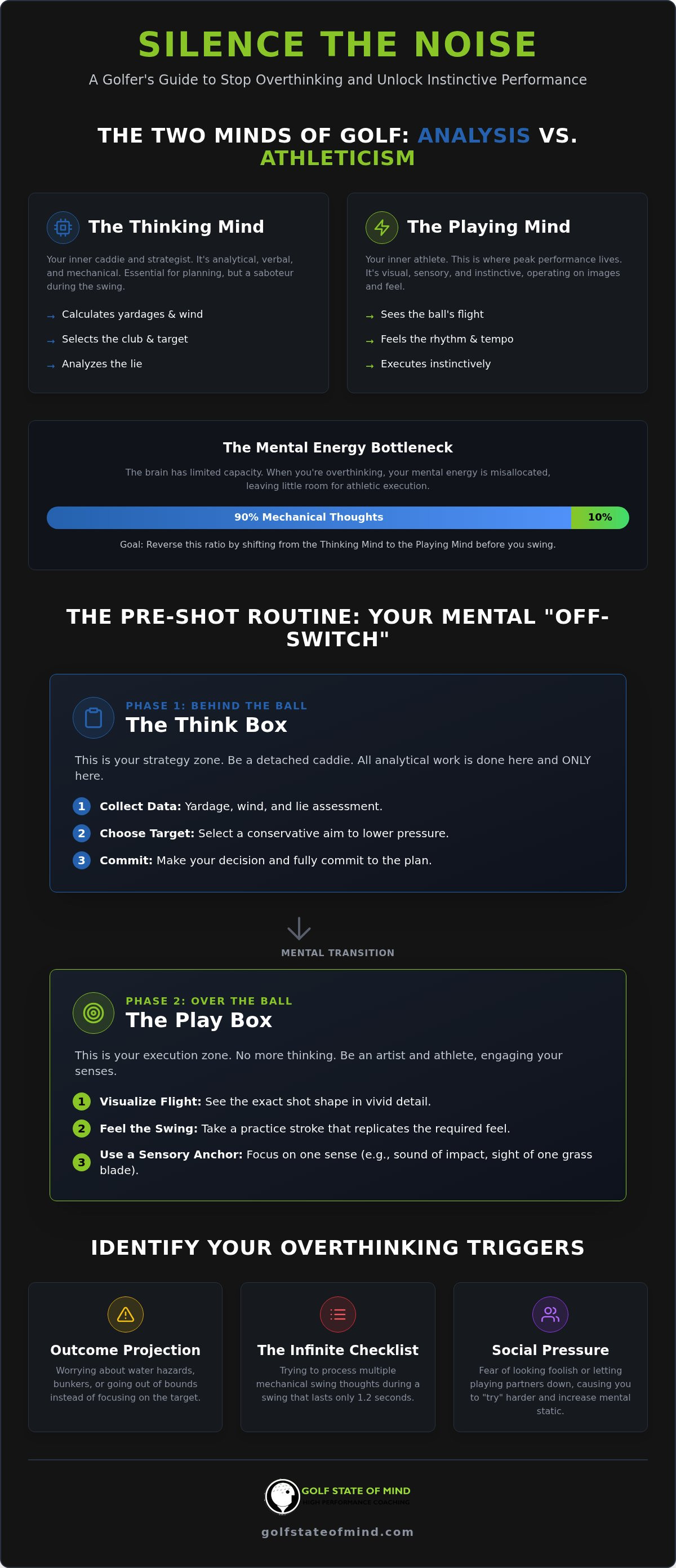
The Thinking Mind vs. The Playing Mind
One of the most useful ways to understand how to stop overthinking golf shots is to recognize that there are two very different jobs your mind needs to perform.
I call these your Thinking Mind and your Playing Mind.
Your Thinking Mind
Your Thinking Mind is analytical.
It’s extremely useful.
It helps you:
- Assess the lie.
- Check the distance.
- Read the wind.
- Understand the situation.
- Consider risk and reward.
- Select a club.
- Choose a target.
- Decide which shot to play.
You need this part of your mind.
The problem isn’t thinking.
The problem is continuing to analyze once the decision has already been made.
Your Playing Mind
Your Playing Mind is less concerned with instructions and more connected to:
- The target.
- The intended ball flight.
- Rhythm.
- Feel.
- Commitment.
You’ve already done the analysis.
Now you’re allowing yourself to respond to the shot you’ve chosen.
Don’t Ask One Mind to Do Both Jobs
The difficulty comes when you stand over the ball still trying to make decisions while simultaneously trying to execute.
“Is this definitely the right club?”
“Maybe I should aim farther left.”
“Don’t forget to keep the club outside.”
“Make sure you don’t get quick.”
You’re trying to play and coach yourself at the same time.
A better process is:
Think → Decide → Commit → Play.
Technical Practice vs. Playing Golf
This distinction is especially important if you’re working on your swing.
There is absolutely a place for technical thinking in golf.
If your instructor is helping you change your movement, you need to understand and practice that change.
But technical practice and playing golf have different objectives.
Technical Practice
During technical practice, you might:
- Use a mirror.
- Watch video.
- Make rehearsals.
- Think about a body movement.
- Use training aids.
- Hit repeated shots with the same club.
That’s fine.
You’re training a movement.
Playing Golf
On the course, you’re solving a different problem.
Your job is to get the ball from where it is to your chosen target.
You may occasionally use a simple swing feel that you’ve agreed on with your coach.
But continually checking positions and diagnosing your swing during the round can pull your attention away from playing the game.
A useful question is:
“Am I training my swing right now, or am I playing golf?”
How to Stop Overthinking Golf Shots
The solution isn’t trying harder to have no thoughts.
That’s usually another thing to think about.
Instead, give your mind a clear process.
1. Gather the Information
Before approaching the ball, determine what matters.
Consider:
- Distance.
- Wind.
- Lie.
- Elevation.
- Hazards.
- Your intended target.
- The best miss.
This is where thinking belongs.
2. Make the Decision
Choose the club.
Choose the target.
Choose the shot.
Then ask:
“Am I committed to this decision?”
If the answer is no, resolve the uncertainty before moving forward.
3. See the Shot
Once the decision is made, begin shifting away from analysis.
See the intended ball flight.
See the target.
Connect with what you’re trying to create rather than everything you’re trying to avoid.
4. Feel the Shot
A rehearsal can help you connect with the movement without turning it into a list of mechanical instructions.
What does the shot feel like?
What rhythm are you looking for?
What does a committed swing feel like?
5. Play
Now go.
Don’t stand over the ball continuing the conversation.
You’ve done the work.
Allow yourself to hit the shot.
Use Your Pre-Shot Routine to Make the Transition
Your pre-shot routine isn’t simply a sequence of physical movements.
Its most important purpose is helping you move from thinking to playing.
Behind the Ball: Think
This is where you can gather information and make decisions.
You have permission to think.
As You Approach the Ball: Transition
Once you’ve made your decision, begin narrowing your attention.
Move away from:
“How am I going to swing?”
and toward:
“What am I trying to do?”
Over the Ball: Play
Now the objective is simple.
Look at the target.
Connect with the shot.
React.
You don’t need to consciously supervise every part of the movement.
Your Routine Doesn’t Need to Be Identical
I wouldn’t worry about making your routine exactly the same number of seconds every time.
Different shots require different amounts of information.
A straightforward wedge from the fairway isn’t the same decision as a recovery shot from the trees.
What should remain consistent is the sequence and purpose:
Information → Decision → Commitment → Execution.
What Should You Focus on Over the Ball?
If telling yourself “don’t think about your swing” doesn’t work, what should you think about?
There isn’t one answer that works for every golfer.
But generally, I want the player’s attention moving away from detailed internal mechanics and toward something simpler and more performance-oriented.
The Target
For many golfers, the target is the best place for attention.
See it.
Keep returning your attention to it.
Let the target organize the movement.
Ball Flight
Instead of thinking about how your body needs to move, picture what you want the ball to do.
Where does it start?
What shape does it have?
Where does it finish?
Feel
Some players perform well with one simple feel.
It might be:
“Smooth.”
“Free.”
“Through.”
That’s very different from carrying four separate mechanical instructions into the swing.
Rhythm
If your mind is particularly busy, rhythm can be useful.
You might simply feel the cadence of the swing or use a simple count during practice.
The objective isn’t to discover a magical tempo number.
It’s to move your attention away from detailed mechanical control.
Give Yourself Permission to Step Away
One of the most useful habits you can develop is stepping away when you’re not ready.
Golfers sometimes think that once they’ve addressed the ball, they have to hit it.
You don’t.
Recognize the Warning Signs
Step away if:
- You suddenly doubt the club.
- Your target changes.
- You become distracted.
- A strong technical thought appears.
- You realize you’re not committed.
Don’t stand there fighting with yourself.
Back away.
Reset.
Make the decision again.
Then return when you’re ready to play.
Stepping Away Isn’t Weakness
It’s part of your routine.
You’re protecting the quality of your process.
I’d much rather see a golfer step away and recommit than hit a shot while thinking:
“This doesn’t feel right.”
Want a clearer process for your mental game? Download my free 7 Key Mental Strategies ebook for practical strategies to improve focus, confidence and commitment on the course. Download the Free Ebook
Practice Playing Without Overthinking
If every practice session involves hitting repeated shots while analyzing your technique, it shouldn’t be surprising if you become technical on the course.
You also need opportunities to practice playing.
One-Ball Practice
Choose a target.
Go through your routine.
Hit one ball.
Then change the target or club.
Now every shot requires a new decision.
There’s no immediate second ball to correct the first one.
Play the Course on the Range
Imagine you’re playing a course you know.
Hit the first tee shot.
Based on where it would have finished, choose your next club.
Continue playing the hole.
Then move to the next.
This forces you to switch clubs, make decisions and use your routine rather than continually working on your swing.
Use Target-Oriented Practice
Instead of asking:
“Did I make the right swing?”
ask:
“How clearly did I see the shot?”
“Was I committed?”
“Did I stay connected to the target?”
You’re practicing where you want your attention to go on the course.
Don’t Turn Every Bad Shot Into a Swing Lesson
This is one of the biggest causes of overthinking during a round.
You hit a poor shot and immediately start diagnosing it.
Sometimes there is something useful to learn.
But you don’t need a technical explanation for every miss.
A Bad Shot Can Just Be a Bad Shot
Golf swings aren’t machines.
Sometimes timing is slightly off.
Sometimes you make a poor swing.
Sometimes the result is simply different from what you intended.
That doesn’t automatically require a correction.
Ask a Better Question
Instead of:
“What did I do wrong with my swing?”
start with:
“Was I committed to the shot?”
If you were committed and followed your process, accept that the outcome wasn’t what you wanted and continue playing.
If you weren’t committed, that’s useful information too.
But that’s a mental adjustment, not necessarily a swing adjustment.
How to Stop Overthinking Under Pressure
Overthinking often becomes stronger when the round matters.
You reach the first tee of a tournament.
You have a good round going.
You need to hit a fairway on 18.
Suddenly you become much more aware of what you’re doing.
Don’t Try to Eliminate the Nerves
You don’t need to feel completely calm before you can make a good swing.
Trying to get rid of nerves can actually give you another problem to solve.
Instead, acknowledge what’s happening.
“I’m nervous because this matters.”
Then return to your process.
Narrow Your Mind
Pressure makes your mind want to move everywhere.
Score.
Consequences.
What other people are thinking.
What happens if you miss.
Your job is to narrow it again.
What is the shot?
What is the target?
What does commitment look like?
That’s enough.
Trust Doesn’t Mean Certainty
You can have doubt and still commit.
You can feel nervous and still swing freely.
You can be unsure of the outcome and still be clear about your intention.
That’s an important distinction.
You aren’t waiting for your mind to become perfectly quiet.
You’re learning to play regardless of the noise.
The Goal Isn’t a Quiet Mind
The title of this article talks about a “quiet mind,” but I think it’s important to clarify what that actually means.
Your goal isn’t to stand over every shot with absolutely nothing going through your head.
That’s unrealistic and unnecessary.
The goal is to become better at directing your attention.
Think when thinking is useful.
Make the decision.
Then move toward:
- Target.
- Intention.
- Feel.
- Commitment.
That’s the real answer to how to stop overthinking golf shots.
You’re not trying to switch your brain off.
You’re learning when to use it.
Think. Decide. Commit. Play.
Frequently Asked Questions
How do I stop overthinking my golf swing?
Separate technical practice from playing. Do your swing analysis during lessons and designated technical practice, then simplify your focus on the course. Gather the information you need, make a decision, choose a target and shift your attention toward the shot you want to hit rather than consciously controlling each part of the swing.
What should I think about during my golf swing?
There isn’t one thought that works for every golfer. Many players perform better when their attention is connected to the target, intended ball flight, rhythm or one simple feel rather than several mechanical instructions. Experiment during practice to discover where your attention produces the freest performance.
Why do I think too much over the golf ball?
Overthinking often increases when you’re uncertain, afraid of the outcome or trying particularly hard to hit a good shot. It can also happen when technical practice carries onto the course. A clearer pre-shot process helps you resolve decisions before addressing the ball so there’s less to work out during execution.
How do I clear my mind before a golf shot?
Don’t make a completely empty mind the objective. Instead, finish your analysis before addressing the ball and give your attention something useful to connect with, such as the target, ball flight, rhythm or feel of the shot. It’s usually easier to redirect attention than to eliminate thought.
Should I have a swing thought when playing golf?
A simple swing feel can sometimes be useful, particularly when you’re working on something specific with your coach. The problem usually occurs when one thought becomes several or when you’re consciously trying to control multiple positions during the movement. Keep any on-course cue simple and evaluate whether it helps you play rather than making you more technical.
Why do I hit the ball better on the range than on the golf course?
The environments are different. On the range you often hit several balls with the same club and have another attempt immediately. On the course, every shot has a consequence and you continually change clubs, targets and situations. Add one-ball, random and performance practice to help bridge that gap.
What is the Thinking Mind and Playing Mind in golf?
The Thinking Mind gathers information, considers strategy and makes decisions. The Playing Mind is concerned with executing the shot you’ve chosen through target, intention, feel and commitment. Problems often occur when golfers continue using the analytical Thinking Mind while they’re trying to execute.
Should I step away from a golf shot if I’m thinking too much?
Yes. If you become distracted, doubt your decision or realize you’re not committed, step away and restart your process. There’s no benefit in forcing yourself to hit simply because you’ve already addressed the ball.
How do I stop thinking about a bad golf shot?
Take any useful information from the shot, distinguish between a poor outcome and a poor process, and then return your attention to the next task. Avoid automatically diagnosing your swing after every miss. Sometimes a bad shot is simply a bad shot.
How can I stop overthinking golf shots under pressure?
Don’t make calmness a requirement for execution. Acknowledge that you’re nervous, then narrow your attention to the immediate task: the situation, target, shot and commitment. Pressure encourages your attention to move toward outcomes and consequences, so deliberately bring it back to what you’re doing now.
Can overthinking cause the golf yips?
Overthinking and excessive conscious control can accompany the yips and may make symptoms worse for some golfers, but the yips are complex and shouldn’t be reduced to a single cause. If you’re experiencing persistent yips, the appropriate approach depends on the individual and may involve mental, technical and other factors.
How long should a golf pre-shot routine take?
There isn’t one correct length. Your routine should be long enough to gather the information you need, make a clear decision and become committed without unnecessarily delaying play. More complex shots may naturally require more consideration than straightforward ones. Consistency of purpose is more important than hitting an exact number of seconds.
Get your FREE Mental Game Scorecard
