

Overcoming a Golf Slump: The Mental Game Blueprint to Reclaiming Your Form
“`html
If you’re in a golf slump, it’s easy to believe something has suddenly gone wrong with your game.
Shots you normally hit without thinking begin to feel difficult. Your scores start climbing. Confidence disappears. You spend more time on the range looking for answers, but the harder you work, the further away your best golf seems to get.
Sometimes there is a genuine technical issue that needs attention. But often, the biggest problem isn’t that you’ve lost your skills.
It’s that your relationship with those skills has changed.
You become more conscious of your swing. You start searching for what’s wrong. Expectations increase. Every poor shot becomes evidence that you’re still “in a slump,” and you begin trying harder to control a game that previously felt much more instinctive.
This is where the golf slump mental game becomes so important.
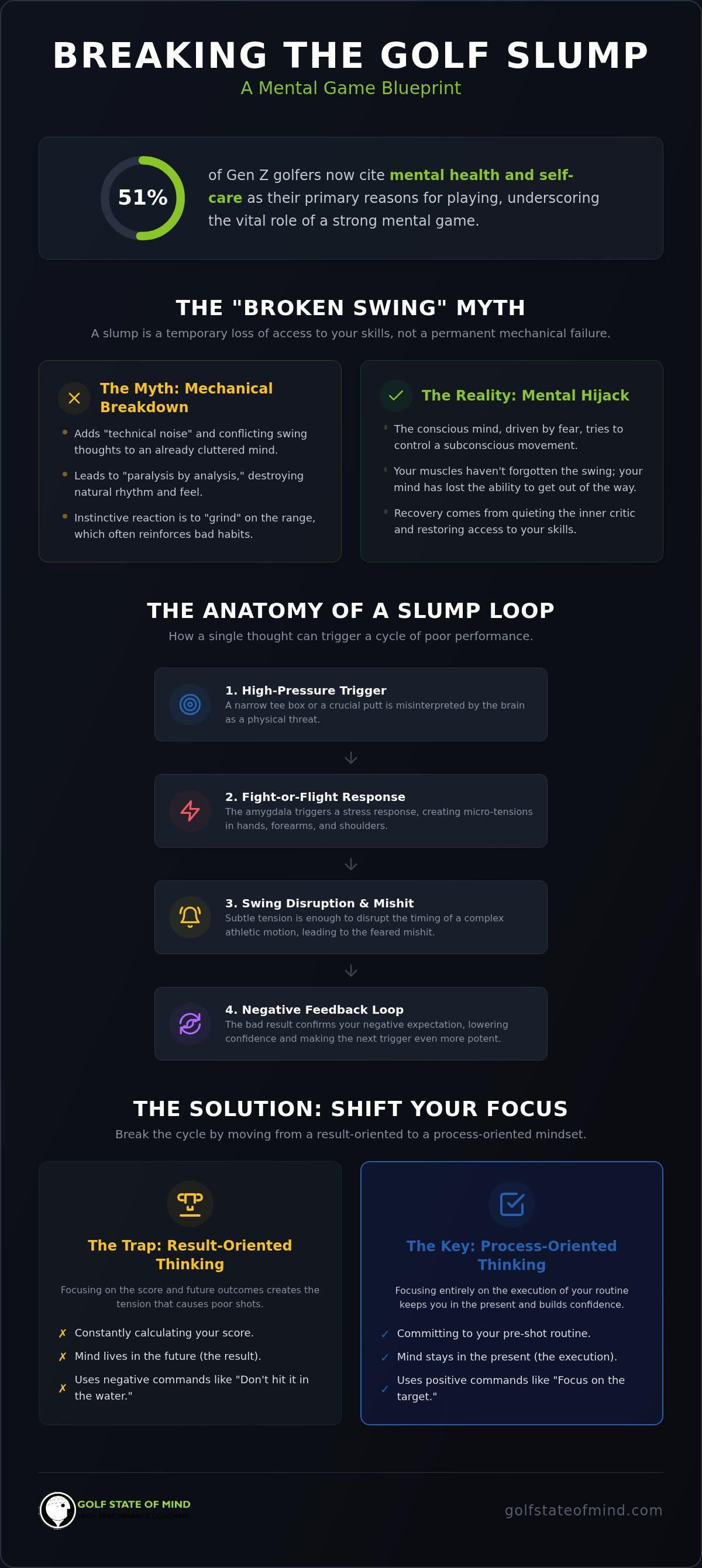
Learning how to get out of a golf slump isn’t about pretending everything is fine or forcing yourself to feel confident. It’s about breaking the cycle of over-analysis, frustration and result-focused thinking so you can begin playing the game in front of you again.
In this article, I’ll show you how to approach overcoming a golf slump, rebuild trust in your game and create a process that helps you move forward without constantly searching for your old form.
Key Takeaways
- A golf slump doesn’t necessarily mean you’ve lost your physical skills.
- Before assuming the problem is mental, rule out genuine technical, physical or equipment issues.
- Constantly searching for a swing fix can increase conscious control and make performance harder.
- Stop using your score as the only measure of whether you’re improving.
- Shift attention toward commitment, routines, decisions and response to mistakes.
- Use performance practice rather than simply hitting more balls.
- Don’t try to recreate your previous best golf. Focus on playing the next shot as well as you can.
- Confidence tends to return as you accumulate evidence of good decisions, committed swings and better responses.
What Is a Golf Slump?
A golf slump is an extended period in which your performance falls below the level you expect from yourself.
But that definition contains an important word:
Expect.
Part of what makes a slump so difficult isn’t simply that you’re playing poorly.
It’s the gap between how you’re currently playing and how you believe you should be playing.
You remember the golfer who shot 72 three weeks ago.
You know how well you’ve been hitting it on the range.
You know what your handicap says you’re capable of.
So every disappointing round creates another question:
“What’s wrong with me?”
A Slump Can Become a Story
Perhaps you initially have two poor rounds.
That’s all they are: two poor rounds.
But then you say:
“I’m in a slump.”
Now the next round has additional significance.
A poor opening hole isn’t simply a bogey.
It’s confirmation.
“Here we go again.”
You start looking for evidence that the slump is continuing.
That’s when a temporary period of poor form can become a much bigger mental challenge.
Struggling to trust your game? Download my free ebook, 7 Key Mental Strategies, and learn practical strategies to improve your confidence, focus and ability to perform when your game doesn’t feel perfect. Get the Free Ebook
Is Your Golf Slump Mental or Technical?
One mistake in discussions about the golf slump mental game is assuming every slump is psychological.
It isn’t.
Your technique can change.
Your body can change.
You may be tired.
You may have an injury.
Your equipment may no longer suit you.
You may simply be going through a normal period of inconsistent ball striking.
That’s why I wouldn’t automatically tell a golfer to ignore technique and work exclusively on the mental game.
Ask Where the Problem Shows Up
One useful question is:
“Where am I seeing the problem?”
If you’re struggling to make solid contact during relaxed practice with no pressure and no concern about the result, there may be something technical worth discussing with your swing coach.
But if you’re hitting the ball well in practice and then becoming a completely different golfer when you keep score or compete, the mental side deserves closer attention.
You might notice that on the course you:
- Become more technical.
- Try harder to control the swing.
- Become increasingly aware of score.
- Lose commitment to targets.
- Play defensively.
- React more strongly to mistakes.
- Start predicting where the next bad shot will appear.
Those are signs that simply hitting more balls may not solve the problem.
How the Golf Slump Mental Game Develops
A slump often becomes self-reinforcing.
It can look something like this:
Poor performance → concern → increased analysis → more conscious control → less trust → more poor performance.
The exact pattern differs from golfer to golfer, but the principle is important.
You Start Looking for What’s Wrong
Once you believe you’re in a slump, your attention naturally becomes biased toward problems.
You hit five good drives and one terrible one.
Which one do you think about?
The terrible one.
You play six solid holes and then make a double.
The double becomes proof that you’re still struggling.
This creates a distorted picture of your performance.
You stop seeing the good things you’re doing because you’re continually scanning for evidence of what’s wrong.
You Become More Conscious of Your Swing
Then comes the search for a solution.
You might start thinking about:
- Your takeaway.
- Your grip.
- Your backswing position.
- Your transition.
- Your hips.
- Your release.
Again, technical work isn’t inherently bad.
The problem is taking all of that thinking onto the golf course.
The swing becomes something you’re trying to consciously manufacture rather than a skill you’re allowing yourself to use.
Your Expectations Create More Pressure
After several poor rounds, the next round starts to feel important.
You tell yourself:
“I need a good round today.”
Now every early shot carries additional weight.
You aren’t simply playing golf.
You’re testing whether the slump is over.
That’s a difficult mindset from which to perform freely.
Stop Searching for Your Old Game
This is one of the biggest changes I would encourage when overcoming a golf slump.
Stop trying to find the golfer you were three weeks or three months ago.
That golfer doesn’t need to be recreated.
You have today’s body, today’s swing, today’s weather, today’s golf course and today’s state of mind.
That’s the game you need to play.
“I Just Want My Confidence Back”
I hear versions of this frequently.
But trying to get your confidence back can become another form of outcome chasing.
You keep checking:
“Do I feel confident yet?”
“Does my swing feel like it used to?”
“Am I back?”
Those questions keep your attention on yourself rather than the task.
You don’t need to feel like the golfer you were when you were playing your best.
You need to become engaged with the shot you’re playing now.
How to Get Out of a Golf Slump
There isn’t a five-step formula that guarantees you’ll shoot your best score tomorrow.
But there are several changes that can help break the patterns keeping the golf slump mental game alive.
1. Accept Where Your Game Is Today
Acceptance doesn’t mean giving up.
It means stopping the argument with reality.
If you’re not currently playing your best golf, acknowledge it.
You don’t need to like it.
But continually thinking:
“I shouldn’t be playing like this.”
doesn’t help you hit the next shot.
Start from where you are.
2. Stop Making Every Round a Test
Your next round doesn’t have to prove that you’re out of the slump.
That creates unnecessary pressure.
Instead, give yourself process goals.
For example:
- Commit fully to every target.
- Use your pre-shot routine.
- Respond well to mistakes.
- Stay engaged with the shot in front of you.
- Make clear decisions.
Now you have things you can actually accomplish regardless of your final score.
3. Simplify
If your mind has become cluttered with swing thoughts, reduce the amount of information you’re carrying onto the course.
Do the technical work during technical practice.
When you’re playing, ask yourself:
“What is the minimum information I need to hit this shot?”
Often that’s:
Target.
Shot.
Commitment.
Then play.
4. Stop Predicting
A slump makes golfers very good at predicting disaster.
You reach a hole where you’ve been struggling and immediately think:
“This is where I always hit it right.”
Notice the prediction.
Then return to the actual information in front of you.
What is the target?
What shot are you choosing?
What does commitment look like?
The previous round doesn’t hit today’s shot.
5. Give Yourself Permission to Play
This may be the most important step.
At some point, you have to stop fixing and start playing.
You won’t necessarily feel completely confident first.
That’s OK.
Make the decision.
See the shot.
Commit.
And allow your body to hit it.
Redefine Success During a Golf Slump
When you’re struggling, score becomes an especially poor way to measure whether your mental game is improving.
You can execute your process very well and still shoot a disappointing number.
You can also execute poorly and occasionally get away with it.
That’s why I like golfers to use a Mental Scorecard.
Use a Mental Scorecard
Instead of grading yourself only on strokes, evaluate things such as:
- Commitment.
- Decision-making.
- Pre-shot routine.
- Focus and presence.
- Response to mistakes.
- Emotional control.
You might simply give yourself a mark for each shot or hole where you executed the mental process you were working on.
This doesn’t mean score no longer matters.
Golf is a scoring game.
It means you’re giving yourself another way to measure progress—one that is much more within your control.
Build Process Confidence
If you finish a round and say:
“I shot 79, so I’m still playing badly.”
you’ve learned very little.
But if you say:
“I committed to 85% of my shots today compared with 60% last week, and I responded much better after mistakes.”
now you have evidence of progress.
That’s how confidence begins rebuilding before the score necessarily catches up.
Want a better process for handling difficult rounds? Download my free 7 Key Mental Strategies ebook and learn practical strategies for improving confidence, focus and emotional control on the course. Download the Free Ebook
Change the Way You Practice
When golfers enter a slump, practice often becomes a search.
They hit ball after ball trying to find a feeling.
Eventually they hit several good shots in a row and think:
“That’s it. I’ve found it.”
Then they get to the first tee the following day and it disappears.
This isn’t necessarily because the range session was useless.
It’s because repeatedly hitting the same club from the same lie to the same target is very different from playing golf.
Use More Random Practice
Once you’ve completed any technical work, make practice more representative of the course.
Change:
- The club.
- The target.
- The shot shape.
- The distance.
- The intention.
Hit one ball and then create a new problem.
This forces you to make decisions rather than simply repeat a movement.
Play the Golf Course on the Range
Imagine the first hole at your home course.
Hit the tee shot.
Based on where that shot would have finished, choose the club for your imaginary approach.
Then play the next hole.
Go through your normal pre-shot routine before every ball.
This changes the objective from:
“Can I find my swing?”
to:
“Can I play golf with the swing I have?”
That’s a much more useful question during a slump.
Add Consequence
Eventually, give your practice some meaning.
Set challenges.
Keep score.
Compete with another golfer.
Give yourself one attempt.
Notice what happens when the result starts to matter.
That’s where you can practice the mental skills you need on the course.
Rebuild Confidence With Evidence
Golfers often try to talk themselves into confidence.
Sometimes that helps temporarily.
But a stronger form of confidence comes from evidence.
Start Collecting Better Evidence
After every round, deliberately identify what went well.
Not only:
- Birdies.
- Great drives.
- Holed putts.
Also include:
- Shots where you committed completely.
- Good decisions.
- Strong routines.
- Good recoveries.
- Moments where you stayed patient.
- Times you responded well after a mistake.
During a slump, your mind will naturally want to build a case for why you’re struggling.
Make sure you’re collecting the other side of the evidence too.
Don’t Demand Confidence Before You Act
You don’t need to wait until you feel confident to make a committed swing.
This distinction is important.
You might feel doubtful and still:
- Choose a clear target.
- Make a good decision.
- Follow your routine.
- Commit to the shot.
- Make a free swing.
Those actions can eventually create the evidence from which confidence grows.
Commitment doesn’t have to wait for confidence.
How to Handle Bad Shots During a Slump
A poor shot feels more significant when you’re already struggling.
If you’re playing well and hit one drive into the trees, you might simply think:
“Bad swing.”
When you’re in a slump, the same shot becomes:
“See? I still haven’t fixed it.”
That’s why your post-shot response becomes particularly important.
Separate the Shot From the Story
The shot happened.
The story is what you add afterward.
For example:
“I pushed that drive.”
That’s an observation.
“My driving has completely gone and I’m going to struggle all day.”
That’s a story.
Learn to recognize the difference.
Take What’s Useful and Move On
If there is useful information from the shot, take it.
Perhaps you chose the wrong club.
Perhaps you weren’t committed.
Perhaps you rushed.
Perhaps there was a technical issue your coach wants you monitoring.
Take the useful information.
Then put the club away and begin moving toward the next task.
You don’t need to solve your entire slump before hitting the next shot.
Stop Trying to Force Your Way Out
Perhaps the most important thing to understand about overcoming a golf slump is that desperation usually makes performance harder.
You can’t force yourself back into form.
You can’t demand confidence.
You can’t guarantee today’s score.
And you don’t need to rediscover some magical swing feeling before you’re allowed to play well again.
Instead:
- Accept where your game is today.
- Rule out genuine physical or technical issues.
- Simplify your on-course thinking.
- Stop making every round a test.
- Measure your mental execution as well as your score.
- Practice playing rather than constantly fixing.
- Collect evidence of what you’re doing well.
- Commit even when you don’t feel completely confident.
The golf slump mental game becomes much easier when you stop trying to escape the slump on every shot.
Your job isn’t to prove you’re back.
Your job is to play the shot in front of you.
Then do it again.
And again.
That’s how form begins to return.
Frequently Asked Questions
How do you get out of a golf slump?
Start by determining whether there is a genuine technical or physical issue that needs attention. If your skills are showing up in practice but disappearing on the course, shift your focus away from constantly fixing your swing and toward process goals such as commitment, decision-making, routines and response to mistakes. Make practice more representative of playing and stop treating every round as a test of whether the slump is over.
How long does a golf slump last?
There is no standard length for a golf slump. It might last several rounds or considerably longer. Trying to put a deadline on recovery can create additional pressure. Focus instead on the quality of your practice and mental process and allow results to improve in their own time.
Is a golf slump mental or technical?
It can be either, and sometimes both. If you’re struggling with ball striking even during relaxed practice, technical input from a qualified instructor may be useful. If you perform well in practice but become more tense, technical or result-focused on the course, the mental game may be contributing significantly.
How do I get my golf confidence back?
Don’t wait to feel confident before taking confident actions. Make clear decisions, commit to targets, follow your routine and collect evidence of good execution. Confidence often rebuilds through repeated experiences of doing these things well rather than through trying to convince yourself that you’re confident.
Should I practice more when I’m in a golf slump?
Not necessarily. More practice only helps if the practice has a useful purpose. Hitting hundreds of balls while searching desperately for a swing feeling can increase frustration and conscious control. Combine any necessary technical practice with random, one-ball and performance practice that more closely resembles playing golf.
Why do I hit the ball well on the range but badly on the golf course?
The environments are different. On the range, you often hit multiple balls with the same club and there is little consequence to a poor shot. On the course, you get one attempt and the result affects your score. Practice using one ball, changing targets and clubs, following your complete routine and adding consequence to help bridge that gap.
How do I stop overthinking my golf swing during a slump?
Separate technical practice from performance. Do the necessary mechanical work with your coach or during designated practice, but simplify your thinking on the course. Make the decision, choose the target and use one simple feel if necessary. Then allow yourself to play rather than continuing to analyze the movement.
Should I take a break from golf when I’m in a slump?
A short break can sometimes be useful if you’re mentally or physically exhausted, but it isn’t always necessary. Another option is to change your relationship with the game temporarily: play without keeping score, play fewer holes, use different tees or have a round where your only goal is commitment and enjoyment rather than performance.
How do I stay positive during a golf slump?
You don’t need to force yourself to feel positive. Aim to be accurate and constructive instead. Acknowledge poor shots without turning them into predictions about the rest of the round. Notice what you’re doing well, identify useful lessons and keep returning your attention to the next controllable task.
Can a mental game coach help with a golf slump?
A mental game coach can be useful when the main difficulties involve confidence, pressure, overthinking, expectations, emotional reactions or transferring your skills from practice to competition. If the underlying issue is primarily technical, physical or equipment-related, the appropriate specialist may be a swing coach, medical professional or club fitter.
What should I focus on during a golf slump?
Focus on things you can control: your decisions, target, commitment, pre-shot routine, response to mistakes and attention to the present shot. Avoid making “getting out of the slump” your goal for every round. Your responsibility is the next shot, not proving that your old form has returned.
“`
Get your FREE Mental Game Scorecard
