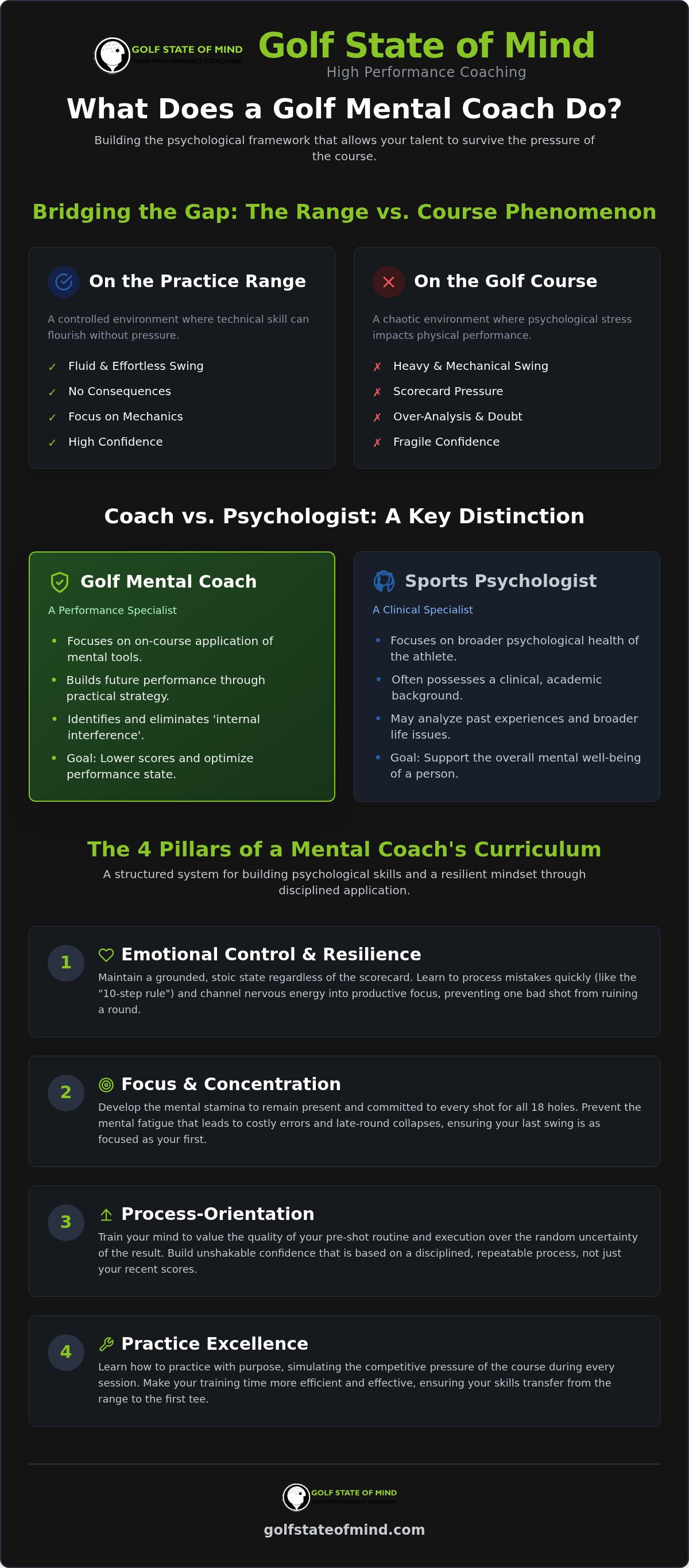
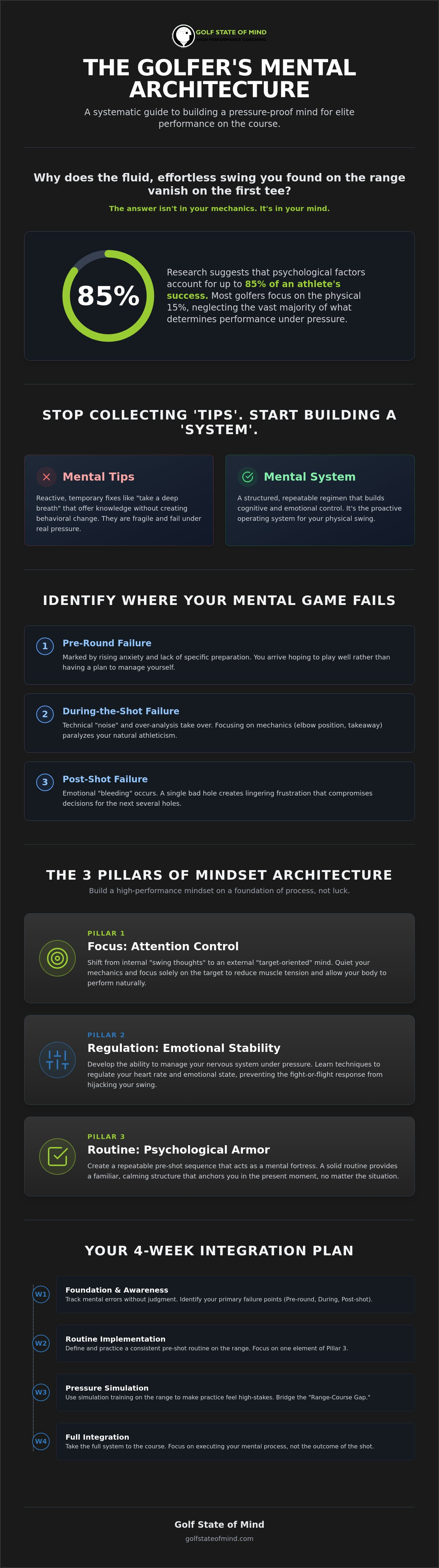
You can hit the ball beautifully on the practice range and feel like a completely different golfer when you step onto the first tee.
You know you have the physical skills.
But when the round matters, you start thinking more. Your swing feels less free. A bad shot affects the next one. You become aware of your score. You start worrying about what might happen instead of simply playing the shot in front of you.
This is where mental coaching can help.
If you’re wondering what does a golf mental coach do, the simplest answer is this:
A golf mental coach helps you develop the mental skills and processes that allow you to access your physical skills more consistently when you play.
That can include improving confidence, managing pressure, developing better focus, creating effective pre-shot and post-shot routines, responding better to mistakes, improving decision-making and learning how to practice your mental game rather than simply hoping it improves.
A golf mental coach isn’t there to fix your swing.
The objective is to help you get more from the game you already have.
In this guide, I’ll explain exactly what a golf mental coach does, what mental coaching sessions typically involve, the problems mental coaching can help with, and how to decide whether it’s something that could benefit your game.
Key Takeaways
- A golf mental coach helps you develop practical mental skills for practice and competition.
- Mental coaching isn’t simply positive thinking or motivational encouragement.
- Common areas include confidence, focus, pressure, routines, emotional control, expectations and response to mistakes.
- A mental coach and swing coach have different but complementary roles.
- Mental coaching can help golfers at every level, not just elite players.
- A good coach should help you understand your individual patterns rather than give every golfer the same set of tips.
- The objective is eventually to make performance simpler and help you become more self-sufficient.
What Does a Golf Mental Coach Do?
A golf mental coach helps you identify the thoughts, behaviors and patterns that are interfering with your performance and then gives you practical ways to work on them.
That doesn’t mean trying to eliminate every negative thought or making sure you feel confident before every shot.
Golf doesn’t work like that.
You will feel nervous.
You will doubt yourself.
You will hit bad shots.
You will become frustrated.
You will sometimes think about your score.
The objective of mental coaching is not to create a perfect mental state.
It’s to help you perform more effectively regardless of the inevitable thoughts, emotions and challenges that appear during a round.
Mental Coaching Is About Skills
I think it’s useful to view the mental game in the same way you view the physical game.
If you want to improve your putting, you practice putting.
If you want to improve your short game, you practice your short game.
Yet golfers frequently expect confidence, concentration and emotional control to improve without deliberately practicing them.
Mental coaching turns these areas into skills you can work on.
For example:
- How do you prepare mentally before a round?
- Where should your attention be before a shot?
- What do you do when you become nervous?
- How do you respond after hitting a poor shot?
- How do you stop one mistake becoming three?
- What do you focus on between shots?
- How do you practice performing under pressure?
These aren’t personality traits.
They’re things you can improve.
Want to start improving your mental game? Download my free ebook, 7 Key Mental Strategies, and learn practical strategies for improving your confidence, focus and performance on the golf course. Get the Free Ebook
What Problems Can a Golf Mental Coach Help With?
Golfers come to mental coaching for many different reasons.
Some are playing well but want to become better competitors.
Others feel that their mental game is actively preventing them from playing to their ability.
Common challenges include:
- Playing much better in practice than in tournaments.
- First-tee nerves.
- Fear of hitting bad shots.
- Loss of confidence.
- Overthinking the swing.
- Becoming too technical on the course.
- Getting angry or frustrated after mistakes.
- Thinking too much about score.
- Struggling to close out good rounds.
- Playing defensively under pressure.
- Comparing yourself with other players.
- Worrying about what other people think.
- Difficulty staying present.
- Poor decision-making.
- Unproductive practice.
- Putting or chipping anxiety.
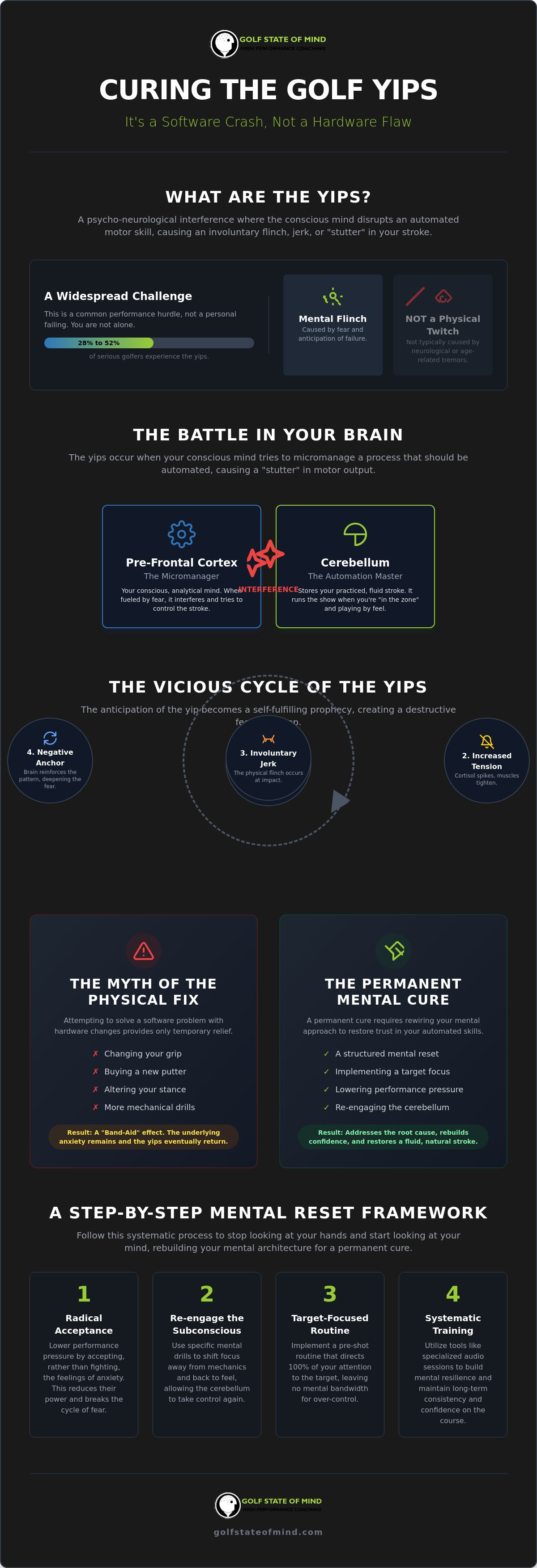
- The yips.
Often, several of these challenges are connected.
The Problem Beneath the Problem
A golfer might initially tell me:
“I’ve lost my confidence.”
But as we talk, we discover that the bigger issue is that they’re constantly evaluating their performance.
Every shot has become a test.
A good shot means:
“Maybe I’ve got it back.”
A bad shot means:
“Here we go again.”
The golfer isn’t simply playing anymore.
They’re monitoring themselves constantly.
Part of the coach’s job is identifying these patterns and helping the player change their relationship with performance.
Golf Mental Coach vs. Swing Coach
A golf mental coach and a swing coach do different jobs.
Your swing coach helps you improve the physical technique required to hit better golf shots.
A mental coach helps you develop the skills required to use that technique effectively while playing.
Both can be extremely valuable.
Is the Problem Technical or Mental?
Sometimes golfers aren’t sure which kind of coaching they need.
A useful place to start is to look at where the problem appears.
If you’re struggling to strike the ball even during relaxed practice, there may be a technical issue worth addressing with a qualified instructor.
But imagine you hit the ball extremely well on the range.
Then you enter a tournament and:
- Your tempo changes.
- You become more mechanical.
- You start steering the ball.
- You become afraid of certain misses.
- You stop committing to targets.
That gap between practice and performance suggests there may be more than technique involved.
Technical Thoughts Can Become Performance Thoughts
Technical information can also become a problem when it follows you onto the course.
Your swing coach may give you something very useful to work on.
But if you’re standing over an important tee shot consciously thinking about your takeaway, hip rotation, wrist position and transition, you’re asking yourself to perform a complicated movement while consciously controlling several parts of it.
Mental coaching can help you develop a clearer distinction between training your swing and playing golf.
Golf Mental Coach vs. Sports Psychologist
These terms are sometimes used interchangeably, but they’re not necessarily the same thing.
A mental performance coach generally works on performance-related skills such as confidence, focus, routines, preparation, goal setting and managing competition.
Sport psychology is a broader field, and practitioners can have different qualifications, professional roles and scopes of practice.
Some sport psychology professionals work primarily on performance. Others may also be qualified to address clinical mental health concerns, depending on their credentials and licensing.
A mental coach should not present themselves as a therapist or attempt to treat clinical mental health conditions unless they hold the appropriate professional qualifications.
Which One Do You Need?
If your primary concern is:
“How can I stay committed to my process when I’m leading a tournament?”
that’s clearly a performance question.
If you’re dealing with broader psychological or mental health concerns that extend beyond sport, an appropriately qualified mental health professional may be the better choice.
There can also be situations where golfers benefit from working with both.
What Happens in a Golf Mental Coaching Session?
If you’re researching what does a golf mental coach do, you may be wondering what actually happens when you speak to one.
There isn’t one universal format.
My own approach begins by trying to understand the player.
Not simply their handicap or tournament results.
I want to understand:
- What are they trying to achieve?
- What does their best golf look and feel like?
- What tends to get in the way?
- What are they afraid of?
- Where does their attention go under pressure?
- How do they respond to mistakes?
- What do they believe about themselves as a player?
- What happens differently in practice and competition?
The answers help determine what we actually need to work on.
There’s No Single Mental Game Problem
Two golfers can shoot exactly the same score for completely different reasons.
One may become angry after mistakes.
Another may become frightened of making mistakes.
One may play too aggressively.
Another may become defensive.
One may overthink technique.
Another may become obsessed with score.
Giving all of those golfers the same motivational advice wouldn’t make much sense.
Good mental coaching should be individualized.
From Understanding to Application
Once we’ve identified the patterns, we develop strategies the golfer can actually use.
That might involve:
- Process goals.
- A Mental Scorecard.
- Pre-round preparation.
- Pre-shot routines.
- Post-shot routines.
- Target orientation.
- Breathing exercises.
- Visualization.
- Attention and focus exercises.
- Performance practice.
- Post-round reviews.
The golfer then applies those skills in practice and competition.
We review what happened and continue refining the process.
Building Golf Confidence
Confidence is one of the most common reasons golfers seek mental coaching.
But confidence is often misunderstood.
Golfers frequently think they need to feel confident before they can play confidently.
I don’t think that’s always true.
Confidence Doesn’t Mean Certainty
You can stand on a tee feeling nervous and still make a committed swing.
You can have doubts and still choose a clear target.
You can miss three putts and still go through your routine properly on the fourth.
This matters because otherwise your performance becomes dependent on your emotional state.
You start waiting to feel right before you’re willing to commit.
A more resilient form of confidence comes from knowing:
“Whatever I’m feeling, I know what I’m going to do.”
Build Confidence Through Evidence
A mental coach can also help you become better at recognizing evidence of good performance.
Golfers naturally remember:
- The missed three-footer.
- The drive out of bounds.
- The double bogey on 18.
They often forget the committed swings, good decisions, excellent recoveries and moments where they handled pressure well.
Confidence becomes stronger when it’s built from accurate evidence rather than forced positive thinking.
Improving Focus and Concentration
Another important part of golf mental coaching is learning how to manage your attention.
Golfers often believe they need to concentrate for four or five hours.
They don’t.
You need to know when to engage your golf focus and when to allow your attention to relax.
Focus on the Right Things
You can be extremely focused on something that doesn’t help you perform.
You can focus intensely on:
- Your score.
- Your swing mechanics.
- What other people think.
- The leaderboard.
- A mistake from three holes ago.
The question isn’t simply:
“Am I focused?”
It’s:
“What am I focused on?”
Mental coaching helps golfers direct their attention toward relevant information: the target, decision, routine and shot in front of them.
Learning to Perform Under Pressure
A mental coach isn’t trying to eliminate pressure from golf.
If you care about the outcome, you’re going to feel something.
That’s normal.
The objective is learning how to perform while those feelings are present.
Pressure Is Something You Can Practice
Many golfers practice almost exclusively in low-pressure environments.
They hit 30 seven-irons from the same lie to the same target.
Then they expect themselves to hit one perfect seven-iron over water when they’re two shots ahead with three holes remaining.
Those are very different environments.
A mental coach can help you make practice more representative of competition by adding:
- Consequence.
- One-ball practice.
- Competition.
- Scoring.
- Changing targets.
- Performance challenges.
Now you’re not simply practicing golf shots.
You’re practicing performing.
Feel like your mental game is holding back the golf you know you’re capable of playing? I work with competitive juniors, college players, professionals and adult golfers to develop the mental skills they need to perform more consistently under pressure. Book a Free 15-Minute Consultation
Pre-Shot and Post-Shot Routines
One of the most practical things a golf mental coach can help you develop is a better routine.
Your pre-shot routine isn’t simply a sequence of physical movements.
It’s a process for moving from information and decision-making into commitment and execution.
Before the Shot
A good process helps you answer:
- What is the situation?
- What is the target?
- What shot am I choosing?
- Am I committed?
Once you’ve answered those questions, you don’t need to continue searching for information.
It’s time to play.
After the Shot
The post-shot routine is just as important.
You need a way of responding to what happened without allowing one shot to consume the next ten minutes.
That doesn’t mean pretending you don’t care.
You can be disappointed.
You can learn something.
But eventually you need to leave the previous shot behind and prepare for the next one.
Learning How to Practice Your Mental Game
This is an area I think golfers frequently overlook.
You can’t simply learn a mental game concept and assume it will automatically appear during competition.
You have to practice it.
Practice the Skill You’re Trying to Develop
If you’re working on commitment, score your commitment during practice.
If you’re working on your pre-shot routine, use the full routine before every ball.
If you’re working on pressure, create consequence.
If you’re working on your response to mistakes, deliberately create difficult challenges and observe your reaction when you fail.
Mental practice should be specific.
Review Your Performance
After playing, don’t simply look at the scorecard.
Ask:
- What did I do well mentally?
- Where did I lose commitment?
- What triggered frustration or fear?
- How well did I follow my routine?
- What happened to my attention under pressure?
- What do I want to practice next?
This turns every round into useful information.
Who Can Benefit From a Golf Mental Coach?
Mental coaching isn’t only for professional golfers.
The pressure changes at different levels, but many of the underlying challenges are remarkably similar.
A junior golfer might worry about rankings or college recruitment.
A college golfer might worry about qualifying for the team.
A professional might worry about keeping their card or earning enough money to continue playing.
An amateur might worry about embarrassing themselves in front of their regular group.
The stakes are different.
But in each case, the golfer is trying to access skills they already possess while dealing with thoughts about what the outcome means.
Junior Golfers
Mental coaching can be particularly valuable for junior golfers because they’re developing both as players and as people.
One of the most important lessons is learning to separate who they are from how they play.
A poor tournament doesn’t make them a failure.
Golf is something they do.
It isn’t who they are.
That distinction can give young players greater freedom to compete, learn and make mistakes.
Competitive and College Golfers
For competitive players, mental coaching can become part of the same performance system as technical coaching, fitness and course strategy.
The objective is to understand exactly what helps that individual player perform at their best and then make those behaviors increasingly repeatable.
Adult Amateur Golfers
Amateurs sometimes assume their game isn’t serious enough for mental coaching.
But if frustration, anxiety, overthinking or expectations are reducing your enjoyment of golf, that’s a perfectly valid reason to work on the mental game.
You don’t need to be trying to make the PGA Tour to want to play with greater freedom and enjoyment.
How to Choose a Golf Mental Coach
If you’re considering mental coaching, don’t simply look for someone who can give you motivational advice.
Look at their experience, philosophy and understanding of golf.
Questions Worth Asking
- Do they specialize in golf?
- What levels of player have they worked with?
- Do they have a structured coaching process?
- Do they individualize their approach?
- Will they give you practical exercises between sessions?
- Do their ideas make golf simpler or more complicated?
- Do they understand the difference between mental performance coaching and clinical mental health care?
You should also feel comfortable speaking openly with the coach.
Mental coaching can involve discussing fear, confidence, expectations, identity and the things you think about when you’re under pressure.
The relationship matters.
The Goal of Golf Mental Coaching
So, what does a golf mental coach do?
They help you understand what happens mentally when you play and give you a process for improving it.
That might mean helping you:
- Build more resilient confidence.
- Focus on the right things.
- Manage pressure more effectively.
- Develop better routines.
- Respond constructively to mistakes.
- Reduce overthinking.
- Practice more effectively.
- Separate your identity from your results.
- Transfer your skills from practice into competition.
But ultimately, the goal isn’t to make you think about the mental game more.
It’s the opposite.
Good mental training should eventually make golf feel simpler.
You know how you want to prepare.
You know what deserves your attention.
You know how you want to respond when things go wrong.
And when it’s time to hit the shot, you can stop trying to control everything and play.
Frequently Asked Questions
What does a golf mental coach do?
A golf mental coach helps golfers develop practical mental skills such as confidence, focus, routines, emotional control, pressure management and response to mistakes. The objective is to help the player access their existing physical skills more consistently during practice and competition.
What happens in a golf mental coaching session?
A session will typically involve discussing recent performances, identifying mental patterns or challenges, developing specific strategies and deciding what the golfer will practice before the next session. The exact structure depends on the coach and the individual player’s needs.
Is a golf mental coach the same as a sports psychologist?
Not necessarily. Mental performance coaches generally focus specifically on performance skills. Sport psychology is a broader professional field, and practitioners may have different qualifications and scopes of practice. Clinical mental health concerns should be addressed by an appropriately licensed professional.
Can mental coaching improve my golf scores?
Mental coaching can’t guarantee lower scores, but it can help reduce behaviors that cost golfers shots, such as poor decisions, loss of commitment, emotional reactions, excessive technical thinking and difficulty performing under pressure. Improving these areas can help you use your existing golf skills more effectively.
How do I know if I need a golf mental coach?
Mental coaching may be worth considering if you consistently perform better in practice than competition, struggle with confidence or pressure, overthink your swing, react strongly to mistakes, have difficulty staying present or feel that your mental game is preventing you from playing to your ability.
Can a golf mental coach help with first-tee nerves?
Yes. Mental coaching can help you understand your response to nerves and develop routines, breathing strategies and attentional cues that make it easier to perform while nervous. The objective isn’t necessarily to eliminate first-tee nerves, but to stop making calmness a requirement for a good swing.
Can a golf mental coach help with the yips?
Mental coaching can help address factors that sometimes accompany the yips, including fear, attention, anticipation, excessive conscious control and reactions to previous experiences. However, the yips can be complex and can have different contributing factors, so no responsible coach should promise a universal cure.
Do junior golfers benefit from mental coaching?
Yes. Junior golfers can learn valuable skills including routines, focus, confidence, emotional regulation and healthy responses to competition. Mental coaching can also help young players separate their identity and self-worth from their golf results.
Do you need to be an elite golfer to work with a mental coach?
No. Mental coaching can help competitive juniors, college players, professionals and adult amateurs. The specific pressures may differ, but golfers at every level can benefit from better focus, confidence, routines and emotional control.
How many mental coaching sessions does a golfer need?
There isn’t a universal number. Some golfers need help with one specific issue, while others want to develop their mental game over a season or longer. The appropriate amount of coaching depends on the player’s goals, challenges and how consistently they’re able to apply the work between sessions.
What’s the difference between a golf mental coach and a swing coach?
A swing coach primarily helps improve the physical technique of the golf swing. A mental coach focuses on how you think, focus, prepare, make decisions and respond during performance. Many golfers benefit from both, particularly when their technical skills are good but aren’t transferring consistently from practice to the course.
How can I start working on my golf mental game?
Start by identifying one mental skill you want to improve rather than trying to change everything at once. That could be your pre-shot routine, commitment, response to mistakes, focus or confidence. Practice it deliberately and review how well you applied it after your rounds.