
Golf Mental Game Audio: The Ultimate Guide to Auditory Training in 2026
You can spend hours learning about the mental game and still struggle to use what you’ve learned when you’re standing on the first tee.
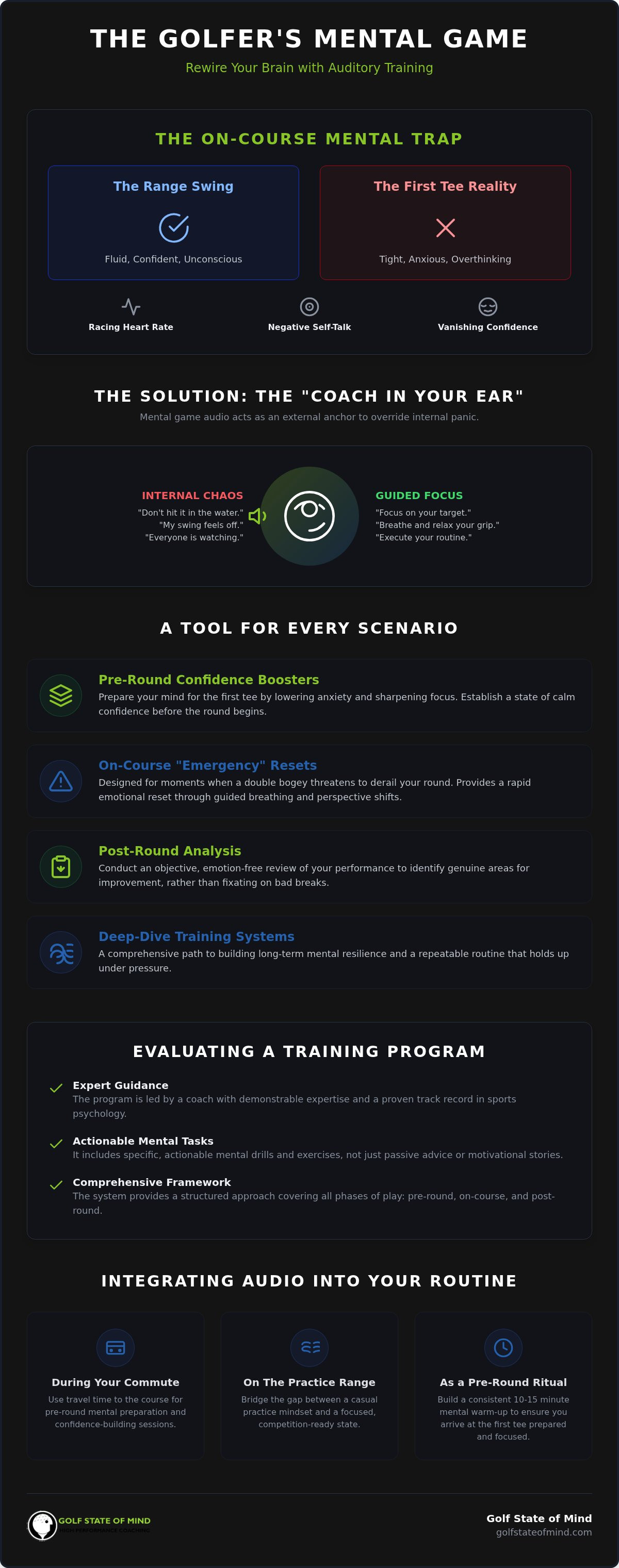
That’s one reason audio can be such a useful format for mental training.
You can listen while driving to the course, walking, warming up or preparing for a tournament. You can use guided exercises for breathing, visualization and pre-round preparation without having to sit down and read another article or book.
But simply listening to motivational content isn’t mental training.
Effective golf mental game audio should have a purpose. It should help you develop a skill, prepare for a specific situation or reinforce a mental process you’ve already been working on.
Used correctly, audio can become a valuable part of your mental game training—particularly before rounds and between rounds.
In this guide, I’ll explain the different ways golfers can use mental game audio, what to look for in a good program and how to integrate audio into your practice and competitive routine.
Key Takeaways
- Golf mental game audio should help you train specific skills rather than simply provide motivation.
- Audio can be particularly useful for pre-round preparation, breathing, visualization and confidence work.
- The best time to learn mental skills is generally away from the shot—not while you’re trying to execute it.
- Repetition can make your mental process more familiar and easier to access under pressure.
- Audio should simplify your thinking rather than give you another list of instructions to remember.
- Combine audio training with practice, reflection and real on-course experience.
Why Audio Can Be Useful for Your Golf Mental Game
There is an important difference between understanding a mental game concept and being able to use it.
You might understand that you need to stay present.
You might know that you should accept poor shots.
You might have read about visualization, breathing and confidence.
But knowing those things doesn’t automatically make them skills.
They need practice.
Audio can help because it allows you to move from simply reading about a concept to actually going through an exercise.
Guided Practice
Imagine you’re working on breathing before an important tournament.
You could read an article explaining how to breathe.
Or you could close your eyes and follow a guided exercise that takes you through the breathing itself.
The second option gives you an experience rather than simply information.
The same applies to visualization.
A written lesson can teach you what visualization is. A guided audio can take you through the process of creating images, feelings and intentions before you play.
Audio Fits Easily Into a Golfer’s Routine
Another advantage is convenience.
You don’t necessarily need to find additional time in your day.
You might listen:
- While driving to the golf course.
- During a walk.
- Before beginning your warm-up.
- At home the evening before a tournament.
- During a mental training session away from the course.
That makes consistent mental training easier to integrate into your normal routine.
Different Types of Golf Mental Game Audio
Not all mental game audio should serve the same purpose.
A golfer preparing for a tournament needs something different from a golfer learning how to visualize or working on confidence.
I find it useful to think about several different categories.
Educational Audio
Educational audio teaches you a mental game concept.
Topics might include:
- Confidence.
- Focus and concentration.
- Pressure.
- Pre-shot routines.
- Post-shot routines.
- Self-talk.
- Emotional control.
- Goal setting.
This is essentially the audio equivalent of a lesson.
The objective is understanding.
Guided Mental Training
Guided audio is different.
Instead of simply explaining something, it asks you to participate.
That might include:
- Breathing exercises.
- Visualization.
- Attention training.
- Pre-round preparation.
- Confidence exercises.
- Reflection after a performance.
This type of audio can be particularly valuable because you’re actively practicing the skill.
Pre-Round Audio
Pre-round audio is designed to help you prepare mentally for the round ahead.
But the goal shouldn’t be to convince yourself that you’re going to play brilliantly.
A useful pre-round routine should help you establish:
- Your intention for the round.
- Your process goals.
- Your attitude.
- Where you want your attention to be.
- How you intend to respond when things don’t go your way.
That creates a much more useful foundation than simply repeating positive statements and hoping they create confidence.
Want to strengthen your mental game? Download my free ebook, 7 Key Mental Strategies, and learn practical strategies to improve your confidence, focus and performance on the golf course. Get the Free Ebook
Pre-Round Mental Game Audio
The drive to the golf course can be an excellent time to begin preparing mentally.
For many golfers, this is when thoughts about the upcoming round start accelerating.
You might think about:
“What do I need to shoot?”
“What if my swing isn’t there today?”
“I really need to play well.”
“Last time I played here I made a mess of the first few holes.”
A pre-round audio can help redirect your attention away from predicting the outcome and toward preparing your performance process.
What Should You Focus on Before a Round?
Rather than trying to manufacture confidence, remind yourself of what you can control.
For example:
- Make clear decisions.
- Commit fully to your targets.
- Use your pre-shot routine.
- Accept the result of each shot.
- Respond constructively to mistakes.
- Keep returning your attention to the present.
These are useful intentions because they’re things you can actually do regardless of how well you happen to hit the ball.
Don’t Overload Yourself Before You Play
More information isn’t necessarily better.
If you listen to an hour of mental game instruction immediately before playing, you may arrive at the first tee with 15 different things you’re trying to remember.
That’s the opposite of what you want.
As you get closer to your tee time, your thinking should become simpler.
The purpose of your preparation is to help you play—not to turn the round into a mental game examination.
Breathing and Relaxation Audio for Golf
Breathing is particularly well suited to guided audio because you can simply follow the timing.
One breathing exercise I use with golfers is the 4–6 breath.
- Breathe in slowly for four seconds.
- Breathe out slowly for six seconds.
- Repeat for 10 breaths.
You can use this before leaving for the course, before your warm-up or when you notice your physical state becoming unsettled.
The goal isn’t necessarily to make every nervous feeling disappear.
Golfers can perform very well while feeling nervous.
Instead, breathing gives you a way to regulate your state and direct your attention toward something happening in the present.
You can learn more about this in my guide to golf breathing techniques.
Relaxation Isn’t Always the Goal
This is an important distinction.
Some golfers believe their goal before competition should be to become completely relaxed.
But you don’t necessarily want to feel like you’re about to fall asleep.
You need enough energy to compete.
Different golfers perform well at different levels of activation.
Use breathing and audio to help you become more aware and intentional about your state rather than assuming calmer is always better.
Visualization and Confidence Audio
Visualization is another mental skill that works naturally with guided audio.
But visualization shouldn’t simply mean imagining yourself holding a trophy.
It can be much more practical than that.
Visualize the Process
You might mentally rehearse:
- Walking onto the first tee.
- Going through your normal routine.
- Seeing your target clearly.
- Making a committed swing.
- Responding calmly after a poor shot.
- Playing an important hole late in the round.
- Feeling nervous and continuing with your process anyway.
Notice that you’re not only visualizing perfect outcomes.
You’re rehearsing how you want to respond to the different situations golf might present.
That’s particularly useful because competition rarely unfolds exactly as we hope.
Confidence Is More Than Positive Thinking
I don’t believe confidence comes simply from telling yourself you’re confident.
More reliable confidence comes from preparation and evidence.
If you’ve practiced your routines, prepared for pressure, worked on your response to mistakes and repeatedly trained your process, you have something real to trust.
Audio can reinforce that preparation.
But it shouldn’t try to convince you of something you don’t believe.
How to Evaluate Golf Mental Game Audio
There is now a huge amount of mindset, meditation and performance content available.
Some of it is excellent.
Some of it sounds impressive without giving you much you can actually use.
When evaluating golf mental game audio, I would ask several questions.
Is It Specific to Golf?
General mindfulness and relaxation exercises can certainly be useful.
But golf has specific mental challenges:
- Long periods between shots.
- Constantly changing targets.
- Score awareness.
- Pressure.
- Recovering after mistakes.
- Making decisions and then committing to them.
Golf-specific mental training should address those realities.
Does It Give You Something to Practice?
After listening, you should know what to do.
If an audio simply tells you to “believe in yourself” for 20 minutes, you may feel motivated but you haven’t necessarily developed a skill.
A good lesson should lead to application.
Does It Make Golf Simpler?
This is one of my biggest tests.
Good mental coaching should eventually simplify performance.
If an audio leaves you standing over the ball thinking about breathing, confidence, posture, visualization, self-talk, tempo and six other things simultaneously, it isn’t helping.
You want to do the learning away from the shot so that when it’s time to play, you can trust your preparation.
Who Created It?
Look at the experience and philosophy of the person creating the material.
Do they understand golf?
Do they understand what actually happens during competition?
Does their approach emphasize practical skills rather than promises of perfect confidence and permanent positivity?
The quality of the thinking behind the audio matters more than how impressive the production sounds.
How to Integrate Audio Into Your Practice
Audio shouldn’t exist separately from your golf training.
The ideas you learn should eventually show up in practice.
Step 1: Learn Away From the Ball
Listen to the lesson or exercise somewhere you can give it your attention.
Understand what you’re trying to develop.
Step 2: Take One Skill Into Practice
Don’t try to implement an entire mental game system in one range session.
Choose one thing.
For example, you might practice:
- Committing fully to every target.
- Using your complete pre-shot routine.
- Returning your attention to the present.
- Responding constructively after a poor shot.
Step 3: Add Consequence
Eventually, practice the skill in situations where the outcome matters to you.
You might keep score, compete against another player, use one-ball practice or complete a drill where a miss means starting again.
That’s when you find out whether the skill is becoming available under pressure.
Step 4: Review
Afterward, ask:
- What did I notice?
- When did the skill become difficult?
- What triggered me?
- What worked?
- What do I need to continue practicing?
This learning-practice-review cycle is much more valuable than endlessly consuming new content.
Want seven practical strategies for improving your mental game? Download my free 7 Key Mental Strategies ebook and start developing the skills you need to play with greater confidence, focus and consistency. Download the Free Ebook
Don’t Become Dependent on Audio
This may sound strange in an article about golf mental game audio, but it’s important.
The objective isn’t to create a golfer who feels unable to perform unless they’ve listened to exactly the right track before teeing off.
That’s dependency, not confidence.
The audio is a training tool.
Over time, you want the skills to become yours.
You should understand:
- How you want to prepare.
- How to regulate your state.
- Where to direct your attention.
- How to respond to pressure.
- How to recover from mistakes.
- How to review your performance.
Eventually, you shouldn’t need somebody in your ear telling you what to do.
You should know your process and trust it.
Building a Stronger Mental Game With Audio
Audio is not a shortcut to a great mental game.
But it can be an excellent training format.
It allows you to learn and practice mental skills in situations where reading isn’t convenient, and guided exercises can help you turn ideas such as breathing and visualization into actual experiences.
The key is using it intentionally.
Don’t simply collect hundreds of audios.
Learn a skill.
Practice it.
Take it onto the golf course.
Review what happened.
Then continue building from there.
That’s how golf mental game audio becomes more than something you listen to.
It becomes part of how you train.
Frequently Asked Questions
Can golf mental game audio improve my scores?
Audio can’t guarantee lower scores, but it can help you train skills that influence performance, such as focus, confidence, routines, breathing and response to mistakes. The important part is applying what you learn during practice and play rather than simply listening.
When is the best time to listen to golf mental game audio?
Useful times include the drive to the course, before beginning your warm-up, at home before a tournament or during dedicated mental training sessions. I generally prefer golfers to do the learning before they play so their thinking can become simpler once the round begins.
Should I listen to mental game audio while I’m playing golf?
For most golfers, I recommend using audio primarily before and after the round rather than continually listening during play. Your objective during the round is to trust the skills you’ve trained. Competitive golfers should also check the applicable Rules of Golf and conditions of competition regarding electronic devices and audio use.
Can audio help with first-tee nerves?
Yes. A short pre-round exercise can help you regulate your physical state and direct your attention toward your process rather than the possible outcome. The objective isn’t to eliminate nerves. It’s to prepare yourself to perform while they’re present.
Can golf mental game audio help with the yips?
Guided audio may help with areas such as breathing, attention, fear and excessive conscious control that can accompany the yips. However, the yips can have different contributing factors, so audio shouldn’t be presented as a universal cure.
What’s the difference between golf meditation and mental game audio?
Meditation generally develops skills such as awareness and attention. Golf mental game audio can include those skills but may also address golf-specific situations such as pressure, pre-round preparation, routines, visualization and response to poor shots.
How often should I use mental game audio?
Consistency matters more than long sessions. A short lesson or guided exercise several times per week can be more useful than occasionally listening to hours of content. Give yourself time to apply each skill before constantly moving to something new.
Can I use golf mental game audio during practice?
You can, but I would avoid becoming dependent on headphones while hitting every shot. A useful approach is to listen to the training first, identify the skill you’re working on and then put the device away while you practice applying it independently.
What should I look for in a golf mental game audio program?
Look for golf-specific expertise, a clear training structure, practical exercises and content that makes performance simpler rather than more complicated. The best programs should help you gradually become more self-sufficient rather than dependent on the audio itself.
Get your FREE Mental Game Scorecard
