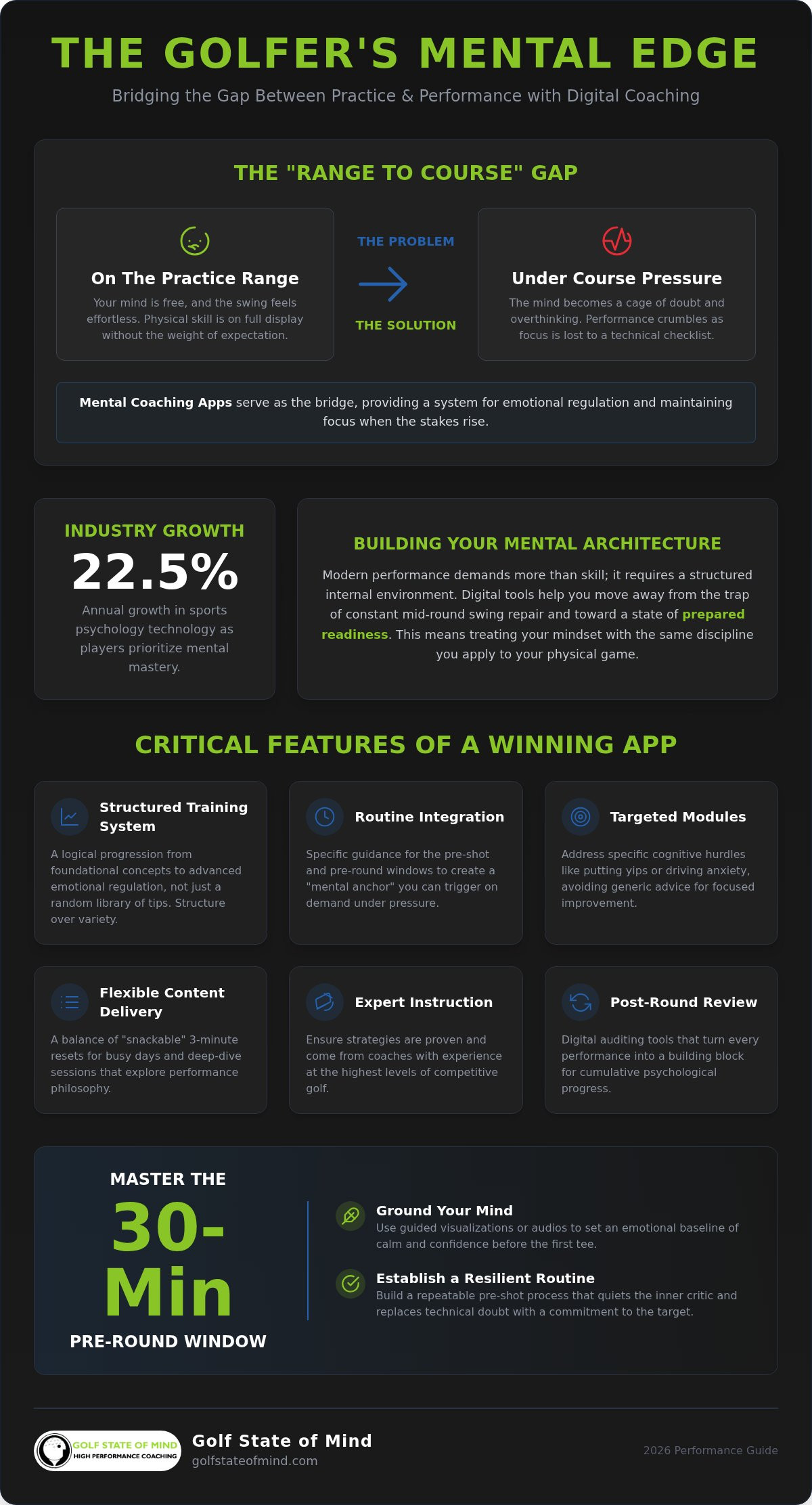
Developing a Killer Instinct in Golf: Compete with Calm Confidence
What if a stronger competitive instinct in golf had less to do with aggression and more to do with commitment? When a shot or putt matters,…
Get your FREE Mental Game Scorecard



Most golfers believe their high scores are the result of a faulty swing, but the reality is that your scorecard is usually a victim of cognitive interference rather than mechanical failure. You’ve likely experienced the frustration of playing six holes of flawless golf only to have a single bad bounce trigger a mental meltdown that ruins the entire round. These common mental mistakes in golf aren’t just annoying; they’re systematic errors in how you process pressure and setbacks. When you battle intrusive swing thoughts over the ball instead of seeing your target, you aren’t fighting your muscles. You’re fighting a lack of cognitive structure.
It’s exhausting to feel intense anxiety over a short putt or a tight tee shot, but you don’t have to remain a prisoner to these emotional fluctuations. We’ll identify the exact psychological traps causing your blown rounds and provide the tools to build a resilient, repeatable pre-shot routine that quiets internal chatter. We’ll also examine how to maintain emotional neutrality after a poor shot to protect your scorecard momentum. By installing these proven cognitive frameworks, you’ll move from reactive frustration to the disciplined mastery required to lower your scores in 2026.
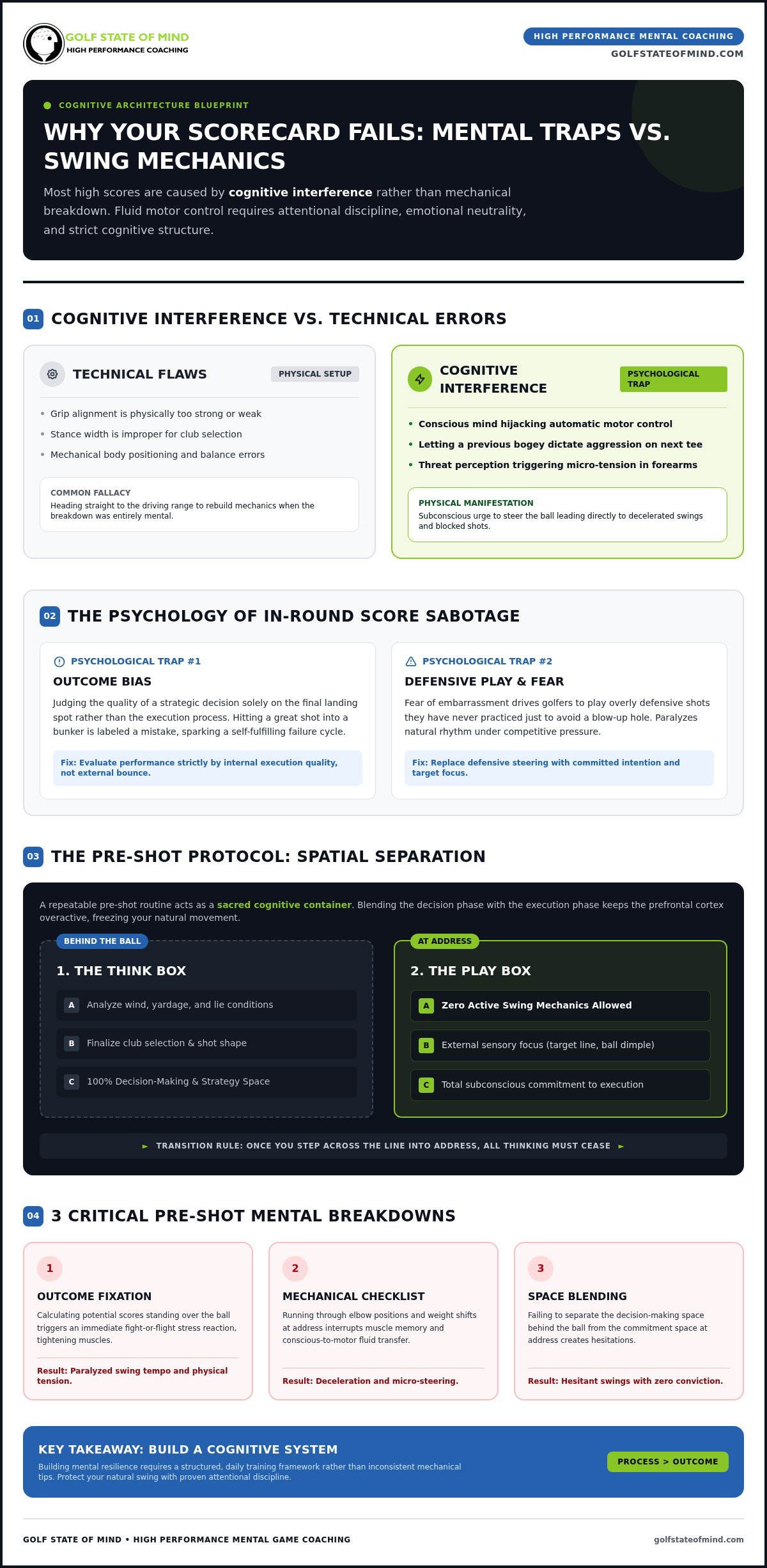
To improve your handicap, you must first recognize that common mental mistakes in golf are not technical failures. They are instances of cognitive interference where your conscious mind disrupts your subconscious motor control. When you stand over a ball and your brain begins a frantic checklist of elbow positions and weight shifts, you’ve already lost the battle. This is the core of sport psychology: understanding that a fluid swing requires a quiet mind. You aren’t fighting your muscles; you’re fighting a lack of attentional discipline.
Attentional lapses differ significantly from technical execution errors. A technical error is a grip that is too strong or a stance that is too wide. A mental mistake is allowing a previous bogey to dictate your aggression on the next tee. This psychological friction manifests physically. When the brain perceives a threat, such as a water hazard or a tight fairway, it triggers a stress response. This results in micro-tensions in your forearms and a subconscious urge to steer the ball, which inevitably leads to decelerated swings and blocked shots. Standard driving range practice rarely exposes these vulnerabilities because the environment lacks the consequence required to trigger your psychological defense mechanisms.
It’s a common trap to finish a poor round and head straight to the range to find your swing. However, chasing mechanical perfection is often a distraction from the real culprit. Under competitive pressure, the conscious brain often tries to take over tasks that should be automatic. When you try to manually control the clubhead, you paralyze your natural rhythm. You don’t need a new backswing. You need a more resilient cognitive container for the one you already have. Attempting to fix a psychological breakdown with a mechanical adjustment only adds more noise to an already cluttered mind.
Score sabotage is frequently driven by outcome bias. This is the tendency to judge the quality of a decision based solely on the result rather than the process. If you hit a great shot into a bunker, you might incorrectly label the choice as a mistake, leading to a self-fulfilling prophecy of failure on the next hole. Additionally, the fear of embarrassment often drives golfers to play defensively. You might choose a safe shot that you haven’t practiced simply to avoid a blow-up. Building mental resilience means prioritizing your internal process over these external anxieties. Correcting these common mental mistakes in golf requires shifting from a subconscious victim to an intentional architect of your own focus.
A structured pre-shot routine serves as a sacred cognitive container for your performance. It protects your swing from external distractions and internal anxiety. To execute consistently, you must separate the decision-making space behind the ball from the commitment space at address. When you blend these two phases, your prefrontal cortex remains overactive. This mental interference interrupts your muscle memory and freezes your natural movement. Golfers regularly suffer from three primary pre-shot breakdowns that trigger common mental mistakes in golf before the club even moves.
Calculating your potential score while standing over a shot triggers a physiological fight or flight reaction. Your body tenses because your brain perceives a threat to your scorecard. Tour professionals learn to evaluate their performance by execution quality rather than the final landing position of the ball. To break this habit, detach your self-worth from individual shot trajectories. Focus entirely on the immediate task. If you want to learn how to recover when things go wrong, you must understand how to bounce back from a bad round by controlling your internal inputs.
Standing over the ball with a checklist of swing mechanics paralyzes your natural tempo. This is the difference between the think box and the play box. The think box belongs behind the ball, where you analyze wind, yardage, and lie. Once you step into the play box at address, all thinking must cease. Shift your attention away from your body movements. Direct your awareness toward external sensory targets, such as the target line or the dimple on the back of the ball, to allow your subconscious motor patterns to take over.
Aiming generally at the fairway increases your target dispersion and creates mental hesitation. Without a specific micro-target, your brain cannot calculate precise movement patterns. Vivid mental pictures prime your motor cortex for success by creating a neurological blueprint of the intended flight path. Take the time to see the ball track through the air before you step forward. For a deeper look into managing your attention on the course, explore this masterclass on how to focus during a golf round.
Eliminating these pre-shot errors requires a systematic approach to your mental preparation. You can build this discipline by integrating The Ultimate Mental Game Training System into your regular practice regimen, transforming your routine into an unbreakable shield against pressure.
The seconds following a ball’s flight are where many rounds are won or lost. While pre-shot errors set the stage for failure, your post-shot reaction determines whether that failure remains an isolated incident or becomes a contagious trend. Common mental mistakes in golf often stem from a misunderstanding of your own physiology. When you hit a poor shot, your body experiences an acute adrenaline spike. This hormone has a significant physiological half-life; it doesn’t dissipate the moment you put the club back in the bag. If you carry that frustration to the next tee, you’re swinging with a compromised nervous system and elevated muscle tension.
Objective evaluation is the antidote to emotional reactivity. Instead of reacting with anger, observe the shot with clinical curiosity. Did the ball move because of a path issue or a face angle error? By treating the shot as data rather than a moral failing, you prevent the emotional cascade that leads to a ruined scorecard. This shift in perspective allows you to maintain the calm confidence required for elite performance.
Many golfers maintain a mental “highlight reel” of their worst moments, replaying them with vivid clarity between holes. This cognitive replay anchors a negative self-identity and creates lingering tension patterns that disrupt your natural rhythm. An emotional outburst doesn’t just vent steam; it elevates your resting heart rate for several minutes, directly affecting your fine motor skills on the subsequent shot. You must learn to close the door on the previous shot completely. To build this level of discipline, you can study the framework of mastering golf emotional control to maintain tactical composure regardless of the outcome.
Score protection is a primary trigger for sudden late-round collapses. When you realize you’re on track for a personal best, your brain often shifts from “playing to win” to “playing not to lose.” This defensive posture is a cognitive trap. It subtly alters your swing speed and rhythm because you’re no longer committed to a target; you’re committed to avoiding a mistake. You can find valuable lessons from a PGA Tour win regarding how professionals manage these high-stakes moments by staying strictly in the present. To combat this, anchor your awareness in your immediate physical environment. Focus on the feel of your feet on the ground or the sound of the wind. By keeping your mind in the “now,” you prevent the common mental mistakes in golf that arise when the weight of the future becomes too heavy to carry.
Identifying common mental mistakes in golf is only the first step toward lower scores. To truly fix score sabotage, you must shift from being a subconscious victim of your emotions to becoming an intentional architect of your focus. This transition doesn’t require a single change to your physical swing mechanics. Instead, it involves establishing boundary rules that separate the analytical phase of the game from the execution phase. When you feel a round beginning to slip, these four protocols provide a structured way to reclaim your mental stability.
Emotional residue is a primary cause of multi-hole collapses. To stop this, create a strict physical boundary for processing your reactions. Give yourself exactly ten yards of walking distance after a shot to feel whatever you need to feel, whether it’s frustration or joy. Use a physical cue, such as unstrapping your glove or placing your club back in the bag, to signal the end of this reflection. Once you cross that ten-yard mark, commit to full mental neutrality. This protocol prevents one bad bounce from bleeding into your next three holes.
When pressure rises, the brain naturally tries to control the body through internal mechanical keys. You must consciously override this impulse. Train your eyes to lock onto a pinpoint target, such as a specific leaf on a tree or a single blade of grass in the distance. Replace complex swing thoughts with simple rhythm and tempo words like “smooth” or “target.” By cultivating “quiet eyes” in the seconds before your takeaway, you reduce neurological noise and allow your subconscious motor patterns to function without interference.
You can’t think your way out of a physiological adrenaline spike, but you can breathe your way out of it. Extended exhalations stimulate the parasympathetic nervous system, which signals your brain to lower your heart rate. If you feel your hands shaking or your tempo rushing, use a “physiological sigh”—two short inhales followed by one long, slow exhale—between holes. Mastering these on-course calming techniques is essential for peak performance. You can learn more about the science of staying calm in our comprehensive guide on how to handle pressure in golf.
Correcting these common mental mistakes in golf requires a dedicated framework that you can rely on when the pressure is highest. To install these habits permanently and see a rapid drop in your handicap, start training with The Ultimate Mental Game Training System today.
Identifying common mental mistakes in golf is a necessary first step, but awareness alone won’t lower your handicap. Psychological fitness requires the same deliberate, daily training as your physical swing. Many golfers spend hours on the range perfecting their ball striking while leaving their cognitive architecture to chance. This is a strategic error. To achieve true consistency, you must move beyond consuming information and begin installing automatic habits that hold up under the heat of competition. By treating your mindset as a skill to be developed, you transform from a reactive player into a disciplined practitioner.
Reading disconnected tips online rarely builds the resilience needed for tournament play. Under pressure, the brain reverts to its most practiced patterns. If you haven’t systematically trained your response to a double bogey or a tight fairway, you’ll likely fall back into old cycles of frustration. Systematic cognitive development is the only definitive pathway to breaking through long-standing scoring barriers. It transforms your mental game from a series of reactive fixes into a proactive, structured system that protects your performance when you need it most. These same principles of emotional regulation and structured focus are equally vital off the fairways; for executives and leaders facing high-stakes career challenges, Charlie Whalley Coaching provides tailored guidance to overcome cognitive interference and perform with clarity under pressure.
There is a vast difference between casual advice and a structured psychological blueprint. Casual tips provide temporary relief, but a system provides a permanent shift in how you process the game. By utilizing daily mental drills and specialized audios, you can rewire your reflexive stress reactions. This process involves moving away from traditional score-based evaluation and toward process compliance. Use a mental scorecard to track specific metrics like your commitment rate to a target and your ability to maintain a quiet mind during the takeaway. When you measure the process, the results naturally follow.
Elite competitors understand that they cannot always see their own cognitive blind spots. A mentor provides the external evaluation necessary to identify subtle patterns of self-sabotage that you might miss. You can discover how top-tier players build unshakeable confidence by utilizing The Ultimate Mental Game Training System. This framework provides the tools to replace common mental mistakes in golf with a disciplined routine that generates repeatable success.
Mastery of the self is the prerequisite for mastery of the craft. If you’re ready to eliminate mental sabotage and build a mind that works for you rather than against you, book a free 15-minute mental coaching consultation today. Let’s build the cognitive structure your talent deserves.
The path to lower scores isn’t found in another swing tip; it’s built through the quiet strength of a prepared mind. We’ve explored how common mental mistakes in golf, such as overactive pre-shot mechanics and post-shot emotional cascades, disrupt the fluid motor control required for excellence. By establishing a rigid boundary between the think box and the play box, and utilizing physiological resets like diaphragmatic breathing, you reclaim control over your performance.
Consistent golf is the byproduct of a structured cognitive system rather than random inspiration. You’ve learned that psychological fitness requires the same deliberate training as your short game. To accelerate this progress, you need a proven framework developed through David MacKenzie’s research at the University of St. Andrews. Join over 100,000 golfers worldwide, including European Tour winners and national champions, who have transitioned from reactive frustration to calm mastery.
Build an unshakeable mind with The Ultimate Mental Game Training System and start protecting your scorecard from internal sabotage. You have the talent; it’s time to install the mental architecture to support it.
The single most common mental mistake in golf is fixating on the score or the outcome of a shot rather than the immediate process. When you worry about making a bogey or breaking 80, your brain perceives a threat, which leads to physical tension. This outcome bias prevents you from staying in the present moment. Instead, successful players commit to a specific target and a disciplined routine, judging their performance by execution rather than where the ball lands.
Yes, psychological errors directly manifest as physical ball-flight issues. When you experience anxiety over a hazard, your brain sends signals that increase micro-tensions in your forearms and shoulders. This tension restricts your natural rotation and often leads to a “steer” or a decelerated swing. These involuntary physical responses are what cause the clubface to open or close at impact, resulting in the very slices or hooks you were trying to avoid.
You stop overthinking by establishing a clear boundary between your analytical planning and your physical execution. Complete all mechanical adjustments and yardage calculations behind the ball in your “think box.” Once you step into your stance, you must enter the “play box,” where your only job is to see the target and feel the rhythm. Use a simple tempo word or an external sensory cue to occupy your conscious mind, allowing your subconscious to handle the swing.
Immediately after a poor shot, you should deploy a structured release protocol to neutralize emotional reactivity. Give yourself a short window, perhaps ten yards of walking, to process your frustration objectively. Use a physical trigger like unstrapping your glove to signal the end of the reaction. Combine this with a physiological sigh, two short inhales and one long exhale, to lower your heart rate and prevent the adrenaline spike from sabotaging your next tee shot.
A proper mental routine isn’t about the specific number of seconds, but the consistency of the cognitive steps involved. Most effective routines take between 15 and 25 seconds from the moment you begin your analysis to the start of the takeaway. The goal is to create a predictable rhythm that signals to your brain that it’s safe to perform. Rushing or dragging the process introduces doubt, which is one of the most common mental mistakes in golf.
You struggle in tournaments because your practice environment lacks the consequence required to trigger your psychological defense mechanisms. In a casual round, there’s no fear of embarrassment or score protection, so your brain allows your subconscious to swing freely. To bridge this gap, you must train your mind to handle pressure using systematic frameworks. Developing a resilient routine ensures that your mental process remains identical, regardless of whether you’re playing for fun or a trophy.
Yes, mental game training is essential for curing the yips, as the condition is often a neurological short circuit caused by excessive conscious control over an automatic movement. By using specialized programs like “How to Cure the Yips,” you learn to quiet the prefrontal cortex and return the movement to the subconscious mind. Focusing on external targets and sensory feedback helps bypass the internal interference that causes involuntary flinches during the putting stroke or drive.
What if a stronger competitive instinct in golf had less to do with aggression and more to do with commitment? When a shot or putt matters,…
What is the difference between golf psychology and mental coaching, and which kind of support fits your goal? The terms often appear side by side,…
Why does a swing that feels effortless on the practice range often crumble under the pressure of the final three holes? You’ve likely felt that…