

Best Golf Mental Coaching App: 2026 Performance Guide
“`html
Golfers spend a lot of time and money improving their physical game.
They use launch monitors, swing-analysis apps, GPS systems, putting aids and fitness programs.
But when it comes to the mental game, many players still rely on a few notes in a book or something they remember hearing years ago.
That is starting to change.
A good mental coaching app for golfers can make mental training much easier to integrate into your everyday routine. Instead of thinking about your mental game only when you’re struggling, you can work on skills such as confidence, focus, routines, pressure management and post-round reflection throughout the week.
But an app is only useful if it actually helps you train.
A collection of motivational quotes or random mental tips might make you feel good for a few minutes, but that isn’t the same as developing mental skills.
In this guide, I’ll explain what I believe golfers should look for in a mental coaching app, how to use one effectively, and how digital training can help you transfer more of the game you have in practice onto the golf course.
Key Takeaways
- A mental coaching app should help you train skills, not simply consume motivational content.
- Look for a clear progression rather than hundreds of disconnected tips and audios.
- The best mental training should include work on focus, confidence, routines, pressure, emotional response and post-round review.
- An app can be especially useful before rounds, between rounds and during practice.
- Digital tools should make your mental game simpler, not give you another list of things to think about while you’re hitting a shot.
- Consistency matters more than spending hours using an app once every few weeks.
- Apps can support coaching, but they don’t necessarily replace the value of individualized feedback.
What Is a Golf Mental Coaching App?
A mental coaching app for golfers is a digital tool designed to help golfers improve the mental skills involved in performance.
That can include areas such as:
- Confidence.
- Focus and concentration.
- Pre-shot routines.
- Post-shot routines.
- Handling pressure.
- Emotional control.
- Self-talk.
- Visualization.
- Goal setting.
- Performance practice.
- Post-round review.
The important word here is training.
Reading a tip about staying present isn’t the same as becoming better at staying present.
Knowing that you should commit to your target doesn’t necessarily mean you’ll do it with three holes remaining and your best tournament round on the line.
Mental skills need repetition.
A well-designed app can help create that repetition by giving you a place to learn, practice and review the mental side of your game consistently.
Why Digital Training Can Be Useful
One of the biggest challenges with mental training is that golfers often don’t know when to do it.
They work on their swing when they’re at the range.
They practice putting when they’re on the putting green.
But mental training can feel less tangible.
An app can give it structure.
You might spend 10 minutes learning about a particular mental skill in the evening, use an audio before your round the following morning and then review that skill after you play.
That turns an abstract concept into something much closer to a training process.
What Should a Good Golf Mental App Help You Improve?
I would be cautious about any mental game app that promises to make you permanently confident, eliminate nerves or instantly stop negative thoughts.
That’s not how performance works.
The objective isn’t to create a golfer who always feels perfect.
The objective is to help you perform more effectively when you don’t feel perfect.
A good mental training program should therefore help you develop skills you can use in different emotional states and different competitive situations.
Awareness
Before you can improve your mental game, you need to understand it.
You should begin recognizing:
- Which situations trigger you.
- When your attention drifts toward score.
- When you become technical.
- What happens after bad shots.
- How pressure changes your behavior.
- What your best performance state feels like.
Awareness creates the opportunity to respond differently.
Presence and Focus
Golf asks you to spend several hours competing while only actually hitting the ball for a very small percentage of that time.
That leaves a lot of opportunity for your mind to wander.
A useful mental coaching app should teach you how to engage your focus when you need it and disengage between shots rather than trying to concentrate intensely for four hours.
It should also help you recognize when your attention has moved into the past or future and redirect it to the present.
Routines
Your pre-shot and post-shot routines provide structure to performance.
A good app should help you understand the purpose behind them rather than simply tell you to repeat a physical sequence.
Your pre-shot routine should help you:
- Gather information.
- Make a decision.
- Commit.
- Move from thinking into playing.
Your post-shot routine should help you learn what is useful, accept the outcome and move on.
Pressure
Golfers don’t need an app that tells them not to feel nervous.
They need to learn how to play while feeling nervous.
Mental training should help you recognize your personal pressure response, regulate your physical state, maintain commitment and direct your attention back toward your process.
You can learn more about this in my guide on how to handle pressure in golf.
Want to start improving your mental game now? Download my free ebook, 7 Key Mental Strategies, and learn practical strategies for improving your confidence, focus and performance on the golf course. Get the Free Ebook
Features to Look for in a Mental Coaching App for Golfers
Not every golfer needs exactly the same features.
But there are several things I would look for when evaluating a mental coaching app for golfers.
1. A Structured Training Path
This is probably the most important feature.
There is a huge amount of mental game information available online.
The problem isn’t usually access to information.
The problem is knowing what to work on, in what order, and how the different skills fit together.
Look for an app that provides a logical progression.
For example, understanding your goals and performance patterns should usually come before trying to learn ten different pressure-management techniques.
2. Short Lessons You Can Actually Use
You shouldn’t need an hour every day to work on your mental game.
Short lessons can be very effective if they focus on one clear idea and give you something specific to practice.
The important thing is that the lesson leads to application.
Ask:
“What am I supposed to do differently after completing this?”
If the answer isn’t clear, the content may be interesting without being particularly useful.
3. Guided Audios
Audio can be particularly useful for mental training because you can listen away from a screen.
Depending on the program, audios might be used for:
- Pre-round preparation.
- Breathing.
- Visualization.
- Confidence.
- Relaxation.
- Recovery from difficult performances.
But audio shouldn’t simply become positive messages you hope will magically change your game.
The strongest use of audio is to reinforce skills and states you’re already learning to develop deliberately.
4. Reflection and Tracking
Golfers collect an enormous amount of physical performance data.
They know their greens in regulation, putting averages, driving accuracy and strokes gained.
Far fewer golfers track their mental performance.
A good digital system should help you review things like:
- Commitment.
- Presence.
- Routine.
- Response to mistakes.
- Emotional control.
- Decision-making.
This helps you understand why certain rounds happen rather than judging everything from the final score.
5. Practical Drills
Your mental game shouldn’t live entirely on your phone.
The app should eventually send you back onto the range, putting green and golf course with something to practice.
That might include:
- One-ball practice.
- Competitive putting drills.
- Routine practice.
- Target-focused exercises.
- Pressure simulation.
- Post-round reviews.
That’s where learning becomes training.
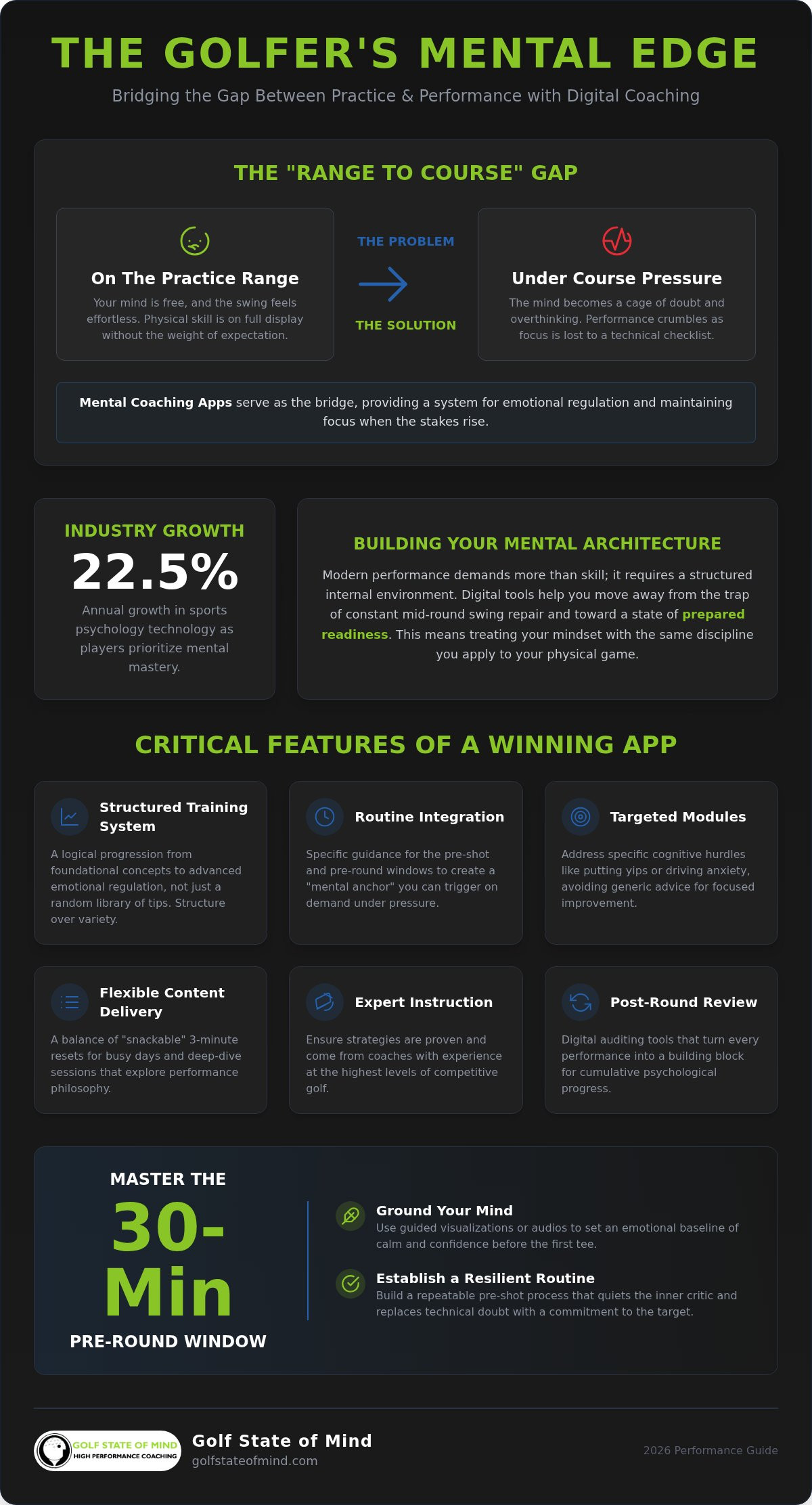
Audio, Guided Training and Written Training
There isn’t one perfect format for everybody.
Some golfers learn best by reading.
Others prefer listening.
Some need practical exercises before a concept really makes sense.
Ideally, a mental coaching app combines several formats.
Written Lessons
Written lessons are useful when you need to slow down and think deeply about a topic.
They also make it easy to return to an idea later.
Audio Lessons
Audio is useful when you’re walking, driving to the course or preparing away from the screen.
It can also be particularly effective for guided exercises.
Worksheets and Reflection
There are some parts of mental training that require you to think about your own game.
No generic lesson can tell you exactly what your individual pressure triggers are.
That’s something you discover through reflection.
Worksheets, assessments and journals can help turn generic information into something personally relevant.
How to Use a Mental Coaching App Before You Play
One of the most useful applications of digital mental training is before your round.
But don’t use the 30 minutes before your tee time to cram your brain with ten new ideas.
The closer you get to competing, the simpler your mental preparation should become.
Use the App Before You Reach the First Tee
You might use a short pre-round session to remind yourself of:
- Your intention for the round.
- Your process goals.
- The attitude you want to bring to the course.
- How you want to respond to mistakes.
- Where you want your attention to be.
You could also complete 10 rounds of 4–6 breathing: inhale for four seconds and exhale for six seconds.
You can read more about that in my guide to golf breathing techniques.
Don’t Take the App Into Your Swing
This is an important point.
The purpose of mental training is not to give you more things to remember while you’re standing over the ball.
By the time you’re playing, the training should help you simplify.
See the shot.
Make the decision.
Commit.
Trust your skills.
An app that leaves you with eight mental instructions before every swing is probably making golf harder rather than easier.
How to Use an App Between Rounds
This may actually be where a mental coaching app provides the most value.
Instead of waiting until your next tournament to think about the mental game, use the days between rounds to develop it.
Review Your Previous Round
Don’t ask only:
“What did I shoot?”
Ask:
- Where was my attention?
- How well did I commit?
- How did I respond to poor shots?
- What situations changed my state?
- Did I follow my routine?
- What did I learn?
Then use that information to choose your next area of training.
Work on One Thing at a Time
If your review shows that you consistently become distracted by score late in the round, work on presence and process.
If you notice that poor shots affect the next hole, work on your post-shot response.
If you become overly technical under pressure, work on target orientation and commitment.
Your mental training should respond to what your performance is teaching you.
Use Your App During Performance Practice
There is a difference between learning about the mental game and practicing it.
At some point, you need situations where the outcome means something.
This is what I call performance practice.
Create Consequence
Use challenges such as:
- One-ball practice.
- Competitive games.
- Keeping score.
- Putting drills where a miss means starting again.
- Playing different shots and targets rather than repeatedly hitting the same club.
Then observe what happens mentally.
As the pressure increases:
- Do you speed up?
- Do you become more technical?
- Does your breathing change?
- Do you start thinking about the result?
Now you have an opportunity to practice the skills you’ve been learning digitally.
This is how the app begins to influence what actually happens on the golf course.
Want seven practical mental game strategies you can start using today? Download my free 7 Key Mental Strategies ebook and start building a more confident, focused and resilient approach to golf. Download the Free Ebook
What a Golf Mental Coaching App Cannot Do
Apps are useful, but it’s important to be realistic about what they can and cannot provide.
An app can teach you principles.
It can give you exercises.
It can remind you to practice.
It can help you reflect.
It can make mental training much easier to access consistently.
But it doesn’t automatically understand the exact patterns occurring in your game.
Personalization Matters
Two golfers can both say:
“I struggle under pressure.”
But the underlying challenge may be completely different.
One golfer might become obsessed with score.
Another might become technical.
Another might fear disappointing a parent or coach.
Another might become angry after mistakes.
The more individualized the issue becomes, the more useful individualized feedback can be.
That’s where coaching, assessment and personal reflection can add something a generic piece of content cannot.
How to Choose the Right Mental Coaching App
Don’t choose an app simply because it has the biggest library.
More content isn’t necessarily better.
I would ask these questions:
- Is there a clear progression? Or am I choosing randomly from hundreds of lessons?
- Does it teach skills or simply motivate me?
- Does it give me things to practice away from the app?
- Does it help me understand my own patterns?
- Does it include pre-round and post-round applications?
- Can I realistically use it consistently?
- Does the philosophy make golf simpler or more complicated?
- Is the person or team behind the content experienced specifically in golf performance?
The best mental coaching app for golfers isn’t necessarily the one with the most features.
It’s the one that helps you develop a mental process you can actually use when the phone is back in your bag and you’re standing over an important shot.
The Goal Is Not to Become Dependent on an App
Ultimately, good mental coaching should make you more self-sufficient.
You should gradually understand:
- What your triggers are.
- Where your attention needs to be.
- How pressure affects you.
- How to regulate your state.
- How to prepare for a round.
- How to respond to mistakes.
- How to review your performance.
The app is there to help you learn and practice those skills.
But when you’re standing on the 18th tee, you shouldn’t need to reach for your phone to know what to do.
You should have a process you trust.
That’s the real measure of whether your mental training is working.
Frequently Asked Questions
What is a mental coaching app for golfers?
A mental coaching app for golfers is a digital training tool designed to help golfers develop psychological skills such as confidence, focus, routines, emotional control, pressure management and post-round reflection.
Can a mental coaching app lower my golf scores?
An app cannot guarantee lower scores, but improving areas such as decision-making, commitment, focus and response to mistakes can help you use your existing physical skills more effectively. The value comes from applying what you learn rather than simply consuming content.
How often should I use a golf mental training app?
Consistency is more important than long sessions. A short lesson, exercise or review several times per week is likely to be more useful than spending an hour on mental training once every few months. The goal is to make mental skills part of your normal golf practice.
Should I use a mental coaching app during a round?
For most golfers, I would use digital mental training primarily before and after the round rather than continually consulting a phone while competing. During play, your mental process should become simpler. Competitive golfers should also check the applicable Rules of Golf and competition conditions regarding electronic devices and advice.
What features should a golf mindset app have?
Look for structured lessons, practical exercises, guided audio, pre-round preparation, post-round review, performance tracking and a progression that develops multiple mental skills over time rather than relying on random daily tips.
Is a golf mental coaching app better than a meditation app?
They serve different purposes. General meditation can help develop awareness and attention, but golf-specific mental training should connect those skills to situations such as pre-shot routines, pressure, poor shots, target commitment and competitive performance.
Can an app help with the golf yips?
Digital mental training may help you work on factors such as fear, attention, tension and excessive conscious control that can accompany the yips. However, the yips can have different contributing factors and there isn’t one universal solution. You can read more in my guide to overcoming the golf yips.
Do I still need a mental coach if I use an app?
Not every golfer needs individual coaching. Many players can make significant progress with self-guided training. Personalized coaching becomes particularly useful when you have patterns you are struggling to identify or change on your own, or when you want the training adapted to your specific competitive situation.
What is the most important feature of a golf mental coaching app?
I would prioritize structure. The app should help you understand what to work on, why you’re working on it and how to practice it. A huge content library is much less useful if you don’t know how the pieces fit together.
“`
Get your FREE Mental Game Scorecard
