

Dealing with Cheating in Golf: How to Respond Fairly and Keep Your Composure
You’re playing in a golf tournament when you notice something that doesn’t seem right.
A playing partner reports a score that doesn’t match the number of strokes you counted.
Or perhaps you see someone move their ball, take a questionable drop, or improve their lie.
What should you do?
Do you confront them immediately? Say nothing to avoid an awkward situation? Or wait until the round is over?
Dealing with cheating in golf requires two things: protecting the integrity of the game and maintaining your own composure.
These aren’t always easy to balance.
Golf is a game built on honesty, and seeing someone potentially gain an unfair advantage can be extremely frustrating. But accusing another player of cheating without understanding the facts can create unnecessary conflict.
I’m David MacKenzie, founder of Golf State of Mind. As a golf mental performance coach, I help golfers manage difficult emotions, maintain their concentration, and respond effectively to challenges during competition.
In this article, I’ll explain how to approach suspected cheating fairly, what you can say in uncomfortable situations, when to involve a rules official, and how to prevent an incident from affecting the rest of your round.
First, Understand the Difference Between Cheating and a Rules Mistake
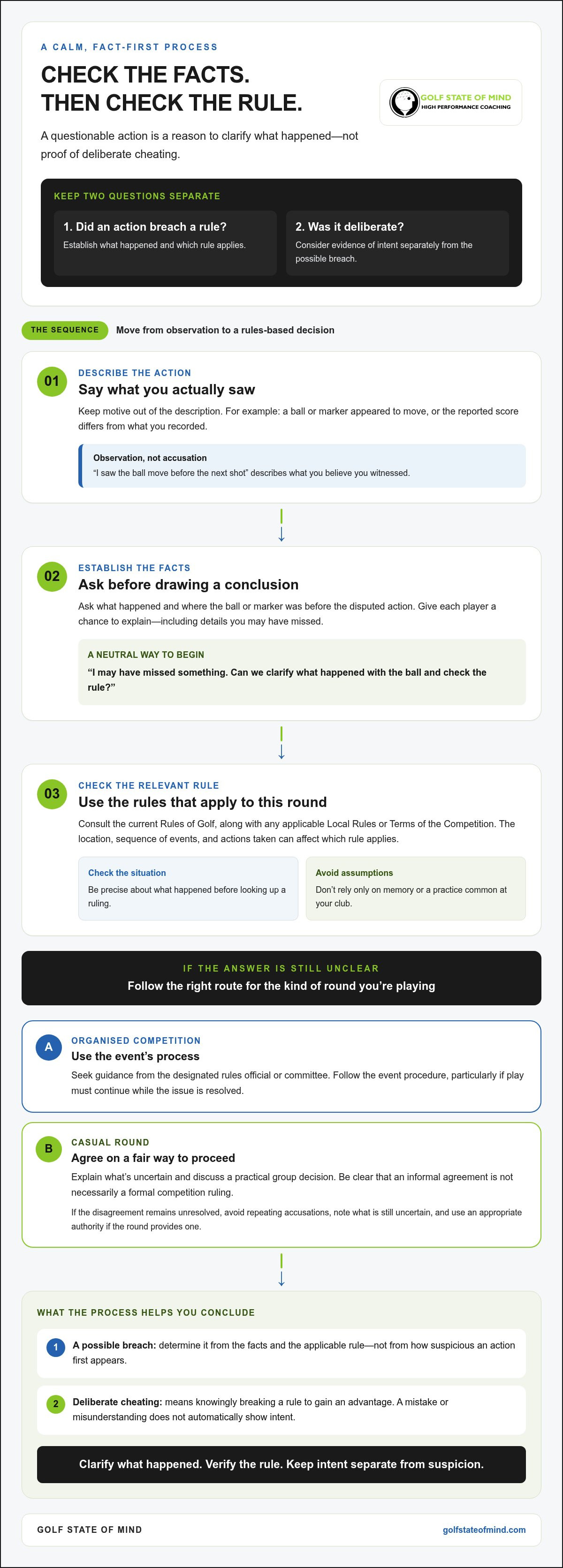
Before accusing someone of cheating, it’s important to distinguish between a possible Rules breach and deliberate dishonesty.
A golfer might:
- Misunderstand a relief procedure.
- Forget to include a penalty stroke.
- Record an incorrect score.
- Move a ball in circumstances where they mistakenly believe they’re allowed to.
These actions may need to be addressed under the Rules of Golf, but they don’t automatically establish deliberate cheating.
Cheating generally involves knowingly acting dishonestly to gain an advantage.
And determining another person’s intent isn’t always straightforward.
For that reason, I recommend separating two questions:
- What actually happened?
- What do the applicable Rules require?
Only after establishing the facts should you consider whether there’s evidence of deliberate misconduct.
This approach protects both the integrity of the competition and the fairness of your response.
1. Stay Calm Before You Say Anything
Mental skill: Emotional awareness and self-control.
Imagine you’ve just watched a player take what appears to be an improper drop.
Your immediate reaction might be anger.
“I can’t believe they’re doing that!”
“That’s completely unfair.”
“How am I supposed to compete against someone who cheats?”
These reactions are understandable.
But if you approach the player while you’re angry, the conversation may quickly become confrontational.
Instead, give yourself a moment to distinguish between what you observed and what you’re assuming.
The Pause Before Responding Exercise
Ask yourself three questions:
- What exactly did I see?
- Is there information I might be missing?
- What is the most constructive way to clarify the situation?
You don’t need to suppress your frustration.
You simply need to avoid allowing that frustration to determine how you speak.
Composure doesn’t mean ignoring a problem. It means addressing the problem without losing control of your response.
2. Ask Questions Before Making Accusations
Mental skill: Clear communication under pressure.
One of the most useful things you can do when something seems questionable is ask a neutral, specific question.
For example, instead of saying:
“You’re cheating. You moved your ball.”
Try:
“I noticed the ball was moved before that shot. Can we check what happened and which rule applies?”
Instead of:
“There’s no way you made a five.”
Try:
“I had a different score for that hole. Can we go through the strokes together?”
This doesn’t mean you’re being weak or avoiding confrontation.
You’re giving the other player an opportunity to explain while making it clear that the issue needs attention.
What to Say in Common Situations
| Situation | Constructive Response |
|---|---|
| A score doesn’t match your count | “I counted a different number. Could we go through the hole together?” |
| A player takes a questionable drop | “Can we confirm the relief procedure for that situation?” |
| A ball appears to have been moved | “I noticed the ball changed position. Can we clarify what happened?” |
| A player overlooks a possible penalty | “I think there may be a rule we need to check before we finalize the score.” |
| A disagreement remains unresolved | “Let’s ask a rules official or the committee so we handle this correctly.” |
Notice that these responses focus on the situation rather than attacking the player’s character.
That makes it easier to establish the facts and reach an appropriate resolution.
3. Know When to Involve a Rules Official
Mental skill: Taking appropriate action rather than prolonging conflict.
Sometimes a simple conversation resolves the issue.
A player may realize they’ve made an honest mistake and follow the applicable correction procedure.
But other situations are more complicated.
Perhaps the players disagree about what happened.
Maybe the relevant rule is unclear.
Or there may be a serious concern about deliberate misconduct.
In an organized competition, the appropriate next step is often to involve a rules official or the committee administering the event.
Provide a factual account of what you observed.
Avoid exaggerating, speculating about motives, or demanding a particular penalty.
Let the appropriate authority assess the situation.
Important: Match Play and Stroke Play Have Different Procedures
The Rules of Golf contain different procedures for resolving certain rules questions in match play and stroke play.
For example, the circumstances in which a player may play two balls when uncertain how to proceed are specific to stroke play under Rule 20.1c(3). This isn’t a general solution for every disagreement or a procedure to use in match play.
Likewise, the requirements and timing for requesting a ruling can matter.
Rather than guessing, consult the current official Rules and the competition’s procedures.
Useful official resources include:
Don’t allow an unresolved rules question to become a personal argument when an official process is available.
4. Don’t Let Another Player’s Behavior Take Over Your Round
Mental skill: Protecting your attention.
This is where dealing with cheating in golf becomes a mental performance challenge.
Imagine you’ve raised a concern about another player’s score.
The matter has been referred to an official.
But for the next four holes, you’re still thinking about it.
“I can’t believe they tried that.”
“I wonder how often they’ve done it before.”
“What if they get away with it?”
Meanwhile, you’re no longer giving your own shots the attention they deserve.
You’ve allowed the situation to influence your performance.
It’s important to understand that addressing an issue and continuing to think about it are two different things.
You can take the appropriate action without spending the rest of the round mentally replaying the incident.
The Control and Influence Exercise
Divide the situation into two categories.
What you can control:
- What you say.
- How accurately you describe what happened.
- Whether you follow the correct reporting procedure.
- Your emotional response.
- Your preparation for the next shot.
What you cannot fully control:
- Another player’s honesty.
- How they react to your concern.
- What other people believe.
- The final ruling or decision.
Once you’ve done what you’re responsible for, redirect your attention toward your own game.
That doesn’t mean forgetting the issue if further action is required.
It means not allowing the dispute to occupy your mind continuously.
5. Use Your Inner Caddy to Manage Frustration
Mental skill: Constructive self-talk.
When another golfer behaves in a way you believe is unfair, your internal dialogue can become highly emotional.
You might tell yourself:
“This is ridiculous. My whole round is ruined.”
Or:
“I can’t concentrate with this person in my group.”
These thoughts may reflect how frustrated you feel, but they aren’t particularly useful for your next shot.
One of the techniques I teach is developing your Inner Caddy.
Your Inner Caddy is the constructive internal voice that helps you respond effectively to challenges.
It doesn’t have to pretend that everything is fine.
It simply guides your attention toward useful action.
| Unhelpful Thought | Inner Caddy Response |
|---|---|
| “They’re ruining my round.” | “Handle the issue properly, then focus on your own game.” |
| “I can’t believe they’re getting away with this.” | “Follow the process. The decision isn’t mine alone.” |
| “I’m too angry to play well now.” | “I can be frustrated and still make a good decision.” |
| “I need to prove something on the next hole.” | “The next shot deserves a clear plan and full commitment.” |
Choose a short phrase that helps you regain perspective.
For example:
“Handle what’s mine. Let go of what’s not.”
Use it when you notice your attention returning to the disagreement.
Improve Your Emotional Control on the Golf Course
Download my free mental game ebook for practical strategies to manage frustration, improve focus, and maintain your confidence under pressure.
6. Return to Your Pre-Shot Routine After a Dispute
Mental skill: Refocusing after an emotional interruption.
One of the most effective ways to regain your concentration after a difficult exchange is to return to a familiar routine.
You may still feel angry.
You may still disagree with what happened.
But you don’t have to wait until those feelings disappear before preparing properly for your next shot.
My approach to the mental pre-shot routine includes three phases:
Planning Phase
Assess the lie, distance, conditions, and available options.
Make a clear decision about the shot you intend to play.
Athletic Phase
Shift your attention toward the target and execution.
Avoid taking the argument or your frustration into the swing.
Acceptance Phase
After the shot, acknowledge the result and move forward.
Plan the shot. Play the shot. Accept the shot.
This routine can provide stability when the emotional environment around you is unsettled.
For more detail, read my guide to the mental pre-shot routine for golf.
The 30-Second Refocus Exercise
When a dispute has interrupted your concentration:
- Recognize that your attention is still on the incident.
- Take one slow, comfortable breath.
- Remind yourself that you’ve taken the appropriate action for now.
- Identify the next decision you need to make.
- Begin your normal pre-shot routine.
You don’t need to force yourself into a perfectly calm state.
You need to give your attention a useful direction.
7. Decide How to Handle Repeated Problems
Mental skill: Setting boundaries and responding deliberately.
A single questionable incident is different from a repeated pattern of behavior.
Perhaps you regularly play with someone who reports questionable scores or appears to disregard rules.
Over time, this can affect the enjoyment of the group and create tension during competitions.
The appropriate response depends on the circumstances.
In a Casual Round
If you’re playing socially, clarify the expectations for the round.
For example, if you’re playing a friendly game for money, everyone should understand which rules and any agreed conditions apply.
If someone repeatedly refuses to follow those expectations, you can choose not to participate in competitive games with them.
You don’t need to create a confrontation every time you play.
But you also don’t have to keep entering situations where the standards of fair play are unclear or repeatedly disregarded.
In a Club Competition
Raise specific concerns through the club’s competition committee or the designated officials.
Describe incidents factually.
Avoid relying on rumors or labeling someone a cheat based on reputation.
Let the appropriate process determine whether further action is warranted.
In Junior Golf
These situations can be especially difficult for younger players.
A junior golfer may be reluctant to question another player because they’re worried about confrontation, embarrassment, or upsetting someone in the group.
I encourage junior golfers to understand that speaking up respectfully about a rules concern is different from accusing someone of dishonesty.
They can ask a neutral question and involve a rules official or responsible adult through the competition’s procedures.
Parents and coaches can help by rehearsing what the player might say before a difficult situation arises.
The goal is to develop confidence in handling the issue appropriately, not to encourage confrontation.
What If You Suspect Cheating but Can’t Prove It?
This is one of the most uncomfortable situations in golf.
You believe something dishonest happened, but you don’t have enough information to establish it.
It’s tempting to keep watching the player, looking for further evidence, or mentally reviewing everything they’ve done.
But that can quickly consume your attention.
Instead, focus on the facts you can establish.
If you’re in a competition and have a legitimate concern, report what you observed through the appropriate process.
Be clear about what you know and what you don’t know.
Don’t present suspicion as certainty.
Then return to your responsibilities as a player.
You can take fair play seriously without becoming consumed by another golfer’s behavior.
How to Prepare Mentally for Difficult Situations Before a Tournament
One technique I use in mental game coaching is the premortem.
Before a round, imagine a few situations that could disrupt your focus.
Then decide how you want to respond if they occur.
For example:
| Possible Challenge | Planned Response |
|---|---|
| A playing partner disputes a score | Clarify the strokes calmly and follow the competition procedure |
| I see a questionable rules action | Describe what I observed and ask to check the rule |
| Another player becomes defensive | Keep my tone measured and involve an official if necessary |
| I’m still angry after the issue | Use my Inner Caddy and return to my next-shot routine |
| The issue remains unresolved | Follow the event’s reporting process without speculating about intent |
This exercise doesn’t guarantee that you’ll handle every situation perfectly.
But it gives you a prepared response rather than requiring you to improvise while frustrated.
For more on preparing mentally before competition, read my guide to building a pre-round mental routine.
What Dealing With Cheating Reveals About Your Mental Game
Most golfers think of mental toughness in terms of handling bad shots, pressure, or disappointing scores.
But difficult interactions with other players can be just as challenging.
They test your ability to:
- Recognize emotional reactions.
- Communicate clearly.
- Make decisions under uncertainty.
- Separate facts from assumptions.
- Focus on what you can control.
- Return your attention to your own performance.
These are all skills that can be developed through mental training.
After a difficult round, consider reviewing your response just as you would review your pre-shot routine or decision-making.
Ask yourself:
- Did I address the concern appropriately?
- Did I remain respectful and factual?
- Did I allow the incident to affect subsequent shots?
- What would I do differently next time?
The purpose isn’t to criticize yourself.
It’s to learn from the experience.
Frequently Asked Questions About Cheating in Golf
What should you do if you catch someone cheating in golf?
First establish what happened and check the relevant rule. Raise the concern calmly and specifically. In an organized competition, involve a rules official or committee when appropriate rather than making an unsupported accusation or attempting to impose your own ruling.
Should you confront someone who is cheating in golf?
You can and often should raise a legitimate concern, particularly in competition. However, begin by describing what you observed and asking for clarification rather than immediately accusing the player of deliberate cheating.
What if a playing partner records the wrong score?
Ask to review the strokes on the hole together. If the discrepancy remains unresolved during a competition, follow the applicable scoring and rules procedures. In stroke play, accurate hole scores and scorecard certification are important, so don’t simply ignore an unresolved discrepancy.
Is improving your lie considered cheating?
Improving the conditions affecting a stroke may breach the Rules of Golf, depending on the circumstances and any applicable exceptions. Whether the action was deliberate dishonesty is a separate question. Establish the facts and consult the current Rules before reaching a conclusion.
Can you report someone for cheating after a round?
You can raise a concern with the appropriate committee or organizer, but whether a score or result can be changed depends on the applicable Rules, the timing, and the circumstances. Report factual information promptly rather than assuming every issue can be resolved after the competition has ended.
How should junior golfers handle suspected cheating?
Junior golfers should be encouraged to ask respectful, factual questions and seek help from a rules official or the appropriate competition authority. Parents and coaches can prepare them by rehearsing simple phrases and explaining the relevant procedures.
How do you stay calm when someone is cheating?
Recognize your frustration, focus on what you actually observed, take the appropriate action, and redirect your attention to your own game. A consistent pre-shot routine and constructive self-talk can help you regain focus after a difficult exchange.
What if I don’t want to play with someone who repeatedly breaks the rules?
In casual golf, you can choose not to enter competitive games with that person. In organized events, raise specific concerns through the club or competition’s established procedures rather than relying on accusations or rumors.
Final Thoughts: Protect the Integrity of the Game and Your Own Composure
Golf is built on honesty, respect, and personal responsibility.
When you encounter a situation that appears unfair, it’s reasonable to want it addressed.
But the way you respond matters.
Start with the facts.
Ask questions before making accusations.
Use the appropriate rules process.
And once you’ve taken the necessary action, return your attention to your own game.
You can’t control another golfer’s integrity.
But you can control how you conduct yourself.
You can choose to be fair, composed, respectful, and committed to the standards you believe in.
Standing up for fair play and protecting your mental performance aren’t competing goals. You can do both.
Develop Greater Composure on the Golf Course
Download my free mental game ebook for practical strategies to improve focus, emotional control, confidence, and your response to difficult situations.
Get your FREE Mental Game Scorecard
