What if a stronger competitive instinct in golf had less to do with aggression and more to do with commitment? When a shot or putt matters, hesitation can make the moment feel heavier. After a mistake, it’s easy to lose confidence or force the next shot. Developing a killer instinct in golf doesn’t mean becoming reckless or angry. It means making a considered decision, committing to it, and staying focused on the best score still available.
You can compete with conviction while accepting that no outcome is guaranteed. The key is to make decisions under pressure, respond constructively to missed opportunities, and use a repeatable mental approach to steady your focus. Practise those skills with clear routines so composure isn’t something you hope to find when the stakes rise. Build the process, trust your preparation, and let intensity serve your decisions rather than control them.
Key Takeaways
- Define competitive instinct by how consistently you pursue the best available outcome, not by how forcefully you show emotion.
- Practise self-trust by choosing a sensible plan without demanding certainty about how the shot will turn out.
- Separate courage from unnecessary risk: commit to a sound decision rather than using a bold shot to prove confidence.
- Build developing a killer instinct in golf into practice with a progression of intention, consequence, commitment, and review.
- Use a simple prepare, commit, respond, and review loop to make mental practice more repeatable.
What Does a Killer Instinct in Golf Actually Mean?
Wanting to compete more decisively doesn’t mean you need to become louder, angrier, or more intimidating. If you hesitate over an important shot and regret the choice before the ball has landed, you might think you need a different personality to compete well. You don’t. Developing a killer instinct in golf is about bringing purpose to your decisions and staying engaged with the round, including after a disappointing result.
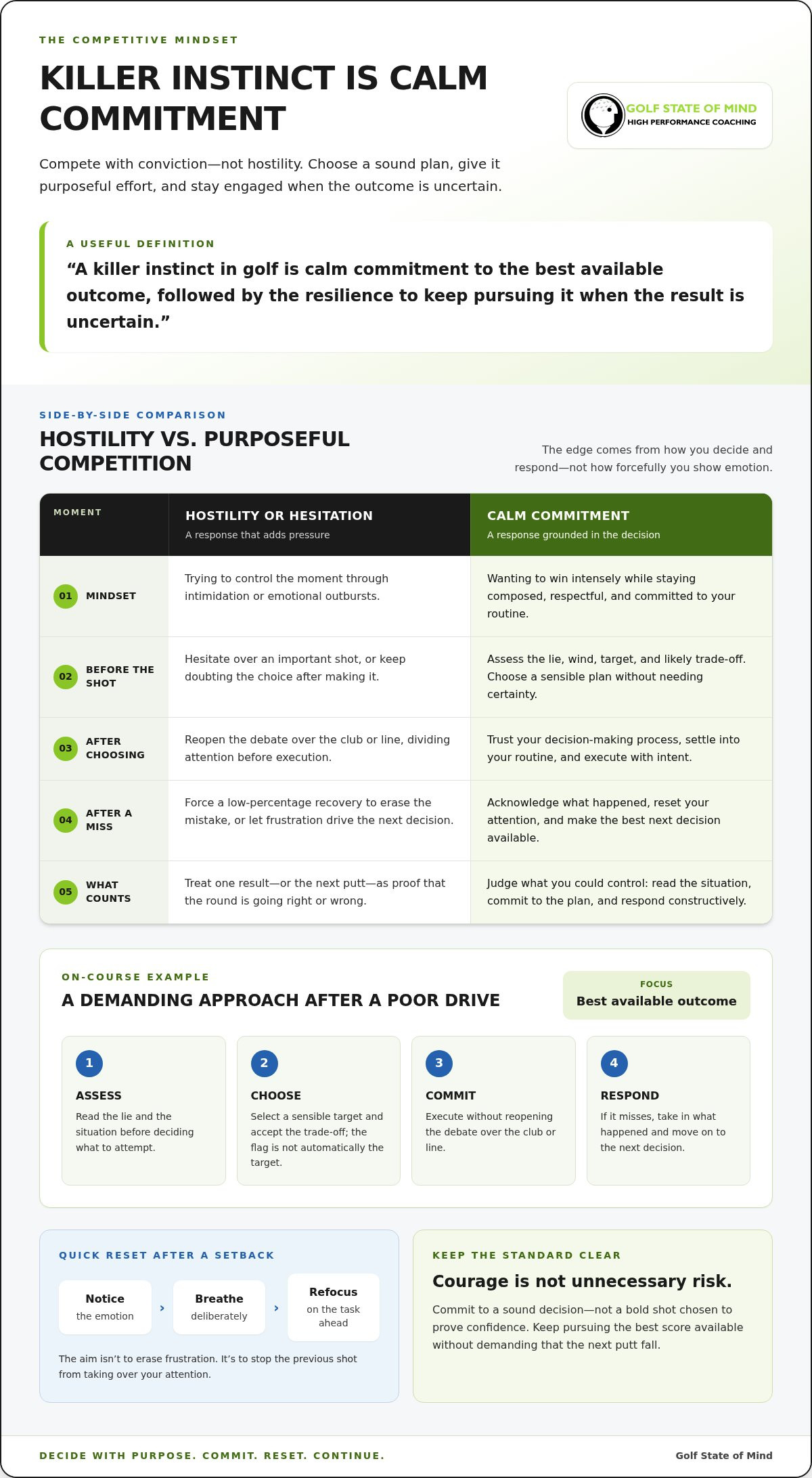
A useful definition: “A killer instinct in golf is calm commitment to the best available outcome, followed by the resilience to keep pursuing it when the result is uncertain.” It doesn’t guarantee a win or remove nerves. It gives you a way to respond while nerves are present. The mental and emotional dimensions of performance are part of sport psychology, including how an athlete thinks and responds in competition.
Killer instinct is commitment, not hostility
Hostility tries to control the moment through intimidation or emotional outbursts. Commitment means making a clear decision and giving it purposeful effort. You can want to win intensely and still speak calmly, respect your playing partners, and follow your routine. A Golf Digest profile of Tony Finau presents a friendly personality alongside a strong competitive edge. His example isn’t a formula for every golfer; it shows that ambition doesn’t require an angry persona.
Conviction doesn’t mean feeling fearless. You can notice nerves, consider the risk, and choose a target based on the lie, wind, and situation. The important part is what happens next: rather than reacting emotionally, return your attention to the shot.
What competitive instinct looks like during a round
Picture a demanding approach shot after a poor drive. A competitive response isn’t automatically aiming at the flag. Assess the lie, choose a sensible target, accept the trade-off, then execute without reopening the debate over the club or line. If the shot misses, take in what happened and move on to the next decision. Persistence means continuing to play with intent, not forcing a low-percentage recovery to erase the mistake.
The same principle applies after a missed opportunity. Stay focused on making the best score available without demanding that the next putt fall. Judge the decision by what you could control: whether you read the situation carefully, committed to your plan, and responded constructively. The outcome matters, but one result can’t tell you whether the process was sound.
Golf State of Mind offers 1:1 mental coaching for golfers who want to build a personal approach to competition, focus, and setbacks. To start on your own, notice one moment in your next round when you second-guess a decision or dwell on a mistake. That’s a useful point to work on.
Why Conviction and Emotional Resilience Shape Golf’s Competitive Edge
Golf asks you to make decisions without knowing exactly how they’ll turn out. Wind can shift, a lie can change your options, and even a well-struck shot can finish somewhere unexpected. Physical execution matters, but so does deciding what to attempt and managing your response when the result differs from your intention. Developing a killer instinct in golf means engaging with those choices rather than waiting for certainty the game can’t provide.
Self-trust isn’t a promise that your shot will succeed. It’s the willingness to assess the situation, choose a plan, and give that plan your attention. Sport psychology explores how thoughts and emotions relate to performance, including in the American Psychological Association’s Sport, Exercise, and Performance Psychology journal. For your own game, focus on observable habits, such as whether you stick to your routine after a poor shot, rather than expecting confidence to guarantee a particular result.
Self-trust helps golfers commit to a decision
There’s a useful difference between evaluating options before choosing and doubting yourself after you’ve chosen. Before the decision, consider the target, likely miss, and demands of the shot. Afterward, repeated internal debate can divide your attention. Commitment means trusting your decision-making process, not expecting a perfect result or trying to manufacture bravado.
Imagine a tee shot with trouble along one side of the fairway. You might choose a target that leaves room for your usual shot shape, even if it isn’t the most aggressive line. Name the target, settle into your routine, and swing with intent. If the ball misses, the outcome may disappoint you, but the decision can still have been sound. That distinction builds confidence rooted in judgment, not luck.
Resilience keeps one result from defining the round
Emotional resilience doesn’t mean pretending a missed putt or poor swing didn’t bother you. Acknowledge the frustration without letting it make the next decision. Try a short reset: notice the emotion, take a deliberate breath, then identify the task in front of you. The aim isn’t to erase the feeling; it’s to stop the previous shot from taking over your attention.
This is the practical side of golf emotional control: respond to what happened, then return to the present challenge. If you’re angry about a three-putt, the next tee shot still deserves its own assessment. Carrying frustration forward can lead to rushed choices. A deliberate reset gives you a chance to act on the information available now. Review your response after the round, when you don’t need to hit the next shot.
For structured practice with decision-making and emotional responses, The Ultimate Mental Game Training System supports ongoing mental-game work. The goal is not to control every outcome. It’s to strengthen the process you bring to each one.
Three Misconceptions That Weaken a Golfer’s Killer Instinct
Competitive instinct can be misunderstood as a fixed personality, a license to take bold risks, or a demand to hide every emotion. Each belief can make decisions less reliable. Developing a killer instinct in golf is better approached as a set of responses you can practise: prepare, choose, commit, and respond deliberately when the round tests you.
Myth: competitive golfers must be naturally ruthless
Some golfers are naturally expressive; others are quieter and more reflective. Neither style determines whether you can compete with intent. Preparation and deliberate responses are behaviours, not personality types. Tony Finau’s friendly public image is a reminder that a golfer doesn’t have to look ruthless to be competitive. It doesn’t prove that his personality causes his performance, or that one style suits everyone.
Define your own standard. You might decide that competing well means respecting your playing partners, sticking to a sound routine, and continuing to make thoughtful decisions even when behind. Write down what you want to do in a tense moment. That gives you a practical measure of competitive intent without asking you to perform a personality that isn’t yours.
Myth: confidence means attacking every opportunity
Aggressive play can be appropriate when the conditions and your skills support it. But a shot chosen to answer frustration, prove courage, or recover lost strokes may be driven by emotion rather than assessment. Before attempting a difficult line, ask what the target offers, what the likely miss costs, and whether the lie supports the shot. Choosing to play conservatively for a clear reason can show conviction, not fear.
This is useful for handling pressure in golf: pressure can make a dramatic option feel more compelling than a sensible one. Pause long enough to distinguish a calculated risk from an attempt to change your mood or score in one swing. Commit to the option that best fits the situation, then give it your full attention.
Myth: strong competitors suppress every emotion
Feeling disappointed after a poor shot isn’t the same as letting disappointment dictate the next one. Suppression asks you to pretend the feeling isn’t there; regulation means noticing it and choosing how to respond. A brief reset can include naming the emotion, taking a breath, and identifying your next task. The feeling may remain, but it doesn’t need to make your next decision.
Use this quick self-check after a difficult moment:
- Am I assuming I need to act like a different kind of person to compete?
- Am I choosing this shot because it fits the situation, or because I want to prove something?
- Am I acknowledging my emotion, or carrying it into the next decision?
Your answers can point to the belief most likely to interfere with your choices. Don’t judge yourself for the response. Use it as information, then practise a more deliberate alternative the next time a similar moment arises.
How to Practise a Killer Instinct in Golf Without Forcing It
Developing a killer instinct in golf doesn’t require you to manufacture intensity or turn every practice shot into a test. Rehearse the behaviours you want under pressure: set an intention, make a decision, commit to it, and learn from the result. A putting challenge or target game can add focus, though practice pressure won’t reproduce every demand of a tournament. Treat it as a way to practise your process, not a guarantee of how you’ll perform in competition.
Build competitive pressure gradually in practice
Begin with a manageable challenge, such as putting to a chosen target or hitting approaches toward a specific section of the green. Keep the focus on actions you can control. Then add a consequence that matters to you, increasing the difficulty only when you can follow your routine consistently.
- Set an intention. Choose one process goal, such as naming a target before each putt or completing your full pre-shot routine on every approach. Make it clear enough that you can tell whether you followed it.
- Add consequence. Give the challenge a personal stake. For example, if you miss a putt in a sequence, restart that sequence. Keep the consequence constructive and manageable; its purpose is to sharpen attention, not punish mistakes.
- Commit. For each attempt, choose your line or target, accept the decision, and execute. If the shot misses, resist changing your goal mid-session just to protect the score.
- Review. After the challenge, consider both the result and your process. Did you stick with the routine after a miss? Did you return your attention to the next shot?
As the routine becomes more consistent, make the task more demanding. You could narrow your target, add more shots to a sequence, or set a personal score to beat. Change one element at a time so you can notice how it affects your decisions and responses.
Review decisions instead of judging yourself by score alone
A score gives useful information, but it can’t tell you by itself whether you chose a suitable target or committed to your plan. After practice, record a few observations: what decision you made, whether your actions matched your intention, and how you responded when a shot didn’t go as hoped. Be specific and neutral. “I rushed the next putt after a miss” offers more to work with than “I choked.”
- Decision: Did your target fit the shot and your intention?
- Commitment: Did you follow your plan without changing it during execution?
- Response: How quickly did you return your attention to the next attempt?
Choose one behaviour to repeat or adjust in your next session. That keeps review practical instead of turning it into self-criticism. If you want a structured golf mental training program, explore The Ultimate Mental Game Training System.
Turn Mental Practice into a Repeatable Competitive System
A mental skill becomes more useful when you can return to it across practice and play. Keep the loop simple: prepare by choosing one behaviour to focus on, commit to it when a relevant moment arrives, respond deliberately when the round changes, and review what you noticed afterward. The point isn’t to monitor every thought. It’s to make a useful response easier to recognize and repeat.
Choose one behaviour to work on, such as recommitting to your routine after a poor shot or holding your attention on the target you selected. For a few rounds or practice sessions, notice each opportunity to use it. Record whether you followed through, what made it difficult, and what helped you return to your plan. Repeated observations are more useful than expecting a new habit to appear after one good session.
Choose a mental skill to develop over time
Keep your focus narrow enough to practise. If you select several goals at once, it may be hard to tell what’s working. Choose one behaviour and look for it in different situations: during a putting challenge, after a wayward drive, or when you’re protecting a score. Consistency doesn’t mean getting every decision right. It means noticing the same opportunity and practising your intended response.
Review the pattern rather than judging yourself by a single outcome. You might find that you recommit well in practice but lose that intention on the course after a mistake. That’s useful information. Keep the behaviour as your focus, or adjust it so it’s easier to apply in the moment. Progress may be uneven, so look for changes across repeated decisions rather than expecting instant transformation.
Continue with structured mental-game training
Some golfers find it difficult to practise mental skills consistently without a clear structure. Golf State of Mind provides mental performance training through digital programs and 1:1 coaching, founded by mental coach David MacKenzie. The Ultimate Mental Game Training System gives golfers a structured way to work on the psychological side of performance.
Use structured training to support your own practice, not replace reflection on your decisions. Keep track of the behaviour you’ve chosen, notice where it holds up under challenge, and review what you want to carry into the next session. The aim is a steadier process, not a promise of a particular score or competitive result.
Build a more structured foundation for your mental game with The Ultimate Mental Game Training System.
Carry Calm Commitment into Your Next Round
Make your next round a starting point, not a test of whether you’ve become a different golfer. Choose one moment you want to handle with greater intention, then let the round show you where that response feels natural and where it still needs practice. A difficult hole or missed opportunity isn’t proof that you lack competitive instinct. It’s a chance to keep shaping the kind of competitor you want to be.
Developing a killer instinct in golf is ongoing work. Keep your ambition, but leave room for uncertainty, imperfect shots, and gradual progress. If a guided structure would help, use The Ultimate Mental Game Training System to practise the mental side of performance.
Take that calm commitment onto the course. Your next decision is a fresh opportunity to compete with purpose.
Frequently Asked Questions
Is a killer instinct in golf an inborn trait or can you develop it?
You can develop it through deliberate practice; it isn’t reserved for golfers with naturally forceful personalities. Start with one behaviour you want to make more reliable, such as sticking to your club choice after making it. Notice when you follow through and what disrupts you. Developing a killer instinct in golf means strengthening useful responses over time, not changing who you are.
Can you develop a killer instinct in golf without playing tournaments?
Yes. Tournaments aren’t the only setting for practising competitive behaviours. Set a personal challenge during a putting or range session, such as following the same routine for every attempt or recording how you respond after a miss. These exercises can add focus, though they can’t recreate all the uncertainty and consequences of tournament play. Treat them as preparation, then observe how your habits hold up on the course.
Does having a killer instinct mean taking more risks on the golf course?
No. A competitive mindset doesn’t require choosing the boldest shot. Before attempting a risky line, consider whether the lie, wind, and likely miss support it. For example, from a blocked position in the trees, a controlled shot back to the fairway may preserve your chance to score. Choosing restraint for a clear reason is different from avoiding a shot because you’re afraid to commit.
How long does it take to develop a stronger competitive mindset in golf?
There’s no fixed timeline, because golfers start with different habits and practise under different conditions. Look for evidence of progress in your decisions, not a guaranteed change in scores: are you following your routine more often, or recovering your focus sooner after a poor shot? Keep a brief note after practice or a round. Reviewing those observations over time can help you see what’s becoming more consistent.
Can mental training help if your golf swing is inconsistent?
Mental training can help you manage attention, expectations, and frustration when your swing feels unreliable, but it doesn’t correct swing mechanics. For example, choose a realistic target for the shot you have today instead of demanding a perfect swing. A consistent routine can also help you approach each shot with less distraction. Keep mental practice focused on your decisions and responses, not on diagnosing the technical cause of a miss.
What should you do when you lose a lead during a golf round?
Shift your attention from the lead you’ve lost to the decisions still available. A changing score can tempt you to force a recovery or play too cautiously. Before the next shot, identify the information that matters now, such as the lie and the safe target. Then decide what the situation calls for. You can acknowledge disappointment without letting the scoreboard dictate a shot that doesn’t fit.
Is killer instinct useful in casual golf, or only in competition?
It can be useful in casual golf, too. Competing doesn’t have to mean playing in a formal event; you can set a personal goal, such as committing to your chosen target or staying engaged after a mistake. Keep the challenge appropriate to the round and your playing partners. This approach can make practice more purposeful while preserving the enjoyment of a relaxed game.