

Developing Mental Toughness for Golf: Build Resilience Shot by Shot
Mental Toughness in Golf: 7 Ways to Build Resilience
What makes a golfer mentally tough?
Is it the ability to stay calm under pressure? Never getting angry after a bad shot? Always believing you’re going to play well?
Not necessarily.
Some of the most mentally resilient golfers still experience nerves, frustration, disappointment, and doubt.
The difference is often what they do when those feelings show up.
They don’t allow one poor shot to dictate the next. They don’t abandon their routine simply because they’re nervous. And they don’t automatically interpret a bad round as evidence that they’re a bad golfer.
I’m David MacKenzie, founder of Golf State of Mind. In my work as a golf mental performance coach, I help players develop practical skills for handling pressure, responding to mistakes, and maintaining commitment when things don’t go according to plan.
In this guide, I’ll explain what developing mental toughness for golf really means and share seven exercises you can practise to become a more resilient player.
What Is Mental Toughness in Golf?
Mental toughness in golf is the ability to respond effectively to challenges, pressure, setbacks, and uncertainty.
It doesn’t mean being unaffected by these experiences.
It means continuing to make useful decisions and demonstrate productive behaviors even when the game becomes difficult.
Think about a golfer who makes a double bogey early in a tournament.
One response might be:
“There goes my round. I always do this in tournaments.”
The golfer becomes frustrated, starts forcing shots, and tries to recover the lost strokes immediately.
Another golfer might feel equally disappointed but respond differently:
“That was a poor hole. What do I need to do on the next one?”
They return their attention to the next shot and continue following their routine.
Both golfers experienced the same setback.
The difference is how they responded.
Mental toughness isn’t the absence of difficult emotions. It’s the ability to keep making effective choices while experiencing them.
1. Separate Your Identity From Your Golf Results
Mental skill: Resilience and self-worth.
One of the biggest obstacles to mental toughness is allowing golf results to define who you are.
When your identity becomes too closely connected to your scores, every poor round can feel like a personal failure.
Instead of thinking, “I played badly today,” you start thinking, “I’m a bad golfer.”
These are very different statements.
One describes a performance.
The other makes a judgment about you as a person.
I’ve seen how this distinction matters, particularly for competitive golfers who invest enormous amounts of time and effort into their development.
Golf can be an important part of your life without becoming the measure of your worth.
The Player Identity Exercise
Write down three qualities you want to demonstrate when you compete.
For example:
- Resilient.
- Committed.
- Adaptable.
Now create a statement that describes how you intend to play:
“I’m a resilient, committed player who welcomes challenges, makes clear decisions, and gives every shot my full attention.”
Notice that the statement doesn’t mention your handicap or scoring average.
It describes the kind of competitor you want to be.
Before your next round, remind yourself of those qualities.
Afterward, ask whether your behavior reflected them, regardless of your score.
This gives you a more stable foundation for confidence and resilience.
2. Learn to Accept Bad Shots Without Giving Up
Mental skill: Acceptance and emotional recovery.
Golf is a game of mistakes.
Even the best players in the world hit poor shots, miss short putts, and make disappointing decisions.
Yet many amateur golfers approach a round with the expectation that they shouldn’t make mistakes.
When something goes wrong, they resist it.
They replay the shot, criticize themselves, or become preoccupied with what it means for their score.
This is where acceptance becomes an important part of mental toughness.
Acceptance doesn’t mean liking a bad result.
It doesn’t mean giving up or lowering your standards.
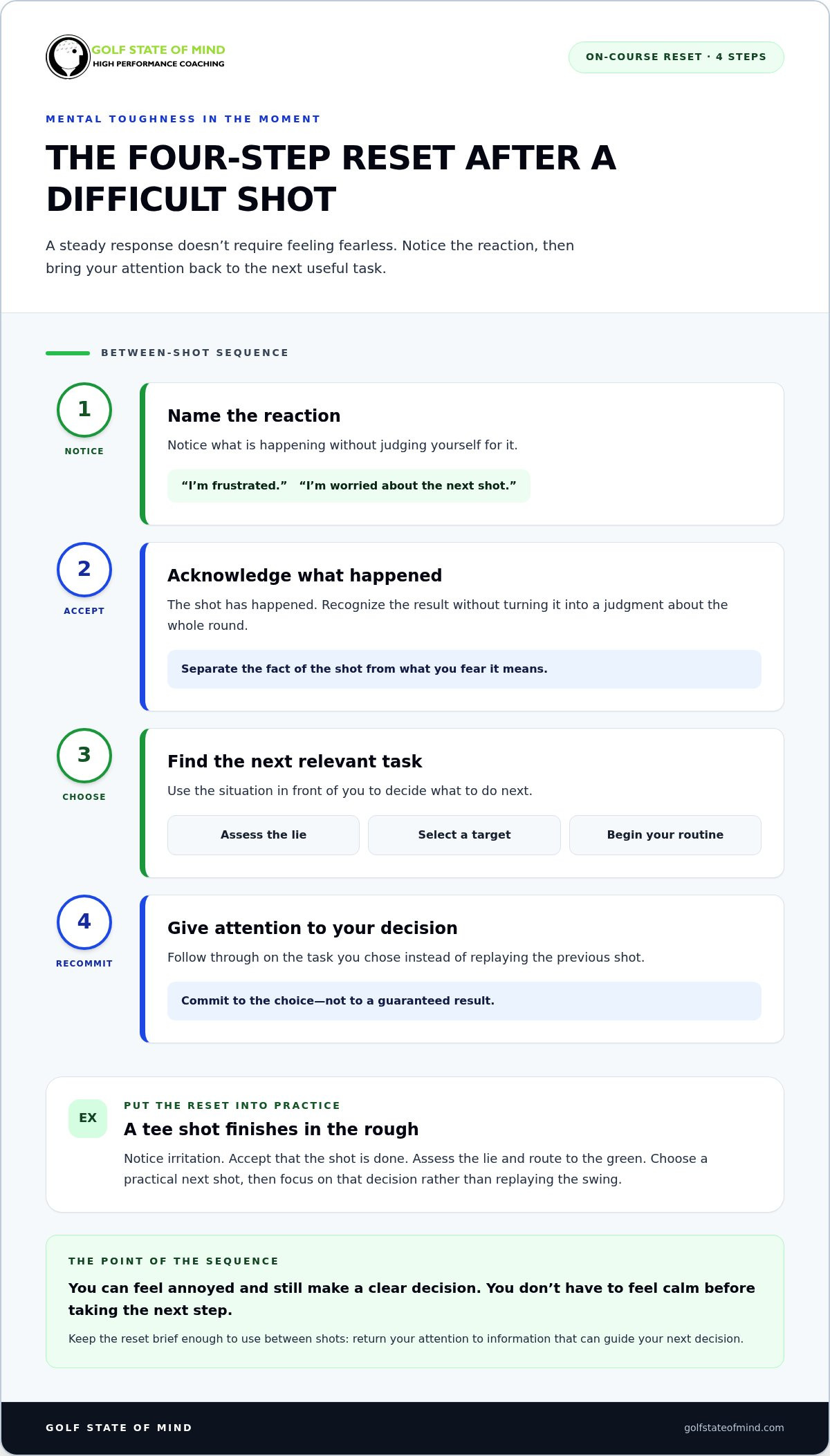
It means recognizing that the shot has happened and that your attention is now better directed toward what comes next.
The Accept and Redirect Exercise
After a disappointing shot:
- Acknowledge: Notice your reaction. “I’m frustrated about that shot.”
- Accept: Recognize that the result can’t be changed.
- Redirect: Ask, “What does the next shot require?”
You don’t need to feel completely calm before continuing.
You can be disappointed and still make a sensible decision.
That’s a practical demonstration of mental toughness.
For more on responding to difficult moments, read my guide to overcoming mental blocks on the golf course.
3. Build Confidence Through Your Behavior
Mental skill: Commitment despite uncertainty.
Many golfers believe confidence is something they must feel before they can play well.
They wait for their swing to feel perfect or for a few good shots to reassure them.
But confidence naturally fluctuates.
Some days you’ll feel comfortable with your game.
Other days you’ll feel uncertain.
If you depend entirely on how confident you feel, your mental performance may fluctuate just as much.
Instead, focus on the behaviors of a confident golfer.
These include:
- Making a clear decision.
- Choosing a specific target.
- Committing to the shot.
- Following a consistent routine.
- Maintaining constructive body language.
You can do these things even when you’re nervous.
The Confidence-as-Behavior Challenge
During your next round, choose one commitment:
“I will make a clear decision and commit to every shot, regardless of how confident I feel.”
Afterward, evaluate how consistently you followed it.
Don’t judge the exercise by how many good shots you hit.
Judge it by whether you behaved with commitment when uncertainty was present.
Over time, repeated experiences of acting decisively can help build trust in your process.
4. Develop a Reliable Response to Pressure
Mental skill: Performing when the outcome matters.
Pressure is part of competitive golf.
It might appear when you’re standing on the first tee, trying to break 80, protecting a lead, or facing a short putt to win a match.
Many golfers respond to pressure by trying to control more.
They become increasingly conscious of their swing mechanics, hesitate over club selection, or start thinking about the consequences of failure.
But the presence of pressure doesn’t mean you need an entirely different swing or routine.
You need to return to the process you’ve practised.
Use the Planning, Athletic, and Acceptance Phases
My approach separates each shot into three phases:
Planning Phase
Assess the situation, consider your options, choose a target, and make a clear decision.
Athletic Phase
Once the decision is made, shift your attention toward execution rather than continuing to analyze.
Acceptance Phase
After the shot, acknowledge the result and prepare to move forward.
Plan the shot. Play the shot. Accept the shot.
Pressure may still be present throughout this process.
That’s okay.
Your goal isn’t to make the nerves disappear. It’s to continue using the routine you’ve trained.
For a deeper explanation, see how to build a mental pre-shot routine for golf.
Practice Exercise: Five Putts Under Pressure
- Choose a putt of approximately four to six feet.
- Set a goal of holing five consecutive putts.
- Use your full routine before every attempt.
- Notice how your thoughts and feelings change as you approach the fifth putt.
- If you miss, reset and begin again.
The purpose isn’t just to complete the challenge.
It’s to practise commitment when the result starts to feel important.
5. Develop a Constructive Inner Caddy
Mental skill: Self-talk and emotional control.
Imagine having a caddy who constantly criticized you.
After a poor shot, they say:
“That was terrible. You always do this.”
Before a difficult putt:
“You’d better not miss this one.”
After a bogey:
“You’ve ruined your round.”
Would that caddy help you perform?
Probably not.
Yet golfers frequently speak to themselves this way.
One of the techniques I teach is developing your Inner Caddy: a constructive internal voice that helps you make decisions and respond to challenges.
Instead of demanding that you always think positively, your Inner Caddy provides useful guidance.
| Unhelpful self-talk | Inner Caddy response |
|---|---|
| “I always mess up when I’m playing well.” | “Stay with the process. One shot at a time.” |
| “Don’t hit it in the water.” | “Choose a target that gives you enough room.” |
| “My swing is terrible today.” | “Play the shot you have today.” |
| “I’ve ruined my round.” | “The next shot deserves your attention.” |
The Inner Caddy Exercise
Write down three critical statements you commonly make during a round.
Then ask yourself:
“What would a good caddy say to me in this situation?”
Choose one or two responses to practise during your next round.
They should be brief, believable, and connected to something you can control.
Build a More Resilient Mental Game
Download my free mental game ebook for practical strategies to improve confidence, commitment, focus, and your response to pressure.
6. Train Your Mental Toughness During Practice
Mental skill: Responding effectively when things don’t go to plan.
You don’t have to wait until a tournament to practise mental resilience.
In fact, regular practice provides opportunities to develop your response to challenges.
Many golfers spend their range sessions trying to hit as many good shots as possible.
But mental toughness develops when you also practise how you respond to poor shots.
The One-Ball Recovery Challenge
Imagine you’re playing a hole at a familiar course.
- Choose a tee shot and go through your full routine.
- Hit one ball.
- Accept the result, whether good or bad.
- Imagine the next shot based on where the ball would have finished.
- Make a new decision and commit to it.
- Continue until you’ve mentally completed the hole.
Don’t give yourself an immediate second attempt simply because the first shot wasn’t good.
That rule encourages you to deal with the situation you’ve created rather than repeatedly trying to produce the result you wanted.
You can also practise resilience during short-game challenges.
For example, try getting up and down from three different locations around the green.
If you hit a poor chip, practise making a committed putt rather than allowing frustration to influence the next shot.
The goal is to make your mental response part of the training, not an afterthought.
7. Measure Mental Toughness Through Performance Commitments
Mental skill: Self-awareness and accountability.
How do you know whether you’re becoming mentally tougher?
Most golfers look at their scores.
But a score doesn’t tell you everything about your response to pressure and adversity.
You might play a poor round while demonstrating excellent resilience.
Or you might shoot a good score despite allowing frustration and poor decisions to affect several holes.
That’s why I encourage golfers to use Performance Commitments.
These are specific behaviors you choose to demonstrate during a round.
For mental toughness, your commitments might include:
- I will accept each shot before preparing for the next one.
- I will maintain constructive body language after mistakes.
- I will make clear decisions rather than reacting emotionally.
- I will follow my pre-shot routine even when I’m nervous.
After your round, rate how consistently you followed each commitment.
You could use a simple 1-to-5 rating or track your commitments hole by hole.
For example, four commitments assessed across eighteen holes create 72 opportunities to demonstrate your mental skills.
Suppose you followed 60 of those commitments.
That’s approximately 83% completion.
This isn’t a scientific measurement of how mentally tough you are. It’s a practical way to track whether you’re following the behaviors you’ve chosen.
Look for patterns across several rounds rather than judging yourself by one result.
Five Situations That Test Your Mental Toughness
Mental toughness becomes most visible when golf challenges your expectations.
Here are five situations worth preparing for.
1. Starting a Round Poorly
You make a double bogey on the first hole.
Your challenge is to resist treating the entire round as a failure and give the second hole your full attention.
2. Playing Well Late in a Round
You’re having one of your best rounds and begin thinking about your final score.
Your challenge is to return to your normal routine rather than trying to protect the result.
3. Losing Confidence in Your Swing
You’ve hit several poor drives.
Your challenge is to make sensible decisions based on the game you have that day, rather than forcing shots to prove your swing is working.
4. Making a Mistake Under Pressure
You miss an important short putt.
Your challenge is to acknowledge the disappointment and prepare properly for the next shot.
5. Dealing With Unfair or Unexpected Conditions
You get a bad bounce, an awkward lie, or an unexpected gust of wind.
Your challenge is to accept the situation as it is and make the best decision available.
These moments don’t require you to feel positive.
They require you to respond effectively.
For more help with competitive situations, read my guide to handling pressure and preventing choking in golf.
A Simple Weekly Mental Toughness Training Plan
You can begin developing resilience by incorporating a few exercises into the golf practice you’re already doing.
| When | Exercise | What to practise |
|---|---|---|
| Before practice | Choose one resilience commitment | Identify a controllable behavior |
| On the range | One-Ball Recovery Challenge | Acceptance and recommitment |
| Putting practice | Five-Putt Challenge | Commitment under pressure |
| Before a round | Review your player identity statement | Competing with intention |
| During a round | Use your Inner Caddy and reset routine | Responding to mistakes |
| After a round | Review Performance Commitments | Recognizing patterns and progress |
You don’t have to complete every exercise each week.
Start with one or two skills that address your biggest challenges.
Consistency is more useful than trying to transform your entire mental game in one session.
Common Myths About Mental Toughness in Golf
Myth 1: Mentally Tough Golfers Never Get Nervous
Nerves are a normal response to important situations.
Mental toughness means being able to use your skills while nervous, not requiring the nerves to disappear.
Myth 2: Mental Toughness Means Staying Positive All the Time
You don’t need to convince yourself that everything is going well.
Constructive thinking is more useful than forced positivity.
Sometimes the best response is simply, “That was disappointing. What’s next?”
Myth 3: You Either Have Mental Toughness or You Don’t
Some golfers may naturally respond more comfortably to certain challenges, but mental skills and behaviors can be developed through practice.
Resilience isn’t a fixed label you should attach to yourself.
Myth 4: Mental Toughness Means Never Showing Emotion
Being disappointed or frustrated doesn’t automatically mean you’re mentally weak.
The important question is whether your emotional response begins to interfere with subsequent decisions and behavior.
Myth 5: A Mentally Tough Golfer Always Plays Well Under Pressure
Even excellent mental preparation can’t guarantee good execution.
Mental toughness is better judged by your preparation, decisions, commitment, and responses than by one shot’s result.
Frequently Asked Questions About Golf Mental Toughness
How do you develop mental toughness in golf?
Develop mental toughness by practising how you respond to mistakes, pressure, and uncertainty. Use a consistent pre-shot routine, develop constructive self-talk, set Performance Commitments, and review your mental behaviors after rounds.
Can mental toughness be learned?
Yes. Golfers can develop skills such as acceptance, attention control, emotional regulation, and commitment through deliberate practice. Progress may take time and won’t necessarily follow a straight line.
How do mentally tough golfers handle bad shots?
They aim to acknowledge the result without allowing it to dictate the next decision. This may involve recognizing frustration, accepting that the shot is finished, and returning attention to the next task.
How can I stay mentally strong when I’m playing badly?
Focus on behaviors you can still control: sensible decisions, a reliable routine, constructive body language, and commitment. You don’t have to be playing well to demonstrate mental resilience.
Does mental toughness mean being confident?
Not necessarily. Confidence can fluctuate. Mental toughness includes continuing to prepare and commit effectively when confidence is low or doubt is present.
How can I practise mental toughness at the driving range?
Use one-ball challenges, vary targets and clubs, follow your full routine, and practise responding constructively after poor shots. Avoid immediately hitting another ball simply to erase an unwanted result.
How long does it take to become mentally tougher in golf?
There’s no fixed timeline. Look for gradual changes in how you respond to mistakes, follow routines, and make decisions under pressure. Review these behaviors across multiple rounds.
Can mental toughness help me stop choking in tournaments?
Mental skills training may help you prepare for pressure and respond more effectively to nerves, doubt, and expectations. It doesn’t guarantee that every pressure shot will be successful, but it can give you a more reliable process to follow.
Final Thoughts: Mental Toughness Is Built One Response at a Time
Developing mental toughness for golf doesn’t mean becoming fearless, emotionless, or permanently confident.
It means learning to respond more effectively when golf becomes difficult.
You can feel nervous and still commit.
You can be frustrated and still make a good decision.
You can play badly and still demonstrate the qualities of the player you want to become.
Start by choosing one situation that regularly challenges you.
Decide how you want to respond.
Practise that response during your next round.
And review what you learned afterward.
Over time, those repeated behaviors can help you develop greater resilience and trust in your process.
Remember: Mental toughness isn’t about controlling everything that happens. It’s about choosing how you respond to what happens.
Build a Stronger, More Resilient Mental Game
Download my free mental game ebook for practical strategies to improve confidence, focus, commitment, and your ability to handle pressure.
Get your FREE Mental Game Scorecard
