Can a Sports Psychologist Help Your Golf Game?
Your swing may not be the only thing shaping your score. The answer to “Can a sports psychologist fix my golf game?” is yes, in the sense that mental…
Get your FREE Mental Game Scorecard


If you’re struggling with confidence, overthinking your swing, or playing significantly better in practice than in tournaments, you might be considering some professional help with your mental game.
But should you work with a golf psychologist, a sports psychologist, or a mental performance coach?
These terms are often used interchangeably, which can make choosing the right support confusing.
And while there is considerable overlap between the approaches, there are some important differences in professional training, qualifications, and the services practitioners provide.
I’m David MacKenzie, founder of Golf State of Mind and a golf mental performance coach. My work focuses on helping golfers develop the mental skills they need to perform more consistently, including routines, confidence, commitment, decision-making, and responding to pressure.
In this article, I’ll explain the differences between golf psychology and mental coaching, what each approach can offer, and how to decide which is most appropriate for your goals.
Golf psychology is the application of psychological principles to the game of golf.
It examines how factors such as attention, emotions, motivation, confidence, expectations, and decision-making influence performance.
For example, golf psychology can help explain why a golfer:
Golf psychology is part of the broader field of sport psychology.
Importantly, sport psychology isn’t limited to understanding why golfers behave in certain ways. Qualified practitioners may also teach practical performance skills, including imagery, goal setting, self-talk, attention control, and routines.
That’s where the overlap with mental performance coaching begins.
A golf mental performance coach helps golfers develop and apply mental skills that support their performance on the course.
Coaching typically involves identifying specific performance challenges, developing practical strategies, and practising those strategies during training and competition.
For example, a golfer might tell me:
“I hit the ball really well on the range, but when I get on the course, I start thinking about my swing and can’t trust it.”
Rather than simply telling that golfer to be more confident, we would explore what changes between practice and competition.
We might examine their pre-shot routine, attention, expectations, decision-making, and how they respond to poor shots.
Then we’d develop a practical plan they can apply during their next practice session or round.
Golf mental performance coaching commonly addresses:
However, the title “mental coach” does not, by itself, establish a particular qualification or professional standard.
Training and experience vary, so it’s important to understand the individual practitioner’s background and methods.
It’s tempting to describe psychology as understanding the mind and coaching as training it.
But that distinction is incomplete.
Both qualified sport psychology practitioners and mental performance coaches may help golfers develop practical mental skills.
The more meaningful differences often concern professional qualifications, scope of practice, and the type of support being offered.
| Area | Sport Psychology Practitioner | Golf Mental Performance Coach |
|---|---|---|
| Primary focus | Psychological factors influencing sport performance and well-being | Developing and applying golf-specific mental performance skills |
| Methods | May use psychological assessment, mental skills training, consultation, and other evidence-informed approaches | May use performance assessments, routines, mental exercises, goal setting, and practice reviews |
| Qualifications | Vary by professional designation; some hold advanced psychology qualifications or clinical licenses | Vary widely by practitioner, training, and experience |
| Clinical treatment | Only when appropriately licensed and qualified to provide it | Not part of ordinary performance coaching unless the practitioner separately holds appropriate clinical credentials |
| Golf specialization | May specialize in golf or work across multiple sports | May specialize specifically in golf performance |
Neither title automatically tells you which practitioner will be the best fit.
A qualified sport psychologist with extensive golf experience may be an excellent choice for developing your mental game.
Likewise, an experienced golf mental performance coach may offer highly relevant practical guidance.
The important questions are what you need help with, how the practitioner works, and whether their qualifications and experience fit your situation.
Mental performance coaching may be particularly useful when your main challenges are related to how you prepare, think, and behave during golf.
Here are several common situations.
This is one of the most common challenges I encounter.
A golfer might hit the ball beautifully during practice but become hesitant and overly analytical when a score matters.
There can be several reasons for this difference.
During practice, the golfer may feel less concerned about the result, while competition introduces expectations, consequences, and uncertainty.
Coaching can help identify what changes in their preparation and attention.
We might work on developing a more consistent pre-shot routine, improving commitment, and making practice more representative of competition.
Many golfers believe they need to feel confident before they can play well.
But confidence isn’t simply a feeling that appears when everything is going right.
It’s also reflected in how you behave.
A golfer can feel uncertain and still make a clear decision, commit to the shot, and follow their routine.
In coaching, we work on developing these behaviors rather than waiting for doubt to disappear.
Golfers often lose more than one stroke because of a single mistake.
A poor shot leads to frustration, which leads to a rushed decision, an unnecessarily aggressive recovery, or a loss of concentration.
We can work on recognizing these patterns and developing a constructive response.
That doesn’t mean eliminating frustration.
It means learning to acknowledge what happened and prepare properly for the next shot.
Technical thinking is useful when you’re deliberately working on your mechanics.
But constantly monitoring your swing during competition can interfere with athletic execution.
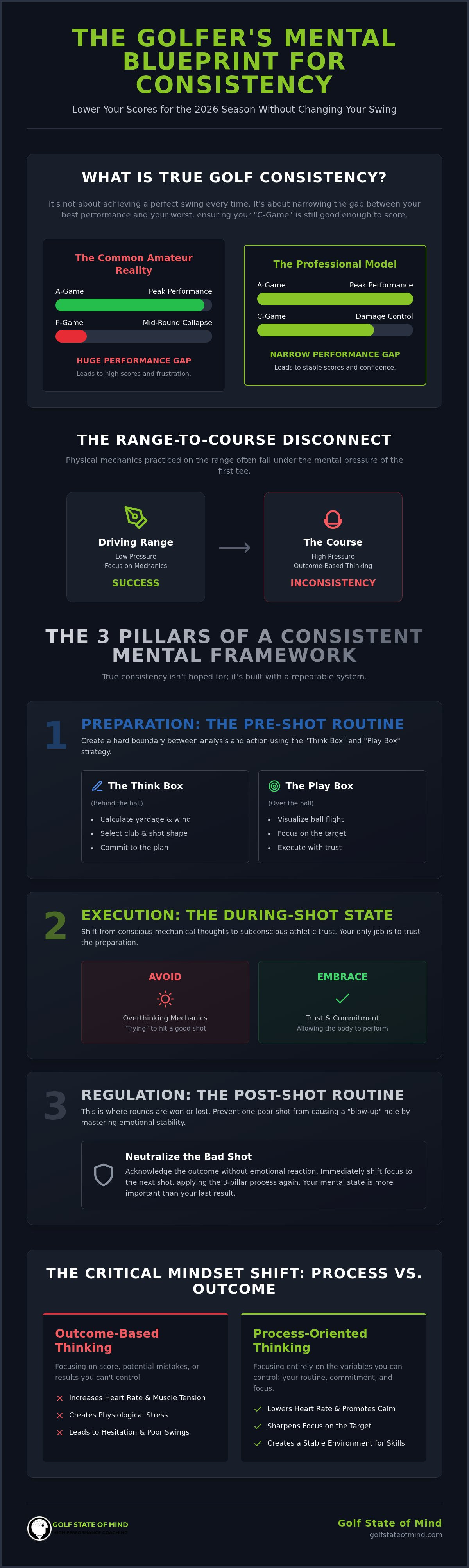
One area I focus on is helping golfers separate planning and analysis from playing the shot.
My approach uses three phases:
Plan the shot. Play the shot. Accept the shot.
Learn more in my guide to developing a mental pre-shot routine for golf.
Download my free mental game ebook for practical strategies to improve confidence, commitment, focus, and your response to pressure.
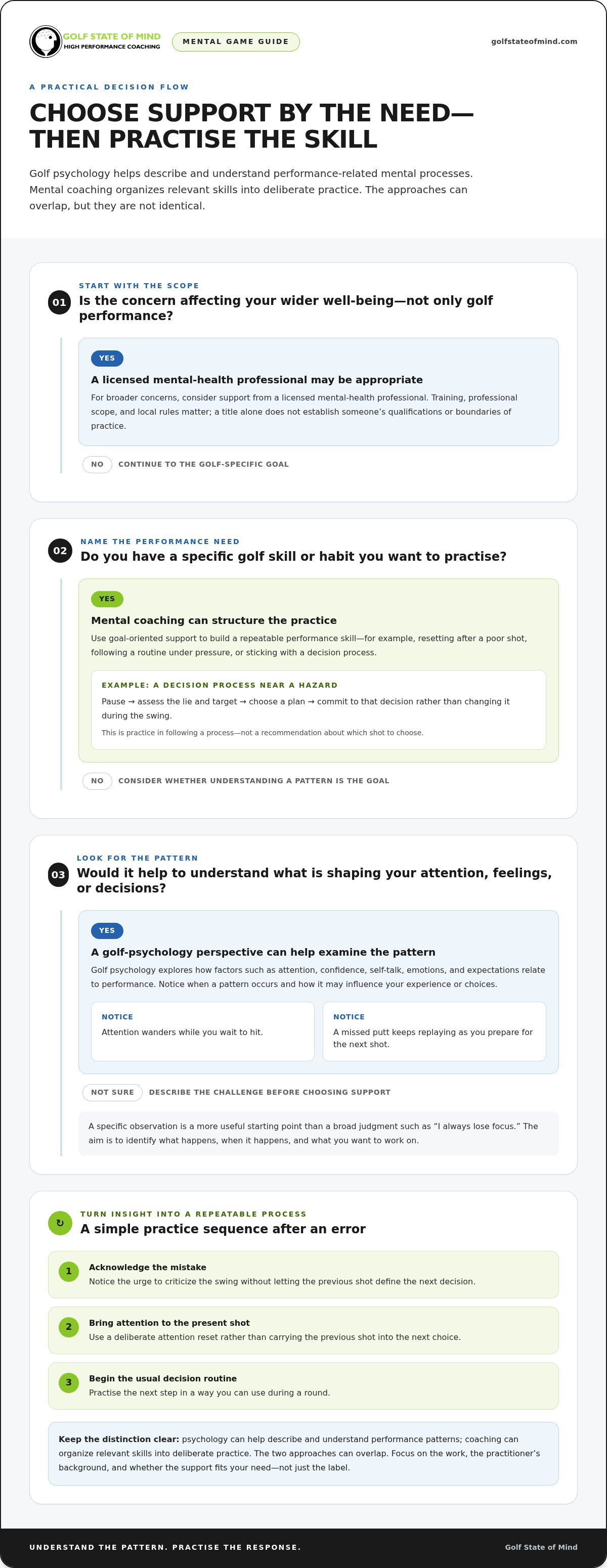
Not every psychological challenge experienced by a golfer is simply a performance issue.
Sometimes anxiety, depression, persistent distress, or other concerns affect both golf and everyday life.
In these situations, an appropriately licensed mental health professional may be the more suitable starting point.
For example, consider seeking clinical support if:
Some licensed psychologists specialize in sport and can address both performance-related concerns and mental health needs within their professional scope.
Others focus primarily on clinical treatment or on performance consultation.
Performance coaching and clinical care aren’t mutually exclusive, but their roles should be clear.
As a mental performance coach, my focus is helping golfers develop skills for performance. I don’t present that work as diagnosis or treatment of mental health conditions.
One question prospective clients often ask is what happens during a mental coaching session.
Is it simply a conversation about confidence?
Do you learn breathing techniques?
Do you receive exercises to practise between sessions?
Different coaches have different approaches, but I believe effective coaching should move beyond general advice.
Here’s how I approach the process at Golf State of Mind.
We begin by exploring your performance patterns.
What happens when you’re playing well?
What changes when you’re under pressure?
Which situations create the most frustration or uncertainty?
We look at areas such as confidence, routines, commitment, attention, and emotional responses.
The objective is to identify specific challenges rather than simply labeling someone a nervous or inconsistent golfer.
Once we’ve identified the patterns, we choose what to work on.
For example, a golfer might discover that their biggest challenge isn’t general confidence but a tendency to become hesitant over the ball when a round is going well.
That gives us something specific to address.
Instead of trying to improve every part of the mental game simultaneously, we prioritize the behaviors most relevant to their performance.
Depending on the golfer, we might work on:
The key is to make these skills practical enough to use during a round.
For example, instead of telling a golfer to “stay focused,” we might develop a clear routine for returning attention to the next shot.
Understanding a mental skill during a coaching session is only the beginning.
It needs to be practised.
We develop ways to apply the skill during range sessions, practice rounds, and competition.
A golfer might work on committing to every target, using a consistent post-shot response, or maintaining constructive body language after mistakes.
After a round, we review what happened.
Importantly, we don’t judge mental performance solely by the score.
We also examine whether the golfer followed their intended behaviors.
This helps distinguish between an execution problem and a mental process that needs attention.
Over time, the process becomes:
Assess → Practice → Play → Review → Refine.
One of the tools I use in coaching is the Performance Commitment.
A Performance Commitment is a specific behavior you choose to follow during a round.
Unlike a scoring goal, it’s something you can directly influence.
For example:
Imagine two golfers who both shoot 82.
One followed their routines, made sensible decisions, and responded constructively to mistakes.
The other rushed several shots, became frustrated, and made unnecessary tactical errors.
Although their scores were identical, their mental performances were different.
Performance Commitments help reveal those differences.
You can review them after a round or track them on a mental scorecard.
For example, if you have four commitments and assess them once per hole, you have 72 opportunities across eighteen holes to demonstrate those behaviors.
This creates a practical way to observe progress without making the score your only measure.
For more strategies, explore my guide to golf mental strategy and on-course composure.
Whether you’re considering a sport psychologist or a mental performance coach, I recommend asking a few questions before committing.
Ask about their education, training, and professional background.
Don’t assume that a particular title guarantees a certain level of expertise.
Also consider their experience with golfers at your level.
Golf presents particular psychological challenges.
There’s a great deal of time between shots, considerable uncertainty, and constant opportunities to evaluate your performance.
A practitioner who understands the game may be better equipped to translate mental skills into realistic golf situations.
Ask what the work involves beyond talking about your experiences.
Will you receive exercises to practise?
How will you assess progress?
How will you apply what you’ve learned during competition?
A clear process makes it easier to understand what you’re working toward.
Be cautious about guarantees to eliminate nerves, cure the yips, or reduce your handicap by a specific number of strokes.
Golf performance depends on many factors.
A credible practitioner should explain what their approach is intended to help with and acknowledge its limitations.
Good coaching requires honest conversations about your experiences, challenges, and habits.
Choose someone whose communication style works for you and who provides a clear, respectful environment for learning.
Absolutely.
There are several mental skills you can begin practising independently.
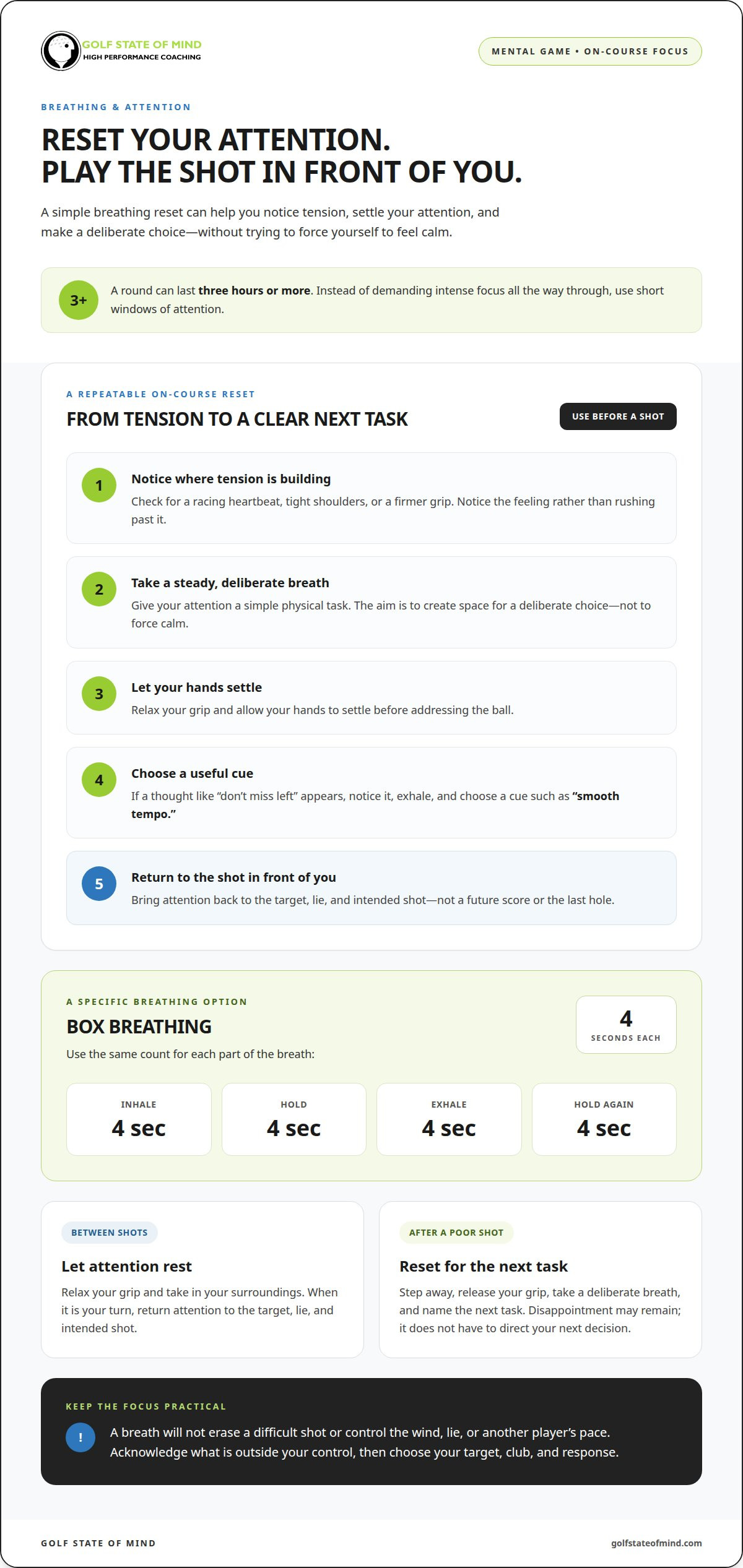
For example, before your next round:
These simple steps can make your mental practice more deliberate.
If you want a broader set of exercises, read my article on preparing your mental game before a round.
Individual coaching can become particularly valuable when you need help identifying patterns, developing a personalized plan, or maintaining accountability.
A golf psychologist may refer to a practitioner who applies psychological principles to golf, while a mental performance coach focuses on developing performance-related skills. Their work can overlap substantially. The most important distinctions involve individual qualifications, professional scope, and the methods used.
Some professional golfers work with sport psychologists, mental performance coaches, or other performance specialists. The type of support varies according to the golfer’s needs and preferences. Working with a mental performance professional isn’t limited to elite players.
Yes, performance coaching can help golfers develop routines, attention strategies, and responses to pressure. The objective isn’t necessarily to eliminate nerves, but to improve the golfer’s ability to make decisions and execute while nervous.
A psychologist who is appropriately licensed and qualified to provide clinical care may be able to assess and treat anxiety within their professional scope. Not every sport psychology practitioner provides clinical treatment, so qualifications and services should be checked.
There is no universal timeline. Some golfers identify useful changes quickly, while developing consistent habits can require sustained practice. Progress depends on the challenge, the golfer’s engagement, and how effectively the skills are applied between sessions.
Online coaching can be a practical way to work on mental performance because many of the skills involve discussion, planning, exercises, and reviewing rounds. Its usefulness depends on the quality of the coaching, the golfer’s needs, and the application of the skills in practice and play.
Mental performance coaching doesn’t replace technical instruction. However, it can help golfers improve how they approach technical changes, manage expectations, and transition from mechanical practice to athletic execution.
Junior golfers can benefit from age-appropriate mental skills training, including routines, constructive self-talk, emotional responses, and learning to separate their identity from their results. The approach should reflect their developmental stage and individual needs.
Golf psychology and mental performance coaching aren’t competing approaches.
They share many principles, and qualified practitioners in both areas may help golfers improve their mental skills.
The important question isn’t which title sounds more impressive.
It’s whether the practitioner has the appropriate qualifications, understands your needs, and offers a clear approach to helping you develop.
If your main challenges involve confidence, commitment, routines, pressure, or responding to mistakes, golf mental performance coaching may be a useful option.
If you’re experiencing broader psychological distress or need clinical assessment or treatment, seek an appropriately qualified mental health professional.
Whatever path you choose, remember that improving your mental game requires more than understanding what to do.
It requires putting those skills into practice.
The goal isn’t to think perfectly. It’s to prepare, commit, and respond more effectively.
Download my free mental game ebook for practical strategies to improve focus, confidence, commitment, and performance under pressure.
Your swing may not be the only thing shaping your score. The answer to “Can a sports psychologist fix my golf game?” is yes, in the sense that mental…
What if the secret to your lowest round isn’t hidden in a new swing thought, but in the silence between your shots? You’ve likely experienced the…