

Golf Mental Strategy: How to Think, Play and Respond Better on the Course
Golf Mental Strategy: How to Think, Play and Respond Better on the Course
Have you ever finished a round feeling that your score didn’t reflect how well you actually played?
Perhaps you hit the ball well but made a few poor decisions. Maybe one bad hole affected the next three. Or you were playing beautifully until you started thinking about your score and what the round might mean.
These are situations where your golf mental strategy becomes especially important.
As a mental golf coach, I’ve worked with players at every level who want to perform more consistently under pressure. One of the biggest lessons I teach is that playing better golf isn’t always about changing your swing or trying to feel more confident.
It’s often about improving the decisions you make, what you focus on, and how you respond when things don’t go your way.
A strong mental game doesn’t mean you never get nervous, frustrated, or distracted. Those experiences are part of competitive golf.
What matters is how you respond to them.
In this guide, I’ll share five practical mental strategies for golf that can help you make better decisions, stay committed to your shots, recover from mistakes, and approach each round with a clearer process.
What Is Golf Mental Strategy?
Your golf mental strategy is the approach you use to manage your decisions, attention, expectations, and reactions throughout a round.
It influences what you do before a shot, how you prepare to execute it, what happens between shots, and how you respond afterward.
For example:
- How do you decide which shot to play?
- What do you focus on when standing over the ball?
- How do you respond after a poor shot?
- What do you think about between shots?
- How do you handle pressure when you’re playing well?
Golf mental strategy works alongside your technical skills and course management. Good technique gives you the ability to hit shots. Course management helps you choose appropriate shots. Your mental game helps you make those decisions and execute them with commitment.
Let’s look at five strategies you can use immediately.
1. Make Better Decisions Before Every Shot
One of the most important mental skills in golf is decision-making.
Golfers often think their mental game is primarily about confidence or positive thinking. But many unnecessary mistakes begin before the club moves.
A player attacks a difficult flag because they’re frustrated. They attempt a risky recovery because they want to make up for a poor tee shot. Or they stand over the ball without being clear about what they’re trying to do.
A useful golf mental strategy begins with choosing the right shot for the situation.
Judge the Decision Separately From the Result
Imagine you’re hitting an approach shot to a green with water on the right and a flag tucked close to the hazard.
You could attack the flag, or you could aim toward the wider part of the green and accept a longer putt.
The best decision depends on your ability, the lie, the conditions, and the situation.
But here’s the important part: the quality of the decision isn’t determined solely by where the ball finishes.
You can make a good decision and hit a poor shot. You can also make a poor decision and get lucky.
If you judge every decision by the result, it becomes difficult to develop better course management.
The PGA of America makes a similar point in its article on using your strengths and weaknesses to improve on-course decisions.
Ask Three Questions Before Every Shot
- What’s the situation? Assess the lie, distance, wind, hazards, and available landing areas.
- What’s the best shot for me? Choose an option that fits your ability and the level of risk involved.
- What am I committing to? Decide on your club, target, and intended ball flight.
Once you’ve made your decision, move toward execution rather than repeatedly questioning yourself.
If new information changes the situation, reconsider. But avoid changing your mind simply because you feel nervous.
Don’t Let Your Previous Shot Dictate Your Next Decision
One of the most common mistakes I see is golfers becoming more aggressive after making a bogey or double bogey.
They start thinking about getting those shots back.
Suddenly, they’re attacking flags and attempting shots they wouldn’t normally consider.
But the score you’ve already made doesn’t change the decision required on the next shot.
Your job is to make the best decision for the situation in front of you, not to make up for what happened earlier.
2. Separate Planning From Playing
Golf requires both conscious decision-making and athletic execution.
You need to assess the situation, select a club, and choose a target. But once you’re ready to swing, trying to consciously control several different parts of the movement can interfere with your ability to play freely.
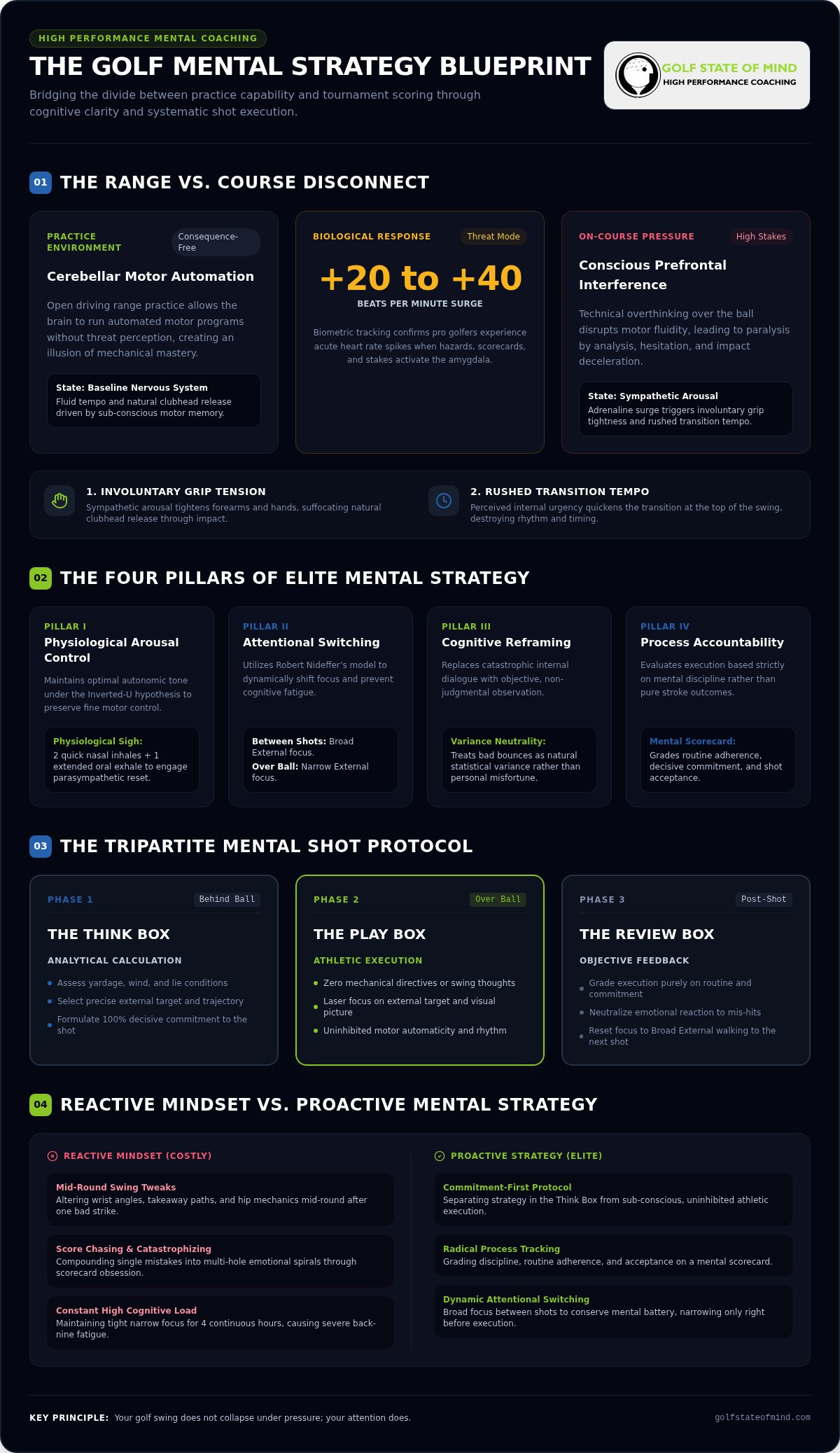
That’s why I teach players to organize their pre-shot routine into three phases.
Planning Phase: Make Your Decision
During the Planning Phase, assess the situation and choose the shot.
Consider your target, club, lie, wind, and intended ball flight.
Make a purposeful rehearsal that connects you with the movement you’re about to make.
This is where you do your thinking and decision-making.
By the end of this phase, you should know what you’re trying to do.
Athletic Phase: Connect With the Shot
Once you step into the ball, your attention shifts from analysis to execution.
Rather than continuing to think about wrist angles, takeaway positions, or potential mistakes, connect with a simple athletic intention.
That might be:
- The target you’re aiming toward.
- The ball flight you’ve visualized.
- The rhythm of your swing.
- A familiar feeling that helps you execute.
The objective isn’t to eliminate every thought.
Thoughts may still appear, particularly when the shot feels important.
You don’t have to get rid of them before you swing.
Return your attention to your intention and play the shot.
Acceptance Phase: Respond to the Result
Once you’ve hit the ball, the shot is finished.
You might be pleased, disappointed, or frustrated.
Acceptance doesn’t mean pretending you don’t care. It means recognizing that you can’t change the shot you’ve just hit.
Take any useful information from it, then move your attention toward what comes next.
Plan the shot. Play the shot. Accept the shot.
For a more detailed explanation, read my guide to the mental pre-shot routine for golf.
Pre-performance routines are also widely discussed in applied sport psychology. The Association for Applied Sport Psychology explains how individualized routines can help athletes prepare for execution.
Build a More Consistent Mental Game
Want to improve your focus, confidence, routines, and ability to respond to pressure? Download my free mental game ebook for practical strategies you can start using in your next round.
3. Develop a Better Response to Mistakes
Every golfer hits poor shots.
Even the best players in the world miss fairways, hit approach shots into hazards, and miss short putts.
The important difference isn’t that better players never become frustrated.
It’s how they respond and what they do next.
Consider two golfers who both make double bogey.
The first golfer spends the next hole thinking about the mistake, criticizing themselves, and worrying about their score.
The second golfer is disappointed too, but recognizes that the previous hole is finished. They assess the next shot and make the best decision available.
Both players experienced the same result. But their responses may lead to very different decisions afterward.
Use a Simple Post-Shot Reset
When something goes wrong, practice three steps:
- Acknowledge: Notice what happened and how you’re reacting.
- Accept: Recognize that the shot is finished and can’t be changed.
- Redirect: Move your attention toward the next useful task.
For example, after hitting a tee shot into the trees, you might think:
That was a poor swing. I’m frustrated, but the shot is finished. Now I need to find the ball and make a good decision about the recovery.
This response doesn’t require you to feel happy or relaxed.
You can still be frustrated.
You’re simply choosing not to let that frustration dictate your next decision.
Don’t Turn One Mistake Into Several
One of the biggest mental-game challenges is allowing a single poor shot to influence the next few shots.
A missed fairway leads to an unnecessarily aggressive recovery.
The recovery goes badly, so the golfer rushes the next shot.
Then they become frustrated with the score and start forcing things.
What began as one mistake becomes a series of avoidable decisions.
A good golf mental strategy helps you interrupt that pattern.
After a mistake, ask:
What’s the best decision I can make from where I am now?
Not where you wish the ball had finished. Not what score you hoped to make. Where you are now.
If pressure regularly causes you to rush or abandon your process, you may also find my article on how to stop choking in golf helpful.
4. Manage Your Attention Between Shots
Golf is unusual because there’s so much time between shots.
During an 18-hole round, you spend a relatively small amount of time actually preparing for and playing shots.
The rest involves walking, waiting, talking, and thinking.
What you do with that time matters.
If you spend the entire round analyzing your swing, worrying about the next hole, or calculating your score, golf can become mentally exhausting.
That’s why I encourage players to develop a distinction between being switched on and switched off.
Switch On When It’s Time to Play
As you approach your ball, begin directing your attention toward the next shot.
Assess the situation. Choose your strategy. Go through your routine. Make a committed swing.
This is when you want to be purposeful and attentive.
Switch Off Between Shots
Once you’ve completed your post-shot response, allow your attention to move away from golf performance.
You might:
- Talk with your playing partners.
- Notice the scenery around you.
- Pay attention to your breathing or walking.
- Enjoy being outdoors.
- Let your thoughts move naturally without analyzing every one.
You’re not trying to force yourself to stop thinking about golf.
You’re simply giving yourself permission not to be in performance mode for the entire round.
When you arrive at the next shot, switch your attention back to the task.
What If Your Mind Keeps Returning to Your Score?
This is particularly common when you’re playing well.
You might start calculating what you’ll shoot if you par the remaining holes.
Or you begin thinking about winning the tournament, breaking 80, or protecting a lead.
It’s natural for those thoughts to appear.
Trying to prevent yourself from thinking about the score can make the thought even more distracting.
Instead, notice that your attention has moved toward the outcome.
Then ask:
What’s important right now?
If you’re walking between shots, perhaps there’s nothing you need to do yet.
If you’re preparing to play, return to the decision and the shot in front of you.
You don’t need to control every thought. You need to become better at choosing where your attention goes next.
If you find yourself repeatedly becoming caught up in worry or excessive swing monitoring, read my article on overcoming mental blocks in golf.
5. Measure Your Mental Game With Performance Commitments
Most golfers judge their mental game by their score.
If they shoot a good score, they assume they were mentally strong.
If they play poorly, they decide their mental game was bad.
But your score doesn’t tell the whole story.
You can make excellent decisions, commit to your shots, and respond well to mistakes while still having a disappointing round.
Equally, you can shoot a good score despite making questionable decisions or becoming distracted.
That’s why I encourage golfers to evaluate their Performance Commitments separately from the score.
Choose Three Commitments for Your Round
For example:
- Routine: I’ll follow my pre-shot routine before every full shot.
- Commitment: I’ll make a clear decision and commit to the shot I’ve chosen.
- Acceptance: I’ll respond constructively to mistakes and move on.
These commitments are behaviors you can influence.
They don’t depend on whether you hit every fairway, make every putt, or shoot a particular score.
Use a Simple Mental Scorecard
After your round, rate each commitment from 1 to 5.
| Performance Commitment | Rating (1–5) | Reflection |
|---|---|---|
| Pre-shot routine | ___ / 5 | Did I follow my process consistently? |
| Shot commitment | ___ / 5 | Did I make clear decisions and commit to them? |
| Acceptance | ___ / 5 | How did I respond when things went wrong? |
You can also identify one situation you handled well and one situation you’d like to improve.
Over time, you may notice patterns.
Perhaps your routine is consistent, but you become more reactive after poor putting.
Or you make good decisions early in rounds but become overly cautious when you’re playing well.
Those observations give you specific things to work on.
Improving your mental-game behaviors can support better performance, but it doesn’t guarantee a particular score.
How to Apply Your Golf Mental Strategy in Common Situations
Understanding mental-game principles is useful, but the real test is applying them when something happens on the course.
Here are five situations I regularly discuss with players.
Situation 1: You’re Nervous on the First Tee
Your heart is beating faster than usual. There are people watching. You’re thinking about the possibility of hitting a poor shot.
The mistake: Trying to force yourself to calm down before you’re willing to swing.
A better strategy: Accept that you’re nervous and focus on your preparation.
Choose an appropriate target, visualize the intended ball flight, make your rehearsal, and commit to the shot.
You can make a good swing while feeling nervous.
For more on preparing for these situations before arriving at the first tee, see my 30-minute pre-round golf routine.
Situation 2: You’ve Made Two Consecutive Bogeys
You’re frustrated because your score is moving in the wrong direction.
You feel the urge to attack the next flag and make a birdie.
The mistake: Allowing your previous score to determine the risk you take on the next shot.
A better strategy: Assess the next shot on its own merits.
Choose the target and strategy that make sense for the situation.
You don’t have to win the lost shots back immediately.
Situation 3: You’re Playing Well With Five Holes Remaining
You realize you’re on track for one of your best scores.
Suddenly, you start thinking about what could go wrong.
The mistake: Becoming defensive, trying to protect the score, or changing the way you’ve been playing.
A better strategy: Recognize that the score matters to you, then return to your Performance Commitments.
Keep making good decisions. Continue using your routine. Play the shot in front of you.
You don’t need to pretend the score is unimportant. You simply don’t want it making your decisions for you.
Situation 4: You’ve Hit a Poor Shot Into Trouble
Your ball is in the trees, and you’re disappointed with the previous swing.
You see a narrow gap that might allow you to reach the green.
The mistake: Attempting a low-percentage recovery because you want to erase the mistake.
A better strategy: Evaluate the lie, available options, and risks.
Choose the best recovery for your ability and situation.
Sometimes that means taking your medicine and playing back into position.
That’s not a lack of confidence. It’s good decision-making.
Situation 5: You Have an Important Putt
You’re standing over a putt to win a match, save par, or shoot your best score.
You begin thinking about what making or missing the putt will mean.
The mistake: Trying to guarantee the result by steering the putter or adding last-second instructions.
A better strategy: Read the putt, choose your starting line and pace, make your rehearsal, and commit to the stroke.
Accept that even a well-executed putt might miss.
Your responsibility is the quality of your preparation and execution, not guaranteeing that the ball goes in.
How to Practice Your Golf Mental Strategy
Mental skills improve when you practice them deliberately, rather than only thinking about them after a bad round.
Here are three simple exercises you can incorporate into your practice.
Exercise 1: One-Ball Practice
Instead of hitting several balls to the same target, take one ball and simulate a hole.
Choose a tee shot, go through your routine, and play it.
Then imagine the next shot based on where the first one finished.
Change clubs and targets as you would on the course.
The goal is to practice making fresh decisions and committing to each shot.
Exercise 2: The Response Challenge
During a practice round, choose one challenging situation and deliberately focus on your response.
For example, after a poor shot, notice your immediate reaction.
Allow yourself to feel disappointed, then practice accepting the result and directing your attention toward the next decision.
After the round, evaluate how well you responded rather than whether the next shot was perfect.
Exercise 3: The Performance Commitment Review
Before a round, choose two or three Performance Commitments.
Afterward, rate them from 1 to 5.
Write down:
- One situation where you followed your process well.
- One situation where you moved away from your process.
- One thing you’ll focus on in your next round.
This creates a simple cycle of preparation, execution, review, and improvement.
A Simple Golf Mental Strategy Checklist
Before your next round, remember these five principles:
- Make good decisions. Choose shots based on the situation, not your frustration or fear.
- Separate planning from playing. Think during preparation, then connect with your athletic intention.
- Respond constructively. Accept mistakes and make the best decision from where you are now.
- Manage your attention. Switch on when it’s time to play and allow yourself to switch off between shots.
- Measure your process. Evaluate your Performance Commitments, not just your score.
You don’t need to master all five immediately.
Choose one or two areas that are most relevant to your game and begin practicing them consistently.
Take Your Mental Game Further
If you’d like more practical strategies for improving your focus, confidence, commitment, and response to pressure, download my free mental game ebook.
Frequently Asked Questions About Golf Mental Strategy
What is the best mental strategy for golf?
One of the most useful strategies is to focus on making good decisions, committing to your intended shot, and accepting the result. A consistent pre-shot routine helps you apply those principles throughout a round. The best approach will also depend on your individual challenges and goals.
How can I stop overthinking my golf swing?
Separate your preparation from your execution. Make your decisions and complete any technical rehearsal before addressing the ball. Once you’re ready to swing, direct your attention toward a simple intention such as the target, ball flight, or rhythm. You don’t need to eliminate every thought before playing.
How do I stay mentally focused for 18 holes?
You don’t need to maintain intense concentration for the entire round. Focus purposefully when preparing for and playing shots, then allow your attention to move away from performance between shots. This helps you use your attention more deliberately throughout the round.
How do I recover mentally after a bad hole?
Acknowledge your disappointment, accept that the hole is finished, and redirect your attention toward the next useful task. Avoid trying to recover lost strokes immediately through unnecessarily aggressive decisions. Make the best decision for the next shot.
How do I handle pressure when I’m playing well?
Recognize that thinking about your score is normal, especially when you’re close to achieving an important goal. Instead of trying to eliminate those thoughts, return to your routine, shot selection, and Performance Commitments. Continue making decisions based on the situation rather than trying to protect the outcome.
Can improving my mental game lower my golf scores?
Improving decision-making, shot commitment, attention, and responses to mistakes can support better performance. However, the effect on scoring varies, and mental training doesn’t replace technical skill, physical preparation, or course-management knowledge.
Should I try to stay positive throughout my round?
You don’t need to force yourself to feel positive after every shot. Frustration and disappointment are normal parts of golf. The important skill is responding constructively rather than allowing those feelings to dictate your decisions and behavior.
How can I measure my mental-game improvement?
Choose two or three Performance Commitments, such as following your routine, committing to decisions, and accepting mistakes. Rate each from 1 to 5 after your round and record specific examples. This helps you identify patterns and track improvements in your behaviors separately from your score.
Better Golf Starts With Better Decisions and Responses
Golf will always involve uncertainty.
You’ll hit poor shots, make mistakes, experience pressure, and occasionally become frustrated with your game.
A strong golf mental strategy doesn’t make those experiences disappear.
It helps you deal with them more effectively.
Make clear decisions before your shots. Commit to the shot you’ve chosen. Accept the result. Manage your attention between shots. And measure your progress by the behaviors you’re developing, not just the number on your scorecard.
You can’t control every outcome in golf. But you can become much better at choosing how you prepare, play, and respond.
Get your FREE Mental Game Scorecard
