Dealing With a Bad Golf Partner Mentally: Stay Composed
When you’re dealing with a bad golf partner mentally, step away if you can, take a few slow breaths, and bring your attention back to your next shot….
Get your FREE Mental Game Scorecard


What if better course decisions came not from another bucket of balls, but from practising how you think between shots? If your range sessions feel composed but one missed fairway unsettles you, you’re not alone. DIY golf mental game training can feel abstract, and isolated tips are easy to forget when pressure rises. A repeatable practice-to-course routine gives you a practical way to work on your mental game, one skill at a time.
This guide shows you how to practise focus, commitment, and emotional resets on your own, then carry those skills into practice rounds and regular play. You’ll also learn to review your progress by looking at your routines and responses, rather than judging every session by its score.
Start with a manageable practice plan, apply it on the course, and review what you notice. The goal isn’t to control every outcome. It’s to prepare your attention and decisions for the next shot.
Golf mental game training is deliberate practice of attention, pre-shot routines, emotional responses, and reflection, helping you approach each shot with greater clarity and commitment. DIY golf mental game training means practising these psychological skills independently, then noticing how you use them on the course. It draws on principles found in sport psychology, the study of how psychological factors influence athletic performance.
This work is separate from swing mechanics. A mental routine can help you settle your attention and commit to a chosen shot, but it doesn’t teach grip, alignment, or swing technique. The focus is how you prepare, respond, and reset. Mental practice can support your ability to execute skills you already have, but it can’t guarantee lower scores. Golf outcomes also depend on factors beyond your control.
Start with skills you can observe during practice or a round. Before a range shot, choose a target, make a clear decision, and begin your swing when you’re ready. This rehearses pre-shot commitment. To practise attention control, notice when your focus shifts to nearby players or an earlier shot, then bring it back to your target. For golfers looking to sharpen their focus and mental endurance off the course as well, brain-training tools like Effectivate offer targeted exercises to strengthen memory and cognitive function.
Emotional regulation and your response after a shot matter, too. After a poor shot, notice your frustration without letting it dictate your next decision. Take a breath, acknowledge what happened, and return your attention to the next task. Your response is within your control. Your score, the weather, your opponents, and the exact result of a shot aren’t. Build practice around the response you choose, not an outcome you can’t command.
Repeating a chosen routine in varied practice conditions can make it more familiar. Change targets, vary the order of shots, or pause briefly after a miss before preparing for the next ball. Then use the same mental cue during an ordinary round. You’re not trying to force perfect concentration. You’re practising how to return to your process when attention or confidence wavers.
Independent practice works best when you review it honestly and consistently. Briefly record whether you followed your routine and how you responded to mistakes, rather than relying on memory or judging progress by score alone. If the same performance challenge keeps getting in the way, individualized support can provide a more tailored structure. Golf State of Mind offers mental game coaching for golfers who want that support.
Trying to change every mental habit at once makes practice difficult to assess. Choose one behaviour you can see and repeat, such as completing your decision routine before each shot. Keep the goal within your control. “Follow my routine before every practice shot” gives you clear evidence to review. “Hit every shot well” depends on outcomes you can’t command.
Build the skill into practice you already do. A brief, focused exercise during a regular range session is easier to maintain than an elaborate plan you rarely follow. Once the behaviour feels familiar in practice, carry it into an ordinary round. The point of DIY golf mental game training is to create a deliberate bridge between rehearsal and play.
Write your goal in plain language before you begin. For example: “Before each shot, I’ll assess the situation, choose a target, and commit to the shot.” You can judge whether you completed those actions even if the ball misses. This keeps your attention on the process, not a perfect result or a particular score.
Use a sequence that moves from assessment to decision, commitment, and action. After a distraction or poor shot, add a neutral cue such as “reset,” take a breath, and return to the next task. PGA of America offers practical mental recovery techniques to help you consider how to respond after setbacks. Adapt your routine so it feels natural. It should steady your attention, not become a script you worry about performing perfectly.
Use this repeatable cycle each week:
Keep your record brief. A few notes about your routine, focus, or reset are enough to reveal patterns without turning every session into a judgment. If you’d benefit from a more structured path for practising mental skills, The Ultimate Mental Game Training System provides a guided option.
A range session can feel comfortable because it often removes the choices and consequences that shape a course round. Hitting the same club toward the same target, one ball after another, may build familiarity with the setting but give you little practice selecting a shot, committing to it, or responding calmly when it misses. A more realistic session adds decisions while keeping the focus on mental skills, not swing mechanics.
This difference helps explain the challenge explored in Why You Play Better on the Range Than the Course: range confidence doesn’t always transfer when every course shot brings a new situation. In DIY golf mental game training, make the practice task resemble the thinking required on the course. You’re not trying to manufacture pressure or judge your swing. You’re rehearsing how you prepare and respond.
Before each ball, pause and make a specific choice. Pick a target and intended shot, then select a club before you set up. Vary targets and clubs instead of hitting a rapid sequence with the same club. If your practice setting permits, change your starting position or use a different lie. These variations give you a reason to assess and decide rather than rely on repetition alone.
Measure your process: Did you make a clear decision? Did you commit to it? Did you reset after a shot that didn’t go as intended? Record those observations, not just how many balls finished near the target. A successful outcome can happen without a committed routine, and a poor result doesn’t automatically mean your decision process failed.
Keep the exercise simple. Choose one mental behaviour and let the shot result provide context, not a verdict. If you catch yourself adjusting technical mechanics, return your attention to the mental task you chose for the session.
Use casual holes to practise your usual pre-shot and post-shot routines, even when the round feels relaxed. After a shot, notice whether your attention has shifted to the score, a previous mistake, or what another player is doing. Then bring it back to the next controllable task, such as assessing the lie or selecting a target. For more on this skill, see How to Focus During a Golf Round.
Carry the same routine from practice to play, but let it remain natural. The aim isn’t to guarantee a better score. It’s to rehearse a reliable response across different shots and situations, so your preparation doesn’t depend on everything going perfectly.
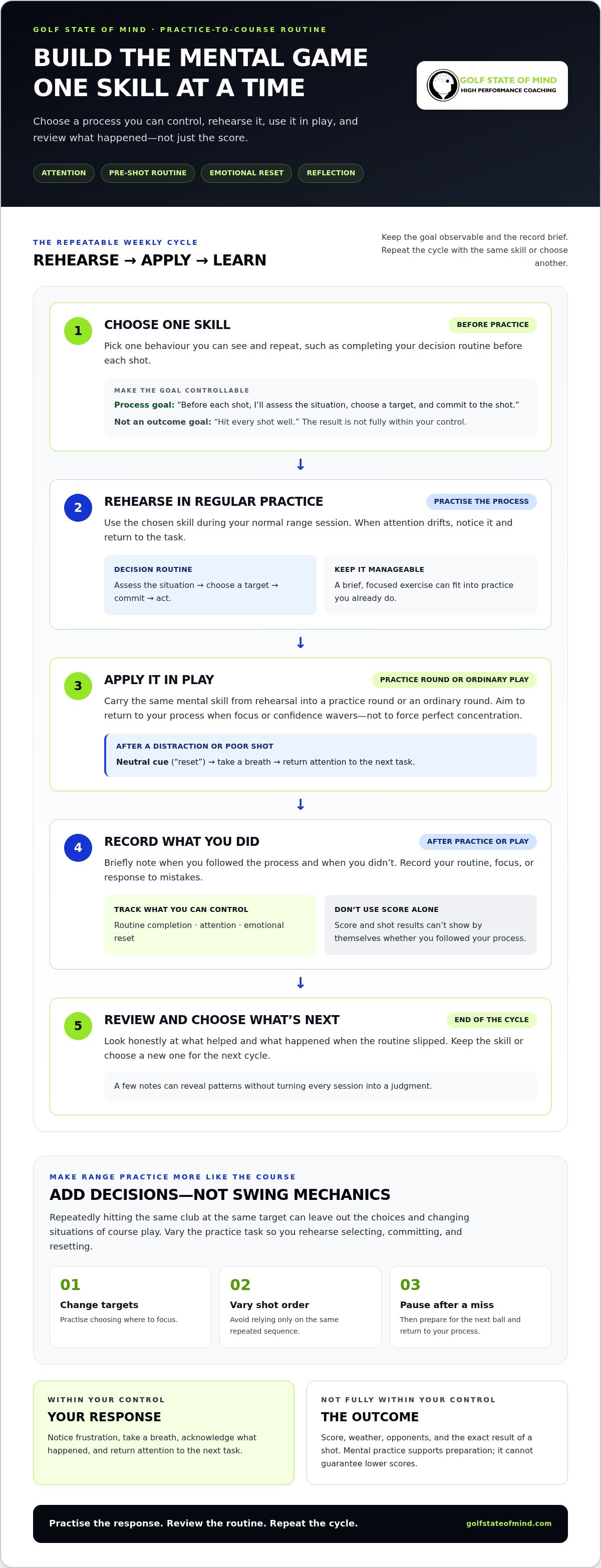
A score tells you what happened, but not necessarily how you handled the moments that shaped the round. For useful DIY golf mental game training, track the process you can influence separately from outcomes affected by execution and changing conditions. A missed target doesn’t erase a committed decision or a well-used reset. Likewise, a good score alone doesn’t show whether your routine is becoming more dependable.
Keep your record simple enough to use after practice or a round. Note the skill you chose, whether you followed your routine, and how you responded after a mistake. A few honest words are more useful than a detailed log you abandon. There’s no universal number of successful repetitions that proves a mental skill is established, so look for patterns rather than treating a single session as conclusive evidence.
Capture process evidence and outcome evidence separately. The questions in the final column can turn a quick note into a useful review without making score the only measure of progress.
| Process evidence | Outcome evidence | Useful reflection question |
|---|---|---|
| Followed the chosen pre-shot routine | Shot direction or result | Did I make and commit to a clear decision? |
| Used a reset after a mistake | Score on the hole or round | How quickly did I return to the next task? |
| Stayed with the selected practice goal | Conditions or other external factors | What helped or disrupted my attention? |
Review notes across several sessions before changing your plan. One difficult round may reflect many factors. Repeated notes can show whether you’re skipping a step, losing focus after errors, or choosing a goal that’s too broad. In Golf Mental Training Program: Building a System for Calm Confidence in 2026, you can explore a broader framework for organizing this kind of practice.
If practice remains inconsistent, first make your routine smaller and easier to repeat. If you’re practising steadily but the same obstacle persists, consider whether you need clearer structure or individualized feedback. Golf State of Mind offers 1:1 mental coaching, as well as digital training for golfers who want a more organized way to work on their mental game. Explore The Ultimate Mental Game Training System for structured mental training.
A mental practice plan only helps if you keep returning to it. Build your week around golf you already play instead of adding a complicated schedule. The aim of DIY golf mental game training is steady attention to one skill at a time, with enough reflection to learn without rebuilding the plan after every round.
Choose one process focus for the week, such as completing your decision routine before each shot. Attach it to a practice session or round that’s already in your calendar. Keep your review brief: after you finish, note whether you used the skill and what made it easier or harder. Then carry forward one useful learning point.
For example, if you chose pre-shot commitment, your review might be: “I made a decision before most shots. After a poor result, I rushed the next one.” That’s enough to guide your next practice. You don’t need a perfect record or a new goal each day. Keep the focus, adjust only what your observations call for, and build consistency through repetition.
Independent practice can suit you if you’re comfortable choosing a focus, applying it on your own, and reviewing honestly. Its flexibility is useful, but it relies on your ability to maintain the routine. If you’re unsure what to work on, repeatedly lose consistency, or keep meeting the same obstacle, a defined learning path can provide helpful structure.
The Ultimate Mental Game Training System is a digital resource for golfers who want guided mental training beyond a self-directed plan. It isn’t a prerequisite for practising these skills, and no program can promise a particular score. Choose the approach that helps you practise with purpose and follow through. If you want a structured path, explore the Ultimate Mental Game Training System.
Make progress manageable: choose one mental skill, practise it in realistic situations, then review how you responded. Track the process you control, not just the score or the result of a single shot. Over time, your notes give you a clearer basis for deciding what to keep practising and what to adjust.
DIY golf mental game training works best as a steady practice-to-course loop. Keep the routine simple enough to repeat, and let each review inform your next step. You don’t need to overhaul your game all at once.
If you’d like a more defined learning path, The Ultimate Mental Game Training System is a digital mental training program from Golf State of Mind, founded and operated by mental coach David MacKenzie. Explore the Ultimate Mental Game Training System to take the next step beyond independent practice.
Choose your next process goal, take it to the course, and build from there. Consistent attention to the process is a worthwhile practice in itself.
Yes. You can practise mental skills independently by choosing one behaviour and applying it consistently. For example, use the same pre-shot decision routine during range practice and casual rounds, then note when you followed it. DIY golf mental game training works best when it’s specific and repeatable. If you find it difficult to practise consistently or a particular challenge keeps returning, guided support can help you make a clearer plan.
Make each range shot a separate decision instead of hitting a rapid sequence. Choose a target and intended shot, select a club, then follow your routine before swinging. Afterward, notice whether you committed to the decision and how you responded to the result. Vary the target or club when practical. The aim is to rehearse focus and decision-making, not turn a mental exercise into swing-mechanics work.
A useful starting exercise is to complete one simple pre-shot routine before every practice shot. Pause, choose a target, make a decision, commit, and begin when ready. Keep the steps natural and use a brief reset cue if your attention wanders. After practice, record whether you followed the routine, not whether every shot was successful. This gives you a clear behaviour to repeat and review without trying to change everything at once.
Practise mental skills as part of your regular golf sessions, choosing a manageable focus you can return to consistently. You don’t need a separate, complicated schedule: rehearse one skill during practice, use it in a round when possible, and take a moment afterward to reflect. If your routine is difficult to maintain, simplify it before adding more exercises. Consistency and honest review matter more than trying to practise every mental skill at once.
Mental game training can help you practise preparation, attention, and responses to setbacks, but it can’t guarantee lower scores. A score reflects many factors, including shot execution and conditions. Track whether you used your chosen routine and returned your attention to the next task after a mistake. Those process measures show how you handled the round, even when the final result wasn’t what you wanted.
Record a few process details after practice or a round: the skill you focused on, whether you used your routine, and how you responded after mistakes. Keep score and shot results as separate outcome information. Review notes across multiple sessions before deciding whether your approach is helping or needs adjustment. One poor shot or round doesn’t prove the training failed. Look for recurring patterns in your behaviour and reflections.
Consider individualized mental game coaching if you struggle to practise consistently, feel unsure what to work on, or keep encountering the same performance obstacle despite steady effort. A coach can help you examine your needs and develop a more tailored approach. Golf State of Mind offers 1:1 mental coaching alongside digital mental performance training. Choose coaching when it can add useful direction, not because independent practice is a required step before getting support.
When you’re dealing with a bad golf partner mentally, step away if you can, take a few slow breaths, and bring your attention back to your next shot….
What if the best response to a three-putt isn’t a pep talk, but one calm sentence that helps you move on? A good 3-putt-quote can acknowledge the…
Why does the fluid, effortless swing you found on the practice range suddenly feel heavy and mechanical the moment you step onto the first tee? It’s…