

Golf Self-Talk Techniques: Build a Clearer Mind on the Course
What do you say to yourself after a bad golf shot?
Maybe it’s something like:
- “I can’t believe I just did that.”
- “I always mess up when I’m playing well.”
- “Don’t hit this one in the water.”
- “My putting is terrible today.”
Most golfers have experienced this kind of inner dialogue. And when the pressure increases, the voice inside your head can become even more critical.
But here’s something important I’ve learned through years of coaching golfers:
The goal isn’t to eliminate negative thoughts or force yourself to think positively. It’s to develop self-talk that helps you play the next shot.
I’m David MacKenzie, founder of Golf State of Mind. One of the mental skills I teach golfers is how to develop their “Inner Caddy”: a constructive internal voice that helps them make decisions, stay committed, and respond to mistakes.
In this article, I’ll share seven practical golf self-talk techniques you can use before, during, and after your shots.
What Is Self-Talk in Golf?
Self-talk is the internal dialogue you have with yourself throughout a round.
Sometimes it’s deliberate. You might remind yourself to choose a target or commit to a shot.
Other times, thoughts appear automatically, particularly when something unexpected happens.
For example, after missing a short putt, you might immediately think, “I’m such a bad putter.”
That thought isn’t necessarily a deliberate choice. It’s simply a reaction.
The important distinction is between having a thought and deciding what to do with it.
You don’t have to believe every thought that enters your mind, and you don’t have to act on it.
Research in sport psychology has examined how different forms of self-talk relate to attention, motivation, and performance. However, no particular phrase guarantees a better golf shot.
What matters is whether your self-talk helps you prepare, decide, commit, and respond effectively.
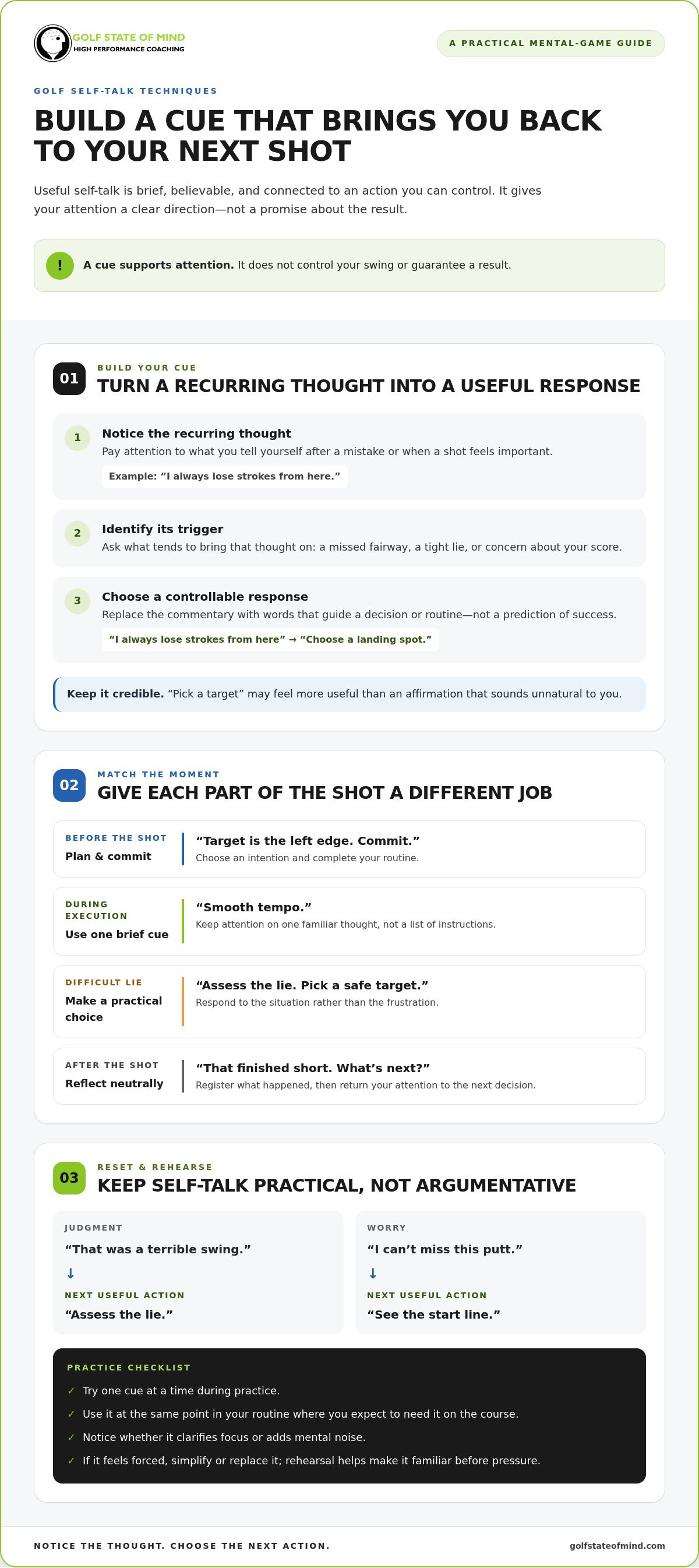
1. Develop Your Inner Caddy
Best for: Reducing self-criticism and making better decisions.
Imagine having a caddy who spoke to you the way you sometimes speak to yourself.
After a missed putt, your caddy says:
“That was pathetic. You always miss those.”
After a poor drive:
“Here we go again. You’re going to ruin another round.”
Would you want that person working for you?
Probably not.
A good caddy provides useful information, helps you make decisions, and encourages you to commit to the shot you’ve chosen.
That’s the role I want your Inner Caddy to play.
The Inner Caddy Exercise
Write down three critical statements you regularly make during a round.
Then ask yourself:
“What would a good caddy say to me in this situation?”
| Critical self-talk | Inner Caddy response |
|---|---|
| “Don’t hit it in the water.” | “Choose a target that gives you enough room.” |
| “I always miss these putts.” | “Read it, choose your pace, and commit.” |
| “My swing is terrible today.” | “Play the shot you have today.” |
| “I’ve ruined my round.” | “The next shot deserves your attention.” |
| “I can’t afford to make bogey.” | “Make the best decision for this shot.” |
Notice that none of these responses promises a good result.
They’re useful because they direct your attention toward something you can do.
2. Replace Outcome Thoughts With Process Cues
Best for: Staying focused when the score matters.
When golfers feel pressure, their self-talk often shifts toward outcomes.
“I need to make this putt.”
“I can’t afford to hit this out of bounds.”
“If I par the last three holes, I’ll break 80.”
These thoughts are understandable, but they don’t tell you how to execute the shot.
Instead, develop a short cue that directs your attention toward the process.
For example:
- Instead of “I have to make this putt,” use “See the line and commit to the pace.”
- Instead of “Don’t miss the fairway,” use “Choose the target and commit.”
- Instead of “I need a birdie,” use “Make a clear decision.”
These cues don’t eliminate the importance of the outcome.
They help you focus on the actions most relevant to producing it.
Practice Exercise
Before your next round, identify one situation where you frequently become outcome-focused.
Choose a short process cue you can use when that situation occurs.
Practice the phrase during your warm-up, then use it on the course.
After the round, assess whether it helped you make a clear decision and follow your routine.
3. Use Different Self-Talk During Planning and Execution
Best for: Reducing overthinking over the ball.
One of the most important distinctions in my mental coaching is separating the thinking phase from the playing phase.
I teach golfers to use three phases:
Planning Phase
This is where your analytical mind has a job to do.
Assess the lie, wind, distance, trouble, and target.
Your self-talk might sound like:
“The wind is helping slightly. Center of the green is the right target.”
Make the decision and commit to it.
Athletic Phase
Once you’ve committed to your shot, your attention should shift toward execution.
This isn’t the time to introduce five new swing thoughts.
You might use a simple cue such as:
- “Target.”
- “Smooth.”
- “Commit.”
Or you might prefer no verbal cue at all, simply connecting with the target and allowing your athletic skills to take over.
The key is to avoid continuing the planning conversation while you’re trying to swing.
Acceptance Phase
After the shot, acknowledge the result and move forward.
Your cue might be:
“That shot is finished.”
Or simply:
“Next shot.”
This doesn’t mean ignoring useful feedback. It means choosing an appropriate time to learn rather than continuing to analyze every mistake during the round.
For more detail, see my guide to developing a mental pre-shot routine for golf.
Plan the shot. Play the shot. Accept the shot.
4. Learn to Respond to Negative Thoughts Without Fighting Them
Best for: Managing doubt, anxiety, and unwanted thoughts.
One of the biggest mistakes golfers make is believing that negative thoughts must disappear before they can play well.
Imagine standing over a narrow tee shot and thinking:
“What if I hit it in the water?”
You might immediately tell yourself:
“Stop thinking negatively. Don’t think about the water.”
But now you’re spending even more attention on the thought you’re trying to avoid.
Here’s a different approach.
The Notice and Redirect Exercise
- Notice: Recognize the thought. “I’m worried about the water.”
- Allow: Accept that the thought is present without treating it as a prediction.
- Redirect: Return your attention to the target, shot selection, and routine.
You don’t need to argue with the thought or replace it with an exaggerated positive statement.
You can feel uncertain and still make a committed swing.
This is particularly important for golfers who struggle with pressure.
Confidence doesn’t have to mean an absence of doubt.
It can mean choosing to behave confidently despite some uncertainty.
If this is a recurring challenge, read my article on how to stop choking in golf under pressure.
5. Change How You Speak to Yourself After Mistakes
Best for: Preventing one poor shot from affecting the next.
Consider two golfers who hit the same poor approach shot.
The first says:
“I’m terrible with my irons. This always happens.”
The second says:
“That came up short. Let’s assess the next shot.”
Both golfers made the same mistake.
But their internal responses are very different.
The first golfer has turned one result into a judgment about their ability.
The second has acknowledged what happened and returned attention to the task.
This is an important mental skill because golf involves constant feedback, much of which is disappointing.
Separate the Shot From Your Identity
One poor shot doesn’t make you a poor golfer.
A missed putt doesn’t mean you’re mentally weak.
A bad tournament doesn’t determine your potential.
Try describing what happened without adding a judgment about yourself.
Instead of:
“I’m such a terrible putter.”
Use:
“I misjudged the pace on that putt.”
Instead of:
“I always choke.”
Use:
“I became hesitant on that shot.”
These statements are more specific, more useful, and easier to learn from.
You can explore this distinction further in my guide to overcoming mental blocks in golf.
Develop a Stronger Mental Game
Download my free mental game ebook for practical strategies to improve your confidence, focus, self-talk, and response to pressure.
6. Create a Player Identity Statement
Best for: Reinforcing how you want to compete.
Self-talk isn’t only about responding to negative thoughts.
It can also help you establish the kind of player you want to be.
In my coaching, I encourage golfers to think about their player identity.
Rather than defining yourself by your handicap, tournament results, or recent scores, consider the qualities you want to demonstrate when you compete.
For example:
- Committed.
- Resilient.
- Patient.
- Adaptable.
- Competitive.
Then create a statement that reflects those qualities.
For example:
“I’m a committed and resilient player who welcomes challenges, makes clear decisions, and gives every shot my full attention.”
Notice that this statement doesn’t promise you’ll always play well.
It describes how you intend to approach the game.
Practice Exercise
Choose three qualities you want to demonstrate on the course.
Write a short player identity statement using those qualities.
Read it before your next round.
Then, afterward, ask yourself:
“Did my behavior reflect the player I want to be?”
This helps connect your self-talk to observable actions rather than simply repeating affirmations.
7. Practice Your Self-Talk Under Pressure
Best for: Making constructive self-talk more reliable in competition.
It’s easy to use positive or constructive language when you’re hitting balls on an empty driving range.
It’s harder when you’re standing over a four-foot putt to win a match.
That’s why self-talk needs to be practised in situations that feel meaningful.
The Five-Putt Inner Caddy Challenge
- Choose a putt of approximately four to six feet.
- Set a goal of holing five consecutive putts.
- Use your normal routine before every attempt.
- Notice your self-talk as the count increases.
- If you miss, respond as your Inner Caddy would and start again.
You might notice thoughts such as:
“Don’t miss this one.”
“I’ve come too far to start over.”
“I always miss the last putt.”
Rather than fighting those thoughts, return to a useful cue:
“Read it. Commit to the pace.”
Afterward, assess how consistently you used your routine and responded constructively.
The purpose isn’t simply to complete five putts.
It’s to practise your mental skills when the outcome begins to matter.
Golf Self-Talk Examples for Common Situations
Here are some additional phrases you can experiment with during your next round.
| Situation | Useful self-talk |
|---|---|
| First-tee nerves | “Choose the shot. Trust the routine.” |
| After a bad drive | “Assess the lie. Make a good decision.” |
| Facing a difficult putt | “See the line. Commit to the pace.” |
| Playing well late in the round | “One shot at a time.” |
| After a double bogey | “That hole is finished.” |
| When confidence is low | “I can commit even when I’m uncertain.” |
| When you’re overthinking | “Target. Trust. Swing.” |
| When you’re frustrated | “I can be disappointed and still play the next shot well.” |
Don’t try to memorize every phrase.
Choose two or three that address situations you commonly experience.
The best self-talk is the language that feels natural to you and supports the action you need to take.
How to Build Better Golf Self-Talk Into Your Routine
To make self-talk a consistent mental skill, incorporate it into your regular practice.
Before Practice
Choose one situation you want to work on.
For example, you might decide to practise your response after a poor shot.
Choose an Inner Caddy phrase that supports the response you want.
During Practice
Use the phrase whenever the situation arises.
Notice whether it helps you return to your routine.
Don’t judge the phrase solely by the outcome of the next shot.
During Your Round
Make constructive self-talk one of your Performance Commitments.
For example:
“After a mistake, I will acknowledge the result and direct my attention to the next useful action.”
Try to follow that commitment consistently, regardless of your score.
After Your Round
Ask yourself:
- When was my self-talk most critical?
- Which Inner Caddy phrases helped me?
- Did I allow negative thoughts to influence my decisions?
- What will I practise next time?
This simple review helps you identify patterns and make your mental training more deliberate.
For a broader approach to improving your mental performance, see my guide to golf mental strategy on the course.
Frequently Asked Questions About Golf Self-Talk
What is the best self-talk for golf?
The most useful golf self-talk is brief, believable, and focused on a controllable action. Phrases such as “Choose a target,” “Commit to the shot,” or “Next shot” can help direct your attention without requiring you to feel completely confident.
How do I stop negative self-talk in golf?
You don’t need to eliminate every negative thought. Start by noticing the thought without treating it as a fact. Then redirect your attention to a useful action, such as making a decision or following your pre-shot routine.
Does positive self-talk improve golf performance?
Self-talk may support attention, motivation, and performance-related behaviors, but no phrase guarantees better results. In many situations, practical and believable instructions are more useful than exaggerated positive affirmations.
What should I say to myself before a golf shot?
During your Planning Phase, use language that helps you assess the shot, choose a target, and commit to your decision. As you move into execution, simplify your attention. A single cue—or no verbal cue at all—may work better than several technical instructions.
How can I be more confident in golf?
Practise the behaviors associated with confident play: clear decisions, commitment, constructive body language, and consistent routines. You can demonstrate these behaviors even when you feel nervous or uncertain.
How do I stop overthinking my golf swing?
Separate technical analysis from execution. Make your decisions before addressing the ball, then shift toward a simple target or movement intention. Avoid adding multiple swing instructions while you’re trying to play the shot.
What should I say after a bad golf shot?
Acknowledge what happened without judging yourself. For example, “That finished short” is more useful than “I’m a terrible golfer.” Then assess the next situation and return to your routine.
What is an Inner Caddy?
Your Inner Caddy is the constructive internal voice you develop to help you make decisions, commit to shots, and respond to mistakes. Rather than criticizing your performance, it offers useful guidance in the same way a good caddy would.
Final Thoughts: Be Your Own Best Caddy
You don’t need to spend an entire round telling yourself how wonderful your golf game is.
And you certainly don’t need to eliminate every negative thought.
What you need is an internal voice that helps you make good decisions, stay committed, and respond constructively when things don’t go your way.
Start by noticing how you speak to yourself.
Replace unnecessary criticism with useful instructions.
Practise those instructions when the pressure increases.
And remember that your identity as a golfer isn’t determined by one shot, one hole, or one round.
Be the caddy you’d want beside you.
Build a More Confident Mental Game
Download my free mental game ebook for practical strategies to improve self-talk, focus, confidence, and your response to pressure.
Get your FREE Mental Game Scorecard
