Drills for Chipping Yips: Rebuild Trust in Your Short Game
What if the first step toward a freer chip isn’t changing your grip or rebuilding your stroke? When a short-game miss feels costly, it’s natural to…
Get your FREE Mental Game Scorecard



The golf flow state is not a rare lightning strike of mystical good fortune; it is a biological condition you can deliberately engineer. Every dedicated golfer knows the acute frustration of standing over a crucial shot with conflicting swing thoughts paralyzing the takeaway. When competitive pressure mounts, that internal critic gets louder, muscles tighten, and the fluid rhythm you felt on the practice range suddenly vanishes. You’ve experienced those afternoons where the cup looks as wide as a bucket and the club swings on autopilot, but waiting for that sensation to happen by accident keeps your scoring wildly inconsistent.
True consistency begins when you treat the zone as a structured mental process rather than a roll of the dice. In this guide, you will discover the science of the golf flow state and learn proven mental protocols to access effortless performance on demand. We will break down how to quiet your overactive analytical mind, trust your subconscious motor patterns under intense pressure, and construct a repeatable routine that reliably triggers peak execution when you need it most.
Every golfer recognizes the sensation, even if it visits only once a season. The fairway appears twice as wide, the target feels magnetized to your ball, and your swing uncoils without conscious intervention. In sports performance, this experience is known as the golf flow state, colloquially described as “the zone.” Rather than an accidental stroke of luck, flow is an optimal psychological condition where action and awareness merge into a single movement, leaving no bandwidth for anxious self-monitoring.
Golfers frequently confuse this state with passive relaxation or casual apathy. True flow is not lazy indifference. As explored in foundational research on Flow (psychology), this mental framework demands complete absorption where acute challenge meets refined capability. When you obsess over mechanical positions during a round, such as agonizing over takeaway angles or wrist flexion at the top, you paralyze your natural athletic instincts. You cannot pilot complex, high-speed motor sequencing with a conscious mind; peak execution requires stepping out of your own way.
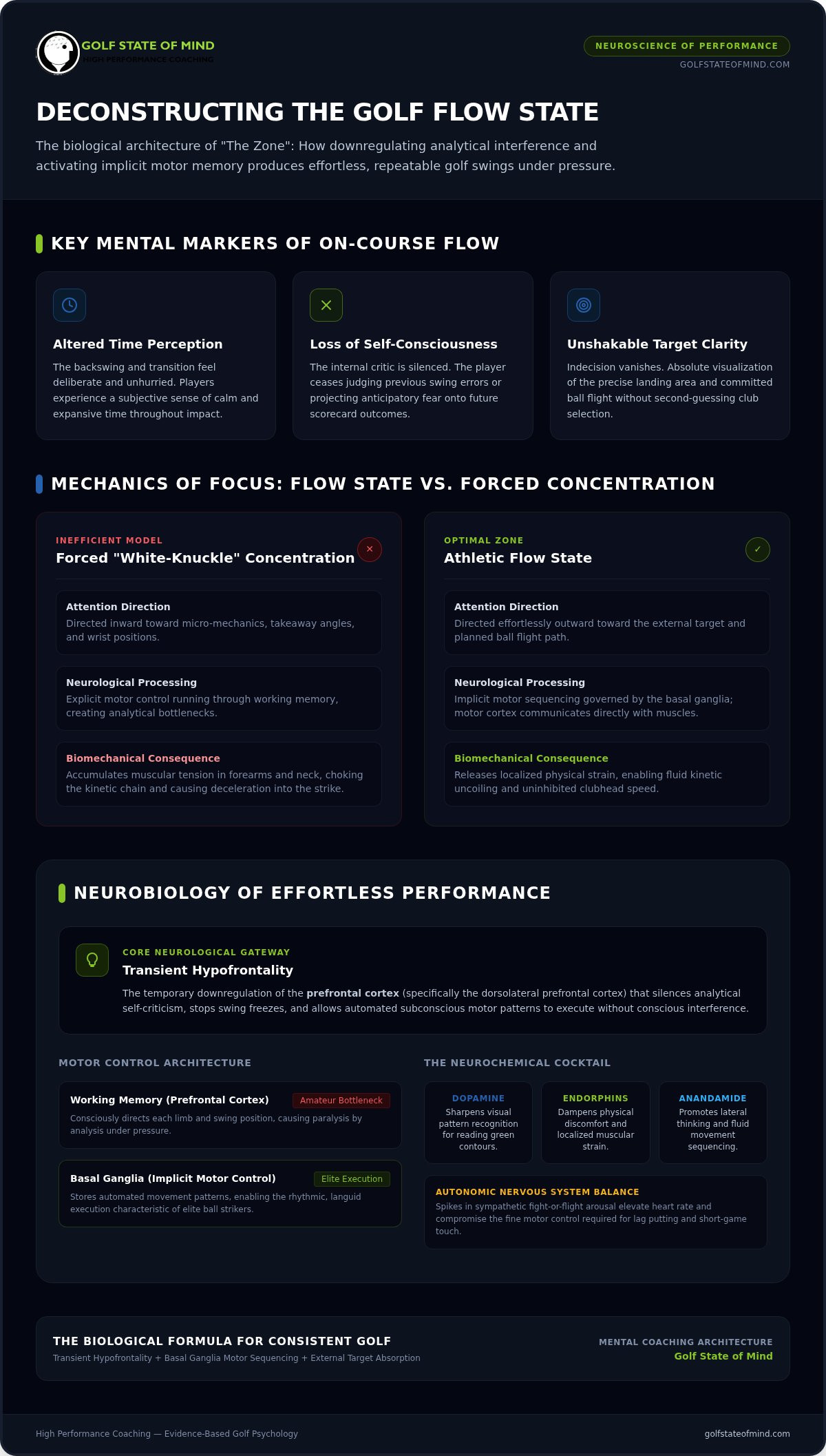
When you enter the zone, distinct mental markers govern your play:
Golfers often attempt to fix poor play by forcing themselves to concentrate harder. Gritting your teeth and applying brute mental effort backfires. White-knuckle concentration produces localized muscular tension in the forearms and neck, choking off your kinetic chain and causing deceleration into the strike. Flow operates on effortless attention directed outward toward an external target rather than inward toward body mechanics. By shifting your awareness away from internal micro-corrections, you release accumulated physical strain and allow subconscious motor programs to fire uninhibited.
Entering the golf flow state is an engineered biological event, not magical fortune. When a shot demands pinpoint precision, amateur golfers instinctively resort to explicit motor control, using working memory to consciously direct each limb. Elite ball strikers bypass this bottleneck. Their execution shifts to implicit motor processing governed by the basal ganglia, the brain structure responsible for automated movement patterns. The languid, rhythmic swing of Fred Couples looks effortless precisely because his neural firing is streamlined; his motor cortex communicates directly with his muscles without analytical interference.
During deep immersion, the brain releases a neurochemical cocktail containing dopamine, endorphins, and anandamide. Dopamine sharpens visual pattern recognition, allowing you to read subtleties in green contours. Endorphins dampen physical discomfort, while anandamide promotes lateral thinking and fluid movement sequencing. Players seeking to understand how to find your zone are actually learning to stimulate this precise internal chemistry through deliberate routines.
The neurobiological gateway to this state centers on a phenomenon known as transient hypofrontality. Transient hypofrontality is the temporary downregulation of the prefrontal cortex that silences analytical self-criticism, allowing subconscious motor patterns to execute without hesitation. When high stakes induce doubt, the dorsolateral prefrontal cortex lights up, attempting to micromanage takeaway plane and clubface rotation. Silencing this analytical center stops swing freezes and restores innate athletic timing.
Athletic execution disintegrates when your autonomic nervous system leans too heavily toward sympathetic fight-or-flight arousal. A spike in adrenaline elevates heart rates, which immediately compromises the fine motor control required for lag putting and delicate short-game touch. Accessing the golf flow state requires balancing sympathetic readiness with parasympathetic calming signals to preserve touch and visual acuity. To systematically build this biological regulation into your rounds, exploring The Ultimate Mental Game Training System offers structured frameworks for maintaining neural composure from the opening tee shot to the final putt.
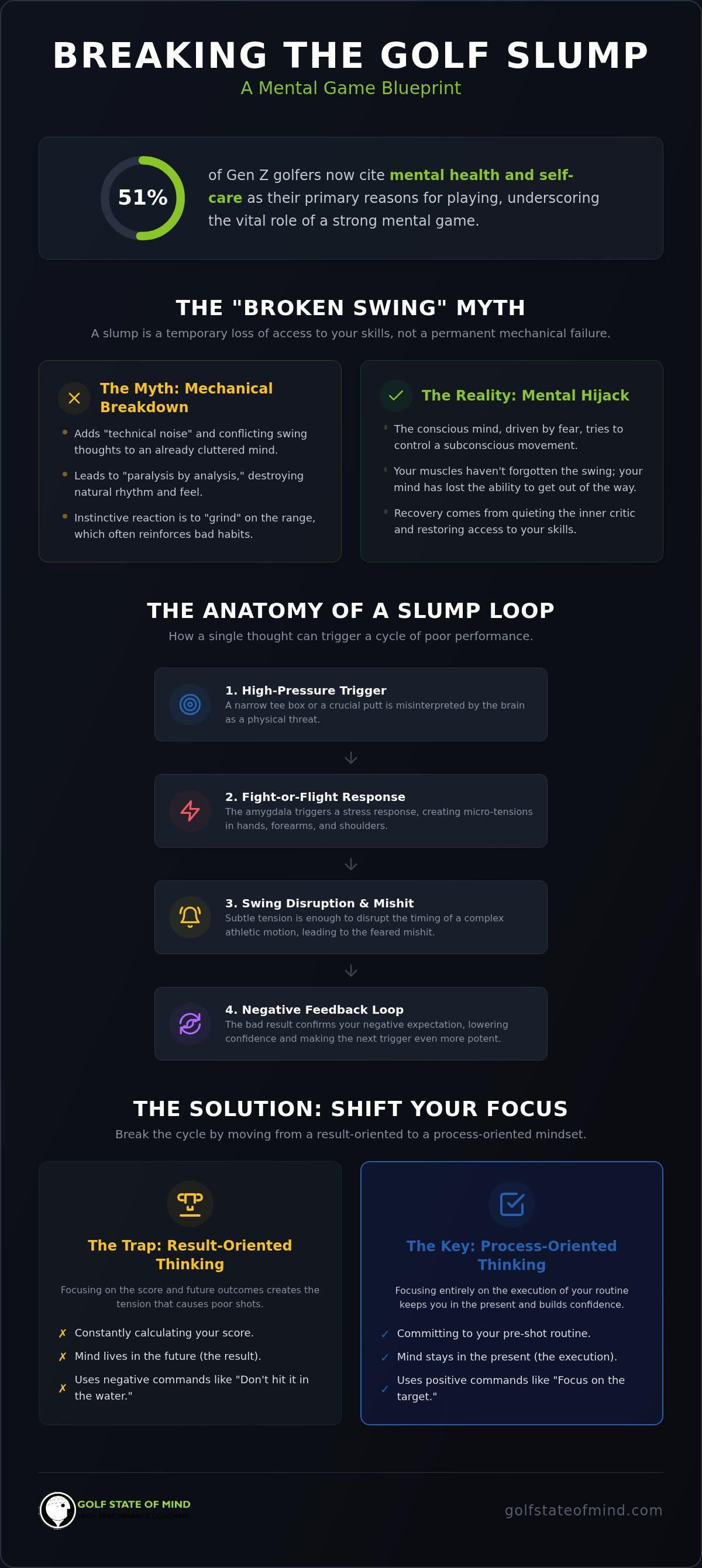
The golf flow state requires your working memory to remain clear of internal chatter. When cognitive interference creeps into your setup, athletic fluidity halts immediately. Technical micromanagement stands as the primary culprit; attempting to consciously guide the clubface into impact disrupts natural rotational release, causing kinetic deceleration right at the ball. Just as destructive is the emotional hangover from an earlier mishit. Carrying frustration from a flared drive on the previous hole burns mental resources, flooding your system with stress hormones and blinding your mind to the current shot.
| Flow Disruptor | Neural Impact | Correction Protocol |
|---|---|---|
| Technical Micromanagement | Overactivates motor cortex, causing muscle rigidity and deceleration. | Shift focus to external target trajectory and rhythm. |
| Scorecard Clinging | Stimulates fear centers by projecting future scoring totals. | Track process adherence rather than hole outcomes. |
| Post-Shot Hangover | Cortisol elevation drains working memory for subsequent shots. | Execute a ten-yard physical reset walk after every mishit. |
| Social Comparison | Heightens performance anxiety and triggers defensive swing steers. | Anchor attention strictly inside your personal shot routine. |
Directing your mind toward internal body mechanics, such as agonizing over your wrist hinge or hip clearance, introduces micro-delays into your kinetic chain. The human body coordinates complex movement best when guided by external intention. Rather than thinking about your elbow angle, visualize the ball carving through the air and landing softly beside a specific flagstick. External focus gives your nervous system a clear goal, allowing subconscious motor programs to organize the strike cleanly.
Obsessing over your scorecard destroys immersion. The moment you calculate what a birdie on the 16th will do for your handicap, you abandon the present strike to defend a future result. This shift turns aggressive swings into defensive guides. Defend your peace by evaluating each shot on process execution, commit fully to your read, maintain balanced rhythm, and accept whatever the ball flight yields.
Entering the golf flow state demands a strict procedural framework. Rather than waiting passively for inspiration, you must build a psychological bridge that shifts your brain from calculation to pure athletic expression. By dividing each shot into clear operational stages, you protect your motor system from late-stage cognitive interference and establish the conditions for spontaneous execution.
Complete all cognitive problem-solving before you approach the ball. Calculate wind, elevation, and ground firmness while standing two paces back. Once you select your club, make a conscious decision to cross the commitment line into sensory mode. In this space, numbers cease to matter. Rehearsal swings here are not technical position checks; they are sensory previews designed to feel the natural whip and release of the clubhead matching your visualized ball flight.
Standing over the ball for too long invites doubt back into your working memory. Trigger your swing execution within six seconds of taking your stance, keeping your primary awareness pinned to the external target. When the strike concludes, grade your performance strictly on routine execution rather than bounce luck. Take a deep, four-second exhalation as you walk toward the fairway to purge lingering physical tension. If you want a structured blueprint to master these four transitions on every shot, install The Ultimate Mental Game Training System to automate your pre-shot discipline under tournament pressure.
Entering the golf flow state during competition is impossible if your practice consists of rapid-firing balls from a pristine mat. Flow requires mental architecture forged under deliberate friction. You cannot cultivate subconscious trust in sterile conditions and expect it to survive tournament pressure. A prepared golfer replaces outcome obsession with structured process evaluation. Implementing a mental scorecard, where you grade your commitment to your routine on a 1-to-5 scale rather than recording your strokes, shifts cognitive focus away from unpredictable bounces and grounds it firmly in disciplined execution.
Raking and hitting balls in rapid succession creates a dangerous illusion of competence. Hitting twenty consecutive 7-irons builds false confidence because your brain never resets between shots. To build a reliable golf flow state, treat every range swing as an isolated test. Switch clubs on every shot, pick a distinct target, and complete your full pre-shot sequence from behind the ball. Introduce tangible consequences into your short game by attempting ten consecutive four-foot putts, restarting your count at zero if you miss a single attempt. These mini-stakes induce real autonomic arousal, training your nervous system to stay composed when true pressure arrives.
Long-term composure also depends on cognitive conditioning away from the course. Guided auditory conditioning exercises train your physiology to downregulate stress responses, establishing calm neural baselines long before you walk onto the first tee. Incorporating The Ultimate Mental Game Training System gives you a proven framework to solidify this mental routine into an everyday training discipline. If specific psychological barriers continue to disrupt your progress, you can schedule a free 15-minute consultation to diagnose your performance bottlenecks and map out a structured path toward effortless execution.
Achieving the golf flow state is not an elusive mystery reserved for sunny afternoons or lucky bounces. It is the predictable outcome of quieting your internal critic, anchoring your attention strictly to external targets, and honoring a structured pre-shot routine. Every memorable round begins with the disciplined decision to step out of your own way. When you measure success by process compliance rather than scorecards, your nervous system remains steady, freeing your natural athleticism to execute without fear.
Peak performance under pressure requires dedicated cognitive conditioning. Designed by mental performance coach David MacKenzie and grounded in sports psychology research from St. Andrews University, these frameworks have helped over 100,000 golfers worldwide build resilient on-course composure. You don’t have to wait for the zone to strike by chance. Master your mental architecture with The Ultimate Mental Game Training System and start playing with the calm, instinctive confidence you’ve earned.
Yes, entering the golf flow state is a trainable mental discipline rather than an inherited genetic gift. You cannot force flow through sheer willpower, but you can systematically engineer the biological conditions for it to emerge. By committing to a consistent pre-shot sequence, setting clear visual targets, and relinquishing conscious mechanical control, any player can reliably trigger this optimal performance zone during competitive rounds.
Flow rarely sustains unbroken for an entire four-hour round. Athletic immersion occurs in intermittent waves, typically lasting across a stretch of three to six holes or isolated within the forty seconds of individual shot execution. Attempting to maintain unbroken concentration between shots leads to acute cognitive fatigue. Preserving your mental energy requires switching off your focus between shots and re-engaging your routine only when approaching your ball.
Immediately disengage from the scorecard and execute a physical reset protocol. Take three slow, deep breaths, clean your clubface, and store the club away deliberately to symbolize closing that chapter. As you walk to the next tee, keep your eyes on the horizon and refuse to analyze swing mechanics mid-round. Flow returns when you surrender outcome judgment and re-commit your focus entirely to the upcoming target.
Driving ranges eliminate consequences, keeping your sympathetic nervous system quiet and allowing effortless swings. On the course, real stakes, hazards, and scorecard tracking activate the brain’s fear centers. This sudden surge of cortisol and adrenaline triggers working-memory interference, leading you to steer the club instead of releasing it. Bridging this divide requires introducing consequence-based drills and singular target switches during range practice.
Technical practice only interferes when you drag mechanical swing thoughts onto the golf course. Block practice on the range serves a distinct purpose for motor pattern development, but you must establish a clear mental firewall during play. Once you step onto the first tee, conscious mechanics must yield to external target focus. Trust the technical repetitions you’ve banked and let subconscious motor execution handle delivery into impact.
External focus directs your conscious awareness toward environmental outcomes, such as a distant tree branch or the arc of ball flight, rather than your body parts. This attentional shift allows the motor cortex and basal ganglia to organize fluid movement automatically. Obsessing over wrist hinge or hip rotation fractures kinetic coordination, while external intention harnesses your innate athleticism to deliver clean, unhurried strikes.
Deep, diaphragmatic breathing directly activates the parasympathetic branch of your nervous system, lowering an elevated heart rate. When tournament stress spikes adrenaline, your fine motor coordination deteriorates rapidly. Taking a four-second nasal inhale followed by an extended six-second exhale stabilizes your physiological arousal. This biological reset clears cognitive panic, helping you access the golf flow state when facing critical putts and narrow tee shots.
What if the first step toward a freer chip isn’t changing your grip or rebuilding your stroke? When a short-game miss feels costly, it’s natural to…
The more you attempt to consciously control your swing mechanics during a round, the more likely you are to remain trapped in a performance plateau….
What if a stronger competitive instinct in golf had less to do with aggression and more to do with commitment? When a shot or putt matters,…