

Drills for Chipping Yips: Rebuild Trust in Your Short Game
You make a few practice swings beside the green and everything feels normal. The club moves freely, your rhythm feels good, and you’re confident you can play the shot.
Then you step up to the ball.
Suddenly, your hands feel different. You become conscious of the clubhead. You worry about blading the ball across the green or hitting the ground behind it. You might freeze, flinch, decelerate, or make a movement that feels nothing like your practice swing.
If you’ve experienced this, you’ll know how frustrating the chipping yips can be.
And when it happens repeatedly, it’s natural to start searching for a technical solution. You change your grip, adjust your setup, try another wedge, or experiment with a different chipping technique.
Sometimes a technical adjustment is exactly what’s needed. But when you can make a perfectly normal practice swing and the movement changes when a ball is introduced, there’s another part of the problem worth exploring: what happens to your attention, intention, and trust when the result starts to matter?
In this article, I’ll share five practical drills for chipping yips designed to help you move away from excessive monitoring, reconnect with the shot you’re trying to play, and gradually rebuild confidence in your short game.
The goal isn’t to guarantee that you’ll never experience another yip. It’s to become increasingly able to make a committed, athletic chipping motion without needing to feel completely certain about the outcome.
What Are the Chipping Yips?
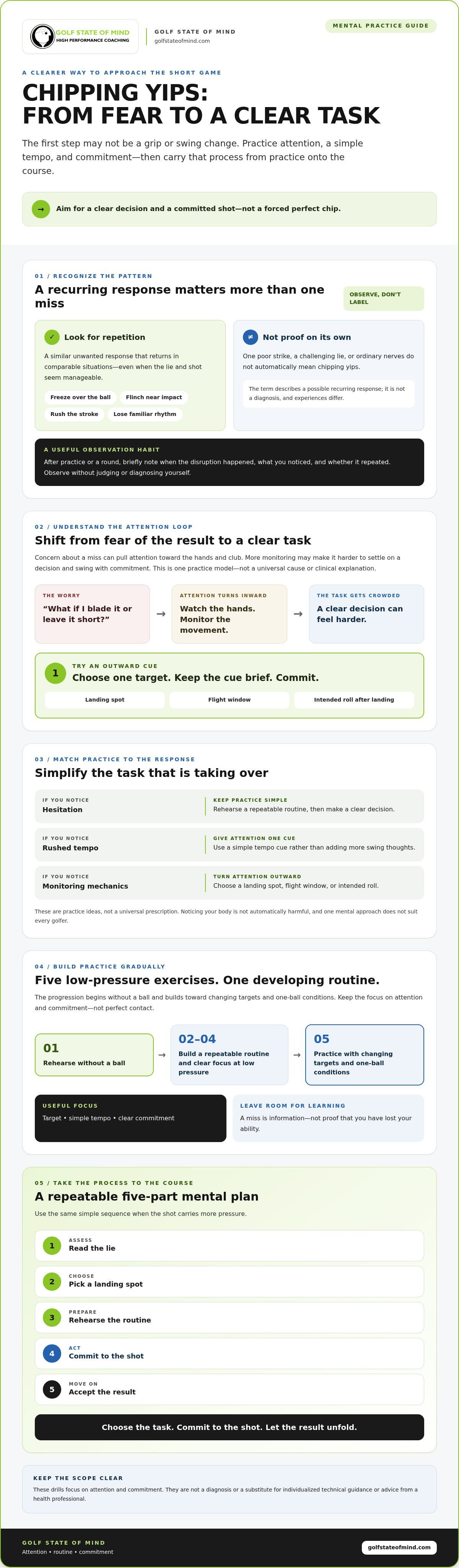
The term “chipping yips” describes a recurring, unwanted disruption to a golfer’s normal chipping movement.
Different golfers experience it in different ways:
- Freezing or hesitating before starting the stroke.
- A sudden jerk or flinch near impact.
- Decelerating through the ball.
- Excessive tension in the hands or arms.
- Feeling unable to make the same movement as a practice swing.
- Becoming unusually conscious of the clubhead or impact.
One poor chip doesn’t mean you have the yips. Even good golfers occasionally hit the ground behind the ball or blade a chip across the green.
What makes the yips particularly frustrating is the recurring feeling that you can’t execute a movement you know you’re capable of making.
There isn’t one cause that explains every case. The yips have been studied in relation to both neurological and psychological factors, and technical difficulties can sometimes contribute too.
For persistent involuntary movements, particularly those occurring outside golf, it’s sensible to seek advice from a qualified healthcare professional rather than assuming the problem is entirely mental.
Why Chipping Yips Can Become a Cycle
Imagine you’re facing a straightforward chip from just off the green.
You’ve bladed a few similar shots recently, so before you address the ball, a thought appears:
Don’t blade this one.
Now you become more aware of your hands and the clubhead.
You try to make sure you don’t lift up, hit too far behind the ball, or make the same mistake again.
Instead of playing the chip, you’re trying to prevent a particular movement.
If the shot goes badly, you might tell yourself:
There it is again. I can’t trust my chipping.
The next chip becomes even more important because you want to prove the problem is gone.
For some golfers, this creates a repeating pattern:
Fear of the miss → Monitoring the movement → Trying to control the stroke → Hesitation or tension → Judging the result → More fear.
This isn’t a diagnosis or an explanation for every golfer’s yips. But it’s a useful pattern to recognize if you notice yourself becoming increasingly concerned with how the movement feels rather than the shot you’re trying to play.
The following drills are designed to help change that relationship.
Before You Start: Change What You Consider a Successful Chip
One of the biggest mistakes golfers make when practicing the yips is measuring every repetition by whether the yip happened.
They hit a chip and immediately ask:
Was that one normal?
Did my hands jerk?
Is it fixed?
Now every chip is another test.
Instead, I want you to begin measuring a few things you can actually influence:
- Did I choose a clear landing spot?
- Did I make a clear decision about the shot?
- Did I commit to my intended movement?
- Did I respond constructively to the result?
These are examples of what I call Performance Commitments.
They give you useful behaviors to work on regardless of whether the ball finishes close to the hole.
You can make a committed chip and still hit a poor shot. Equally, you can hit a good chip while feeling hesitant and overcontrolled.
Both experiences provide useful information.
Rebuilding trust starts with changing what you’re practicing, not just demanding better results.
Build a Mental Game You Can Trust
Want to develop more confidence, commitment, and focus on the golf course? Download my free mental game ebook for practical strategies you can start using in your next round.
5 Practical Drills for Chipping Yips
These exercises progress from simple, low-pressure movements toward more realistic golf situations.
You don’t have to complete all five in one session. Start with the exercise that best matches your experience, then gradually introduce more variation and consequence.
Drill 1: The No-Ball Commitment Drill
Purpose: Reconnect with a free chipping motion without immediately judging the result.
This is particularly useful if you freeze over the ball or find that your practice swings feel significantly more comfortable than your actual chips.
How to do it:
- Choose a specific landing spot on the practice green.
- Stand behind where the ball would normally be and visualize a simple chip landing on that spot.
- Walk into your setup without a ball.
- Look at the landing spot, reconnect with your intention, and make a normal chipping motion.
- Step away and repeat, going through your routine each time.
Complete five repetitions.
Then place a ball down and repeat the same process, this time playing the chip.
Notice whether your attention changes when the ball is introduced.
Do you start checking your hands? Do you become more concerned about the strike? Do you hesitate before beginning?
You don’t have to immediately correct everything you notice.
The first objective is to recognize the difference between making a movement and trying to make sure the movement goes correctly.
Measure: Out of five repetitions, how many times did you follow your routine and commit to the movement without adding extra checks or instructions?
Drill 2: The Landing Spot Challenge
Purpose: Shift attention away from the hands and clubhead toward the shot you’re trying to create.
When golfers struggle with the chipping yips, their attention often becomes very internal.
They’re thinking about their wrists, their takeaway, or exactly where the club will contact the ground.
This drill gives your attention a different task.
How to do it:
- Place three small markers or tees on the practice green at different landing spots.
- Choose a straightforward lie and an appropriate club.
- Before each chip, decide which landing spot you’re aiming for.
- Look at the landing spot and picture the ball landing there and releasing toward the hole.
- Make one purposeful rehearsal, then play the shot.
- Change the landing spot after every chip.
Hit nine chips, rotating between the three targets.
You’re not trying to hit all nine shots perfectly.
You’re practicing creating a clear intention before every shot.
If a thought about your hands or the yip appears, you don’t need to force it away.
Notice it, then return your attention to the landing spot.
Measure: How many of the nine chips did you play with a clearly chosen landing spot and shot intention?
Drill 3: The Rhythm and Commitment Drill
Purpose: Reconnect with an athletic rhythm when you find yourself hesitating, rushing, or trying to steer the club.
Some golfers find that a simple rhythm cue helps them move away from excessive technical control.
The cue isn’t intended to guarantee a perfect strike. It’s simply something useful to connect with while playing the shot.
How to do it:
- Choose a straightforward chip with plenty of green to work with.
- Make two relaxed practice swings while noticing the natural rhythm of the club.
- Choose a simple cue such as “back and through” or a rhythm that feels natural to you.
- Pick your landing spot and make your decision.
- Step in and play the shot, allowing the cue to guide your movement.
- Step away and begin again for the next chip.
Hit eight chips.
Avoid changing your cue after every poor strike. Give yourself an opportunity to practice the same intention across several different outcomes.
If you notice yourself desperately trying to create a particular feeling, remember that the cue is there to support your attention, not to become another movement you have to control.
Measure: On how many chips did you maintain your chosen rhythm intention rather than introducing additional technical instructions?
Drill 4: The One-Ball Up-and-Down Challenge
Purpose: Make practice more like golf by removing the opportunity to repeat the same shot until you get it right.
On the practice green, it’s easy to hit 20 chips from the same spot.
After a few repetitions, you may begin to feel more comfortable because you’ve rehearsed the same movement repeatedly.
But golf doesn’t give you 20 attempts at the same chip.
You get one.
How to do it:
- Take one golf ball, your chipping club, and your putter.
- Choose a straightforward chip to a hole on the practice green.
- Go through your complete pre-shot routine and play the chip.
- Putt out, regardless of where the chip finishes.
- Move to a different location, lie, or hole.
- Repeat for six different up-and-down attempts.
The important part is that every chip is a fresh decision.
You can’t immediately drop another ball and try to erase the previous result.
If you hit a poor chip, you still have a putt to play.
That gives you an opportunity to practice acceptance and moving on.
Measure: Record how many of the six chips you played with a clear decision and committed routine. You can also record up-and-down results, but keep them separate from your process score.
Drill 5: The Pressure Progression Drill
Purpose: Practice your response when the result starts to feel important.
If the chipping yips become worse on the golf course, eventually your practice needs to include some consequence.
But that doesn’t mean immediately creating an overwhelming challenge.
Start small.
How to do it:
- Choose a relatively simple chip and a clearly defined landing area.
- Play five chips, going through your complete routine each time.
- Set a manageable challenge, such as getting three of the five balls to finish within a chosen distance of the hole.
- Notice what happens when you reach the final ball and need a successful result.
- Before that final chip, acknowledge any nerves or thoughts that appear.
- Return to your landing spot, decision, and commitment.
Don’t make the challenge so difficult that it becomes another frustrating test.
The point is to observe what changes when a shot matters.
Perhaps you become more conscious of your hands.
Perhaps you hesitate longer over the ball.
Perhaps you start thinking about what will happen if you miss.
That’s the moment to practice your response.
Notice the pressure. Allow it to be there. Return to the shot.
Measure: On the most important repetitions, did you maintain your process even when you felt uncertain?
Which Chipping Yips Drill Should You Start With?
Different exercises address different parts of the experience.
| If you notice… | Start with… | What you’re practicing |
|---|---|---|
| Freezing or hesitating over the ball | No-Ball Commitment Drill | Moving from preparation into action |
| Thinking constantly about your hands or impact | Landing Spot Challenge | External attention and shot intention |
| Rushing, steering, or losing rhythm | Rhythm and Commitment Drill | Simple athletic cues |
| Chipping well in practice but struggling on the course | One-Ball Up-and-Down Challenge | Making each repetition count |
| Chipping becomes harder when the result matters | Pressure Progression Drill | Maintaining your process under pressure |
These are starting points, not rigid rules. If an exercise makes you more focused on preventing the yip, simplify it or try a different task.
Take the Drills to the Course With a Three-Phase Routine
Practicing the exercises is only part of the process.
You also need a way to apply the same principles when you’re standing beside the green during a round.
For that, I recommend using the three phases of your pre-shot routine.
1. Planning Phase
Assess the lie and choose the shot.
Where do you want the ball to land?
How much will it roll?
Which club gives you the best chance of executing that shot?
Make a purposeful rehearsal that connects you with the intended shot.
Once you’ve made your decision, there’s no need to keep solving the problem.
2. Athletic Phase
Step in and connect with your intention.
It might be the landing spot, the ball flight, or a simple rhythm cue.
Allow yourself to make the movement.
You might still notice the thought:
What if I yip this one?
You don’t have to argue with it.
And you don’t have to wait for the thought to disappear.
Return to your intention and play the shot.
3. Acceptance Phase
Once the ball has been struck, the shot is finished.
You might be disappointed.
You might feel relieved.
You might notice the movement wasn’t as free as you’d hoped.
That’s okay.
Respond to the result, learn what you need to learn, and move on to the next shot.
Plan the shot. Play the shot. Accept the shot.
For a deeper explanation, read my guide to the mental pre-shot routine for golf.
Why Trying to Feel Confident Can Make Chipping Harder
One thing I regularly see with golfers struggling with the yips is the desire to feel confident before playing the shot.
They think:
If I could just feel confident over the ball, I’d be fine.
But confidence is a feeling, and feelings fluctuate.
Some days you might feel good about your chipping.
Other days, particularly after a few poor shots, you might feel very uncertain.
If you make confidence a requirement for playing the shot, what happens when you don’t feel it?
You wait.
You rehearse again.
You check your hands.
You look for reassurance.
Instead, I want you to focus on the behaviors of a confident golfer.
A confident golfer makes a clear decision.
They choose a landing spot.
They commit to the shot they’ve selected.
They accept that the result is uncertain.
They respond constructively when something goes wrong.
You can do all of those things even when you don’t feel particularly confident.
You don’t need to feel confident to behave confidently.
How to Measure Progress Without Constantly Testing the Yips
One of the challenges with the yips is that golfers often want immediate proof they’re improving.
After every chip, they’re asking:
Did it happen?
Was that one better?
Am I cured?
That can keep their attention centered on the problem.
Instead, choose three Performance Commitments for your practice.
For example:
- Clear intention: I chose a specific landing spot.
- Commitment: I played the shot without adding last-second instructions.
- Acceptance: I responded constructively to the result.
After your practice session, rate each commitment from 1 to 5.
You can still record your contact, proximity to the hole, and how frequently the yip occurs. Those observations matter.
But they don’t have to be the only definition of progress.
Perhaps you experience some hesitation but still complete your routine and play the shot.
That’s worth recognizing.
Perhaps you hit a great chip but spent 20 seconds checking whether your hands felt normal.
The result was good, but there’s still something useful to work on.
Progress is about rebuilding effective behaviors, not just chasing the absence of an uncomfortable sensation.
What If the Chipping Yips Return?
Progress isn’t always linear.
You might have a few encouraging practice sessions and then experience the old movement again during a round.
It’s tempting to think:
I’m back to square one.
But one difficult chip doesn’t erase the work you’ve done.
Try not to give a single shot more meaning than it deserves.
Notice what happened.
Ask whether there was something useful to learn.
Then return to your process.
That doesn’t mean pretending you aren’t frustrated.
You can feel disappointed and still respond constructively.
The skill you’re developing is not perfect emotional control. It’s the ability to choose what you do next, even when the previous shot didn’t go well.
When Should You Work on Technique Instead?
Not every chipping problem is a mental-game problem.
If you consistently hit behind the ball, struggle with contact from different lies, or lack a reliable basic technique, working with a qualified short-game instructor may be helpful.
A sound technique gives you something you can trust.
Equally, if your practice swings and range chips are generally good but your movement changes considerably when the ball or consequence is introduced, it’s worth examining the mental side as well.
Technique and mental skills aren’t competing explanations.
Both can contribute to performance.
And if the movement feels genuinely involuntary, persistent, or unusual, don’t rely solely on drills or mental coaching to explain it.
A Simple 20-Minute Chipping Yips Practice Session
Here’s how you could put these exercises together in one practice session.
| Time | Exercise | Focus |
|---|---|---|
| 3 minutes | No-Ball Commitment Drill | Free movement and routine |
| 5 minutes | Landing Spot Challenge | Clear external intention |
| 4 minutes | Rhythm and Commitment Drill | Athletic rhythm |
| 5 minutes | One-Ball Up-and-Down Challenge | One-shot practice and acceptance |
| 3 minutes | Review your Performance Commitments | Learning without judgment |
Don’t worry if you don’t complete a particular number of repetitions. The times are a guide, not a test.
As the exercises become more familiar, you can replace part of the session with the Pressure Progression Drill.
And remember: a useful practice session doesn’t have to end with every chip feeling perfect.
It should leave you with a clearer understanding of what you’re practicing and how you want to respond on the course.
Build Greater Trust in Your Golf Game
If you’d like more help developing a stronger mental game, my free ebook shares practical strategies for improving your focus, commitment, confidence, and response to mistakes.
Frequently Asked Questions About Chipping Yips Drills
What is the best drill for chipping yips?
There isn’t one drill that works for every golfer. If you freeze over the ball, begin with the No-Ball Commitment Drill. If you overthink your hands or clubhead, try the Landing Spot Challenge. If your problem mainly appears under pressure, gradually introduce the One-Ball Up-and-Down Challenge and Pressure Progression Drill.
Can chipping yips be cured?
Some golfers experience substantial improvement, but there’s no universal solution or guaranteed timeline. The term “yips” can describe different experiences and contributing factors. Mental-game practice can help with attention, anticipation, commitment, and responses to pressure, but it shouldn’t be presented as a guaranteed cure for every form of involuntary movement.
Why can I make a good practice swing but struggle when the ball is there?
When a ball is introduced, the movement suddenly has an outcome. If you’re worried about a poor strike or anticipating the yip, your attention may shift toward monitoring or controlling the stroke. Comparing your practice swing with your actual chip can help you identify what changes, although it doesn’t establish a specific medical cause.
Should I change my chipping grip to stop the yips?
A grip adjustment may help some golfers, particularly if it improves comfort or technique. But if your problem is strongly connected to anticipation, pressure, or excessive self-monitoring, changing the grip alone may not address those patterns. A short-game coach can help determine whether a technical change is appropriate.
How often should I practice these chipping yips drills?
Short, purposeful sessions are a useful starting point. You might begin with 15–20 minutes a few times per week, adjusting according to your response. Focus on the quality of your attention and commitment rather than hitting as many balls as possible.
Should I avoid pressure while rebuilding my chipping?
It’s reasonable to begin with simpler, lower-pressure exercises. But if the problem primarily occurs when the result matters, eventually you’ll want to practice in situations that involve some consequence. Increase the difficulty gradually and focus on maintaining your process rather than forcing perfect results.
What should I think about when chipping if I have the yips?
Try connecting with a simple intention such as your landing spot, the intended ball flight, or a natural rhythm cue. You don’t need to eliminate every technical thought or uncomfortable feeling. The goal is to direct your attention toward something that helps you play the shot rather than continually checking whether the yip might happen.
Can I still chip well when I feel nervous?
Yes. Feeling nervous doesn’t automatically prevent you from making a good chip. Rather than trying to remove every uncomfortable feeling, practice making clear decisions, committing to your intended shot, and accepting the result. Those behaviors are available even when confidence is low.
Rebuild Trust One Chip at a Time
When you’re struggling with the chipping yips, it’s understandable that you want to find something that guarantees the next chip will be normal.
But repeatedly checking your hands, searching for the perfect feeling, or testing whether the yip is gone can become part of the problem.
These drills are designed to give you something more useful to practice.
Choose a clear landing spot.
Make a decision.
Connect with an athletic intention.
Allow some uncertainty.
Play the shot.
Accept the result.
Then do it again.
The goal isn’t to stand over every chip knowing with certainty that the yip won’t happen.
It’s to become increasingly willing to make a committed chipping motion without needing that certainty first.
Cures For The Yips
