
Golf Psychology: 2026 Mental Performance Guide
Why can golf feel so easy on the practice range and so difficult when the result actually matters?
You haven’t suddenly lost your swing.
Your physical ability hasn’t disappeared between the range and the first tee.
What’s changed is the environment in which you’re trying to access those skills.
Now you’re keeping score.
There are consequences.
You care about the outcome.
You may become more aware of your swing, more concerned about mistakes and more conscious of what other people are thinking.
This is where golf psychology becomes important.
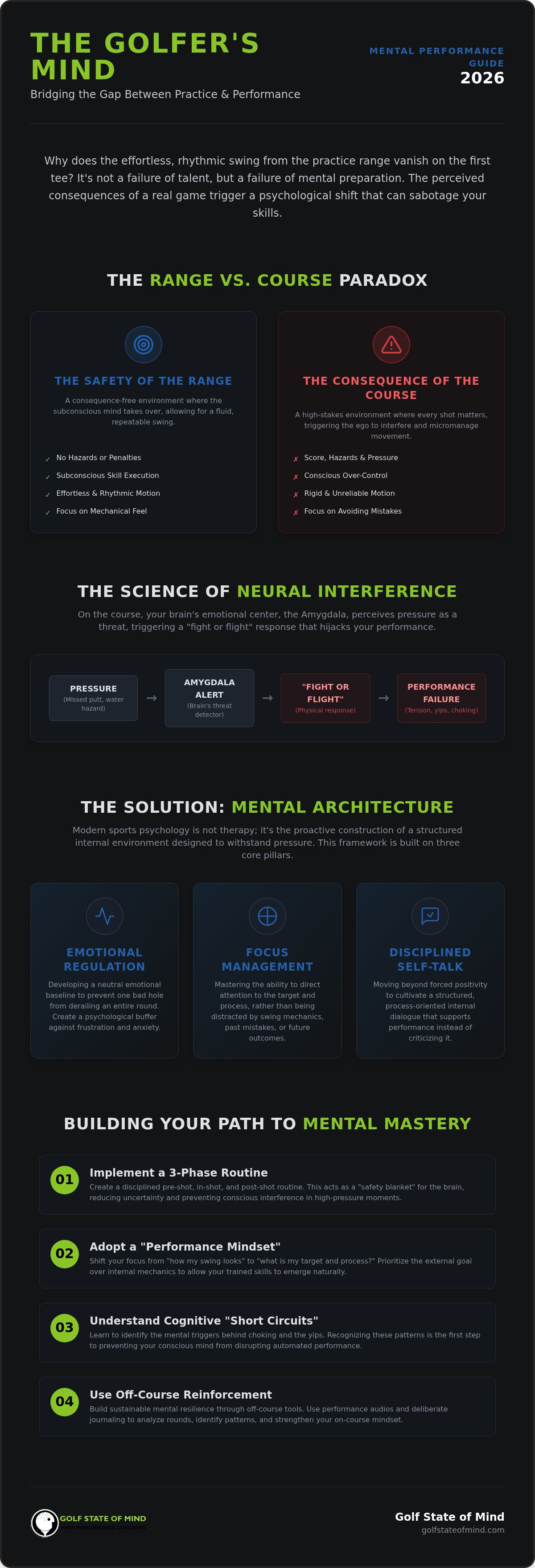
The mental game isn’t about positive thinking or trying to make yourself feel confident all the time. It’s about developing the skills and processes that help you access the golf you already possess when it matters.
That means learning how to direct your attention, make committed decisions, manage thoughts and emotions, respond to mistakes, handle pressure and practice in a way that prepares you to perform.
In this guide, I’ll explain the most important principles of golf psychology and how you can begin applying them to your own game.
Key Takeaways
- Golf psychology helps you access your existing physical skills more consistently under pressure.
- The goal isn’t to eliminate thoughts, nerves or emotions; it’s to respond to them more effectively.
- Your player identity and process give you guidelines for how you want to compete.
- A good pre-shot routine helps you move from analysis to commitment and execution.
- Focus is about directing and returning your attention, not concentrating intensely for four hours.
- Your response to mistakes can be trained just like any other performance skill.
- Confidence comes from preparation, evidence and committed action rather than certainty about the outcome.
- Performance practice helps bridge the gap between the driving range and the golf course.
- A Mental Scorecard helps you measure the quality of your mental execution rather than judging everything by score.
What Is Golf Psychology?
Golf psychology is the application of psychological skills and principles to the way you prepare, practice and perform on the golf course.
It includes areas such as:
- Confidence.
- Focus and concentration.
- Decision-making.
- Pre-shot and post-shot routines.
- Managing pressure.
- Responding to mistakes.
- Self-talk.
- Emotional regulation.
- Visualization.
- Practice habits.
- Player identity.
But I think there’s an even simpler way to understand it.
The goal of the mental game is to help you access and express the golf skills you already possess.
Your mental game doesn’t magically give you a better golf swing.
If you normally carry your seven-iron 160 yards, mental training isn’t going to suddenly make it fly 180.
What it can do is help you access that seven-iron swing more freely when you’re nervous, when you’ve just made a double bogey, when you’re leading a tournament or when there’s water down the right.
That’s an important distinction.
Why Is Golf So Mentally Difficult?
Golf creates a particularly demanding mental environment.
You have plenty of time to think.
Every shot produces a visible result.
There is uncertainty before every swing.
And once you’ve hit the ball, you can’t undo what happened.
The Range and the Course Are Different Environments
On the range, you usually have another ball waiting.
If you hit a poor seven-iron, you can pull another ball across and make an adjustment.
On the course, that shot counts.
The next shot may be from behind a tree.
That consequence changes the experience.
Pressure Makes Golfers Want More Control
When the outcome matters, golfers often respond by trying harder to control what happens.
They become more technical.
They steer the ball.
They become cautious.
They spend longer making decisions.
They start thinking about everything they’re trying not to do.
Good golf psychology helps you recognize these patterns and return to something simpler and more useful.
Want to strengthen the mental side of your golf? Download my free ebook, 7 Key Mental Strategies, for practical strategies to improve your confidence, focus and ability to perform under pressure. Get the Free Ebook
What Are the Goals of the Mental Game?
I think golfers sometimes make the mental game far more complicated than it needs to be.
At its core, there are two important questions:
Who do you want to be when you play?
And:
What are the guidelines that will keep you focused on what’s most important during the round?
The first question is about your player identity.
The second is about your process.
Together, they give you a way to compete that isn’t completely dependent on the unpredictable outcome of every golf shot.
1. Decide How You Want to Show Up
Before worrying about techniques and exercises, decide what your best competitive self looks like.
Ask:
“How do I want to show up when I play?”
Your answer might include qualities such as:
- Committed.
- Patient.
- Confident.
- Resilient.
- Brave.
- Present.
- Decisive.
- Accepting.
These qualities become especially valuable when the round isn’t going according to plan.
Your Identity Is Bigger Than Your Score
There’s another important part of player identity.
You are a person first and a golfer second.
Golf is something you do. It isn’t who you are.
When your identity becomes too closely attached to performance, every shot can begin to feel like a judgment.
A bad round doesn’t simply mean:
“I played badly.”
It starts to feel like:
“I’m not good enough.”
Separating who you are from what you shoot creates more freedom to compete.
2. Build a Process
Golfers naturally care about outcomes.
You want to shoot a good score.
You want to win.
You want your handicap to come down.
You want to qualify.
There’s nothing wrong with any of that.
But during the round, those outcomes aren’t completely under your control.
Focus on Behaviors You Can Influence
Your process might include commitments such as:
- Choose a clear target.
- Make committed decisions.
- Use your pre-shot routine.
- Accept each result.
- Respond constructively to mistakes.
- Return your attention to the present.
These are things you can actually do.
Use Process as Your Measure of Success
At the end of the round, score matters.
But it isn’t the only useful measure.
Ask yourself:
“How well did I compete?”
“How well did I follow my process?”
“How often did I show up as the player I wanted to be?”
That’s where the mental game becomes something you can actually train.
3. Use Your Pre-Shot Routine to Move From Thinking to Playing
Thinking isn’t the enemy in golf.
You need to think before a shot.
You need to assess:
- The lie.
- Distance.
- Wind.
- Trouble.
- Conditions.
- Club and shot selection.
- Target.
Then you need to make a decision.
Think Box and Play Box
One way I explain this is through the Think Box and Play Box.
In the Think Box, you have permission to analyze.
Gather the information.
Choose the shot.
Choose the target.
Make the decision.
Then you cross an imaginary line into the Play Box.
Now the job changes.
See the shot.
Feel it.
Connect with the target.
Commit.
Play.
Don’t Take the Conversation Over the Ball
The problem comes when you’re standing at address still asking:
“Is this the right club?”
“Should I aim farther left?”
“What was that swing thought again?”
If you’re not ready, step away.
Resolve the uncertainty.
Then return when you’re prepared to commit.
4. Learn How to Manage Your Focus
Focus is often misunderstood.
You don’t need to concentrate intensely for an entire four-hour round.
That’s exhausting and unnecessary.
Focus On and Focus Off
When it’s time to prepare and hit:
Switch on.
Narrow your attention.
Process the information.
Choose the target.
Commit.
Execute.
Once the shot is finished:
Switch off.
Walk.
Talk to your playing partners.
Notice your surroundings.
Allow your attention to broaden.
Good Focus Means Returning
Your mind will wander during a round.
You’ll think about your score.
You may think about the last hole.
You might wonder what someone else is shooting.
That doesn’t mean you’ve failed.
The skill is noticing where your attention has gone and bringing it back when you need it.
5. Change Your Relationship With Thoughts and Emotions
A strong mental game doesn’t mean having only positive thoughts.
And it doesn’t mean being calm all the time.
Golf will create:
- Frustration.
- Nerves.
- Doubt.
- Excitement.
- Disappointment.
- Fear.
The question is what you do when those experiences appear.
You Don’t Have to Believe Every Thought
Your mind might say:
“Don’t hit it in the water.”
“You’re going to choke.”
“Your swing doesn’t feel right.”
“You always mess this hole up.”
A thought appearing doesn’t make it true.
You can notice it without turning it into an instruction.
You Don’t Need to Remove the Emotion
If you’re nervous, you can still commit.
If you’re frustrated, you can still make a good decision.
If you’re uncertain, you can still choose a target.
The goal is not emotional perfection.
It’s effective action.
6. Improve Your Response to Mistakes
Every golfer hits poor shots.
The mental difference is often what happens next.
Separate the Shot From the Story
You hit a drive out of bounds.
That’s what happened.
Then your mind adds:
“Here we go again.”
“I’ve ruined the round.”
“I always do this.”
Those aren’t the shot.
They’re the story you’re adding to it.
Allow the Reaction
You don’t have to pretend you aren’t disappointed.
Feel the frustration.
Take whatever useful information you can from the shot.
Then begin moving your attention toward what comes next.
There Is No Magic Number of Steps
You don’t need to be over a poor shot after exactly ten yards or ten seconds.
Different situations create different reactions.
What matters is developing the ability to recognize when you’re still carrying the previous shot and deliberately return to the next task.
7. Learn to Perform Under Pressure
Pressure is not something you need to eliminate.
If golf matters to you, there will be moments when you feel nervous.
Nerves Are Not the Enemy
Your heart might beat faster.
Your breathing may change.
Your hands might feel different.
You may become more aware of the outcome.
None of that means you can’t hit a good golf shot.
Use Breathing to Regulate Your State
If your arousal feels too high, slower breathing can help.
One exercise I use with golfers is:
Inhale for 4 seconds. Exhale for 6 seconds.
You might take several breaths before the round or use it between shots.
You’re not trying to force yourself into complete calm.
You’re helping yourself become more regulated and ready to perform.
Narrow Your Mind
Pressure makes your attention expand into the future.
“What if I win?”
“What if I don’t qualify?”
“What will I shoot if I par in?”
Bring it back.
What is the situation?
What is the target?
What is the shot?
Commit.
8. Build Real Golf Confidence
Confidence is one of the most misunderstood areas of golf psychology.
Golfers often believe confidence means knowing they’re going to play well.
But you can never know that.
Golf contains too much uncertainty.
Confidence Is Not Certainty
You don’t need to know that the shot will work.
You need enough belief in yourself to commit to what you’ve chosen.
That’s different.
Build Confidence From Evidence
Confidence grows from things such as:
- Good preparation.
- Quality practice.
- Past successes.
- Responding well to adversity.
- Keeping commitments to yourself.
- Seeing improvement.
Notice and record that evidence.
Don’t Wait for Confidence Before You Commit
This is particularly important.
You can feel uncertain and still make a committed swing.
Sometimes confidence follows committed action rather than preceding it.
Want a stronger mental framework for your golf? Download my free 7 Key Mental Strategies ebook and learn practical ways to improve confidence, focus, commitment and emotional control on the course. Download the Free Ebook
9. Practice Your Mental Game
Understanding sports psychology for golfers is useful.
But understanding isn’t enough.
You need to practice the behaviors you want to use on the golf course.
Technical Practice and Performance Practice Are Different
If you’re making a swing change, block practice and repetition can be valuable.
Hit the same club.
Make rehearsals.
Use video.
Work on the movement.
That’s technical training.
But you also need performance practice.
Make Practice More Like Golf
During performance practice:
- Change clubs.
- Change targets.
- Use one ball.
- Go through your routine.
- Make decisions.
- Accept the result.
You can even play an imaginary golf course on the range.
Hit the first tee shot.
Imagine where it finished.
Then play the next shot from there.
Add Consequence
Create challenges where something matters.
Perhaps you need to:
- Hit four out of five fairways.
- Hole ten consecutive three-foot putts.
- Get five out of seven chips inside a target area.
- Beat your previous practice score.
Then notice what changes when you’re close to completing the challenge.
That’s where mental training becomes performance training.
10. Measure Your Mental Execution
Your scorecard measures your physical outcome.
A Mental Scorecard can help you measure how well you executed the mental behaviors you’re trying to develop.
Choose One or Two Commitments
You might track:
- Commitment.
- Routine.
- Acceptance.
- Target focus.
- Response to mistakes.
- Staying present.
Don’t try to measure everything at once.
A Good Shot Isn’t Always Good Mental Execution
Imagine you’re indecisive, stand over the ball full of doubt and make a tentative swing.
The ball catches a good bounce and finishes six feet from the hole.
Great result.
But was it good mental execution?
Now imagine choosing a clear target, committing completely and making a free swing that gets caught by a gust of wind and finishes in a bunker.
Worse result.
Better mental execution.
Learning to separate those two things is critical.
Building Your Golf Psychology Plan
You don’t need 25 different mental techniques.
In fact, adding too many can make golf more complicated.
Start with a simple system.
Before the Round
Ask:
- How do I want to show up?
- What are my one or two process goals?
- What do I need to accept about today?
Before Each Shot
Use your process:
Assess → Decide → See → Feel → Commit → Play.
After Each Shot
Notice your response.
Take any useful information.
Accept what happened.
Move on.
Between Shots
Allow your attention to broaden.
Walk.
Breathe.
Talk.
Notice your surroundings.
Then switch back on when you reach the next shot.
After the Round
Don’t ask only:
“What did I shoot?”
Also ask:
- What did I do well mentally?
- Where did my process break down?
- What triggered me?
- What did I learn?
- What should I practice next?
The Real Purpose of Golf Psychology
The purpose of golf psychology isn’t to turn you into a golfer who never gets nervous, never becomes frustrated and never has a negative thought.
That’s unrealistic.
The goal is freedom.
Freedom to access and express the golf skills you’ve already developed.
Freedom to make committed swings without needing certainty about the outcome.
Freedom to compete without every shot becoming a judgment of who you are.
And freedom to respond to the inevitable mistakes, emotions and pressure of golf without allowing them to dictate what happens next.
Your technical skills don’t suddenly change because you develop a stronger mental game.
They become easier to access.
That’s ultimately what mental performance training is trying to achieve.
Frequently Asked Questions
What is golf psychology?
Golf psychology is the application of psychological skills and principles to golf performance. It includes areas such as confidence, focus, routines, decision-making, emotional regulation, pressure management, visualization and response to mistakes. The objective is to help golfers access their physical skills more consistently during play.
Why is psychology important in golf?
Golf creates uncertainty, consequence and considerable time to think. A golfer’s attention, decisions, confidence and emotional reactions can influence how freely they’re able to access their physical skills. Mental training helps golfers develop more effective ways of handling those demands.
What is the difference between a golf mental coach and a sports psychologist?
A golf mental performance coach typically focuses on practical performance skills such as routines, confidence, attention, pressure, practice and competition. Sport psychology is a broader professional field, and qualifications and scope of practice vary. Clinical mental-health concerns should be addressed by an appropriately qualified and licensed professional.
Can golf psychology help me lower my scores?
Improving your mental game can help you make better decisions, commit more consistently, respond more effectively to mistakes and access your existing golf skills under pressure. That can contribute to better scoring, although mental training cannot guarantee a particular score or compensate for every technical weakness.
How do I stop overthinking my golf swing?
Separate the thinking and playing parts of your routine. Gather information and make decisions before approaching the ball. Once you’ve committed, shift your attention toward the target, intended shot, rhythm or feel rather than continuing to analyze several technical positions.
How do I stay focused for an entire round of golf?
Don’t try to maintain intense concentration for four hours. Narrow your attention when preparing and executing a shot, then allow it to broaden between shots. Good focus is less about never becoming distracted and more about recognizing distraction and returning your attention when it’s needed.
How do I mentally recover after a bad golf shot?
Acknowledge your reaction, take any useful information from the shot and then begin moving your attention toward the next task. Avoid turning one poor shot into a prediction about the rest of your round. There isn’t a fixed number of seconds or steps you must use; the important skill is learning to return.
How can I become more confident in golf?
Build confidence from evidence: preparation, quality practice, previous successes, improvement and occasions when you’ve responded well to difficulty. Don’t make confidence dependent on knowing you’ll play well. You can be uncertain about the outcome and still commit fully to the shot.
How do I handle pressure in golf?
Accept that pressure may create nerves and physical sensations rather than trying to eliminate them. Use breathing when helpful, narrow your attention to the immediate task and return to your process. You can also use consequence-based practice to develop experience performing while something matters.
Is the golf mental game just positive thinking?
No. Effective mental training isn’t about forcing yourself to think positively. It’s about developing skills such as attention control, decision-making, acceptance, routines, confidence, emotional regulation and effective responses to pressure and mistakes.
Are the golf yips psychological?
The yips are complex and shouldn’t automatically be described as purely psychological. Research has considered psychological, movement-related and neurological factors, and the relative contribution may differ between golfers. Mental performance work can address factors such as fear, attention, conscious control and pressure, while some golfers may also benefit from technical or medical assessment.
How should I practice the mental game of golf?
Practice the behaviors you want to use on the course. Use your routine, change clubs and targets, use one ball, create consequence and measure skills such as commitment and acceptance. Technical repetition still has an important place when you’re learning a movement; performance practice serves a different purpose.
What should I focus on before a golf shot?
Gather the relevant information, choose the shot and target, and make a clear decision. Then shift from analysis toward execution by connecting with the target, intended ball flight or feel of the shot. Once you’re committed, play rather than continuing to solve the shot over the ball.
How long does golf mental training take to work?
Some strategies can change the way you approach a round immediately, but developing reliable mental skills takes practice. There isn’t a universal four-week or six-week timeline. Like other golf skills, progress depends on the player, the challenge and how consistently the skills are practiced.
Get your FREE Mental Game Scorecard
