
How to Recover From a Bad Golf Shot: A Mental Reset That Actually Works
You hit a terrible shot.
Maybe it’s a drive out of bounds.
A chunked wedge.
A three-putt from 20 feet.
Or a shot that comes at exactly the wrong moment in an otherwise good round.
The shot costs you one stroke.
What happens next can cost you several more.
That’s why learning how to recover from a bad golf shot is one of the most important mental skills you can develop.
The goal isn’t to become a golfer who doesn’t get frustrated.
It’s not to pretend the shot didn’t matter.
And it’s definitely not to force yourself to become positive immediately.
The goal is to prevent one mistake from influencing the decisions, commitment and execution that follow it.
You need to be able to experience the disappointment, take whatever useful information you need from the shot, accept what happened and eventually return your attention to what’s next.
That’s a skill.
And like every other part of your mental game, it can be practiced.
Key Takeaways
- A bad golf shot doesn’t have to become a bad hole or a bad round.
- Don’t demand an immediate emotional reset; frustration and disappointment are normal.
- Separate what actually happened from the story your mind starts creating about it.
- Take useful information from the shot without turning the golf course into a technical practice session.
- Acceptance doesn’t mean liking the result; it means stopping the fight with something you can no longer change.
- Use your post-shot routine to create a clear end to the previous shot.
- Switch your attention away from golf between shots and reconnect with the present moment.
- Don’t automatically become aggressive or conservative after a mistake; make the best decision for the shot in front of you.
- Measure the quality of your response as part of your mental performance.
Why One Bad Shot Can Turn Into Several
A poor shot is rarely the entire problem.
The bigger problem is often what the golfer does with it.
Imagine hitting your drive into the trees.
You immediately think:
“I can’t believe I’ve done that.”
Then:
“I always do this when I’m playing well.”
Then:
“I’ve ruined the round.”
By the time you reach the ball, you’re no longer simply dealing with a difficult recovery shot.
You’re dealing with the meaning you’ve attached to the previous one.
Your Attention Moves Away From the Present
Instead of assessing the shot in front of you, you’re still replaying the previous one.
Or you’ve jumped ahead:
“Now I have to make par.”
“I need to get that shot back.”
“I can’t make another bogey.”
That makes it much harder to give the next shot the attention it deserves.
You Start Trying to Fix the Problem Immediately
Another common reaction is technical.
You hit one poor drive and immediately start diagnosing your swing.
Was the clubface open?
Did you come over the top?
Did you move too quickly from the top?
Now you’re walking toward the next shot thinking about your mechanics instead of playing golf.
Sometimes there is useful information in a poor shot.
But one bad swing doesn’t necessarily require an immediate rebuild.
Separate the Shot From the Story
This is one of the most useful distinctions you can make when learning how to recover from a bad golf shot.
Separate what happened from what your mind says it means.
The Shot
You hit the ball into the water.
That’s a fact.
The Story
“Here we go again.”
“I’m choking.”
“I’ve blown the tournament.”
“I always mess up when I’m playing well.”
“My swing has gone.”
Those are interpretations.
They may feel convincing in the moment, but they aren’t the same thing as what actually happened.
Don’t Turn One Shot Into an Identity
There’s an even more damaging version:
“I’m terrible.”
“I’m mentally weak.”
“I’m such an idiot.”
Now a golf shot has become a judgment of you.
Remember:
You are a person first and a golfer second.
A poor golf shot is something that happened.
It isn’t who you are.
Want to become better at handling mistakes, pressure and frustration on the golf course? Download my free ebook, 7 Key Mental Strategies, for practical strategies to improve focus, confidence and emotional control. Get the Free Ebook
A Simple Mental Reset After a Bad Golf Shot
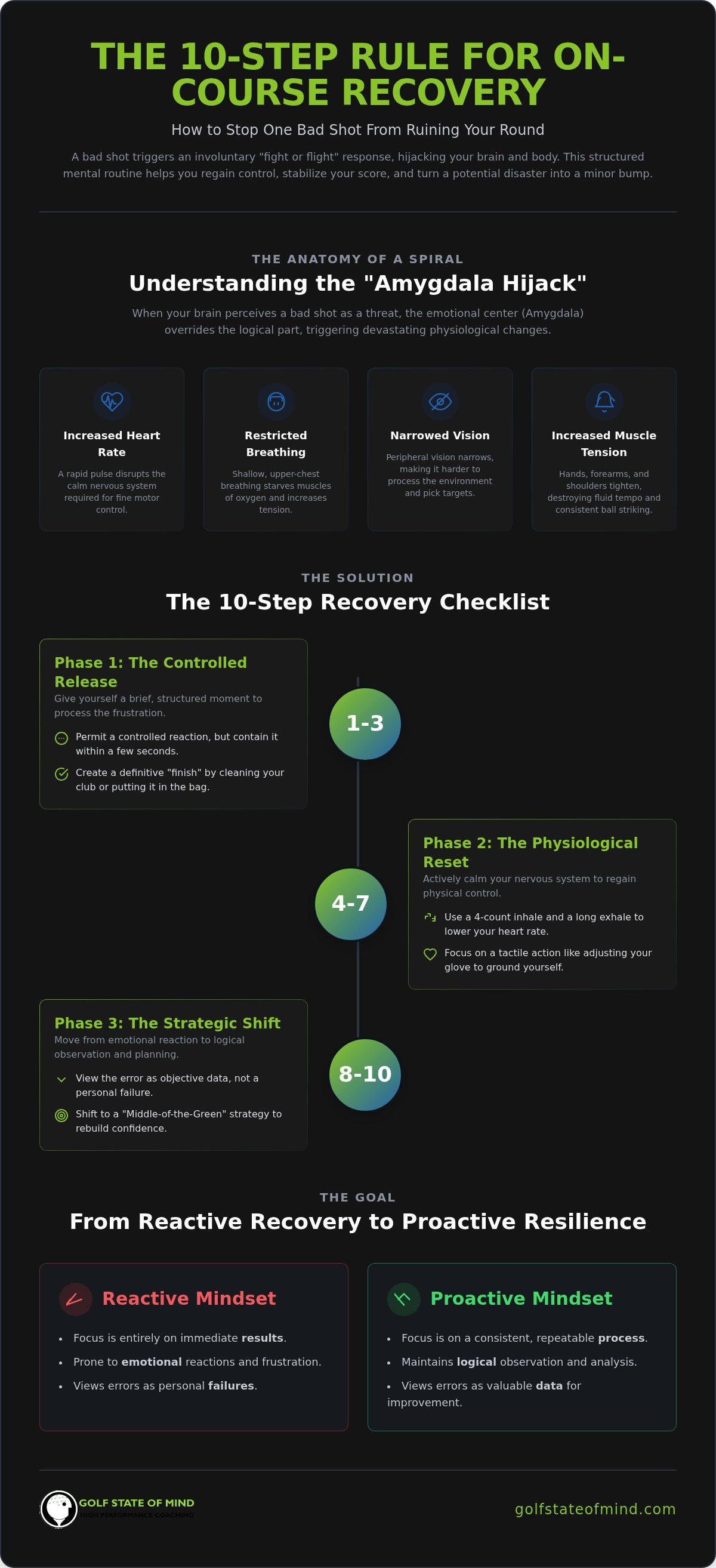
I don’t believe you need an arbitrary rule that says you must be over a poor shot within exactly 10 steps, 10 seconds or 10 yards.
Some mistakes barely bother you.
Others hurt.
Missing a four-footer on the second hole of a casual round isn’t necessarily going to create the same reaction as making double bogey on the 17th hole when you’re leading a tournament.
What you need is a process rather than a stopwatch.
A useful sequence is:
React → Learn → Accept → Switch Off → Start Again.
Let’s look at each part.
Step 1: Allow the Reaction
You’re allowed to be disappointed.
You’re allowed to feel frustrated.
You don’t have to hit a ball into the water and immediately smile as though nothing happened.
Don’t Add Judgment to the Emotion
There’s a difference between:
“I’m really frustrated about that.”
and:
“I shouldn’t be frustrated. Why can’t I control myself?”
The second response creates another problem.
Now you’re frustrated about being frustrated.
Notice Rather Than Feed It
Feel the reaction.
Notice what’s happening.
But try not to feed it with more stories.
You don’t need to replay the shot five times.
You don’t need to predict the rest of the round.
And you don’t need to attack yourself.
Step 2: Take the Information
Once the initial reaction begins to settle, ask whether the shot gave you any useful information.
Perhaps:
- The wind affected it more than you expected.
- The lie behaved differently.
- You chose the wrong club.
- Your target was too aggressive.
- You weren’t fully committed.
- You rushed your routine.
That’s useful information.
Analysis Is Different From Judgment
“I didn’t commit to that target.”
is useful.
“I’m terrible under pressure.”
is judgment.
One helps you make a better decision next time.
The other simply damages confidence.
Be Careful With Technical Analysis
If there’s an obvious simple feel you’ve been working on with your swing coach, fine.
But the golf course usually isn’t the place to conduct a detailed swing investigation after every poor shot.
Make a note of something if necessary.
You can investigate it properly after the round.
Step 3: Accept What Happened
Acceptance is often misunderstood.
It doesn’t mean you have to like the shot.
It doesn’t mean you don’t care.
And it doesn’t mean poor performance is acceptable.
It simply means recognizing:
“That has happened, and I can’t change it now.”
Stop Arguing With Reality
A lot of mental energy gets wasted on thoughts such as:
“That shouldn’t have happened.”
“I can’t believe I did that.”
“Why did that bounce there?”
But it did happen.
The ball is where it is.
The stroke has been counted.
Your next opportunity begins from here.
Acceptance Creates Freedom
Once you stop trying to change something that has already happened, your attention becomes available for what’s next.
That’s the practical value of acceptance.
Step 4: Switch Off
Once you’ve reacted, learned and accepted, you don’t need to continue thinking about golf all the way to the next shot.
Allow your attention to broaden.
Reconnect With Your Surroundings
Notice:
- What you can see.
- What you can hear.
- What you can feel.
- The temperature.
- The wind.
- The course around you.
You can also talk to your playing partners.
You’re not losing focus.
You’re conserving it.
Let Your Body Move On Too
Notice if you’re still carrying the shot physically.
Are your shoulders tense?
Are you gripping the club?
Are you walking faster?
Are you replaying the swing?
You don’t need to force yourself into some artificial “champion posture.”
Simply notice what you’re doing and allow yourself to return to your normal pace.
Step 5: Start Again With the Next Shot
When you arrive at your next shot, switch back on.
This is a new problem.
Assess What Is Actually in Front of You
What’s the lie?
What’s the distance?
Where is the trouble?
What are the conditions?
What’s the smartest shot?
What’s the target?
Don’t Try to Get the Shot Back
This is critical.
You cannot get the previous shot back.
You can only play this one.
The thought:
“I need to make birdie now.”
can lead you toward decisions you wouldn’t normally make.
Instead ask:
“What does this shot require?”
Commit
Once you’ve made the decision, commit to it.
You don’t have to feel completely confident.
You don’t have to be completely calm.
You just need to give the next shot your full commitment.
Use Breathing When You Need Help Resetting
Sometimes the emotional reaction remains strong.
This is where breathing can be useful.
Try 4–6 Breathing
Breathe in for four seconds.
Breathe out for six seconds.
Repeat for several breaths as you walk.
The objective isn’t to make every trace of frustration disappear.
It’s to help regulate your state and give your attention something simple to return to.
Don’t Turn the Breathing Into Another Test
If you’re still disappointed after three breaths, nothing has gone wrong.
You can still play the next shot while feeling disappointed.
The question isn’t:
“Do I feel perfect again?”
It’s:
“Am I ready to give the next shot my attention?”
Build a Post-Shot Routine
Most golfers understand the value of a pre-shot routine.
A good post-shot routine can be just as important.
It gives each shot a beginning and an end.
After a Good Shot
Notice what you did well.
Take the confidence.
Then move on.
After a Poor Shot
Use the same basic process:
React → Learn → Accept → Switch Off.
You might use putting the club back into your bag as a simple physical signal that the shot is finished.
Not because putting a club away magically changes your mental state.
But because consistent behaviors can help create a familiar transition.
Don’t Carry the Shot With You
If you notice yourself replaying it 100 yards later, that’s okay.
You’ve noticed.
Now redirect.
Look around.
Talk to someone.
Reconnect with where you are.
Focus is about returning.
Should You Play Safer After a Bad Shot?
Not automatically.
This is where I disagree with the idea that every bad shot should be followed by several holes of deliberately conservative golf.
Your strategy should be determined by the situation — not by your emotional reaction to the previous shot.
Don’t Become Reckless
You don’t need to chase a heroic shot because you’re angry.
If the percentage play is pitching back to the fairway, pitch back.
But Don’t Become Afraid Either
Likewise, don’t suddenly start aiming 40 yards away from every flag simply because you made a mistake.
That’s allowing the previous shot to influence the next one too.
Make a Fresh Decision
Ask:
“What would I choose here if the previous shot hadn’t happened?”
That’s often a useful way to identify whether emotion is influencing your strategy.
How to Recover From a Blow-Up Hole
A triple bogey can be harder to accept than a single poor shot because several things may have gone wrong.
But the principle is the same.
Don’t Try to Repair the Score Immediately
You walk onto the next tee thinking:
“I need two birdies now.”
You’ve already left the present.
The next hole doesn’t require you to make up for the previous one.
It requires you to play the next hole.
Shrink the Round
If your mind is racing ahead, narrow it.
Not the next nine holes.
Not the next three.
Not even the entire hole.
What’s the next shot?
Return to Your Process Goals
This is exactly why process goals are so useful.
If your goals for the day are:
- Commit to every target.
- Accept every result.
then a triple bogey doesn’t prevent you from succeeding on the very next shot.
Want a better process for handling mistakes during a round? Download my free 7 Key Mental Strategies ebook for practical ways to improve acceptance, focus, confidence and emotional control on the golf course. Download the Free Ebook
Recovering From a Mistake During a Good Round
Sometimes a bad shot hurts more because of what came before it.
You’re three under through 13.
Then you hit one out of bounds.
Suddenly the mistake feels enormous.
Notice the Meaning You’re Adding
“There goes my chance.”
“I knew I wouldn’t keep it going.”
“I’ve thrown it away.”
Again, separate the event from the story.
The Job Hasn’t Changed
You don’t need to save your good round.
You need to play the next shot.
That’s it.
Practice Your Response to Mistakes
Most golfers practice trying to hit good shots.
Very few deliberately practice what they will do after a bad one.
But if you want to become better at recovering, this skill needs repetitions too.
Use One-Ball Practice
When you’re doing performance practice, don’t immediately correct a poor shot.
Hit one ball.
Accept the result.
Go through your post-shot routine.
Then create a completely different shot.
Practice Consequence
Use games where you’re keeping score.
When you fail a challenge or hit a poor shot, notice your reaction.
Then practice:
React → Learn → Accept → Switch Off → Start Again.
Recovery Is Part of Performance
You don’t have to wait until tournament day to discover whether you can handle frustration.
Practice it.
Measure Your Recovery With a Mental Scorecard
If responding to mistakes is an area you’re working on, make it part of your Mental Scorecard.
After the round, don’t simply ask:
“How many bad shots did I hit?”
Ask:
“How well did I respond to them?”
Separate Outcome From Mental Execution
You can respond beautifully to a bad shot and still make double bogey.
That doesn’t mean the mental process failed.
Likewise, you can react terribly, make a reckless decision and then get lucky.
A par doesn’t necessarily mean you handled the situation well.
Measure the behavior you’re trying to improve.
The Goal Isn’t to Stop Hitting Bad Shots
Bad golf shots are inevitable.
Even when you’re playing well.
Even when you’re confident.
Even when you’ve prepared properly.
The mental game doesn’t remove them.
What it can change is how much influence one mistake has over what happens next.
Learning how to recover from a bad golf shot means becoming better at:
- Allowing your reaction without feeding it.
- Taking useful information without becoming overly technical.
- Accepting what you can’t change.
- Switching your attention away from the previous shot.
- Making the next decision independently.
- Committing again.
That’s resilience.
Not never getting frustrated.
Not forgetting the shot instantly.
And not pretending you don’t care.
The goal is to make sure the previous shot doesn’t get to hit the next one too.
Frequently Asked Questions
How do I recover from a bad golf shot?
Allow yourself to acknowledge the reaction, identify any useful information from the shot, accept that the result can no longer be changed and then switch your attention away from it. When you reach the next shot, assess it as a new problem and commit to the best decision available.
How do I stop getting angry after a bad golf shot?
Don’t make eliminating anger your immediate objective. Acknowledge that you’re frustrated without adding self-criticism or repeatedly replaying the mistake. As the initial reaction settles, use breathing, your surroundings or conversation to help redirect your attention before the next shot.
What is a good mental reset after a bad golf shot?
A simple process is: React, Learn, Accept, Switch Off and Start Again. This gives you permission to experience the reaction while still creating a deliberate transition toward the next shot.
Should I use the 10-step rule after a bad golf shot?
A fixed number of steps can work as a personal cue if you find it helpful, but there is nothing inherently special about ten steps. Different shots create different emotional reactions. The important skill is recognizing your reaction, accepting the result and returning your attention to the next task rather than meeting an arbitrary deadline.
Should I fix my swing after hitting a bad shot?
Not necessarily. A single poor shot doesn’t always indicate a technical problem. Take any obvious information from the result, but avoid conducting a detailed swing analysis after every mistake. If there’s a recurring technical issue, investigate it properly with your coach or during practice.
Should I play conservatively after making a mistake?
Don’t automatically become more conservative or more aggressive. Make the best strategic decision for the situation in front of you. Ask what you would choose if the previous shot hadn’t happened. This can help prevent frustration or fear from influencing your course management.
How do I recover mentally after a double or triple bogey?
Don’t immediately try to make the lost shots back. Allow the disappointment, review anything useful and then narrow your attention to the next shot. Returning to your process goals can help you create an immediate opportunity for good mental execution regardless of the score.
How do I stop one bad shot ruining my golf round?
Separate the shot from the story you create about it. One poor shot doesn’t prove that you’ve lost your swing or that the rest of the round will go badly. Use a post-shot routine to process the result and deliberately approach the next shot as a new problem.
Can breathing help after a bad golf shot?
Yes. Slower breathing can help regulate your level of arousal and redirect your attention. Try inhaling for four seconds and exhaling for six seconds for several breaths. You don’t need the frustration to disappear completely before the technique has been useful.
What should I think about between golf shots?
You don’t need to think about golf continuously. Allow your attention to broaden between shots by noticing your surroundings, walking, breathing or talking to your playing partners. When it’s time to prepare for the next shot, deliberately narrow your attention again.
What is a post-shot routine in golf?
A post-shot routine is the process you use immediately after a shot to evaluate anything useful, accept the outcome and transition away from it. It complements your pre-shot routine by giving each shot a clear end before you move toward the next one.
How can I practice recovering from bad golf shots?
Use one-ball and consequence-based performance practice. When you hit a poor shot or fail a challenge, resist the temptation to immediately hit another ball to correct it. Go through your recovery process, change the club or target and start again with a new task.
How do professional golfers recover from bad shots?
There isn’t one universal routine used by every professional golfer. Strong competitors tend to develop individual ways of processing mistakes, managing their reactions and returning attention to the next shot. The useful lesson isn’t to copy a specific number of seconds or steps, but to develop a repeatable recovery process that works for you.
Get your FREE Mental Game Scorecard
