

How to Create a Golf Mental Game Plan That Works
Have you ever finished a range session feeling as though you’ve finally figured out your golf swing?
You’re striking the ball beautifully. Your driver feels effortless. Your irons are flying toward the target, and you’re beginning to imagine the score you could shoot if you played like this on the course.
Then you step onto the first tee.
Suddenly, everything feels different.
Your swing doesn’t feel as natural. You start thinking about your mechanics. You become more aware of where you don’t want the ball to go.
And the confidence you had on the driving range seems to disappear.
Why can you hit the ball so well on the range but struggle to reproduce that performance on the golf course?
It’s one of the most common challenges I encounter in my work as a golf mental performance coach.
I’m David MacKenzie, founder of Golf State of Mind, and a significant part of my coaching involves helping golfers bridge the gap between what they’re capable of in practice and what they produce in competition.
The solution isn’t necessarily another swing change.
It’s learning how to practise for the demands of playing golf, rather than simply becoming better at hitting balls on the range.
In this article, I’ll show you how to create a golf mental game plan that helps transfer your range confidence to the course, with practical exercises for your next practice session and round.
Why Your Range Game Doesn’t Always Transfer to the Course
The driving range and golf course place very different demands on your mind.
On the range, you might hit ten seven-irons in a row.
You have a perfect lie, a familiar target, and an opportunity to make immediate adjustments after every shot.
If you hit a poor one, you simply pull another ball toward you.
On the course, you get one opportunity.
Every shot has a different lie, distance, target, and consequence.
There’s no automatic second attempt.
And because the outcome matters, you may become more concerned about avoiding mistakes.
Practice Mode vs. Performance Mode
| Practice Mode | Performance Mode |
|---|---|
| Working on swing mechanics | Choosing and executing a shot |
| Repeating the same club | Changing clubs and targets |
| Making adjustments after each ball | Accepting the result and moving on |
| Thinking about body movements | Focusing on the target and intention |
| Little consequence for a poor shot | Dealing with hazards, scores, and pressure |
| Measuring swing improvement | Measuring decisions, commitment, and execution |
Both modes are important.
If you’re making a technical swing change, you need time to work deliberately on the movement.
But if all your practice takes place in that mode, you’re not adequately preparing yourself for the mental demands of the golf course.
You need to practise playing golf, not just practise your golf swing.
1. Separate Technical Practice From Performance Practice
The first step in creating a golf mental game plan is understanding what you’re trying to achieve during each part of your practice session.
I recommend dividing your range time into two distinct modes.
Technical Practice
This is where you work on the mechanics of your swing.
You might be developing a better transition, improving your clubface control, or working on something your instructor has identified.
During technical practice, it’s perfectly appropriate to think about your movements.
You may use drills, video, training aids, and repetition.
The goal is learning and improvement.
Performance Practice
During performance practice, your objective changes.
You’re no longer trying to fix your swing.
You’re trying to play a shot.
That means:
- Choosing a specific target.
- Making a clear decision.
- Using your full pre-shot routine.
- Committing to the shot.
- Accepting the outcome.
You can still learn from the result, but you don’t immediately start rebuilding your swing after every imperfect shot.
Try This at Your Next Range Session
Spend the first part of your practice session working on the technical skill you’re developing.
Then create a clear transition into performance practice.
Change targets.
Change clubs.
Go through your full routine before every ball.
And give each shot a purpose.
When you get to the golf course, your performance routine should feel familiar because you’ve already been rehearsing it.
2. Stop Hitting the Same Shot Over and Over
One reason golfers become so confident on the range is that repeated shots can create a sense of rhythm and predictability.
Let’s say you’re hitting a seven-iron.
The first shot is poor.
The second is better.
By the fifth or sixth ball, you’re striking it beautifully.
But think about what you’ve actually practised.
You’ve practised hitting the same club repeatedly from the same lie toward the same target.
That’s useful for some types of skill development.
It’s not particularly representative of the golf course.
The One-Ball Challenge
This is one of my favorite ways to make range practice more like playing golf.
- Choose a target and imagine a specific golf hole.
- Select the club you’d use from the tee.
- Go through your full pre-shot routine.
- Hit one ball.
- Evaluate the result and imagine where the ball would have finished.
- Choose the next club and target based on that outcome.
For example, you might hit driver toward a fairway between two range markers.
If the shot finishes in the imaginary right rough, your next shot should reflect that situation.
Perhaps you choose a more conservative target for your approach.
Then move on again.
The important rule is simple:
Don’t hit another ball just because you didn’t like the previous one.
Every ball represents a new decision.
This trains you to commit to one shot at a time rather than relying on repeated attempts to find a comfortable rhythm.
3. Build a Consistent Mental Pre-Shot Routine
One of the biggest differences I notice between range practice and on-course performance is the quality of a golfer’s routine.
On the range, many golfers hit balls almost automatically.
They don’t choose a precise target or make a deliberate commitment.
Then, on the golf course, they suddenly feel the need to think about everything.
A consistent pre-shot routine helps bridge that gap.
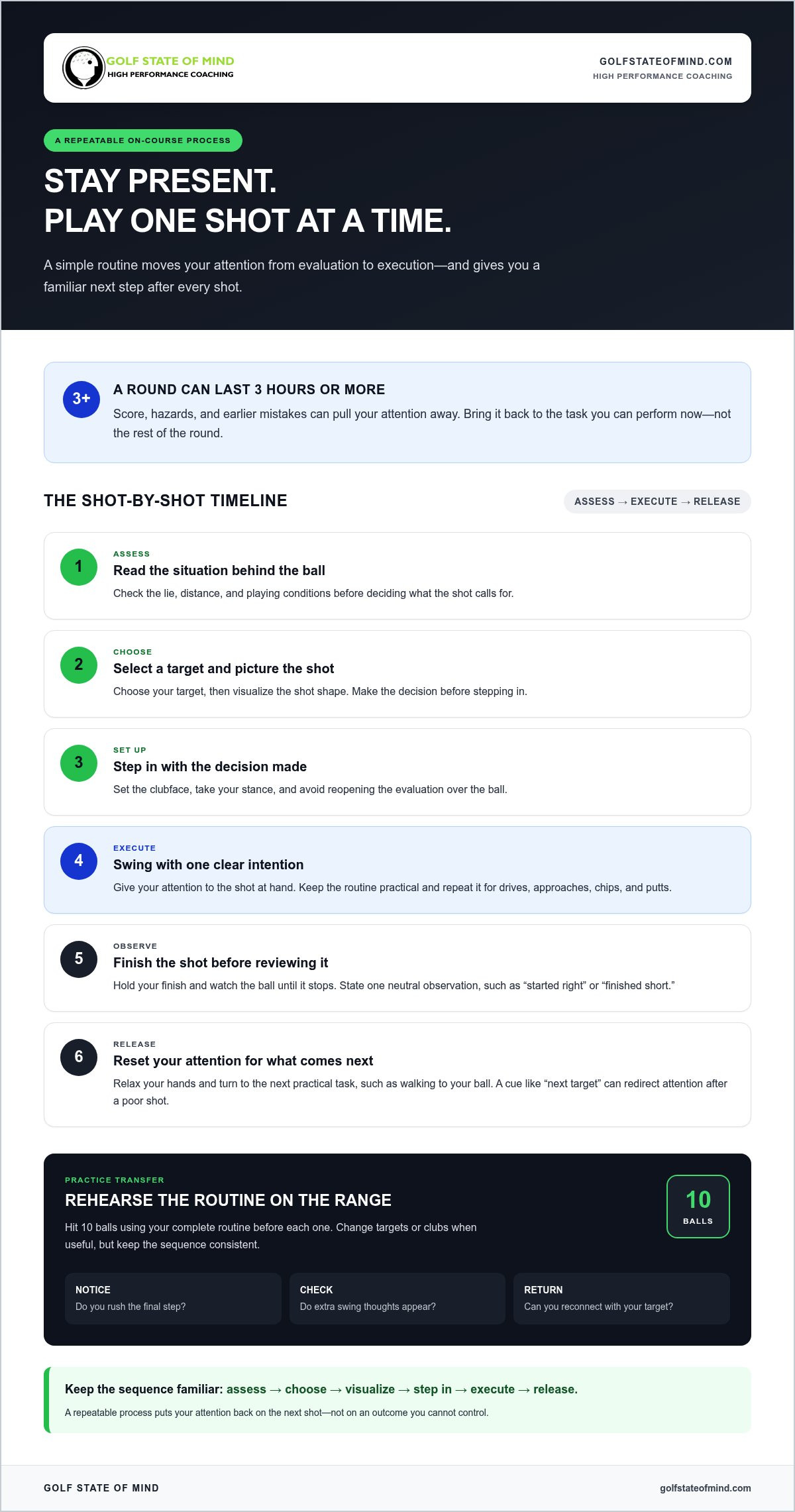
My mental pre-shot routine includes three phases.
Planning Phase
This is where you make your decisions.
Assess the lie, distance, wind, hazards, and available options.
Choose a target that fits the shot you’re capable of playing.
Decide on the intended ball flight.
Then commit to your plan.
Athletic Phase
Once you’ve made your decision, shift away from analysis.
Direct your attention toward the target and the movement you’re about to make.
A simple feel or cue may be useful, but avoid carrying several mechanical instructions into the swing.
Your job now is execution, not correction.
Acceptance Phase
After the shot, accept the result.
You can acknowledge a poor outcome without turning it into a judgment about your ability.
Then begin preparing for the next challenge.
Plan the shot. Play the shot. Accept the shot.
Practise the Routine With Every Performance Ball
When you switch into performance practice, use this same sequence before each ball.
Don’t skip the routine because you’re on the range.
The more familiar your preparation becomes, the easier it is to return to it when you’re feeling nervous on the course.
For a deeper explanation, read my guide to the mental pre-shot routine for golf.
4. Learn to Commit Without Needing Certainty
One of the reasons golfers lose confidence on the course is that they become more aware of what could go wrong.
On the range, you might stand over a shot thinking about the target.
On the course, you might think:
“Don’t hit it in the water.”
“I can’t afford to miss this green.”
“What if I slice this drive?”
Now your attention is focused on protecting yourself from a bad result.
I call this a protection mindset.
Instead of playing the shot you’ve chosen, you’re trying to avoid a mistake.
And the more important the shot becomes, the stronger that tendency can be.
Move From Protection to Performance
A performance mindset doesn’t mean ignoring hazards or taking unnecessary risks.
It means making a sensible decision and then committing to that decision.
For example, if water guards the left side of the green, you might choose a target safely to the right.
That’s good course management.
But once you’ve chosen that target, your attention should be on executing the shot, not repeatedly thinking about the water.
Commitment isn’t believing the shot will definitely succeed. It’s being willing to execute your decision without needing a guarantee.
The Commitment Challenge
During your next practice session, rate your commitment after each performance shot.
Use a simple scale:
- 1: Very hesitant or indecisive.
- 2: Some doubt during preparation.
- 3: Reasonably clear intention.
- 4: Fully committed to the selected shot.
Don’t base the rating on where the ball finished.
A poor shot can still receive a four if you made a clear decision and committed to it.
Likewise, a good result doesn’t automatically mean you were committed.
You’re learning to evaluate the mental behavior separately from the outcome.
Take Your Range Confidence to the Course
Download my free mental game ebook for practical strategies to build confidence, improve focus, and develop a more consistent pre-shot routine under pressure.
5. Practise Recovering From Bad Shots
Another major difference between the range and the course is how golfers respond to mistakes.
On the range, a poor shot often has very little consequence.
You simply hit another ball.
But on the course, that same poor shot might leave you behind a tree, in a bunker, or facing a difficult recovery.
Now you’re frustrated.
You might feel tempted to make up for the mistake immediately.
And that can lead to another poor decision.
Part of transferring your range game to the course is learning to recover from imperfect outcomes.
The Bad-Shot Reset
After a disappointing shot:
- Acknowledge: Recognize what happened without exaggerating it.
- Accept: Remind yourself that the shot is finished.
- Redirect: Bring your attention to the next decision.
For example:
“That was a poor drive. It’s finished. What’s the smartest shot from here?”
This is a much more useful response than:
“I always do this when it matters.”
The Worst-Ball Challenge
If you have access to a practice area where you can safely play multiple balls, try this exercise.
- Play two balls from the same starting position.
- Choose the worse result.
- Play your next shot from that position.
- Repeat for several shots or a short practice hole, where permitted.
Follow the facility’s rules and avoid slowing other golfers.
The purpose isn’t to punish yourself.
It’s to practise making good decisions after disappointing outcomes.
You’re teaching yourself that a bad shot doesn’t have to be followed by a bad response.
6. Make Range Practice More Competitive
If you want to perform under pressure, some of your practice should include meaningful challenges.
That doesn’t mean every practice session needs to be stressful.
But you should occasionally create situations where the result matters enough to test your concentration and commitment.
Challenge One: Three Fairways
Choose two range markers to represent the edges of a fairway.
Use your normal driving routine.
Your goal is to hit three imaginary fairways out of five attempts.
Before every ball, make a clear target decision.
If you miss, don’t immediately hit another ball.
Step back, reset, and begin again.
Challenge Two: Five-Putt Pressure Drill
Choose a putt of a distance that’s challenging but realistic for your ability.
Set a goal of making five in a row.
Use your full routine before each attempt.
If you miss, restart the count.
As you approach the fifth putt, notice what changes.
Do you become more concerned about missing?
Do you start thinking about your stroke?
Does your routine speed up or slow down?
Practise responding to those changes by returning to your line, pace, and commitment.
Challenge Three: One Chance to Execute
Choose a demanding target on the range.
Give yourself one ball.
Go through your full routine and execute the shot.
Then move on, regardless of the result.
Repeat with a different club and target.
This exercise removes the comfort of repeatedly hitting the same shot until you get one you like.
It helps develop the discipline of preparing properly for the one opportunity you have.
7. Create Four Mental Performance Commitments
Most golfers judge their rounds almost entirely by score.
But if you’re trying to improve the transfer from range to course, score alone doesn’t tell you whether you’re developing the right mental habits.
That’s why I encourage golfers to identify specific Performance Commitments.
These are behaviors you want to execute consistently, regardless of the outcome.
For example:
- I will choose a clear target before every shot.
- I will follow my mental pre-shot routine.
- I will commit fully to the shot I’ve chosen.
- I will accept the result and respond constructively.
These four commitments give you a practical mental game plan for the course.
Use a Mental Scorecard
After each hole, give yourself one point for each commitment you followed consistently on that hole.
That gives you a maximum of four points per hole, or 72 points for an 18-hole round.
For example:
| Commitment | Points Available Per Hole |
|---|---|
| Clear target selection | 1 |
| Consistent pre-shot routine | 1 |
| Full commitment | 1 |
| Acceptance and constructive response | 1 |
| Total | 4 |
Suppose you shoot 84 but score 64 out of 72 on your Mental Scorecard.
That means you followed your mental commitments approximately 89% of the time.
Now you have information about your process, not just your score.
You might discover that your pre-shot routine is strong but your commitment drops when you’re facing a difficult tee shot.
That’s a specific skill you can work on in your next practice session.
The purpose of the Mental Scorecard is to make your mental game measurable and trainable.
Your Complete Golf Mental Game Plan: Range to Course
Here’s how I would structure a practice session specifically designed to transfer performance to the golf course.
Part One: Technical Practice — 15 Minutes
Work on one swing priority.
Use the drills and feedback recommended by your instructor.
Don’t worry about creating pressure during this phase.
The objective is skill development.
Part Two: Performance Practice — 15 Minutes
Change clubs and targets regularly.
Use your full mental pre-shot routine.
Give every ball a specific purpose.
Evaluate your commitment rather than immediately correcting your swing.
Part Three: Simulated Golf — 15 Minutes
Play an imaginary three- or four-hole stretch.
Use the One-Ball Challenge.
Choose clubs based on the result of the previous shot.
Include at least one challenging tee shot and one recovery scenario.
Part Four: Pressure Challenge — 10 Minutes
Finish with a measurable challenge.
It might be hitting three fairways out of five or making five putts in a row.
Pay particular attention to what happens to your routine when you feel pressure.
Part Five: Review — 5 Minutes
Ask yourself:
- Did I make clear decisions?
- Did I use my full routine?
- Did I commit to my shots?
- How did I respond to poor outcomes?
- What one mental skill should I focus on next time?
This is a sample 60-minute session, not a rigid formula. Adjust the time according to your needs, but keep a meaningful portion of practice dedicated to performance.
What to Do When You Get to the First Tee
Now imagine you’ve completed several sessions of performance practice.
You’re standing on the first tee.
You feel nervous.
And you notice yourself beginning to think about your swing.
What should you do?
First, don’t interpret the nerves as evidence that your range confidence has disappeared.
The course is a different environment, and it’s normal to feel more pressure.
Next, return to the process you’ve been practising.
- Assess the hole and choose a sensible target.
- Decide which shot you intend to play.
- Use your normal pre-shot routine.
- Commit to your target and intention.
- Accept the outcome and move forward.
Notice what’s missing from that list.
There’s no instruction to find your perfect swing.
No requirement to eliminate nervousness.
And no demand that the first shot must be good.
You’re simply giving yourself the opportunity to play with the same mental process you’ve been developing in practice.
How to Stop Overthinking Your Swing on the Course
One of the biggest obstacles to transferring range performance is taking technical swing thoughts onto the course.
During practice, you might work on your takeaway, transition, wrist position, or weight shift.
But once you’re playing, trying to consciously manage several of those movements can interfere with your commitment to the shot.
I encourage golfers to distinguish between learning a movement and playing a shot.
When you’re learning, mechanical awareness may be necessary.
When you’re playing, your attention should be directed toward the shot you’re trying to produce.
That doesn’t mean a single swing cue can never be helpful.
Some golfers perform well with one simple feel.
But if you notice yourself accumulating instructions over the ball, step away and return to your target and intention.
Don’t turn every golf shot into another swing lesson.
How Long Does It Take to Transfer Range Confidence to the Course?
There’s no universal timeline.
Some golfers notice improvements quickly when they begin using a consistent routine and practising with greater purpose.
Others need more time, especially if they’ve spent years developing habits of overthinking, protecting their score, or reacting emotionally to mistakes.
What matters is whether you’re practising the mental skills that you want to use on the course.
If you only practise them when you’re playing a tournament, progress may be slower.
Instead, rehearse them during ordinary range sessions, short-game practice, and casual rounds.
Then use your Mental Scorecard to monitor how consistently you’re applying them.
Don’t expect every round to be better than the last.
Look for improvements in the quality of your decisions, commitment, and responses.
Frequently Asked Questions About Taking Your Range Game to the Course
Why do I hit the ball well on the range but poorly on the course?
The range offers repetition, familiar conditions, and opportunities to make immediate adjustments. On the course, every shot is different and the consequences matter more. Practising decisions, routines, and commitment can help prepare you for those demands.
How do I take my driving range swing to the golf course?
Include performance practice in your range sessions. Change clubs and targets, use your full pre-shot routine, simulate golf holes, and practise accepting the outcome of each shot instead of automatically hitting another ball.
How do I stop thinking about my swing during a round?
Separate technical practice from performance. Make your shot decisions before addressing the ball, then focus on the target and intended shot. If several mechanical thoughts appear, step away and simplify your intention.
How can I build confidence on the golf course?
Build confidence through preparation and repeatable behaviors rather than relying entirely on good results. Practise making clear decisions, committing to shots, and responding constructively when the outcome is disappointing.
Should I use the same pre-shot routine on the range and course?
During performance practice, yes. Rehearsing the same mental sequence helps connect your practice habits to the demands of playing. Technical practice can be different because its purpose is learning and adjusting a movement.
What is the best mental game exercise for transferring range performance?
The One-Ball Challenge is a useful starting point. Choose a specific target, use your full routine, hit one shot, and move on to a different situation. This helps train the decision-making and commitment required on the course.
How do I recover mentally after a bad shot?
Acknowledge the result, accept that the shot is finished, and redirect your attention to the next decision. Avoid using the next shot to compensate emotionally for the previous one.
What should I measure besides my golf score?
Track behaviors such as target selection, pre-shot routine consistency, commitment, and acceptance. A Mental Scorecard can help you identify improvements in your process even when your score varies.
Final Thoughts: Practise the Way You Want to Play
If you hit the ball beautifully on the range but struggle on the golf course, don’t automatically assume that something is wrong with your swing.
Look at how you’re practising.
Are you rehearsing the mental skills required to play golf?
Are you making decisions, changing targets, and committing to one shot at a time?
Are you practising your response to mistakes?
Or are you simply hitting balls until you find a rhythm that makes you feel confident?
There’s nothing wrong with enjoying a great range session.
But the goal is to develop skills you can rely on when every shot is different and the outcome matters.
Range confidence becomes more useful when it’s supported by a repeatable process, not dependent on perfect ball striking.
Build your mental game plan around clear decisions, consistent routines, full commitment, and acceptance.
Then practise those behaviors until they become part of how you play.
Build a Mental Game You Can Trust on the Course
Download my free mental game ebook for practical strategies to improve confidence, focus, and consistency when you move from practice to competition.
Get your FREE Mental Game Scorecard

Golf Flow State: How to Get in the Zone and Play More Freely
The golf flow state is not a rare lightning strike of mystical good fortune; it is a biological condition you can deliberately engineer. Every…
Get your FREE Mental Game Scorecard