Golf Self-Talk Techniques: Build a Clearer Mind on the Course
What if the best thing to say to yourself on the golf course isn’t something positive, but something useful? After a poor shot, self-criticism can…
Get your FREE Mental Game Scorecard



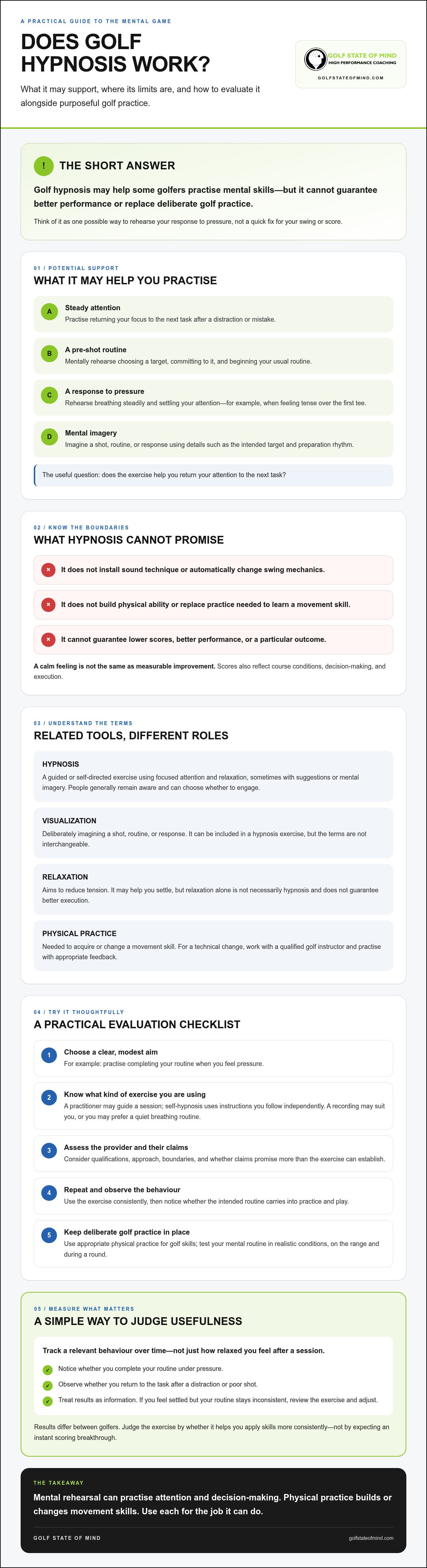
The most useful thing golf hypnosis may change isn’t your swing, but how steadily you access skills you’ve already practised. So, does golf hypnosis work? It may help some golfers rehearse routines, manage pressure, and direct attention. But it can’t install sound technique, guarantee lower scores, or replace deliberate practice.
If you’re unsure whether hypnosis is a credible tool or a quick-fix promise, that caution makes sense. Hypnosis, meditation, visualization, and mental coaching can overlap, but they aren’t interchangeable. Knowing what each involves helps you decide whether it fits your needs before investing time or money.
This guide explains what golf hypnosis may support, where its limits are, and how to assess a provider, recording, or self-hypnosis exercise. You’ll also learn how to pair mental rehearsal with purposeful practice, so you can choose a practical next step without expecting one technique to transform your game overnight.
Does golf hypnosis work? It may help some golfers practise mental skills, such as settling their attention or mentally rehearsing a pre-shot routine. The effect varies, and hypnosis can’t guarantee better performance. It doesn’t automatically change swing technique, build physical ability, or determine your score. Think of it as one possible way to practise your response to pressure, not a substitute for practising golf itself.
Golf hypnosis generally refers to a guided or self-directed exercise that uses focused attention and relaxation, sometimes alongside suggestions or mental imagery. A guided session may involve listening to a practitioner; self-hypnosis uses instructions you follow independently. Relaxation exercises may be included, although relaxation alone isn’t necessarily hypnosis. The Sports hypnosis overview offers general background on how hypnosis has been used in sport.
Despite dramatic portrayals, hypnosis isn’t mind control or unconsciousness. People generally remain aware of the exercise and can choose whether to engage with suggestions. It’s better understood as a focused, receptive state than as someone else taking control of your thoughts or actions.
Set a modest, observable aim. For example, if you feel tense over the first tee, you might use a session to rehearse breathing steadily, choosing a target, and beginning your usual pre-shot routine. The useful question is whether the practice helps you return your attention to the next task, not whether it produces an instant scoring breakthrough.
Feeling calm is a personal experience. It may feel valuable, but it isn’t the same as measurable improvement on the course. To assess performance, track a relevant behaviour over time, such as whether you complete your routine under pressure. Scores can provide context, but they’re also affected by course conditions, decision-making, and execution.
Approach the exercise with curiosity, then review what changes. If you feel more settled but your routine remains inconsistent, that’s useful information, not proof of failure or evidence that hypnosis has improved your game. Results differ between golfers, and no single session can promise a particular outcome. Keep deliberate golf practice in place, and judge hypnosis by whether it helps you apply your skills more consistently.
Hypnosis is one possible format for practising attention, relaxation, or imagery. Its value depends on what you practise and whether the exercise feels useful enough to repeat. For example, you might imagine choosing a target, committing to it, and returning your attention to the next shot after a mistake. That’s mental rehearsal of a response, not proof that hypnosis has changed your underlying ability.
Visualization means deliberately imagining a shot, routine, or response, using details such as the intended target and the rhythm of preparation. Relaxation aims to reduce tension. Feeling calmer may help you settle, but it doesn’t guarantee better execution. A hypnosis exercise may incorporate either technique, perhaps guiding your attention before introducing imagery or suggestions. The methods can overlap without being identical. Outside of sport, mindset coaches such as Salarah K Starre similarly use visualization and subconscious techniques to help individuals calm mental chatter and build confidence under pressure.
Personal comfort matters. If guided imagery feels distracting, you might prefer a quiet breathing routine; if you respond well to prompts, a recording may suit you. Expectations and repetition can shape your experience. It’s easier to assess an exercise when you know which skill you’re practising and use it consistently, rather than judging it by one session.
Rehearsing a smooth tempo in your mind doesn’t teach your body a new swing pattern. Mental rehearsal can practise attention and decision-making; physical practice is needed to acquire or change a movement skill. If you’re working on a technical change, take it to a qualified golf instructor and practise the movement with appropriate feedback.
Then test your mental routine in realistic conditions. Practise it on the range, use it during a round, and notice whether it helps you return to the task after a distraction or poor shot. Feeling calm during an exercise isn’t the same as reliably using a routine when a putt matters. Observe the behaviour you want to build over time, and adjust if the exercise isn’t carrying into play.
So, does golf hypnosis work as part of mental preparation? It may offer a format for rehearsal, but its usefulness depends on the golfer and how the skill is applied. For a broader approach to practising psychological skills, explore this structured mental-game training system. It’s mental-game training, not hypnosis or hypnotherapy, and should be considered a distinct option.
Hypnosis isn’t a guaranteed shortcut to better golf, and it can’t replace purposeful practice. You might use an exercise to practise settling before a shot or returning your attention to a clear target. Whether that feels useful is personal. Feeling calmer during an exercise doesn’t, by itself, show that your on-course performance has improved.
Be cautious about broad promises. Claims that hypnosis will lower scores or resolve a specific problem need reliable, golf-specific evidence. Anecdotes, testimonials, and marketing language can prompt questions, but they don’t establish that a method caused an improvement or that another golfer is likely to get the same result.
Possible aims include easing tension, rehearsing a confident response, or practising how to focus on the next task. These are goals, not assured outcomes. Notice how you respond, whether you’re comfortable with the exercise, and whether you can use the skill consistently in practice and play. If you try hypnosis, assess a specific behaviour over time instead of relying on a strong first impression.
A golfer’s experience of the yips can have different contributing factors, so avoid assuming one explanation or treating hypnosis as a cure. It may be considered as a complementary mental practice, but it shouldn’t stand in for appropriate assessment when symptoms persist, worsen, or cause significant concern. A qualified golf instructor can help assess technique; a relevant health professional can advise on health concerns.
For focused context on the yips that isn’t specific to hypnosis, read this golf yips guide. Treat any approach as something to evaluate, not a promise of a particular result. Keep practice and appropriate support in the picture, and judge progress by observable changes rather than claims alone.
If you’re asking “does golf hypnosis work?” for your game, start with a small, testable goal rather than a promise of lower scores. A careful trial can help you decide whether the exercise feels appropriate and supports a mental skill you actually want to practise.
Before you begin, find out what the exercise involves, who created or leads it, and what it is designed to do. A responsible provider should explain the approach and its limits, not guarantee results or promise to cure a golf problem. Ask how consent works, whether you can decline a suggestion, and how to stop the exercise at any point. If the answers are unclear or the claims sound absolute, pause before proceeding.
Use the checklist to make a measured decision, not to pressure yourself into liking a method. If you’d rather build repeatable psychological skills through a separate approach, explore The Ultimate Mental Game Training System. It’s structured mental-game training, not hypnosis or hypnotherapy.
The right choice depends on the skill you want to practise. A hypnosis exercise may appeal if you’re curious about guided relaxation or mental rehearsal for a particular situation. Structured mental training may suit you better if you want a broader framework for developing psychological skills over time. Neither option replaces deliberate golf practice, and neither guarantees a change in performance.
Ask yourself what you need most: a guided experience to try, or a wider structure for building and practising mental-game skills. Consider the format, the time you’re prepared to commit, and what a realistic outcome would look like. That clarity can help you choose without expecting a quick fix.
Golf State of Mind offers The Ultimate Mental Game Training System, a digital mental-training offering for golfers interested in the psychological side of performance. It is not hypnosis or hypnotherapy. It doesn’t promise a particular score or treat a condition.
If a structured approach to mental-game training fits what you’re looking for, review The Ultimate Mental Game Training System as one possible next step. Choose the approach that suits your goal, then give it a fair, measured place alongside your regular practice.
So, does golf hypnosis work? It may help some golfers rehearse mental skills, but it isn’t a guaranteed route to better scores or a replacement for deliberate practice. Its value depends on your response and whether a specific skill, such as maintaining a steady routine, carries into practice and play.
Keep the distinction clear: hypnosis may be one way to explore relaxation or mental rehearsal, while structured mental training offers a different path for developing psychological skills. Neither changes swing mechanics on its own. Set a realistic goal, observe your experience over time, and seek appropriate support when your needs go beyond mental-game practice.
Golf State of Mind, operated by mental coach David MacKenzie, offers digital mental-game training and one-to-one coaching. Its training is not hypnosis or hypnotherapy. If a structured approach fits your next step, explore The Ultimate Mental Game Training System.
Build patiently. A repeatable process gives your practiced skills a better chance to show up when the moment matters.
Golf hypnosis may help some golfers practise mental skills such as attention or a pre-shot routine, but it isn’t a guaranteed performance fix. The answer to “does golf hypnosis work” depends on the individual, the exercise, and whether a practised skill carries into play. Assess it against a process measure across multiple practice occasions, not solely by one score. Keep regular golf practice in place.
Hypnosis may be one complementary way to practise relaxation or a steadier response, but it can’t be described as a cure for the yips. The experience can have different contributing factors, so avoid assuming one cause or relying on a single approach. If the problem persists or raises health concerns, seek appropriate professional advice. A qualified golf instructor can help assess technical aspects of your game.
No. Visualization is deliberately imagining a shot, routine, or response, such as picturing your target and rehearsing your pre-shot sequence. A hypnosis exercise may include imagery, relaxation, or suggestions, but those methods aren’t identical. You can visualize without hypnosis, and a hypnosis exercise may use techniques other than visualization. Whichever you choose, treat mental rehearsal as practice for attention and preparation, not as physical swing training.
You can try a familiar self-hypnosis or relaxation exercise before a round if it feels comfortable and helps you prepare. During play, keep any practice brief and practical, such as a familiar breathing cue or routine between shots. Don’t introduce a new or distracting exercise over the ball. Stop if you feel uncomfortable, and choose an approach that keeps your attention on the shot and playing safely.
There’s no reliable timeline that applies to every golfer, and a particular number of sessions can’t guarantee a result. Your response may depend on the exercise, your comfort with it, and consistent practice. Choose one process goal, such as following your routine under pressure, and record how it goes across practice occasions. Review the pattern rather than treating an early feeling of calm as proof of improved performance.
Hypnosis doesn’t teach or automatically change swing mechanics. It may help you mentally rehearse a shot or prepare to focus, but physical skill acquisition requires physical practice. For a technical change, work with a qualified golf instructor and follow an appropriate practice plan. Keep mental rehearsal in its proper role: it can support your preparation, but it isn’t a replacement for instruction, feedback, or repetitions with a club.
Choose based on what you want to practise. Hypnosis may suit someone curious about guided relaxation or mental rehearsal; mental game coaching may suit a golfer seeking personalized support with psychological performance. Golf State of Mind offers digital mental-game training and 1:1 mental coaching, not hypnosis or hypnotherapy. Neither option guarantees better scores, so set a clear goal and consider which format you’re more likely to use consistently.
What if the best thing to say to yourself on the golf course isn’t something positive, but something useful? After a poor shot, self-criticism can…
Imagine standing on the eighteenth tee with a career-best round within reach, only to feel your grip tighten and your heart hammer against your ribs….