

How to Use Golf Breathing Techniques to Stay Calm Before Every Swing
Golf Breathing Techniques: 5 Ways to Calm Your Nerves
You’re standing on the first tee of an important tournament.
Your heart is beating faster than usual. Your hands feel tense. You know exactly what shot you want to hit, but your mind keeps jumping ahead to what might happen if you miss the fairway.
Or perhaps you’re standing over a four-foot putt to shoot your best-ever score.
You suddenly become aware of how much the putt matters.
These are moments when a simple breathing technique can be useful.
Breathing won’t guarantee a good golf shot, but it can help you interrupt tension, manage your attention, and return to a familiar process.
I’m David MacKenzie, founder of Golf State of Mind. As a golf mental performance coach, I teach golfers how to prepare mentally for competition, manage pressure, and develop consistent routines.
One of the simplest tools I encourage golfers to practise is using the breath deliberately.
But there’s an important distinction: you don’t need to control your breathing throughout the golf swing or follow a complicated sequence every time you address the ball.
In fact, trying to do too much with your breathing can become another distraction.
In this article, I’ll explain five practical golf breathing techniques, when to use them, and how to incorporate them into your mental game without overthinking.
Why Breathing Matters in Golf
When you’re nervous, your breathing pattern may change.
You might breathe more quickly, take shallow breaths, or notice yourself holding your breath.
At the same time, you may experience increased muscle tension, particularly in your shoulders, arms, hands, or jaw.
These sensations are common when something matters to you.
They don’t necessarily mean you’re going to play badly.
But they can become distracting if you start worrying about them.
Deliberate, comfortable breathing gives you something simple to return your attention to.
It can also help create a moment between feeling pressure and deciding what to do next.
That’s particularly useful in golf because we have time to think between shots.
And sometimes we use that time to create unnecessary pressure.
Breathing Is a Tool, Not the Goal
I want golfers to understand this distinction.
The goal isn’t to feel completely calm before every shot.
It’s to be able to make a clear decision and commit to that decision, even when you feel nervous.
You can be excited, uncomfortable, or anxious and still execute a committed golf shot.
Breathing is one way to help you return to the process.
1. Use a Longer Exhale to Release Tension Before a Shot
Best for: First-tee nerves, important putts, and moments when you feel rushed or tense.
This is one of the simplest breathing techniques to use on the course.
Before beginning your pre-shot routine, take a comfortable breath in and allow yourself to exhale slowly.
As you breathe out, notice whether you can soften unnecessary tension in your shoulders, jaw, and hands.
Don’t force the exhale or try to empty your lungs completely.
Just let the breath be smooth and comfortable.
How to Practise
- Stand comfortably behind the ball.
- Notice any unnecessary tension in your body.
- Take a natural breath in.
- Exhale slowly and comfortably, allowing your shoulders and grip to soften.
- Return your attention to the target and begin your normal routine.
That’s it.
You don’t need a complicated count.
And you don’t need to repeat the exercise until you feel perfectly relaxed.
One comfortable exhale can become your cue to stop reacting to pressure and start preparing for the shot.
Example: The First Tee
Imagine you’re about to tee off in a tournament.
You’ve got people watching, and you can feel your heart beating faster.
Instead of telling yourself to calm down, acknowledge the nerves.
Then take one comfortable breath, release unnecessary tension, and return to your plan.
Your next job isn’t to eliminate the nerves.
It’s to choose a target and make a committed swing.
2. Practise 4-7-8 Breathing Before Your Round
Best for: Mental preparation before leaving for the course or during a quiet period before warming up.
Another technique I introduce in mental game training is 4-7-8 breathing.
The pattern involves:
- Inhaling gently for four counts.
- Holding the breath for seven counts.
- Exhaling slowly for eight counts.
This structured pattern can provide a focus exercise before a round.
However, the counts aren’t appropriate or comfortable for everyone, particularly the breath-holding portion.
If you feel strained, dizzy, short of breath, or uncomfortable, stop and return to normal breathing. If you have a respiratory or cardiovascular condition, seek appropriate medical guidance before trying exercises involving prolonged breath holds.
You can also skip the holds entirely and simply practise a gentle inhale followed by a slightly longer, comfortable exhale.
When I Would Use It
I wouldn’t recommend performing a full 4-7-8 sequence while standing over a golf ball.
There’s already enough to think about before a shot.
Instead, use a structured breathing exercise during your pre-round mental warm-up, when you have time to sit or stand comfortably.
Then, once you’re on the course, simplify it to one natural breath when needed.
The purpose of practising breathing before a round is to become familiar with using it as an attention-management tool.
It’s not to make yourself dependent on a particular count before every swing.
3. Use Box Breathing to Reset Between Holes
Best for: A pre-round routine or a quiet moment after a frustrating stretch of golf.
Box breathing is another structured technique.
Traditionally, it follows four equal phases:
- Inhale for four counts.
- Pause for four counts.
- Exhale for four counts.
- Pause for four counts.
The sequence forms four sides of a box.
Some golfers find counting helpful because it gives their attention a specific task.
But there are two things I want you to remember.
First, don’t force the breath or treat the holds as a test of endurance. If holding your breath is uncomfortable or medically unsuitable, skip the holds and breathe naturally.
Second, you don’t need to complete a full box-breathing exercise every time something goes wrong.
Example: After a Double Bogey
Imagine you’ve just made a double bogey after hitting a poor approach and three-putting.
You’re angry, disappointed, and thinking about the shots you’ve lost.
Once you’re safely away from play, you could take a quiet moment to practise a comfortable breathing pattern.
Then ask yourself:
“What do I need to focus on for the next hole?”
Maybe it’s making a clear decision.
Maybe it’s committing to your target.
Maybe it’s simply avoiding the temptation to chase the strokes you’ve lost.
Breathing creates the pause.
Your next decision gives that pause a purpose.
Don’t use breathing to escape the disappointment. Use it to help you respond to the disappointment.
4. Practise Diaphragmatic Breathing Away From the Course
Best for: Developing awareness of your breathing and unnecessary upper-body tension.
Diaphragmatic breathing is often called belly breathing.
It involves allowing the diaphragm to contribute naturally to breathing rather than relying primarily on exaggerated upper-chest movement.
For golfers, the practical value is learning to notice when you’re breathing comfortably and when you’re creating unnecessary tension.
A Simple Practice Exercise
- Sit or lie comfortably.
- Place one hand on your abdomen and the other on your upper chest.
- Take a gentle breath in and notice the movement of your abdomen and rib cage.
- Exhale naturally without forcing the air out.
- Continue for a short period while keeping your shoulders and jaw relaxed.
Don’t try to take the biggest breath possible.
And don’t push your stomach outward artificially.
The goal is comfortable breathing and greater awareness.
How This Helps Your Golf Routine
Once you’re familiar with the sensation of relaxed breathing, you may find it easier to notice tension before a shot.
Perhaps you’re gripping the club too tightly.
Maybe your shoulders are raised.
Or you notice that you’re holding your breath while worrying about the outcome.
Recognizing those patterns gives you an opportunity to reset before starting your routine.
But you don’t need to consciously monitor your diaphragm while swinging.
That’s not where I want your attention during execution.
Build a Calmer, More Confident Mental Game
Download my free mental game ebook for practical strategies to manage pressure, improve focus, and commit more confidently to your shots.
5. Use a Breathing Cue to Transition Into Your Pre-Shot Routine
Best for: Every type of shot, especially when you feel distracted or under pressure.
Of all the breathing techniques we’ve discussed, this is the one I’d most like golfers to incorporate into their on-course routine.
It’s also the simplest.
Use a comfortable breath to mark the transition from thinking and planning to committing and playing.
Here’s how it fits into my mental pre-shot routine.
Planning Phase: Make Your Decision
Stand behind the ball and assess the situation.
Consider the distance, wind, lie, hazards, and available options.
Choose your club and target.
Once you’ve made your decision, avoid repeatedly questioning it.
The Breathing Transition
Take one comfortable breath.
As you exhale, let go of unnecessary tension and shift your attention away from analysis.
This becomes your cue that the decision-making phase is finished.
Athletic Phase: Commit to the Shot
Step into the ball with your attention directed toward the target and the movement you want to make.
Allow your breathing to happen naturally.
You don’t need to count your breath or coordinate your inhale and exhale with specific points in the backswing and downswing.
For many golfers, trying to control breathing during the swing would simply add another mechanical thought.
Acceptance Phase: Respond to the Result
After the shot, acknowledge the outcome.
Whether the ball finishes exactly where you intended or somewhere disappointing, return to the present and prepare for the next task.
Plan the shot. Breathe and commit. Play the shot. Accept the result.
For a fuller explanation, read my guide to the mental pre-shot routine for golf.
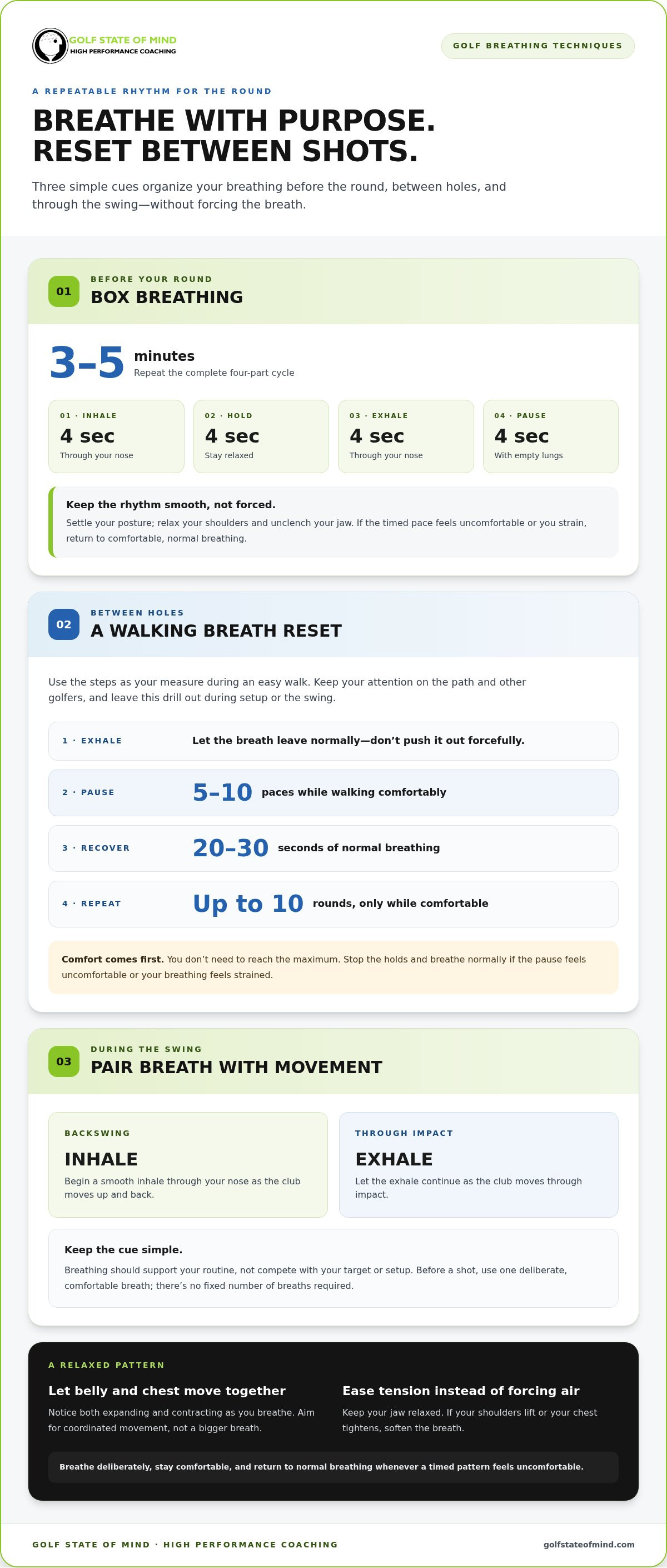
Should You Inhale During the Backswing and Exhale During the Downswing?
Some breathing advice recommends inhaling during the backswing and exhaling during the downswing.
That might feel natural for certain golfers during slow practice swings.
But I wouldn’t make it a universal requirement.
Think about what happens when you’re standing over an important shot.
You’re already trying to make a committed movement.
If you also start thinking about exactly when to inhale, when to exhale, and how to synchronize those actions with impact, your attention may move away from the target and toward internal mechanics.
That’s the opposite of what we want.
My preference is to use breathing before the swing to support a calm, committed transition into execution.
Then let your breathing take care of itself.
If a particular breathing rhythm genuinely helps you and doesn’t interfere with your attention or movement, that’s fine. But it isn’t something every golfer needs to adopt.
Which Golf Breathing Technique Should You Use?
| Situation | Suggested Technique | Main Purpose |
|---|---|---|
| Before leaving for the course | Comfortable diaphragmatic breathing | Build breathing awareness |
| During a quiet pre-round warm-up | Optional 4-7-8 or box breathing, if comfortable | Practise deliberate attention |
| Standing on the first tee | One comfortable inhale and longer exhale | Release unnecessary tension |
| After a frustrating hole | Gentle breathing followed by a refocus question | Interrupt rumination and reset |
| Before an important putt | One natural breath before the routine | Transition from pressure to process |
| During the golf swing | Natural, unforced breathing | Avoid adding mechanical thoughts |
There isn’t one perfect breathing technique for every golfer.
Choose the simplest method that helps you prepare without becoming another thing to control.
Breathing and Golf Anxiety: You Don’t Have to Eliminate Nerves
One of the biggest misconceptions about mental training is that successful golfers always feel calm.
They don’t.
Pressure is part of competitive golf.
If you’re standing over a putt to win a tournament, it makes sense that you might feel nervous.
The outcome matters to you.
But nerves don’t have to dictate your behavior.
This is where I distinguish between a performance mindset and a protection mindset.
In a protection mindset, you’re trying to avoid something going wrong.
You may think:
“Don’t miss this.”
“Don’t embarrass yourself.”
“I need to calm down before I can hit it.”
In a performance mindset, you accept the uncertainty and focus on the task.
You might say:
“I’m nervous because this matters.”
“I’ve made my decision.”
“Now I’m going to commit to this putt.”
Breathing can help you make that transition.
But the ultimate skill is learning to compete even when the nerves are still there.
Three Common Breathing Mistakes Golfers Make
1. Trying to Force Yourself to Relax
When golfers feel nervous, they sometimes become frustrated that they can’t make the feeling disappear.
That creates another problem to solve.
Instead, acknowledge the nerves and use a comfortable breath to return your attention to the shot.
2. Holding Your Breath to Control the Swing
Some golfers unintentionally hold their breath when they’re trying too hard to control their movement.
If you notice this pattern, practise relaxed breathing away from the ball and avoid turning breath-holding into a deliberate swing technique.
3. Making Breathing Another Complicated Routine
A golfer who already struggles with overthinking doesn’t need five more instructions before hitting the ball.
Keep your on-course breathing cue simple.
One breath.
One decision.
One committed shot.
A Seven-Day Golf Breathing Practice Plan
Here’s a simple way to develop the skill without making it overly complicated.
| Day | Exercise | Focus |
|---|---|---|
| 1 | Practise a few minutes of comfortable diaphragmatic breathing | Notice tension and breathing patterns |
| 2 | Use a gentle inhale and slightly longer exhale | Release unnecessary tension |
| 3 | Try a comfortable structured breathing exercise, if appropriate | Practise directing attention |
| 4 | Use one breath before each shot on the range | Build a consistent transition into the routine |
| 5 | Use one breath before five short putts with your full routine | Practise commitment under a small challenge |
| 6 | Use breathing after a disappointing shot during practice | Improve emotional recovery |
| 7 | Use your chosen breathing cue during a round | Transfer the skill to the course |
After the seventh day, ask yourself:
- Did breathing help me recognize and release unnecessary tension?
- Did it make my pre-shot routine simpler or more complicated?
- Was I better able to redirect my attention after mistakes?
- Did I use it as a cue for commitment rather than trying to force calmness?
The goal is to discover what helps your own mental game.
Frequently Asked Questions About Golf Breathing Techniques
What is the best breathing technique before a golf swing?
For most golfers, a comfortable breath before beginning the pre-shot routine is a useful starting point. A gentle, unforced exhale can help you notice tension and transition from planning to execution without adding extra swing thoughts.
How do you breathe when putting under pressure?
Take a comfortable breath before your routine, choose your line and pace, and commit to the stroke. Avoid repeatedly trying to calm yourself or monitoring your breathing during the putting motion.
Does deep breathing help golf anxiety?
Comfortable, deliberate breathing may help you manage your attention and physical tension when you’re nervous. However, you don’t need to eliminate anxiety to play well. Focus on making clear decisions and committing to your process.
Should you hold your breath during a golf swing?
There’s no need to deliberately hold your breath during the swing as a mental performance technique. Natural, unforced breathing is generally a simpler approach than trying to control breath timing during the movement.
What is box breathing for golfers?
Box breathing is a structured exercise involving an inhale, pause, exhale, and pause of equal duration. Some golfers use it during pre-round preparation. If breath holds feel uncomfortable or aren’t medically appropriate, use ordinary comfortable breathing instead.
Is 4-7-8 breathing good for golf?
Some golfers may find it useful as a pre-round attention exercise. However, the prolonged breath holds aren’t suitable for everyone, and it isn’t necessary to use the technique immediately before a shot. A natural breath is often more practical on the course.
Can breathing techniques lower your golf score?
Breathing techniques may support focus, tension awareness, and consistency in your preparation. But they don’t guarantee better shots or lower scores. Their value is in helping you practise mental behaviors that support performance.
When should golfers practise breathing exercises?
Practise away from the course first, then introduce a simple cue during range sessions and putting practice. Once it feels natural, use it during rounds when you notice tension, distraction, or pressure.
Final Thoughts: Breathe, Commit, and Play
Breathing is one of the simplest tools available to golfers.
But it doesn’t need to become complicated.
You don’t need to count every inhale and exhale.
You don’t need to control your breathing during every part of the golf swing.
And you don’t need to feel perfectly calm before you can hit a good shot.
Instead, use your breath to create a moment of awareness.
Notice the tension.
Allow yourself to exhale.
Return to your target.
And commit to the shot you’ve chosen.
The purpose of breathing isn’t to control the outcome. It’s to help you give the next shot your best attention.
Start with one comfortable breath before your pre-shot routine and build from there.
Take Your Mental Game to the Next Level
Download my free mental game ebook for practical strategies to improve focus, confidence, emotional control, and performance under pressure.
Get your FREE Mental Game Scorecard
